


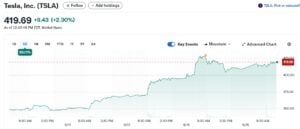
Tesla’s (TSLA) stock gained momentum in September 2025 after CEO Elon Musk announced a $1 billion stock purchase. The move, Musk’s first open-market buy since early 2020, is being viewed as a renewed vote of confidence in Tesla’s long-term direction.
It comes at a time when the EV maker faces challenges like softening demand and margin pressures, but is doubling down on its transformation into an AI and robotics powerhouse.
TSLA Stock Rebounds: Musk’s Vote of Confidence Fuels Investor Optimism
On September 15, Tesla (TSLA stock) shares surged 6% in early trading after Musk revealed he acquired 2.57 million shares at prices ranging from $372.37 to $396.54 per share. The transaction was disclosed through a regulatory filing, drawing investor attention for its timing and significance. Analysts see this as Musk’s unmistakable signal that Tesla’s strategic direction remains firmly on course.
Reuters revealed what Matt Britzman, senior equity analyst at Hargreaves Lansdown, said on this move:
“This is the clearest signal yet that Musk is going all in again. After a shaky start earlier this year, the Tesla-Musk narrative is back on track.”
The purchase aligns with Musk’s longstanding desire for greater influence over Tesla’s future. The report further explained that he has previously expressed the need for at least 25% voting power to drive AI and robotics ventures within the company. As of December 2024, Musk held a 13% stake in Tesla, according to LSEG data.
This stock buy also comes shortly after Tesla’s board unveiled a proposed $1 trillion compensation package for Musk, setting out ambitious financial and operational goals. The package, designed to incentivize long-term growth, reflects both Musk’s demands and the company’s broader vision for the future.
Tesla’s Challenge: Slowing EV Sales Amid Rising Competition
Despite the positive sentiment around Musk’s investment, Tesla’s recent performance has been mixed. The company’s shares have been among the weakest performers among other tech megacap stocks, with a 2% decline in year-to-date value through its last close.
The company’s latest quarterly results pointed to margin pressures driven by rising input costs, softening EV demand, and growing competition. Tesla faces challenges from both established automakers transitioning to electric vehicles and emerging players aiming to carve out market share.
Dan Ives, global head of tech research at Wedbush, noted, “The insider purchase is a huge sign of confidence for Tesla bulls. It shows Musk doubling down on his AI-driven vision, even as margin pressures and competition mount.”
Tesla’s pivot toward AI and robotics remains central to its strategy, with efforts focused on building software-driven platforms and automated vehicle systems. However, its core EV business continues to experience volatility, prompting Musk’s renewed investment in its stock.
GigaBerlin: A Strategic EV Expansion Amid Market Uncertainty
While Tesla faces headwinds in its traditional EV business, its GigaBerlin factory in Germany is emerging as a crucial growth driver. Recently, the plant’s chief, André Thierig, confirmed that production would be ramped up in the final quarters of 2025 due to rising demand.
Business blog EV also highlighted Thierig’s statement to the German Press Agency. He said,
“We have revised our production planning upward for both the third and fourth quarters. The brand currently has a very good sales situation, which is driving higher output at the factory.”
The GigaBerlin plant, which exclusively manufactures the Model Y, hit a milestone of half a million units produced as of March 2025, around three years after production began.
The factory’s output has been temporarily disrupted this year as Tesla refreshed the Model Y lineup. The rollout of the updated model caused short-term production and delivery interruptions but is expected to fuel growth in subsequent quarters.
Tesla’s Global EV Push
Despite global economic uncertainties, Tesla’s leadership sees continued demand across regions. Thierig emphasized that the factory serves more than 30 markets worldwide, including Europe, Canada, Taiwan, and the Middle East.
He is optimistic about seeing positive trends across the markets.
Earlier this month, Tesla’s first vehicles from GigaBerlin reached Canadian shores, marking a strategic shift from U.S.-produced Model Ys. This move helps Tesla navigate trade barriers, such as tariffs, while expanding its global footprint.
Additionally, Tesla recently introduced the Model Y Performance variant in Europe, priced from €62,970 ($73,800) in Germany—higher than the standard model’s €44,900 ($52,600). Deliveries are set to begin soon in key markets like Germany and the Netherlands.
Sales in Germany Remain Volatile
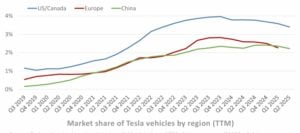
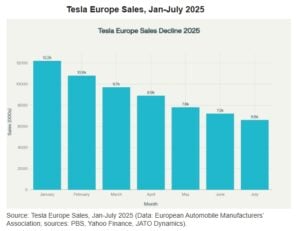
Despite production growth, Tesla’s European operations are grappling with a decline in sales. As of August 2025, Tesla’s vehicle sales across Europe fell 19.8% compared to the same period in 2024, with Germany showing a sharp 56% decline year-to-date.
New government incentives, introduced in July 2025 to support EV adoption, have yet to fully reverse the downward trend. The incentives include accelerated depreciation, tax relief, support for startups, and expanded charging infrastructure—efforts aimed at spurring demand for electric vehicles among business fleets.
Amid the push for EV growth, Thierig urged policymakers not to side with legacy automakers opposing the 2035 EU ban on petrol vehicles. He warned that favoritism toward traditional manufacturers could undermine the EV industry’s prospects in eastern Germany.
Can Tesla (TSLA) Stock Navigate Competition and Rising Costs?
Tesla’s rebound in September erased some of its earlier losses, with shares posting year-to-date gains after a slump in the first half of the year. However, the road ahead remains challenging.
The company’s ambition to transform into an AI and robotics leader offers long-term upside but also requires substantial investment, regulatory navigation, and technological advancement. At the same time, its core EV business must contend with rising competition, fluctuating demand, and cost pressures.
Musk’s $1 billion stock buy and GigaBerlin’s expanded production capacity signal bold moves to sustain growth and investor confidence. But industry watchers caution that execution, market trends, and geopolitical dynamics will ultimately shape Tesla’s trajectory.
For now, Tesla’s message to investors and regulators is clear: it’s betting on innovation and scale, even as short-term hurdles persist. Musk’s confidence and the company’s global expansion underscore its intent to remain a pioneer in sustainable mobility, while navigating the complex realities of today’s EV market.
The post Tesla (TSLA) Stock Surges on Musk’s $1 Billion Buy and GigaBerlin EV Growth Strategy appeared first on Carbon Credits.

EU carbon credit claims changed on 27 September 2026, the day the Directive (EU) 2024/825 began to apply across the European Union. The change is narrow. It changes how a company can talk about the credits it buys. A product can no longer be called neutral on the strength of compensation alone; however, every specific, evidenced statement about what a company measured, reduced, and funded stays fully available.

The post Promoting Improved Cooking Practices in Nigeria appeared first on Terrapass.



-
Climate Change1 year ago
Guest post: Why China is still building new coal – and when it might stop
-

 Greenhouse Gases2 years ago
嘉宾来稿:满足中国增长的用电需求 光伏加储能“比新建煤电更实惠”
-
Greenhouse Gases1 year ago
Guest post: Why China is still building new coal – and when it might stop
-

 Climate Change2 years ago
嘉宾来稿:满足中国增长的用电需求 光伏加储能“比新建煤电更实惠”
-

 Renewable Energy12 months ago
Sending Progressive Philanthropist George Soros to Prison?
-
Climate Change2 years ago
Bill Discounting Climate Change in Florida’s Energy Policy Awaits DeSantis’ Approval
-
Greenhouse Gases1 year ago
嘉宾来稿:探究火山喷发如何影响气候预测
-

 Climate Change2 years ago
Analysis: China’s CO2 falls 1% in Q2 2024 in first quarterly drop since Covid-19