The International Atomic Energy Agency (IAEA) has raised its expectations for the future of nuclear power. The agency’s latest report, the 45th edition of Energy, Electricity and Nuclear Power Estimates for the Period up to 2050, says nuclear capacity could more than double by 2050.
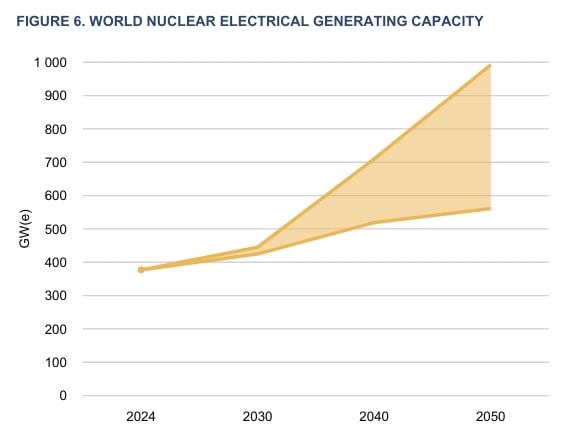
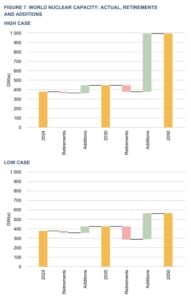
- In the best-case scenario, nuclear power could expand from 377 gigawatts (GW) in 2024 to nearly 992 GW by 2050 — that’s a 2.6 X increase.
The findings were shared by IAEA’s Director General, Rafael Mariano Grossi, at the organization’s General Conference in Vienna, Austria.
The report draws on expert analysis and examines how nuclear power could shape the world’s clean energy transition. It’s clear that nuclear power is being seen as a major player in helping meet global energy and climate goals.
Nuclear Energy as a Backbone for Sustainable Electricity
At the end of 2024, the world had 417 nuclear reactors in operation, producing a combined 377 GW of electricity. Another 62 reactors, totaling 64.4 GW, were being built, and 23 reactors with 19.7 GW were temporarily offline.
Over the year, six new reactors were added, with 6.8 GW of capacity, while four reactors with 2.9 GW were retired. Two reactors that had been shut down were restarted, adding 1.6 GW back to the grid. Additionally, construction began on nine new reactors, expected to provide an additional 10.1 GW.
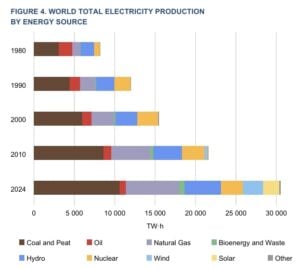
Electricity demand grew by about 3.4% in 2024, while nuclear electricity rose by 2.8%, reaching 2,670 terawatt-hours (TWh). Despite this growth, nuclear’s share of total electricity slipped slightly to 8.7%. Even though it’s the second-largest source of low-carbon power, nuclear energy’s share has declined since the early 1990s.
Fossil fuels, especially coal, still account for the bulk of electricity, though coal’s share has been dropping since its peak in 2010.
Other low-carbon sources like hydro, wind, and solar are also contributing. Hydropower, which remains the largest source of clean energy, now accounts for 15% of global electricity, down from 21% in 1980. Wind and solar energy, however, have grown rapidly, reaching 8% and 7% of the global electricity mix, respectively, in 2024.
IAEA’s Bold Predictions for Nuclear Energy’s Future
The IAEA’s projections show two possible futures: a high case and a low case.
- In the high case, nuclear capacity could rise by 18% by 2030 and 2.6 times by 2050. This would help nuclear’s share in the energy mix slightly increase.
- The low case sees only modest growth: a 13% rise by 2030 and a 32% increase by 2050, which would lead to a small decline in its share of total capacity.
The gap between these two futures largely depends on how governments and industries act today. The high case assumes nations are committed to expanding nuclear energy, while the low case assumes things continue as they are, with few policy changes.
Significantly, the IAEA has been consistently raising its forecast for nuclear power. The trend started after the 2011 Fukushima disaster, when many thought nuclear energy’s role would shrink. However, rising concerns about climate change, energy security, and investment opportunities have shifted global opinion.
Grossi pointed out that there’s now a global consensus: nuclear energy is essential for achieving clean, reliable, and sustainable electricity.
The Role of Small Modular Reactors (SMRs)
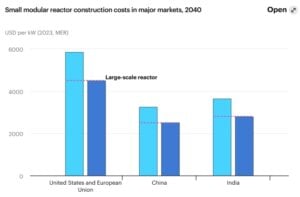
One of the biggest differences between these scenarios is the contribution of small modular reactors (SMRs). These smaller, more flexible reactors are seen as crucial to expanding nuclear power. In the high case, SMRs would supply 24% of the new capacity added by 2050. In the low case, they would only account for 5%.
SMRs are being developed to be safer, cheaper, and quicker to deploy than traditional reactors. Many experts believe they could be a game-changer, especially for countries with smaller grids or limited infrastructure.
What’s Driving the Change
Jessica Callen-Kovtunova, an energy planner at the IAEA, explained that investments in nuclear power are being encouraged by several factors:
- Climate concerns and policy support – Countries are committing to lowering their carbon footprints.
- Rising electricity demand – Tech companies and expanding industries need more energy.
- Development banks backing nuclear projects – Institutions like the World Bank are financing nuclear plant upgrades and SMRs.
- Lifetime extensions of existing reactors – Many reactors have been in operation for over 30 or even 40 years.
Unlocking Nuclear’s Full Potential
Even with strong support, scaling up nuclear power is not an easy task. The high scenario would require an average of 26 GW of new nuclear capacity each year — more than four times the recent five-year average of 5.9 GW annually.
Another major hurdle is the ageing nuclear fleet. Two-thirds of reactors have been running for over 30 years, and 40% have been online for over 40 years. Without adding new reactors or extending existing ones, a large portion of nuclear capacity could be lost in the coming decades.
Thus, according to Grossi, three major challenges must be addressed for nuclear power to expand globally:
- Support for newcomer countries – Many nations need help building the technical, legal, and financial frameworks for nuclear projects.
- Adapting regulation – Rules and licensing procedures must evolve to accommodate new technologies like SMRs.
- Financing – Large investments are required, and innovative funding models will be essential.
The IAEA is working with countries to address these challenges and make nuclear power a cornerstone of the clean energy future.
Extending Reactor Lifetimes: A Key Solution
Another important factor that the IAEA’s report emphasizes is extending the operating life of existing reactors. Experts say it is the most cost-effective way to keep nuclear energy part of the grid. In the high case, only 81 GW of capacity is expected to retire by 2050, while in the low case, 156 GW could be retired.
In the high case, new additions would reach 615 GW, whereas the low case would result in only 184 GW of net additions by 2050.
The Bigger Picture: Energy and Climate
Nuclear energy’s future is tied closely to global energy demand. By 2050, electricity consumption is expected to double, with electricity making up a much larger share of overall energy use. For example, in North America, electricity’s share of final energy consumption is projected to rise from 23% in 2024 to 45% in 2050.
Nuclear energy is set to play a bigger role in fighting climate change. The path won’t be easy, but new technologies like SMRs create opportunities. Extending the life of existing reactors adds further support. Together, they can deliver reliable, low-carbon energy for billions.
The IAEA’s growing forecasts show rising confidence in nuclear’s potential. As a result, the world’s energy future looks cleaner and more secure.
The post IAEA Predicts Doubling Nuclear Capacity by 2050—SMRs and Reactor Life Extensions Lead the Way appeared first on Carbon Credits.
Carbon Footprint
Finding Nature Based Solutions in Your Supply Chain
Carbon Footprint
How Climate Change Is Raising the Cost of Living
Americans are paying more for insurance, electricity, taxes, and home repairs every year. What many people may not realize is that climate change is already one of the drivers behind those rising costs.
For many households, climate change is no longer just an environmental issue. It is becoming a cost-of-living issue. While climate impacts like melting glaciers and shrinking polar ice can feel distant from everyday life, the financial effects are already showing up in monthly budgets across the country.
Today, a larger share of household income is consumed by fixed costs such as housing, insurance, utilities, and healthcare. (3) Climate change and climate inaction are adding pressure to many of those expenses through higher disaster recovery costs, rising energy demand, infrastructure repairs, and increased insurance risk.
The goal of this article is to help connect climate change to the everyday financial realities people already experience. Regardless of where someone stands on climate policy, it is important to recognize that climate change is already increasing costs for households, businesses, and taxpayers across the United States.
More conservative estimates indicate that the average household has experienced an increase of about $400 per year from observed climate change, while less conservative estimates suggest an increase of $900.(1) Those in more disaster-prone regions of the country face disproportionate costs, with some households experiencing climate-related costs averaging $1,300 per year.(1) Another study found that climate adaptation costs driven by climate change have already consumed over 3% of personal income in the U.S. since 2015.(9) By the end of the century, housing units could spend an additional $5,600 on adaptation costs.(1)
Whether we realize it or not, Americans are already paying for climate change through higher insurance premiums, energy costs, taxes, and infrastructure repairs. These growing expenses are often referred to as climate adaptation costs.
Without meaningful climate action, these costs are expected to continue rising. Choosing not to invest in climate action is also choosing to spend more on climate adaptation.
Here are a few ways climate change is already increasing the cost of living:
- Higher insurance costs from more frequent and severe storms
- Higher energy use during longer and hotter summers
- Higher electricity rates tied to storm recovery and grid upgrades
- Higher government spending and taxpayer-funded disaster recovery costs
The real debate is not whether climate change costs money. Americans are already paying for it. The question is where we want those costs to go. Should we invest more in climate action to help reduce future climate adaptation costs, or continue paying growing recovery and adaptation expenses in everyday life?
How Climate Change Is Increasing Insurance Costs
There is one industry that closely tracks the financial impact of natural disasters: insurance. Insurance companies are focused on assessing risk, estimating damages, and collecting enough revenue to cover losses and remain financially stable.
Comparing the 20-year periods 1980–1999 and 2000–2019, climate-related disasters increased 83% globally from 3,656 events to 6,681 events. The average time between billion-dollar disasters dropped from 82 days during the 1980s to 16 days during the last 10 years, and in 2025 the average time between disasters fell to just 10 days. (6)
According to the reinsurance firm Munich Re, total economic losses from natural disasters in 2024 exceeded $320 billion globally, nearly 40% higher than the decade-long annual average. Average annual inflation-adjusted costs more than quadrupled from $22.6 billion per year in the 1980s to $102 billion per year in the 2010s. Costs increased further to an average of $153.2 billion annually during 2020–2024, representing another 50% increase over the 2010s. (6)
In the United States, billion-dollar weather and climate disasters have also increased significantly. The average number of billion-dollar disasters per year has grown from roughly three annually during the 1980s to 19 annually over the last decade. In 2023 and 2024, the U.S. recorded 28 and 27 billion-dollar disasters respectively, both setting new records. (6)
The growing impact of climate change is one reason insurance costs continue to rise. “There are two things that drive insurance loss costs, which is the frequency of events and how much they cost,” said Robert Passmore, assistant vice president of personal lines at the Property Casualty Insurers Association of America. “So, as these events become more frequent, that’s definitely going to have an impact.” (8)
After adjusting for inflation, insurance costs have steadily increased over time. From 2000 to 2020, insurance costs consistently grew faster than the Consumer Price Index due to rising rebuilding costs and weather-related losses.(3) Between 2020 and 2023 alone, the average home insurance premium increased from $75 to $360 due to climate change impacts, with disaster-prone regions experiencing especially steep increases.(1) Since 2015, homeowners in some regions affected by more extreme weather have seen home insurance costs increased by nearly 57%.(1) Some insurers have also limited or stopped offering coverage in high-risk areas.(7)
For many families, rising insurance costs are no longer occasional financial burdens. They are becoming recurring monthly expenses tied directly to growing climate risk.
How Rising Temperatures Increase Household Energy Costs

The financial impacts of climate change extend beyond insurance. Rising temperatures are also changing how much energy Americans use and how utilities plan for future electricity demand.
Between 1950 and 2010, per capita electricity use increased 10-fold, though usage has flattened or slightly declined since 2012 due to more efficient appliances and LED lighting. (3) A significant share of increased energy demand comes from cooling needs associated with higher temperatures.
Over the last 20 years, the United States has experienced increasing Cooling Degree Days (CDD) and decreasing Heating Degree Days (HDD). Nearly all counties have become warmer over the past three decades, with some areas experiencing several hundred additional cooling degree days, equivalent to roughly one additional degree of warmth on most days. (1) This trend reflects a warming climate where air conditioning demand is increasing while heating demand generally declines. (4)
As temperatures continue rising, households are expected to spend more on cooling than they save on heating. The U.S. Energy Information Administration (EIA) projects that by 2050, national Heating Degree Days will be 11% lower while Cooling Degree Days will be 28% higher than 2021 levels. Cooling demand is projected to rise 2.5 times faster than heating demand declines. (5)
These projections come from energy and infrastructure experts planning for future electricity demand and grid capacity needs. Utilities and grid operators are already preparing for higher peak summer electricity loads caused by rising temperatures. (5)
Longer and hotter summers also affect how homes and buildings are designed. Buildings constructed for past climate conditions may require upgrades such as larger air conditioning systems, stronger insulation, and improved ventilation to remain comfortable and energy efficient in the future. (10)
For many households, this means higher monthly utility bills and potentially higher long-term home improvement costs as temperatures continue to rise.
How Climate Change Affects Electricity Rates
On an inflation-adjusted basis, average U.S. residential electricity rates are slightly lower today than they were 50 years ago. (2) However, climate-related damage to utility infrastructure is creating new upward pressure on electricity costs.
Electric utilities rely heavily on above-ground poles, wires, transformers, and substations that can be damaged by hurricanes, storms, floods, and wildfires. Repairing and upgrading this infrastructure often requires substantial investment.
As a result, utilities are increasing electricity rates in response to wildfire and hurricane events to fund infrastructure repairs and future mitigation efforts. (1) The average cumulative increase in per-household electricity expenditures due to climate-related price changes is approximately $30. (1)
While this increase may appear modest today, utility costs are expected to rise further as climate-related infrastructure damage becomes more frequent and severe.
How Climate Disasters Increase Government Spending and Taxes
Extreme weather events also damage public infrastructure, including roads, schools, bridges, airports, water systems, and emergency services infrastructure. Recovery and rebuilding costs are often funded through taxpayer dollars at the federal, state, and local levels.
The average annual government cost tied to climate-related disaster recovery is estimated at nearly $142 per household. (1) States that frequently experience hurricanes, wildfires, tornadoes, or flooding can face even higher public recovery costs.
These expenses affect taxpayers whether they personally experience a disaster or not. Climate-related recovery spending can increase pressure on public budgets, emergency management systems, and infrastructure funding nationwide.
Reducing Climate Costs Through Climate Action
While this article focuses on the growing financial costs associated with climate change, the issue is not only about money for many people. It is also about recognizing our environmental impact and taking responsibility for reducing it in order to help preserve a healthy planet for future generations.
While individuals alone cannot solve climate change, collective action can help reduce future climate adaptation costs over time.
For those interested in taking action, there are three important steps:
- Estimate your carbon footprint to better understand the emissions connected to your lifestyle and activities.
- Create a plan to gradually reduce emissions through energy efficiency, cleaner technologies, and more sustainable choices.
- Address remaining emissions by supporting verified carbon reduction projects through carbon credits.
Carbon credits are one of the most cost-effective tools available for climate action because they help fund projects that generate verified emission reductions at scale. Supporting global emission reduction efforts can help reduce the long-term impacts and costs associated with climate change.
Visit Terrapass to learn more about carbon footprints, carbon credits, and climate action solutions.
The post How Climate Change Is Raising the Cost of Living appeared first on Terrapass.
Carbon Footprint
Carbon credit project stewardship: what happens after credit issuance
A carbon credit purchase is not a transaction that closes at issuance. The credit may be retired, the certificate filed, and the reporting box ticked. But on the ground, in the forest, in the field, and in the community, the work continues. It endures for years. In many cases, for decades.
![]()
-
Greenhouse Gases10 months ago
Guest post: Why China is still building new coal – and when it might stop
-
Climate Change10 months ago
Guest post: Why China is still building new coal – and when it might stop
-
Greenhouse Gases2 years ago嘉宾来稿:满足中国增长的用电需求 光伏加储能“比新建煤电更实惠”
-

Climate Change2 years ago嘉宾来稿:满足中国增长的用电需求 光伏加储能“比新建煤电更实惠”
-
Climate Change2 years ago
Bill Discounting Climate Change in Florida’s Energy Policy Awaits DeSantis’ Approval
-
Renewable Energy7 months agoSending Progressive Philanthropist George Soros to Prison?
-
Carbon Footprint2 years agoUS SEC’s Climate Disclosure Rules Spur Renewed Interest in Carbon Credits
-
Greenhouse Gases10 months ago
嘉宾来稿:探究火山喷发如何影响气候预测

