

Since January, swathes of southern Africa have been suffering from a severe drought, which has destroyed crops, spread disease and caused mass hunger. But its causes have raised tough questions for the new UN fund for climate change losses.
Christopher Dabu, a priest in Lusitu parish in southern Zambia, one of the affected regions, said that because of the drought, his parishioners “have nothing”- including their staple food.
“Almost every day, there’s somebody who comes here to knock on this gate asking for mielie meal, [saying] ‘Father, I am dying of hunger’,” Dabu told Climate Home outside his church last month.
The government and some humanitarian agencies were quick to blame the lack of rain on climate change.
Zambia’s green economy minister Collins Nzovu told reporters in March, “there’s a lot of infrastructure damage as a result of climate change”. He added that the new UN-backed loss and damage fund, now being set up to help climate change victims, “must speak to this”.

Reverend Christopher Dabu outside his church in Lusitu, Zambia (Photo: Joe Lo)
But last week, scientists from the World Weather Attribution (WWA) group published a study which found that “climate change did not emerge as the significant driver” of the current drought affecting Zambia, Zimbabwe, Malawi, Angola, Mozambique and Botswana.
Instead, they concluded that the El Niño phenomenon – which occurs every few years with warming of sea surface temperatures in the eastern Pacific Ocean – was the drought’s “key driver”. They said the damage was worsened by the vulnerabilities of the countries affected, including reliance on rain-fed farming rather than irrigation.
Nonetheless, briefing journalists on the study, co-authors Joyce Kimutai and Friederike Otto said climate change does make El Niños stronger and more frequent – and therefore could be playing an indirect role in the southern African drought. Otto noted that climate change “might have a small role but not a big one”.
While WWA studies have often found that disasters like this are driven by climate change, there have been other cases where they have played down that link – as with droughts in Brazil in 2014 and Madagascar in 2021, and floods in Italy in 2023.

The complex nature of the science raises a dilemma for those now designing the fledgling loss and damage fund.
Its board holds its first meeting in Abu Dhabi this week. In three days of talks, the board’s 26 members will discuss the fund’s name and how to decide where it will be hosted and who will lead it. Trickier issues like the role of climate change attribution will be left to future meetings.
Climate Home spoke to several experts and two of the fund’s board members, whose opinions were divided on whether the link between climate change and a particular disaster should have to be proven before funds are dished out to affected communities.
Droughts and climate change
Egyptian climate negotiator Mohamed Nasr, a member of the new fund’s board, said he thought triggers for funding “would include the climate relation to the losses and damages”.
But to judge that connection, he said the board would “rely on confirmed science per the Intergovernmental Panel on Climate Change (IPCC) and United Nations Environment Programme (UNEP) rather than individual studies”. He said the IPCC and UNEP “provide the scientific reference needed as they bring all views and assess the credibility and scientific basis”.
The IPCC does not do original research, including attribution studies, but every five to seven years it compiles existing research to reach conclusions about climate change, including its impacts. The last IPCC report focused on that topic in 2022 said “increases in drought frequency and duration are projected over large parts of southern Africa”.
UNEP currently does not conduct attribution studies, with a spokesperson saying this was “due to resource constraints” but adding “we hope to do more in the future”.
Another loss and damage fund board member, who wanted to remain anonymous, said the fund should only disburse money for loss and damage caused by climate change. But they asserted that due to the “chicken and egg” link between climate change and El Niño, the current southern African drought is climate-driven and so its victims should be entitled to funding.
‘Theoretical disputes’
Mattias Söderberg, who works for humanitarian organisation DanChurchAid – which has been defining and addressing loss and damage since 2019 – said attribution “is not always easy”.
But, he added, “people facing disasters should not be left behind because of theoretical disputes about attribution”.
Speaking ahead of a visit to a Kenyan refugee camp for people displaced by what he calls “loss and damage and climate-related conflicts”, he said, “I’m pretty sure they will be frustrated if they knew funding to help them cope could be questioned.”
The loss and damage fund, with advice from scientists, should draw up categories of disaster that tend to be driven by climate change – like heatwaves and droughts but excluding earthquakes which are not, he added.
Tensions rise over who will contribute to new climate finance goal
Zoha Shawoo, who researches loss and damage at the Stockholm Environment Institute, said that even if climate change played only a small role in the latest southern Africa drought, previous climate disasters had made the region’s people more vulnerable to the drought.
In addition, the current dry spell leaves them more vulnerable to future climate disasters, she added. “If they don’t receive financial support for recovery, future losses and damages will be a lot worse,” she said.
Gernot Laganda, director for climate and resilience at the UN’s World Food Programme, said that a formal attribution requirement for the loss and damage fund feels like “overkill” for a still relatively small fund. Transaction costs should be kept as low as possible, he added.
Data gaps
Kimutai, who worked on the WWA study, said she was confident the group had enough data to reach its conclusions on this particular drought. But she told a webinar hosted by the CGIAR agricultural research centre last month that a lack of data in many poorer countries means a funding requirement of attribution to global warming would be “detrimental to climate justice”.
In 2022, WWA was unable to work out the role of climate change in a drought in the Sahel region of Africa, partly blaming a lack of data. One of the drought-hit countries was Mali – which is three times the size of Germany. Mali has just 13 active weather stations, while Germany has 200, according to Bloomberg.
Limiting frontline voices in the Loss and Damage Fund is a recipe for disaster
Kimutai added that, besides data, there is a lack of expertise in doing these kinds of studies in the Global South.
Any moves to deny funds to vulnerable people impacted by drought – whatever the causes – are likely to be met with anger. Speaking to journalists about the southern Africa emergency a few days after the WWA study was issued, Chikwe Mbweeda, Zambia director for the aid agency CARE, said that “for us, we definitely understand that [the drought] is coming from the climate change effects”.
The post Southern Africa drought flags dilemma for loss and damage fund appeared first on Climate Home News.
Southern Africa drought flags dilemma for loss and damage fund

Three countries have been named by the Paris Agreement’s compliance committee for failing to submit a nationally determined contribution (NDC) and repeatedly snubbing offers of help with their climate plans.
After months of internal debate over whether to identify serial non-responders, the Paris Agreement’s Implementation and Compliance Committee (PAICC) named the three countries which have failed to engage with it over their NDCs on Friday.
It named Democratic Republic of Congo, Senegal and North Korea in a footnote of its annual report, adding that it decided to name them “with a view to facilitating engagement”, adding that representatives of the three nations had been invited to its meeting in early 2027 “with the purpose of identifying any challenges and constraints”.
“The Committee noted the importance of Parties engaging with the Committee in a timely manner, while noting that some delays may be due to the national capabilities and circumstances of the Parties”, the report said.
-
Under US pressure, World Bank says it will back gas “where appropriate”
The US wants the World Bank to expand its gas support while climate campaigners are pushing for it to end – its head spoke this week of limited backing for the fossil fuel -
IPCC scientists vow to press on with climate reports despite political deadlock
After governments again failed to agree a timeline, nearly 120 IPCC authors pledged to complete their assessment on time and with full scientific rigour -
Paris Agreement committee snubbed over missing NDC climate plans
Many governments have still not submitted a nationally determined contribution to the UN, breaching a key requirement of the Paris Agreement

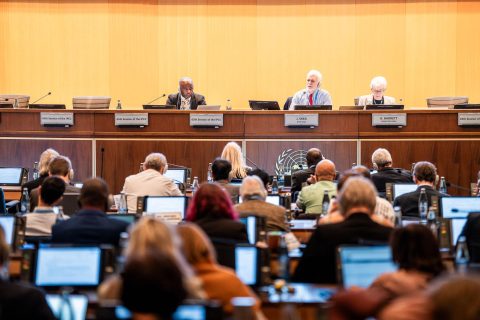

In July, PAICC said 12 countries had ignored its repeated attempts to discuss why they had not published an NDC as required every five years under the 2015 Paris accord.
Members of the committee had been divided over whether to name them, but at a September meeting decided to do so in their annual report to the annual climate COP summit.
By the time the report was published on Friday, only Congo, Senegal and North Korea “had not communicated an NDC or submitted a [Biennial Transparency Report] and had not yet responded to any of the Committee’s notifications, despite several reminders issued by the Committee in this regard”.
Rainforest and renewable energy ambitions
The silence from Congo and Senegal is notable because the former is home to much of the Congo Basin rainforest while the latter has sought billions of dollars in climate finance to support its renewable energy ambitions.
After Brazil, Congo has more rainforest than any country in the world. This forest, and the country’s peatlands, absorb huge amounts of greenhouse gas but are fast being lost to expanding farmland, charcoal production, logging and mining.
Senegal signed a Just Energy Transition Partnership with Canada and wealthy European nations in 2023, to help it meet its renewable energy targets under the-then government of Macky Sall. It was chair of the Least Developed Countries group between January 2022 and December 2023.

Tejas Rao, who is researching the PAICC as part of a doctoral thesis at Cambridge University, said the governments of the three countries should engage with the committee.
“Engagement costs these governments very little and the committee has shown it will listen,” he said.
“Silence leaves the committee with no basis to help, and it leaves the [governments] exposed to the narrative that they are simply disengaged,” he told Climate Home News.
Paris Agreement requirement
The 2015 Paris Agreement requires all parties to publish an NDC every five years outlining their emissions reduction targets, with each plan meant to be more ambitious than the country’s last NDC.
The latest set – the third round of plans, with new targets for 2035 – was due in February 2025. While most countries missed this deadline, all but around 30 – mostly small emitters but including Egypt, Vietnam and Argentina – have now submitted them.
Over the year, the PAICC – which is made up of government climate officials from developed and developing countries – has been communicating with governments that have not submitted NDCs and trying to overcome barriers to them doing so.
Some nations have cited exceptional circumstances as the reason for not submitting an NDC, a process that requires a significant amount of work in tracking emissions and consulting on how to curb them across the economy. For example, a letter from a Sudanese official to the PAICC, seen by Climate Home News, said that the country’s civil war had led to the suspension of its NDC preparation.
-
IPCC scientists vow to press on with climate reports despite political deadlock
After governments again failed to agree a timeline, nearly 120 IPCC authors pledged to complete their assessment on time and with full scientific rigour -
Under US pressure, World Bank says it will back gas “where appropriate”
The US wants the World Bank to expand its gas support while climate campaigners are pushing for it to end – its head spoke this week of limited backing for the fossil fuel -
Who shapes climate science? The equity question facing the IPCC
Early completion of the next global climate science assessment reports risks excluding research from the Global South, which is key to ensuring the findings are fair
The US and Iran are not signed up to the Paris Agreement and so do not have active NDCs, nor does Taiwan, which is not a UN member state.
Rao said that because the PAICC is “facilitative and non-punitive”, naming the countries “is meant to open a door, not close one – the invited consultation is the point”.
“In recent months, governments that explained their constraints, whether capacity, finance or domestic process, have been met with follow-up and support rather than sanction, and the number of silent governments has fallen sharply,” Rao said.
The post Paris Agreement committee names three countries snubbing it over NDCs appeared first on Climate Home News.
Paris Agreement committee names three countries snubbing it over NDCs