

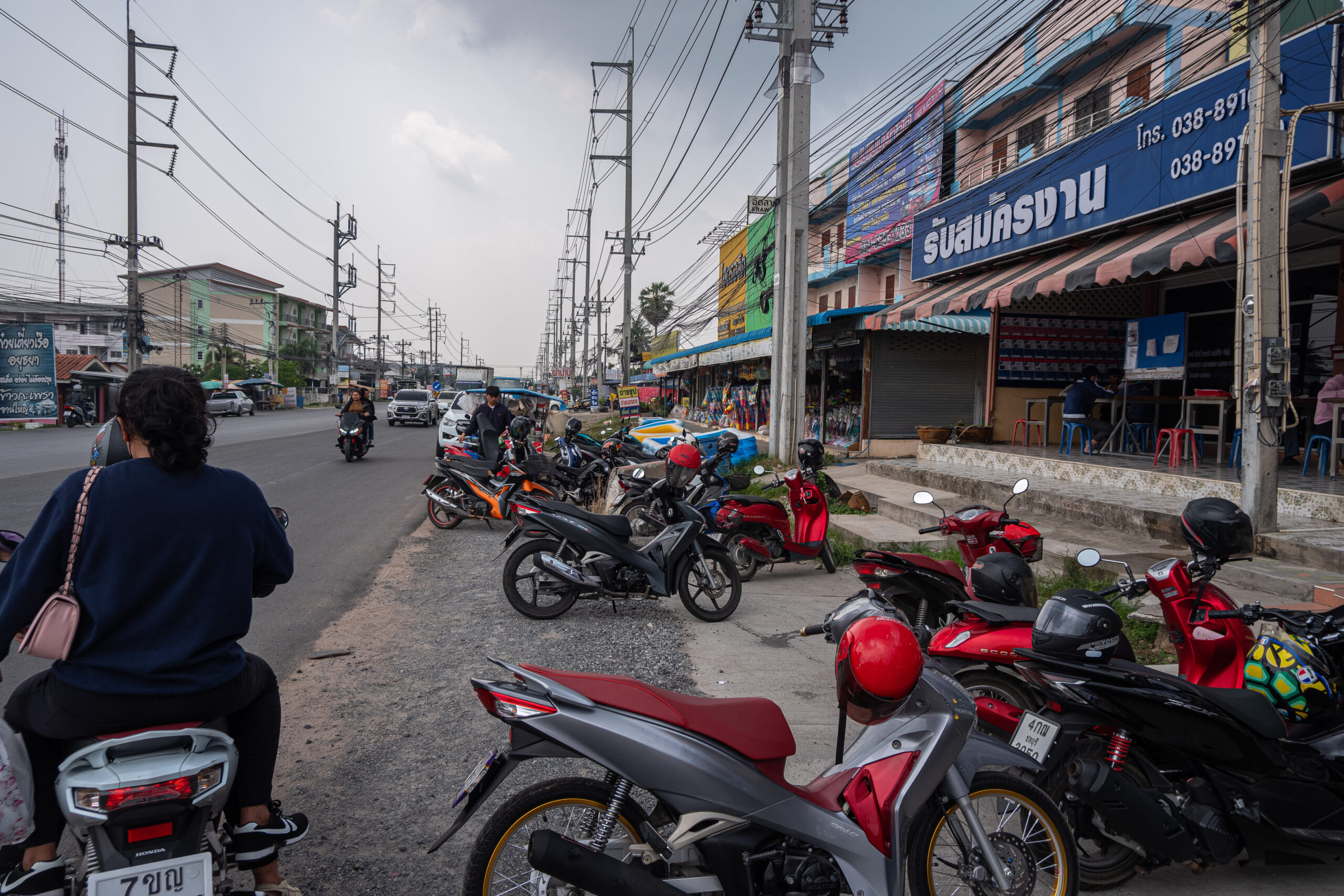
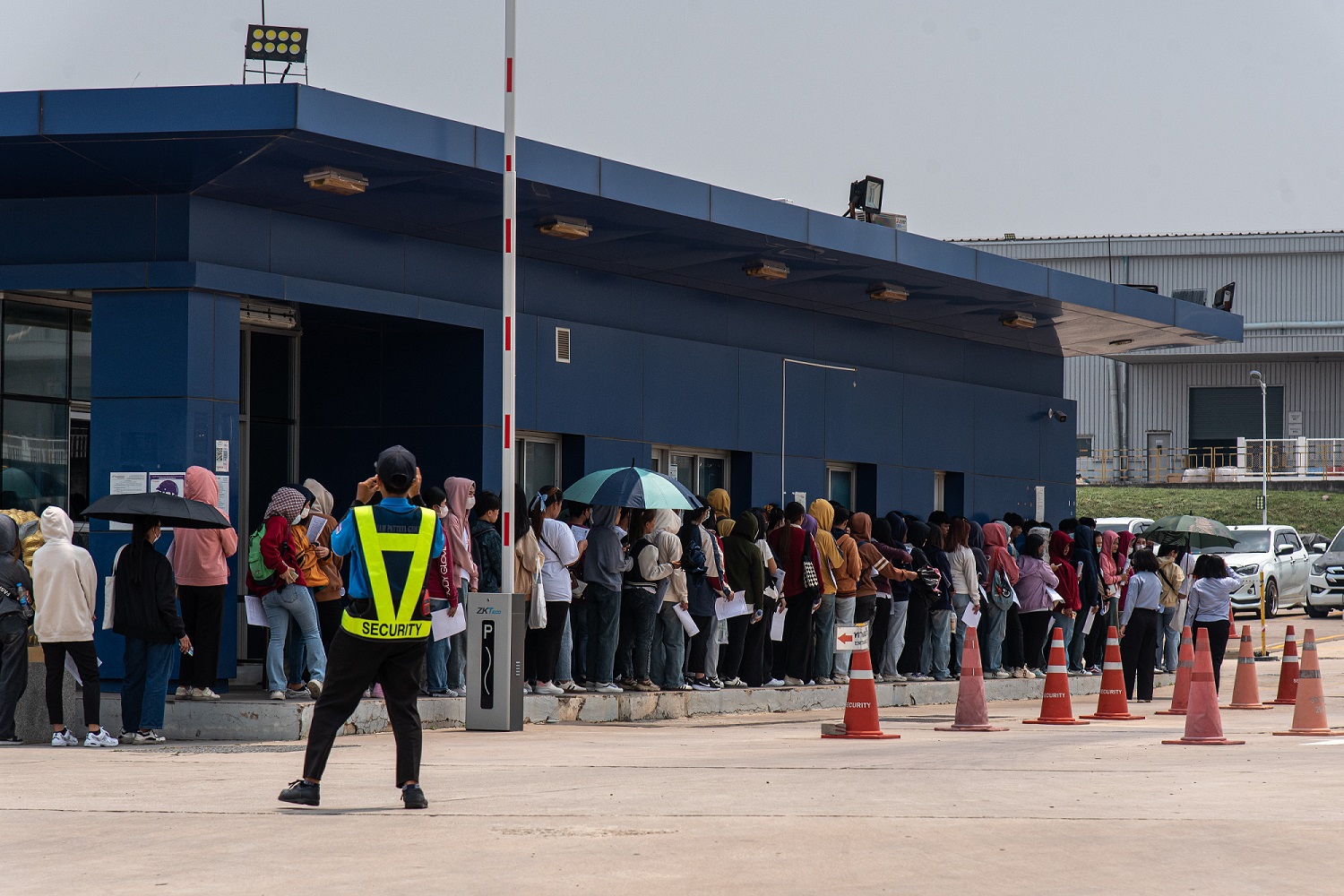
On a humid day in February, a small group of workers huddled in front of a large solar panel factory inside Thailand’s biggest manufacturing hub in the eastern coastal province of Chonburi, home to some of the world’s top solar panel-producing companies.
The men and women, mostly in their twenties, all hoped to land a job on a production line assembling solar cells into panels destined for export.
They knew they may not hold the job for very long after reading complaints of former employees on social media about work being regularly cut when orders were low.
But the company promised fair pay and, needing work, they were willing to take the risk.
That risk is growing, as Thailand’s solar industry has become caught in an escalating trade war between the US and China, with Thai solar workers paying the price.
Large Chinese companies dominate Thailand’s solar manufacturing industry, which produces solar cells and panels for export to the US market.
But as Washington erects trade barriers to protect its homegrown solar sector from a rising tide of cheap Chinese imports, Thailand’s industry is being squeezed.
Solar manufacturers in Southeast Asia’s second-largest economy that rely heavily on Chinese components are now facing nearly 400% tariffs to export their products to the US.
Analysts say the tariffs threaten to hurt Thailand’s manufacturing sector and its workers, and could have a knock-on impact on solar rollout in the country. But the changing trade landscape also creates an opportunity for producers to find new markets, including by accelerating solar deployment and the energy transition across the Southeast Asian region.
The heat of the solar trade war
For more than a decade, the US has waged a tariff war on growing imports of cheap Chinese solar panels, which it says harm its domestic industry.
China’s mass production of solar cells and modules has enabled the expansion of clean energy globally. The cost of solar panels has declined by 90% in the past decade. But China’s subsidised and cut-price solar production has also led to accusations of unfair trade practices.
In response, Chinese manufacturers relocated the final production stages to neighbouring Asian countries in an attempt to avoid the US import tax, turning Southeast Asia into a major solar-panel assembly hub and export base.
As Chinese exports of solar components to Vietnam, Thailand, Malaysia and Cambodia boomed, so did US imports of Southeast Asian solar panels.
By 2023, 80% of US solar module imports came from those four countries. Nearly a quarter came from Thailand alone.

But in recent months, several Chinese manufacturers with factories in Southeast Asia suspended some of their operations in the region, after the US announced a string of antidumping duties on solar imports from the four countries in a bid to close the loophole.
Thousands working in Thailand’s solar factories – most of whom had left the agricultural north of the county to seek better-paid employment in an industry which promised decent jobs – were put on leave or suddenly dismissed.
Climate Home News analysed local media reports and social media posts relating to worker dismissals at three leading solar manufacturers with factories in the Eastern Economic Corridor, the country’s largest manufacturing zone: Chinese companies Runergy and Trina Solar, one of the world’s largest solar PV manufacturing firms, and Canadian Solar, which has long conducted most of its manufacturing operations in China.
We found that close to 8,000 full-time staff and subcontracted workers were either temporarily or permanently dismissed in 2024. Over that time, US officials investigated a complaint from American manufacturers that companies with factories in Southeast Asia were dumping subsidised and unfairly cheap products on the US market.
An industry losing its grip on its biggest export market
Last month, US trade officials unveiled hefty tariffs of at least 375% on imports of solar cells from Thailand.
The US International Trade Commission, a bi-partisan government agency, is due to make a final decision about the tariffs in June. In private, analysts say they are likely to be approved.
The Institute for Energy Economics and Financial Analysis (IEEFA) recently found that any price increases beyond 250% would make most Southeast Asian imports “untenable”.
“Any company in any country where the combined tariffs is greater than 250% will likely see their orders decline or get cancelled,” Grant Hauber, of IEEFA, told Climate Home.
Over the past year, US officials’ tariff deliberations rocked Thailand’s solar industry.
“There has been a broad suspension of operations among Chinese companies in Southeast Asia, including Thailand, with many closures likely to be permanent,” said Linxiao Zhu, a research fellow at the Oxford Institute for Energy Studies.
“The region risks losing a significant share of its solar manufacturing capacity due to the loss of access to the US market.”
“Thailand’s solar manufacturing industry faces some serious challenges,” agreed Forbes Chanthorn, BloombergNEF’s Thailand energy transition analyst based in Singapore. “It is losing its grip on some of its biggest export markets without any short-term alternatives in sight.”
And the situation could go from bad to worse as US President Donald Trump threatens an additional 37% import tariff on all goods from Thailand – one of the highest rates in Washington’s planned universal tariff onslaught, now paused until June. If applied, this would push the tariffs on Thailand’s solar cells up to 426%.
In an interview, Charuwan Phipatana-Phuttapanta, a solar expert at Thailand’s energy ministry, acknowledged that the tariffs will impact employment in the country’s solar industry.
Workers fall victim to tariffs
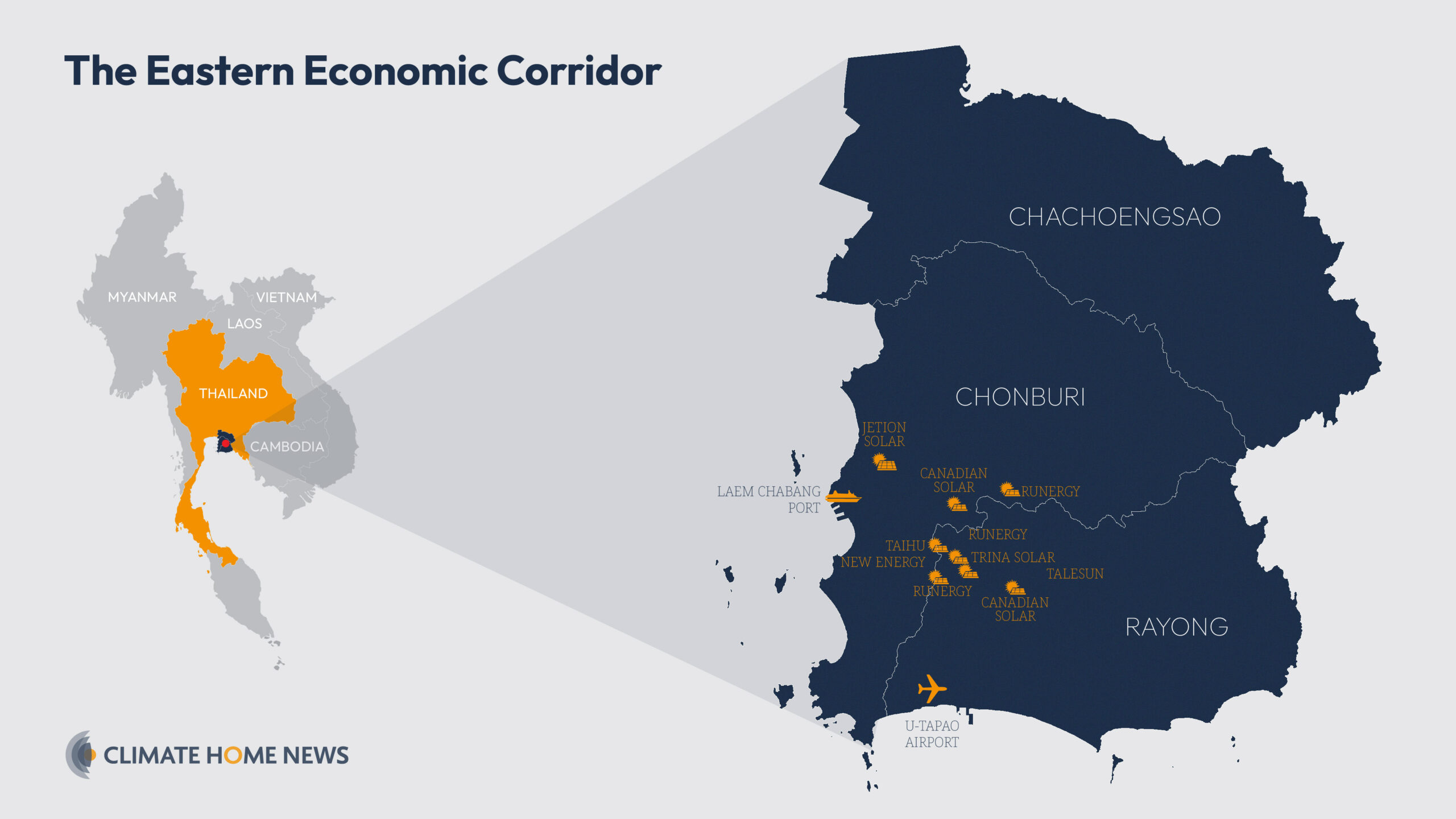
Spanning three provinces on Thailand’s eastern coast, the Eastern Economic Corridor (EEC) is key to the government’s plan to transform the area into an economic powerhouse.
Enticed by generous tax breaks and cheap labour, international companies have flocked here to manufacture everything from air conditioners to batteries for electric vehicles and solar panels for the regional and global markets.
Several leading Chinese solar manufacturing companies set up shop in the EEC nearly a decade ago. Soon, Thailand’s solar exports to the US soared.
But in June 2024, a two-year US tariff waiver on solar products from Southeast Asia – introduced by Joe Biden to boost solar deployment in the country – came to an end. Companies in the region importing silicon wafers from China to make solar cells for export to the US became subject to tariffs.
In the days that followed, several manufacturers slowed down or suspended operations, letting go of staff to adjust to the new tax regime, Amnuay Ngamnet, director of Rayong Labour Protection and Welfare office, the labour ministry’s local representative, told Climate Home.
In Rayong alone, the most southern of the EEC’s three provinces, 3,200 full-time workers at five solar factories were put on leave between 2022-2024, according to official data.
Videos posted on TikTok in recent weeks show deserted parking lots and unusually quiet grounds around some solar factories.
“No matter how good you are, if life stumbles, you cannot succeed. Goodbye,” one solar worker posted on the social media platform with a photo of a dismissal letter.


Amnat (whose name has been changed because of concerns that speaking to the media might affect his job prospects) was among thousands affected.
Like many others, the 39-year-old left his hometown in the agricultural northeastern region in 2022 to find a better-paid job at a solar plant in the EEC.
“It seemed like a promising industry. I hoped to spend years there,” Amnat told Climate Home over the phone. “But it didn’t turn out that way.”
Amnat worked as a subcontractor at a few Chinese solar factories, eventually landing a staff position at Runergy, which manufactures solar cells and modules.
He worked six days a week and earned approximately 25,000 baht ($745) a month, way above the average income for unskilled workers.
But in October 2024, he was dismissed along with “almost all of the employees” at the factory, according to local media reports. Amnat told Climate Home the retrenchment affected nearly 3,000 workers.
Runergy did not respond to repeated requests for comment.
The same month, Runergy opened its first module manufacturing plant in the US to keep supplying the American market – one of a number of solar companies hoping to benefit from tax credits under the Inflation Reduction Act (IRA).
As a permanent employee, Amnat was compensated 75% of his monthly wage, a lifeline during the three months it took him to find another job. But others were not so lucky.
Thousands of workers hired as subcontractors and benefiting from fewer rights were left without work or pay overnight as companies suspended some of their operations.
At risk of labour rights violations
“After leaving the solar company, my girlfriend was left unemployed for two months. It was difficult for us,” a TikTok user who had complained about the dismissals on social media, told Climate Home. The subcontracting company employing her made her sign a dismissal letter, absolving it of paying the compensation she was entitled to, he explained.
Bunyuen Sukmai, a local labour lawyer and rights activist, told Climate Home “most workers are not aware that the practice violates their rights” despite being routinely deployed.

In the workers’ housing estate, a few kilometres outside the industrial zone, the offices of subcontracting firms are flanked by hair salons and restaurants. A steady stream of job-seekers fill in application forms and scan QR codes to follow job announcements on social media.
“Subcontractors are usually the first to be affected by industry changes. They usually receive lower benefits and are most at risk of having their rights violated,” said Sukmai. But legal cases over unfair dismissal are rare as few workers have the resources to go down the judicial route, he added.


A representative of Trina Solar in Thailand declined to respond to questions. Canadian Solar did not respond to Climate Home’s repeated requests for comment.
However, in a letter dated June 2024 and shared on social media, Canadian Solar said it had paused operations at one of its factories to make changes to its production line and improve machinery. “Due to the current economic conditions and trade competition, the company needs to adjust to the market situation and the direction of the domestic and international economy,” it said.
It added that it had “great confidence in the potential and economic conditions of Thailand” where it intended to continue operating.
In search of new markets
Some large Chinese panel-makers have already started setting up production lines in Indonesia and Laos, which are not currently affected by the US solar import duties.
The Middle East has also emerged as a growing destination for Chinese solar investments, including for the production of key solar components such as polysilicon ingots and wafers.
“These efforts are designed to forge a supply chain completely outside of China serving the Middle East, the US, and other markets that may be subject to tariff risks,” Zhu wrote in a recent report for The Oxford Institute for Energy Studies.

To continue operating in Thailand, analysts say large solar manufacturers will need to seek new export markets outside of the US.
In the short-term, exports could be redirected to the European Union and India. The Thai government is racing to finalise a free-trade deal with the EU, where demand growth for solar equipment may be stronger than in the US, Laura Schwartz, a senior Asia analyst at risk intelligence company Verisk Maplecroft, told Climate Home.
“However, over half of China’s solar cell and module exports already go to Europe, so Thai exports would face stiff competition,” said Schwartz. And Indian solar developers will have to use locally made solar cells in government projects from June 2026.
But the tariffs could also mark “a turning point” for Southeast Asia’s solar industry, which could focus on supplying emerging markets in Africa and South America, and urgently accelerate the region’s own solar deployment, said Christina Ng, director of the Energy Shift Institute, a think-tank focused on Asia’s energy transition.
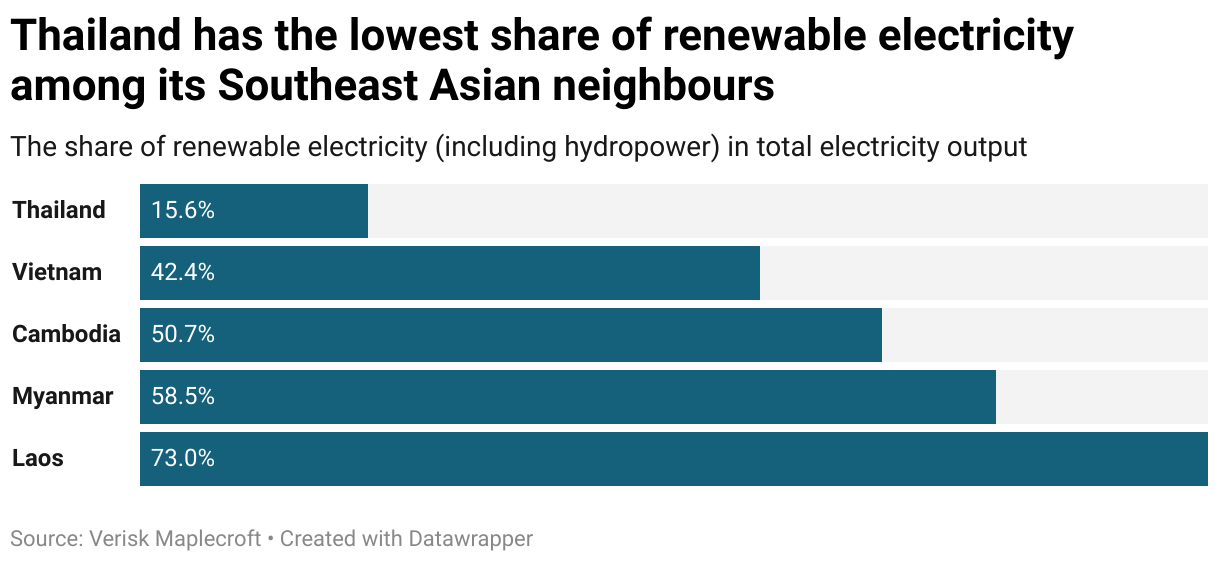
Thailand is dependent on gas for electricity generation but the government has set out plans for 51% of its electricity to come from renewables by 2037, with most of the additional renewable power expected from solar. Only around 3% of Thailand’s electricity currently comes from solar.
Thai companies assembling solar modules in the country are already calling for more incentives to expand a homegrown supply chain.
Krit Pornpilailuck, CEO of Solar PPM, fears Chinese solar manufacturers that can’t export their goods to the US “will flood the Southeast Asian market and plunge the price” of modules.
To protect the industry, Pornpilailak wants to see more support for Thai manufacturers to produce solar cells and other upstream components domestically.
“Thailand has more than six million tonnes of solar-grade quartz reserves that could be used to produce polysilicon – the key ingredient to produce solar wafers,” said Phipatana-Phuttapanta, the government’s solar expert. Although developing the resources would require “technical expertise and high investment”, she added.
“This is a chance for [manufacturers] to move up the value chain – from being seen as mainly low-cost assemblers to becoming leaders in more advanced clean energy technologies,” said Ng. “If the region takes this moment seriously and diversifies, it won’t just weather the disruption; it will emerge more resilient and competitive.”
The post Solar squeeze: US tariffs threaten panel production and jobs in Thailand appeared first on Climate Home News.
Solar squeeze: US tariffs threaten panel production and jobs in Thailand

The launch of the Africa Energy Bank (AEB) has been put back yet again, raising doubts about the institution’s future ability to finance fossil fuel projects – its main objective – as global lenders retreat from such investments over climate concerns, experts told Climate Home News.
The bank, which had been billed to launch in September after a series of delays, is now scheduled to begin operations in November, according to the head of the African Energy Chamber, an advocacy body for the continent’s oil and gas sector.
Even as the world aims to transition away from fossil fuels, many African leaders have made clear they want to continue exploring and extracting the continent’s large oil and gas deposits – estimated at around 125 billion barrels of crude and over 600 trillion cubic feet of gas – to boost economic development.
As a group, Africa sided with a number of powerful oil-and-gas producing nations in blocking progress on negotiations to craft a global roadmap to transition away from fossil fuels at last year’s UN COP30 climate talks, although some countries did individually support the proposal.
-
Campaigners oppose Dangote’s planned Kenya refinery over climate and ecological risks
Plans to build Africa’s second largest oil refinery in ecologically sensitive region criticised as “environmental recklessness” -
Tanzania pushed African nations to oppose fossil fuel transition at COP30
While chairing the African group at the summit, the gas-dependent nation advised the continent’s ministers to block language on transitioning away from fossil fuels


Meanwhile, major projects under development across the continent – including the 1,443-km East African Crude Oil Pipeline (EACOP) and Dangote’s 700,000-barrel-per-day Kenyan refinery – show that African governments see oil and gas as playing a significant role in meeting their energy and economic needs for many years to come.
In 2022, at a gathering of the African Petroleum Producers’ Organization (APPO) in oil-rich Angola, ministers from its member states adopted a resolution to create the Africa Energy Bank to finance projects for the production, use and trade of oil, gas and broader energy sources.
African control over energy resources
An article on the APPO website explains that the bank was conceived as a way to overcome “disenchantment” with fossil fuels among “the international community” which it said had crystallised around the “energy transition” concept.
“If Western countries, after having long taken advantage of the energy sources they now revile to develop, can afford the luxury of abandoning them, this is not the case in Africa,” it adds, noting that many of the continent’s economies are still largely dependent on oil and gas revenues.
A separate web page about the bank, also hosted on APPO’s website, says its objectives include financing the exploration, production and refining of oil and gas, as well as supporting member states in transitioning from fossil fuels to cleaner energy sources “while ensuring energy security”.
Said Addi, a former executive with Shell and energy commodities trading house Gunvor, said the new bank was judged necessary because financing for hydrocarbons from many traditional international lenders has become constrained.
In trying to fill this financing gap, Africa is not simply setting up another fund to support oil and gas, he added. “It is also an attempt to give African countries greater control over how their energy resources and infrastructure are financed,” he explained.
Nigeria to host the AEB
The energy bank – a joint initiative of APPO and the African Export–Import Bank (Afreximbank) – has so far suffered several delays and is almost two years behind schedule. The initial plan was to start operations in January 2025, with Nigeria as the host country, but the bank’s opening was delayed to June of that year to allow Nigeria time to finalise the construction of the bank’s headquarters in Abuja.
After the government announced the completion of the offices in late November 2025, a new launch date was set for January 2026, which was moved back to April, June and then September. Now it has shifted again to November, raising concerns that the institution may be losing momentum.
Former Shell executive Addi said that if the capital is eventually paid in, the bank becomes operational and its first projects are commercially credible, then the delays will be regarded as normal teething troubles in setting up a multilateral institution. But, he added, scepticism will be justified if it continues to stall.
Uganda may see lower oil revenues than expected as costs rise and demand falls
Baron Lamarré, an oil and gas expert and former Petronas oil trader, said that missing “three deadlines in a row is not normal”, and warned that if the timeline slips again, “the story flips from ‘ambitious institution finding its footing’ to ‘good idea that lost momentum before it found any’.”
The Nigerian government, APPO and Afreximbank did not respond to requests for comment by the time of publication.
The funding challenge
The Africa Energy Bank is targeting base capital of $5 billion, with plans to scale up to $120 billion within five years by mobilising private-sector funds. However, it is expected to start operations with initial seed capital of $500 million.
The funding plan is to have the 18 member countries of the APPO contribute $83 million each to the bank as equity for a combined $1.5 billion. Afreximbank, other non-APPO African countries and investors outside the continent are expected to provide the remaining $3.5 billion.
But even the initial $500 million has not been easy to mobilise. In May, APPO Secretary-General Farid Ghezali called on members to deliver on their pledges towards the startup goal before the end of June. But the delays suggest this may not have been met, with experts saying Africa may be finding it difficult to self-fund its oil and gas projects in the absence of international capital.
Lamarré said every extension of the deadline points to the fact that “raising fossil fuel capital in Africa without the majors and their financing networks is brutally hard”.
Why the global electrification agenda misses the point on Africa’s energy crisis
Since 2020, Western lenders, export credit agencies and insurers have been in steady retreat from African hydrocarbons, he said, while oil majors are divesting their African assets, handing over fields to smaller local operators whose credit ratings are not high enough to borrow cheaply.
Even capital from China and the Gulf, which has partially filled the gap, cannot match the volume, tenor or pricing that Western investors once offered, Lamarré argued.
“If mobilising the first $500 million of seed capital [for the AEB] has taken this long, that’s the clearest signal yet of how steep the climb to $120 billion looks,” he said, noting that the continent’s energy financing gap is as large as $30 billion-$45 billion per year.
Africa’s investment landscape, meanwhile, has been shifting. While foreign direct investment dropped from a 2024 peak, inflows remained roughly one-third above the continent’s long-term average in 2025, according to the 2026 World Investment Report from UN Trade and Development (UNCTAD). They are concentrated in a few sectors including critical minerals needed for renewable energy technologies, battery manufacturing and advanced industrial production.
At the same time, data on global energy investment from the International Energy Agency (IEA) shows that fossil fuel investment in Africa has declined over the last decade.

“Trojan horse” for fossil fuels
While the Africa Energy Bank struggles to get off the ground, climate campaigners have criticised its primary aim of financing oil and gas on the continent at a time when the world is starting to move away from high-carbon fuels to cleaner alternatives.
Bhekumuzi Dean Bhebhe, founder of Africa Change Lab, described the bank as a “Trojan horse”, arguing that its focus on fossil fuel financing runs counter to the global energy transition and the African Union’s Agenda 2063 goals of sustainable development and inclusive growth.
The energy bank, he warned, “risks locking Africa into a new cycle of debt, dependency and fossil fuel entrenchment”, adding that its financing blueprint does not pave the way for a climate-resilient future. “In truth, it is to deepen the same extractive, carbon-heavy pathways that the continent should be moving away from,” he added.
Ugandan farmers use British court to try to stop East Africa oil pipeline
Kenya-based climate and energy expert Joab Okanda said the AEB’s plan to finance oil and gas is “a misplaced priority” and it should instead back clean energy in line with the policies of some of Africa’s major export markets like Europe.
In addition, the new bank could struggle to mobilise enough resources to advance large-scale oil and gas projects, he added, noting that its proposed $5-billion initial capital is equivalent to the cost of the East African Crude Oil Pipeline alone.
The AEB’s aim of backing more fossil fuels should be flipped “to support countries that are oil-dependent to start working on their transition plans”, Okanda said.
The post Launch of Africa Energy Bank delayed again in blow to oil and gas hopes appeared first on Climate Home News.
Launch of Africa Energy Bank delayed again in blow to oil and gas hopes