

It has become a tradition for world leaders to kick off the annual UN climate conference by telling each other and the world what they’re doing to tackle climate change.
This year, some big hitters like the US’s Joe Biden and China’s Xi Jinping will stay away. Other influential leaders including Narendra Modi, Emmanuel Macron, Mohamed bin Salman, Mia Mottley, William Ruto and Lula Da Silva are due to attend.
World leader speeches at Cop28 are a chance to show off ambitious policies, bear witness to climate impacts, pledge funding and point fingers. Here are seven things to watch out for.
1. Fossil fuel phase-out
A broad coalition of nations is calling for a phase out, or at least phase down, of fossil fuels. They will face resistance from countries that rely on fossil fuels to generate revenue and keep their people content.
Any deal on a fossil fuel phase out will be struck by negotiators in closed meeting rooms towards the end of Cop28 in two weeks time.
But we will get a good sense of the strength of resistance from the first two speeches on Friday – that of UAE’s Mohamed Bin Zayed and Saudi Arabia’s Mohammed bin Salman.
Its not just Gulf petrostates that defend fossil fuels though. Several African leaders in particular want to exploit their fossil fuel reserves, they say, to bring wealth and electricity to their people.
Senegal’s Macky Sall and the Democratic Republic of Congo’s Felix Tshisekedi are among them. They may use their speeches to ask why they shouldn’t pump for new oil and gas when the likes of the US and Canada plan to increase production.
2. Tales from the frontline
After a year that had climate scientists reaching for the thesaurus to describe their shock at global temperature spikes, leaders will share how climate disasters hit their people.
In Libya, extreme rainfall overwhelmed decrepit dams and washed away much of the city of Derna in September.
Leaders from Iraq and East African nations may tell of extreme drought while South American leaders could address their weird winter heatwave.
Then there are the slow, creeping climate impacts. In the Pacific, rising seas and intensifying storms are eroding narrow atolls, while expanding desert eats into the fertile land of northern Africa and mountain glaciers retreat.
3. Start-up cash for a loss and damage fund
Negotiators are set to agree at Cop28 on how to set up a global loss and damage fund for victims of the climate crisis.
A handful of pledges are expected from the EU and others to get it started. Don’t get too excited: we’re talking in the region of $0.5-1 billion, not the $100bn a year developing countries ultimately want to see flowing through the fund.
Avinash Persaud, climate adviser to Barbados’ prime minister, told Climate Home that amounts like that should not be dismissed. “Countries can’t pull billions out of a hat,” he said, “because you have to budget in advance.”
Climate Action Network’s Harjeet Singh took a stronger line. “Recovery costs are soaring into the billions,” he said, “far exceeding the expected pledges of a few hundred million.”
4. Green Climate Fund pledges
The UN’s flagship climate fund held its four-yearly fundraising round in October. Pledges from wealthy countries totalled a disappointing $9.3bn – less than last time in 2019.
That’s left the fund’s secretariat looking to have to scale back ambition – help fewer farmers adapt to climate change, conserve less forest, protect fewer countries with early warning systems.
A few late pledges could improve its fortunes. Italy, Sweden and Switzerland have yet to announce contributions. Their leaders are attending.
The US and Australia are not sending leaders but could announce funds elsewhere. Both now claim to be climate leaders. This is the time to prove it with cash.
5. Bridgetown developments
Two years ago, Barbados’ prime minister Mia Mottley got some influential allies together in her capital city Bridgetown to plot how to transform the global financial system to make it work for climate.
Since then, her speeches have become must-watch verdicts on how that mission is going and where it should go next. We’re expecting her to call for more ambition in reforming banks like the World Bank so that they spend more on climate.
Her speeches often include innovative ideas. Last year, she suggested that oil companies should pay for climate damages. With Barbados’ support, France and Kenya have set up a task force to look into making that happen, which Emmanuel Macron and William Ruto are likely to promote. So what Mottley proposes this year is worth watching.
6. Coal-to-clean updates
Two years ago in Glasgow, the concept of a Just Energy Transition Partnership was launched. The idea was for rich countries to financially help coal-reliant emerging economies switch to renewables.
South Africa piloted the idea, while agreements with Indonesia and Vietnam came next. All have been plagued by arguments over the pace of change and the nature of finance.
President Cyril Ramaphosa will give an update on South Africa’s package on Friday. The most advanced of the partnerships, it nonetheless faces political challenges.
Fearing repression in Dubai, non-binary people stay away from Cop28
Vietnam is due to announce its investment plan at Cop28. Prime minister Chinh Pham Minh will no doubt talk it up, without mentioning that he’s jailed several environmental campaigners.
The words of Indonesian president Joko Widodo could be interesting as, ahead of February’s elections, he could air his complaints about rich countries’ insistence on mainly loans not grants.
With India uninterested, there are no more in the immediate pipeline but plenty of leaders will emphasise the volume of investment needed to support clean development.
7. Bids to host Cop29
Two years ago, we already knew that we’d be in the United Arab Emirates for Cop28. Similarly, we already know that Cop30 will be in Belém in Brazil in two years time.
But we don’t know where we’ll be this time next year. It’s up to the UN’s Eastern Europe group to decide. Various EU states have offered but Russia has vetoed them because of EU support for Ukraine.
Russia supports Azerbaijan’s candidacy but Armenia, which is at war with Azerbaijan, opposes that and wants to host itself – which Azerbaijan opposes right back.
Meet the Italian fugitive advising Emirati start-up Blue Carbon
The various potential hosts could use their speeches to make their case. If there’s no agreement the default is for the UAE to keep the presidency with the physical conference held at the UN climate headquarters in Bonn, Germany.
For Cop31, contenders include Australia, whose leader is not on the speaker list, and Turkiye whose president Recep Tayyip Erdoğan will speak on Friday.
The post Seven things to watch out for in world leader speeches at Cop28 appeared first on Climate Home News.
Seven things to watch out for in world leader speeches at Cop28

Three countries have been named by the Paris Agreement’s compliance committee for failing to submit a nationally determined contribution (NDC) and repeatedly snubbing offers of help with their climate plans.
After months of internal debate over whether to identify serial non-responders, the Paris Agreement’s Implementation and Compliance Committee (PAICC) named the three countries which have failed to engage with it over their NDCs on Friday.
It named Democratic Republic of Congo, Senegal and North Korea in a footnote of its annual report, adding that it decided to name them “with a view to facilitating engagement”, adding that representatives of the three nations had been invited to its meeting in early 2027 “with the purpose of identifying any challenges and constraints”.
“The Committee noted the importance of Parties engaging with the Committee in a timely manner, while noting that some delays may be due to the national capabilities and circumstances of the Parties”, the report said.
-
Under US pressure, World Bank says it will back gas “where appropriate”
The US wants the World Bank to expand its gas support while climate campaigners are pushing for it to end – its head spoke this week of limited backing for the fossil fuel -
IPCC scientists vow to press on with climate reports despite political deadlock
After governments again failed to agree a timeline, nearly 120 IPCC authors pledged to complete their assessment on time and with full scientific rigour -
Paris Agreement committee snubbed over missing NDC climate plans
Many governments have still not submitted a nationally determined contribution to the UN, breaching a key requirement of the Paris Agreement

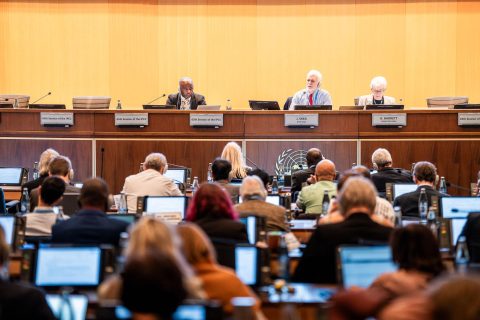

In July, PAICC said 12 countries had ignored its repeated attempts to discuss why they had not published an NDC as required every five years under the 2015 Paris accord.
Members of the committee had been divided over whether to name them, but at a September meeting decided to do so in their annual report to the annual climate COP summit.
By the time the report was published on Friday, only Congo, Senegal and North Korea “had not communicated an NDC or submitted a [Biennial Transparency Report] and had not yet responded to any of the Committee’s notifications, despite several reminders issued by the Committee in this regard”.
Rainforest and renewable energy ambitions
The silence from Congo and Senegal is notable because the former is home to much of the Congo Basin rainforest while the latter has sought billions of dollars in climate finance to support its renewable energy ambitions.
After Brazil, Congo has more rainforest than any country in the world. This forest, and the country’s peatlands, absorb huge amounts of greenhouse gas but are fast being lost to expanding farmland, charcoal production, logging and mining.
Senegal signed a Just Energy Transition Partnership with Canada and wealthy European nations in 2023, to help it meet its renewable energy targets under the-then government of Macky Sall. It was chair of the Least Developed Countries group between January 2022 and December 2023.

Tejas Rao, who is researching the PAICC as part of a doctoral thesis at Cambridge University, said the governments of the three countries should engage with the committee.
“Engagement costs these governments very little and the committee has shown it will listen,” he said.
“Silence leaves the committee with no basis to help, and it leaves the [governments] exposed to the narrative that they are simply disengaged,” he told Climate Home News.
Paris Agreement requirement
The 2015 Paris Agreement requires all parties to publish an NDC every five years outlining their emissions reduction targets, with each plan meant to be more ambitious than the country’s last NDC.
The latest set – the third round of plans, with new targets for 2035 – was due in February 2025. While most countries missed this deadline, all but around 30 – mostly small emitters but including Egypt, Vietnam and Argentina – have now submitted them.
Over the year, the PAICC – which is made up of government climate officials from developed and developing countries – has been communicating with governments that have not submitted NDCs and trying to overcome barriers to them doing so.
Some nations have cited exceptional circumstances as the reason for not submitting an NDC, a process that requires a significant amount of work in tracking emissions and consulting on how to curb them across the economy. For example, a letter from a Sudanese official to the PAICC, seen by Climate Home News, said that the country’s civil war had led to the suspension of its NDC preparation.
-
IPCC scientists vow to press on with climate reports despite political deadlock
After governments again failed to agree a timeline, nearly 120 IPCC authors pledged to complete their assessment on time and with full scientific rigour -
Under US pressure, World Bank says it will back gas “where appropriate”
The US wants the World Bank to expand its gas support while climate campaigners are pushing for it to end – its head spoke this week of limited backing for the fossil fuel -
Who shapes climate science? The equity question facing the IPCC
Early completion of the next global climate science assessment reports risks excluding research from the Global South, which is key to ensuring the findings are fair
The US and Iran are not signed up to the Paris Agreement and so do not have active NDCs, nor does Taiwan, which is not a UN member state.
Rao said that because the PAICC is “facilitative and non-punitive”, naming the countries “is meant to open a door, not close one – the invited consultation is the point”.
“In recent months, governments that explained their constraints, whether capacity, finance or domestic process, have been met with follow-up and support rather than sanction, and the number of silent governments has fallen sharply,” Rao said.
The post Paris Agreement committee names three countries snubbing it over NDCs appeared first on Climate Home News.
Paris Agreement committee names three countries snubbing it over NDCs