


Sasol Ltd., a South African energy and chemicals firm, is gaining attention. They reported stronger earnings and are shifting their strategy to buy more carbon credits. The move comes as the company, the second-biggest emitter of greenhouse gases in the region, boosts coal production and grows its renewable energy portfolio.
Investors, regulators, and climate observers are watching closely to see how Sasol balances its reliance on fossil fuels with its stated commitment to reaching net-zero emissions.
Earnings Power: Fueling a Dual Strategy
In its latest earnings report, Sasol posted a year-on-year improvement supported by stable product prices and efficiency gains. The company’s operating profit rose due to stronger chemical sales.
However, this was partly offset by higher costs in its coal division. Earnings were strong, giving Sasol the money to invest in fossil fuels and low-carbon projects.
For the fiscal year ending June 30, the company earned 10.60 rand per share. This is a turnaround from a loss of 69.94 rand per share. Asset write-downs fell sharply to 20.7 billion rand, down from 74.9 billion rand last year.
Sasol gained from a 4.3 billion rand settlement with Transnet over oil transport fees. Capital expenditure dropped 16% to 25.4 billion rand. This helped improve the company’s financial profile.
Management highlighted that a resilient balance sheet is critical as the company continues its transition journey.
Sasol has steady cash flows. This helps support its short-term coal operations. It also funds longer-term projects like renewable energy growth and carbon reduction efforts.
Sasol’s renewed profit helped lift investor sentiment. Following the earnings, the company’s shares climbed 7% in pre-market trading. Its stock on the Johannesburg Stock Exchange (JSE: SOL) surged by 44% over the last quarter.

Analysts predict that earnings per share will increase by 20% year-on-year. This shows rising confidence in the company’s ability to balance profit and sustainability.
Rising Carbon Credit Purchases: Flexibility or Delay?
One of the biggest headlines is Sasol’s decision to boost its purchase of carbon credits.
- In the fiscal year that ended in June 2025, Sasol’s carbon credit purchases increased to R723 million, a 25% increase year-on-year.
- This amount was nearly triple the value of the credits it bought in 2023.
- Since 2019, Sasol has acquired more than 11 million South African carbon credits, which has reduced its carbon tax liability by more than R650 million.
Most of these credits come from international renewable energy and reforestation projects, while some are linked to African-based carbon offset programs. Sasol plans to grow its carbon credit portfolio, showing its commitment to climate responsibility.
- Wonderbag: In 2021, Sasol announced it would use carbon credits generated by the Wonderbag project, which provides non-electric heat-retention cookers to reduce household emissions.
- Bethlehem Hydro: In 2020, Sasol purchased over 100,000 credits from Bethlehem Hydro, a 7MW hydropower plant that was the first Independent Power Producer in South Africa.
- Nitrous oxide abatement: As far back as 2007, Sasol received credits for a nitrous oxide abatement project at its nitric acid plants in Sasolburg and Secunda.
However, it recognizes that cutting emissions from its own operations is tough in the near term. The company plans to steadily increase reliance, but acknowledges that credits are a temporary solution.
The use of credits has generated debate. Supporters say it gives companies flexibility to meet interim targets while low-carbon technologies scale.
Critics argue it can delay direct emissions cuts. Sasol’s growing use of offsets shows the urgent climate pressures and the challenges of moving away from coal.
Coal’s Grip: South Africa’s Energy Dilemma
Sasol is one of South Africa’s top coal users. It relies on coal for power and to make synthetic fuels and chemicals. Its Secunda plant is one of the single largest point sources of carbon dioxide globally, emitting more than 56 million tons of CO₂ equivalent each year.
The world’s biggest producer of fuels and chemicals from coal emits around 63 million tons of CO₂ equivalent each year. This makes it one of Africa’s largest industrial polluters.
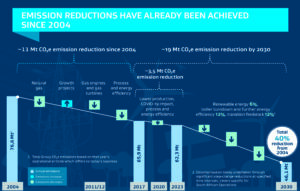
The company believes coal is still essential for South Africa’s energy and industry right now. This is especially true due to the country’s electricity shortages and its dependence on Eskom, the state utility. Sasol knows that relying on this can lead to risks such as regulatory pressure, investor scrutiny, and possible costs from future carbon pricing.
Counting Carbon: Sasol’s Net-Zero Targets and Progress
Despite its coal footprint, Sasol has stepped up efforts to diversify its energy mix. The company is putting money into renewable energy projects. This includes solar and wind farms. These efforts will help provide cleaner electricity for its operations.
Moreover, partnerships with independent power producers are helping Sasol shift portions of its energy use away from coal-generated power.
In addition, Sasol is advancing work in green hydrogen and sustainable aviation fuel (SAF). Its Fischer-Tropsch technology, long used for coal-to-liquids production, is being adapted for cleaner feedstocks, such as natural gas and green hydrogen. The company announced pilot projects to produce low-carbon chemicals for local and global markets.
Sasol aims to cut its Scope 1 and 2 emissions by 30% by 2030. This goal uses a 2017 baseline, which is about 72 million tons of CO₂e. Progress: current emissions are down about 13% from baseline.
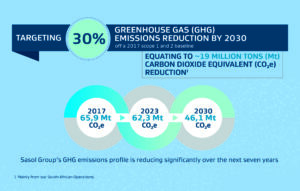
It aims for net-zero emissions by 2050. However, it admits that success relies on policy support, technological progress, and available funding.
In summary, Sasol’s key emission reduction initiatives are:
-
Green hydrogen projects – Developing hydrogen production in South Africa through partnerships to support cleaner fuels and power.
-
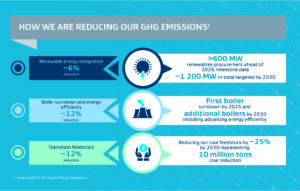
Renewable energy procurement – Securing up to 1,200 MW of renewable electricity (wind and solar) to replace coal-based power at operations.
-
Energy efficiency improvements – Implementing process optimization and equipment upgrades to reduce energy use across its facilities.
-
Coal-to-gas transition – Shifting part of its feedstock mix from coal toward natural gas, which has a lower carbon footprint.
-
Carbon capture and utilization (CCU) – Exploring technologies to capture CO₂ from operations for use in chemicals or fuels.
-
Sustainable aviation fuel (SAF) development – Advancing projects to produce low-carbon jet fuel from sustainable feedstocks.
-
Offsets and carbon credits – Expanding purchases of carbon credits to compensate for hard-to-abate emissions.
Markets in Motion: Offsets, Renewables, and Risks
Sasol’s strategy reflects broader challenges facing energy and industrial companies worldwide. Carbon credits are gaining popularity. The voluntary carbon market was worth over $2 billion in 2024. It’s expected to grow to nearly $50 billion by 2030, under the best-case scenario.

However, the credibility of offsets is under scrutiny, and investors are demanding more transparency on how credits are used.
At the same time, global coal demand remains strong, particularly in emerging markets. South Africa’s energy system still relies heavily on coal, which generates about 80% of the country’s electricity. This makes decarbonization complex, as companies like Sasol must balance energy security with climate commitments.
Meanwhile, renewable energy costs continue to fall. According to the International Renewable Energy Agency (IRENA), solar and wind are now the cheapest forms of new power generation in most regions. For Sasol, scaling renewables not only helps reduce emissions but also lowers long-term energy costs.
Balancing Growth, Risk, and Climate Goals
Sasol’s higher earnings give it the financial strength to follow its dual-track strategy. This means it can keep expanding coal operations and invest in low-carbon solutions. The company’s growing purchase of carbon credits shows its urgent need to meet climate goals. It also reflects the challenge of cutting emissions from coal-heavy operations.
Sasol’s future will depend on whether it can scale up renewable energy, develop viable low-carbon technologies, and manage the risks tied to its coal reliance. Its net-zero commitment remains a long-term goal. Yet, the company’s latest moves suggest it is trying to walk a fine line between financial performance and climate responsibility.
The post Sasol’s (SSL) Stock Rises on Profits, Carbon Credit Surge, and Net-Zero Push appeared first on Carbon Credits.

EU carbon credit claims changed on 27 September 2026, the day the Directive (EU) 2024/825 began to apply across the European Union. The change is narrow. It changes how a company can talk about the credits it buys. A product can no longer be called neutral on the strength of compensation alone; however, every specific, evidenced statement about what a company measured, reduced, and funded stays fully available.

The post Promoting Improved Cooking Practices in Nigeria appeared first on Terrapass.


-
Climate Change1 year ago
Guest post: Why China is still building new coal – and when it might stop
-

 Greenhouse Gases2 years ago
嘉宾来稿:满足中国增长的用电需求 光伏加储能“比新建煤电更实惠”
-
Greenhouse Gases1 year ago
Guest post: Why China is still building new coal – and when it might stop
-

 Climate Change2 years ago
嘉宾来稿:满足中国增长的用电需求 光伏加储能“比新建煤电更实惠”
-

 Renewable Energy12 months ago
Sending Progressive Philanthropist George Soros to Prison?
-
Climate Change2 years ago
Bill Discounting Climate Change in Florida’s Energy Policy Awaits DeSantis’ Approval
-
Greenhouse Gases1 year ago
嘉宾来稿:探究火山喷发如何影响气候预测
-

 Climate Change2 years ago
Analysis: China’s CO2 falls 1% in Q2 2024 in first quarterly drop since Covid-19