

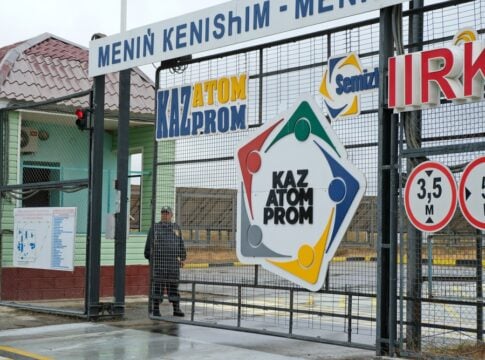
Kazatomprom, the world’s largest uranium producer and Kazakhstan’s national atomic company, has released its financial and production results for the first half of 2025. Despite reporting a sharp fall in profits compared to last year, the state-owned miner is sticking to its production guidance for the year and maintaining a cautious but stable outlook for the future.
Kazatomprom’s Profit and Revenue Decline in H1 2025
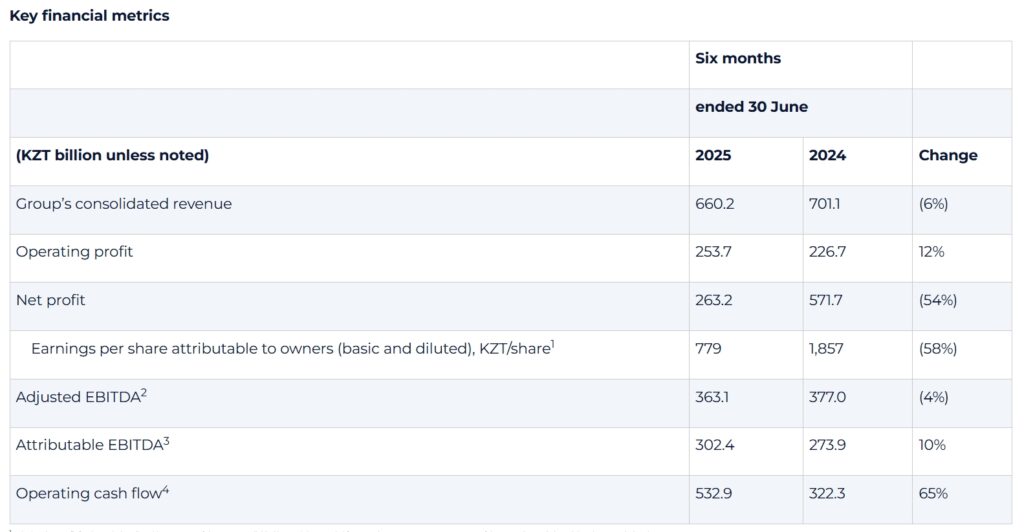
Kazatomprom’s consolidated revenue for the first half of 2025 was 660.2 billion tenge ($1.2 billion), down 6% from 2024 due to lower sales volumes.
This shows Kazatomprom kept costs under control and improved core profitability despite lower sales volume and the absence of one-time gains.
CEO Meirzhan Yussupov, made an elaborate statement, saying:
“As the world’s largest producer and seller of natural uranium, Kazatomprom fully recognises the critical role the Company has in supporting the global energy transition. We remain committed to delivering long-term value to all stakeholders. Kazatomprom is currently undertaking a large-scale exploration in Kazakhstan, which is a top priority for replenishing its resource base and maintaining its leading position as a global nuclear fuel supplier,” said
“Despite the volatility in the spot uranium market and the broader capital markets, some of which may be due to uncertainty brought by the tariff wars, uranium long-term price has remained stable at 80 US dollars per pound proving that fundamentals remain strong. However, the Company does not view the current market developments to be sufficient to return to the Company’s initial 100% levels at this time, which are now being decreased by roughly 8 million pounds, cutting about 5% of the world’s primary supply.
“Kazatomprom takes its role in strengthening global energy policy seriously. Its leadership in ESG, combined with the scale of its operations, enables the Company to remain a reliable and responsible supplier of natural uranium globally. We are ready to participate in diversification of utilities’ supply sources, and our strong position in this new cycle of long-term contracting reflects the trust and confidence the market places in us.”
Boost to Uranium Production and Sales
During the first six months of 2025, Kazatomprom produced 12,242 tonnes of uranium (tU) on a 100% basis, representing a 13% increase year-on-year.
Looking ahead, the miner expects to finish 2025 with annual output of 25,000–26,500 tU on a 100% basis. On its attributable basis (Kazatomprom’s own share in joint ventures), full-year production is estimated at 13,000–14,000 tU.
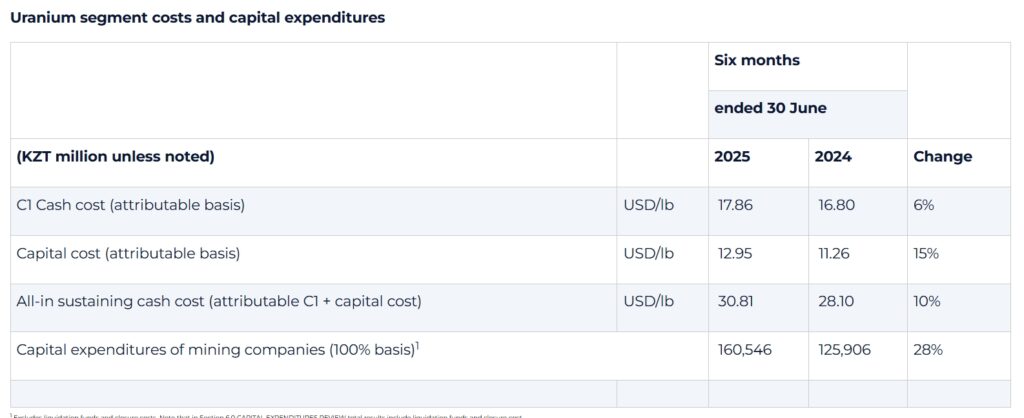
- Uranium sales for this year are projected at 17,500–18,500 tonnes, while the all-in sustaining cash cost (AISC) is expected to stay between $29.00 and $30.50 per pound.
Plans for 2026 and Beyond
Kazatomprom also gave a crucial update regarding its 2026 production strategy. The company will reduce its nominal output level by about 10%, cutting production from roughly 32,777 tU to 29,697 tU. Most of this decrease will come from adjustments at the Budenovskoye operation.
Importantly, this decision is not tied to supply constraints. In fact, sulphuric acid — a critical input for Kazakhstan’s in-situ recovery mining — is expected to be available in stable amounts. Instead, the reduction reflects the company’s long-term policy of “value over volume”: prioritizing market balance and profitability over sheer output growth.
The company also highlighted Kazakhstan’s plans to develop its own nuclear power plants in the coming years. These facilities could create strong internal demand for uranium, giving Kazatomprom an additional domestic market alongside its dominant global role.
Kazakhstan’s Unique Advantage: Sustainable Uranium Mining with In-Situ Recovery (ISR)
One of Kazatomprom’s greatest strengths is its use of in-situ recovery (ISR) mining. This method extracts uranium from underground deposits using a liquid solution, eliminating the need for large open pits. This approach is:
- Environmentally friendlier than conventional mining.
- Less carbon-intensive, producing far lower greenhouse gas emissions.
- More cost-efficient, keeping production competitive against global peers.
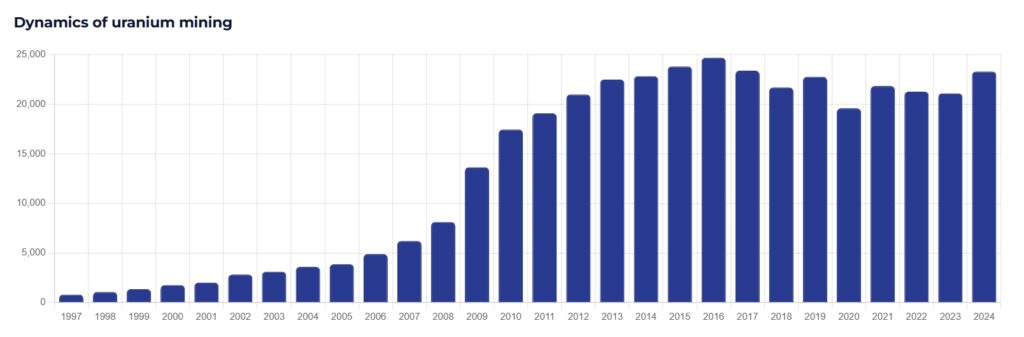
As of 2024, Kazatomprom produced 23,300 tonnes of uranium (100% basis) using ISR, equal to 21% of worldwide production. This made it the largest supplier of uranium on the planet, controlling about 40% of the global market.
ESG and Net-Zero Commitments
The uranium giant is not just a production leader, but also a champion of sustainable mining. Its updated 2025–2034 strategy places responsibility and environmental protection at the core of its business model.
Climate Targets
- Achieve carbon neutrality by 2060.
- Cut emissions by 10–15% by 2030, and by 55% by 2045.
- Keep direct (Scope 1) emissions below Kazakhstan’s reporting threshold of 20,000 tonnes of CO₂ equivalent each year.
ESG Initiatives
- Participates in Kazakhstan’s Emissions Trading System.
- Regularly reports on environmental, social, and governance (ESG) performance.
- Invests in renewable energy solutions, clean technology R&D, and energy efficiency upgrades.
- Committed about $30 million in 2024 to green innovation, with plans to expand this spending moving forward.
As a result of these initiatives, S&P Global raised Kazatomprom’s ESG score to 50/100 in December 2024 — more than double the industry average.
Community Engagement and Social Responsibility
The company supports community initiatives like Earth Hour, Car-Free Day, and tree planting efforts across Kazakhstan. These campaigns aim to raise awareness about climate change and sustainability among both employees and the public.
The company also collaborates with research institutions for developing medical isotopes and recovering useful byproducts from uranium mining.
Reliable Uranium Supply Secures Kazatomprom’s Global Leadership
By maintaining its dominant share of the uranium market, Kazatomprom plays a central role in the global transition toward low-carbon and nuclear power generation. Nuclear energy is regaining demand worldwide as governments seek cleaner, stable energy sources to meet climate targets.
The company’s ability to provide a reliable uranium supply, combined with its focus on sustainability and climate action, positions it as not just a commercial giant but also a key partner in the fight against climate change.
Kazatomprom’s first-half 2025 results show stable core operations despite lower net profit. Costs stayed controlled, and adjusted profits dropped only slightly. The company chose not to return to full production. Instead, it plans a 10% cut for 2026 to focus on long-term market stability and growth. With advanced ISR mining, strong ESG goals, and global reach, Kazatomprom is set to remain a top uranium supplier.
The post Kazatomprom Uranium Output Jumps 13% in 2025, But Plans for 2026 Cutback appeared first on Carbon Credits.

EU carbon credit claims changed on 27 September 2026, the day the Directive (EU) 2024/825 began to apply across the European Union. The change is narrow. It changes how a company can talk about the credits it buys. A product can no longer be called neutral on the strength of compensation alone; however, every specific, evidenced statement about what a company measured, reduced, and funded stays fully available.

The post Promoting Improved Cooking Practices in Nigeria appeared first on Terrapass.



-
Climate Change1 year ago
Guest post: Why China is still building new coal – and when it might stop
-

 Greenhouse Gases2 years ago
嘉宾来稿:满足中国增长的用电需求 光伏加储能“比新建煤电更实惠”
-
Greenhouse Gases1 year ago
Guest post: Why China is still building new coal – and when it might stop
-

 Climate Change2 years ago
嘉宾来稿:满足中国增长的用电需求 光伏加储能“比新建煤电更实惠”
-

 Renewable Energy12 months ago
Sending Progressive Philanthropist George Soros to Prison?
-
Climate Change2 years ago
Bill Discounting Climate Change in Florida’s Energy Policy Awaits DeSantis’ Approval
-
Greenhouse Gases1 year ago
嘉宾来稿:探究火山喷发如何影响气候预测
-

 Climate Change2 years ago
Analysis: China’s CO2 falls 1% in Q2 2024 in first quarterly drop since Covid-19