

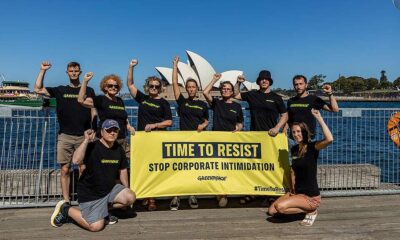
SYDNEY, Wednesday 9 October 2024 — Greenpeace Australia Pacific has today warned about the growth of US-style corporate legal tactics aimed at silencing public interest groups.
In 2022 the Environmental Defenders Office (EDO) sued fossil fuel giant Santos on behalf of Tiwi Islanders, representing Simon Munkara, alleging its offshore Barossa gas project could risk cultural heritage and had not been adequately assessed.
In the Federal Court today, Judge Charlesworth ordered that the EDO pay Santos’ costs on an indemnity basis, but also that Santos’ application for the discovery of documents from the EDO continue.
“Santos’ actions in this case are part of a worrying US-style trend towards big polluters using litigation to silence ordinary people using the law to challenge big corporations in Australia,” said David Ritter, CEO at Greenpeace Australia Pacific.
“Santos, a 23.5 billion dollar fossil fuel giant, appears to be trying to silence the legitimate public interest of Australian people in defending our environment against pollution and damage — this should sound alarm bells for anyone who cares about our democratic rights and our magnificent country.
“We do not want to live in a country where ordinary Australians are too afraid to go to court, to take reasonable issues up with big polluting corporations, because they are too frightened of the consequences if they lose.
“We’ve seen these SLAPP tactics play out overseas as our colleagues in the United States face a US$300 million lawsuit by fossil fuel company Energy Transfer. Ultimately the real issue is the polluting activities of massive fossil fuel corporations which are literally threatening the future of human civilization.
“Rulings like this have a chilling effect on democracy and public interest litigation — we must stand against these silencing tactics as bad for the rights of Australians and bad for our democracy.”
Strategic Litigation Against Public Participation, or SLAPP lawsuits are designed to intimidate and silence those working in the public interest on matters including civil rights and the environment. The EU recently introduced an anti-SLAPP directive to protect against meritless lawsuits by big corporations.
“Public interest litigation plays a vital role in upholding the principles of a healthy democracy,” said Katrina Bullock, General Counsel at Greenpeace Australia Pacific.
“The Munkara case, initiated by the Tiwi Islanders, aimed to safeguard their Sea Country from the detrimental impacts of a proposed large-scale gas project, anticipated to release 380 million tonnes of climate pollution over its 25-year lifespan — exacerbating climate change, damaging the environment, and threatening culturally significant areas.
“In response to the community’s efforts, Santos has employed aggressive legal tactics seemingly intended to intimidate those opposing its actions. The company has sought internal documents from charities that voiced support for the case, potentially to pursue them for costs.
“Furthermore, it has aggressively targeted the Tiwi Islanders’ legal team, relentlessly seeking costs against them. These actions risk discouraging communities from using legal avenues to hold fossil fuel companies accountable for their harmful practices.”
-ENDS-
For more information or interviews contact Kate O’Callaghan on 0406 231 892 or kate.ocallaghan@greenpeace.org
Santos’ aggressive legal tactics designed to silence public interest groups


Climate Change
Summit Sold Its Midwest Pipeline as a Carbon Solution. Now, It’ll Be Used for Fossil Fuels.
The pivot reveals a company adapting to Trump’s “drill, baby, drill” agenda and looking to cash in on recently boosted tax incentives for enhanced oil recovery.
For four years, battles over private property rights have gridlocked state legislatures across the Midwest and stalled plans for a pipeline to transport liquified carbon dioxide from ethanol plants in the region.
Summit Sold Its Midwest Pipeline as a Carbon Solution. Now, It’ll Be Used for Fossil Fuels.
“Today, as in the beginning, life is still made out of carbon dioxide, and the world’s problems are made out of carbon dioxide as well.”
From our collaborating partner Living on Earth, public radio’s environmental news magazine, an interview by Jenni Doering with Peter Brannen, the author of “The Story of CO2 Is the Story of Everything.”
The 4-Billion-Year Perspective to Understanding Earth’s Current Climate Crisis
Climate Change
Trump’s ‘God Squad’ Will Weigh Gulf Oil Drilling Against the Survival of Endangered Whales and Turtles
Citing national security, the Trump administration wants to exempt all federally regulated offshore oil from protections for endangered animals—even if it could cause their extinction.
The Trump administration is turning to the nuclear option on endangered-species protections in the name of national security.


-
Greenhouse Gases8 months ago
Guest post: Why China is still building new coal – and when it might stop
-
Climate Change8 months ago
Guest post: Why China is still building new coal – and when it might stop
-

 Greenhouse Gases2 years ago
嘉宾来稿:满足中国增长的用电需求 光伏加储能“比新建煤电更实惠”
-
Climate Change2 years ago
Bill Discounting Climate Change in Florida’s Energy Policy Awaits DeSantis’ Approval
-

 Climate Change2 years ago
嘉宾来稿:满足中国增长的用电需求 光伏加储能“比新建煤电更实惠”
-
Climate Change Videos2 years ago
The toxic gas flares fuelling Nigeria’s climate change – BBC News
-

 Carbon Footprint2 years ago
US SEC’s Climate Disclosure Rules Spur Renewed Interest in Carbon Credits
-

 Renewable Energy5 months ago
Sending Progressive Philanthropist George Soros to Prison?