
Connect with us

Published

on

Battery energy storage has entered a new era. Costs have fallen to historic lows, and deployments are accelerating across major markets. According to BloombergNEF’s (BNEF) Levelized Cost of Electricity 2026 report, the economics of grid storage shifted dramatically in 2025 — even as other clean energy technologies became more expensive.

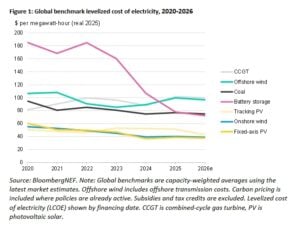
  • The global benchmark cost for a four-hour battery storage project dropped 27% year-on-year to $78 per megawatt-hour (MWh) in 2025.

That marks the lowest level since BNEF began tracking the data in 2009. As a result, batteries are now reshaping how power systems balance renewable energy and meet rising electricity demand.

At the same time, solar and wind projects faced cost pressures. Supply chain constraints, weaker resource quality in some regions, and policy reforms in mainland China pushed up benchmark costs. However, despite these short-term headwinds, BNEF expects long-term clean energy costs to continue declining through 2035.
BATTERY COST
Source: BNEF

Battery Storage Breaks Records While Solar and Wind Stall

In 2025, battery storage clearly stood out. The $78/MWh benchmark for a four-hour system reflected a steep and rapid decline. Lower battery pack prices, stronger competition among manufacturers, and better system design all helped drive the drop.

By contrast, solar and wind moved in the opposite direction. The global benchmark cost for a fixed-axis solar farm rose 6%, reaching $39/MWh. Onshore wind increased to $40/MWh. Offshore wind climbed sharply to $100/MWh due to tight supply chains and financing challenges.

Thermal power also became more expensive. The levelized cost of electricity (LCOE) for new combined cycle gas turbine (CCGT) plants jumped 16% to $102/MWh — the highest level recorded. Equipment price increases and strong demand for gas turbines, partly fueled by data center expansion, kept costs elevated. Coal plants also faced higher capital expenses.

Yet even with solar and wind costs rising in 2025, BNEF projects that innovation and scale will push prices down again over the next decade. By 2035, the firm expects:

  • Solar LCOE to fall 30%
  • Battery storage to decline 25%
  • Onshore wind to drop 23%
  • Offshore wind to decrease 20%

These projections suggest the current cost increases are temporary rather than structural.

China’s Cost Advantage 

Wind energy told a more mixed story.

Mainland China retained a cost advantage. However, projects built in lower wind-speed regions pushed up the global benchmark. Onshore wind projects outside mainland China saw a 4% cost decline, but the global average rose 2% due to Chinese market dynamics.

Offshore wind faced deeper challenges. Supply chain bottlenecks increased turbine and installation costs across major markets. In the United Kingdom, recently financed offshore wind projects now cost 69% more than they did five years ago. BNEF expects offshore wind costs to remain elevated until at least 2030.

Still, in the United States, wind power regained its position as the cheapest source of new electricity generation in 2025. Rising gas turbine costs pushed wind ahead of gas for the first time since 2023.

EV Overcapacity Slashes Battery Prices

One major factor behind the storage cost collapse is manufacturing overcapacity in the electric vehicle (EV) sector.

China’s lithium-ion battery production capacity surpassed 2 terawatt-hours in 2024. That was about 60% higher than total battery demand. As a result, manufacturers competed aggressively on price, which benefited grid-scale storage buyers.

Battery pack prices for EVs fell 8% in 2025 to a record low of $108 per kilowatt-hour, according to BNEF’s December survey. Lower pack prices directly reduced the cost of large storage projects. Meanwhile, system-level improvements — including better integration and optimized engineering — improved performance and reduced overall project expenses.

According to Amar Vasdev, senior energy economics associate at BNEF and lead author of the report, manufacturing overcapacity and better system designs are transforming the economics of large energy storage projects. In six markets, the LCOE of a four-hour battery system has already dropped below $100/MWh.

That threshold is critical. At those levels, battery storage becomes highly competitive with fossil fuel peaking plants.

Lower Battery Costs Drive Renewables Plus Storage Boom Worldwide

Lower battery costs are accelerating hybrid renewable development. In 2025 alone, developers added 87 gigawatts of co-located solar and storage projects worldwide. These combined systems delivered electricity at an average cost of $57/MWh.

This model solves one of solar’s biggest challenges — intermittency. Batteries allow solar farms to store excess daytime generation and dispatch it later when demand peaks. As storage becomes cheaper, solar-plus-storage projects become more financially attractive and reliable.

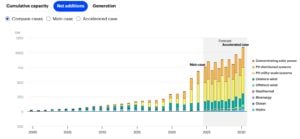
BNEF expects annual global energy storage additions to reach 220 GW by 2035, growing at a compound annual rate of nearly 15%. If that projection holds, batteries will become central to grid balancing worldwide.
renewable global
Source: IEA

The U.S. Storage Boom Accelerates

The United States is emerging as a key growth engine for battery deployment.

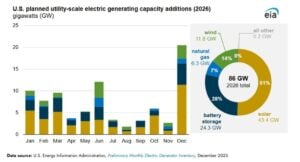
According to the February 2026 Electric Power Monthly report from the U.S. Energy Information Administration (EIA), 86 GW of new utility-scale capacity is expected to come online in 2026. Of that total, 26.3 GW will come from battery storage.

That represents the largest single-year capacity expansion in more than two decades. Solar and battery storage together account for nearly 79% of planned additions.

Texas has become a hotspot for battery development. As of July 2025, the state had 12.2 GW of storage capacity operating. Developers rushed projects online ahead of summer peak demand, including nearly 1 GWh brought online by esVolta across three projects.

California continues to lead nationally, with more than 12 GW of operational storage capacity. Projects such as the Rexford solar-plus-storage facility in Tulare County strengthened the state’s position as a grid storage pioneer.
US energy boom

Meanwhile, New England expanded its footprint with large-scale additions to the ISO New England grid. These projects demonstrate that battery storage is no longer confined to a few early-adopter markets.

Australia’s Breakout Year

Australia also delivered a major milestone in 2025. The country commissioned 4.9 GWh of utility-scale battery storage during the year — more than the combined total installed between 2017 and 2024.

In the fourth quarter alone, over 1,000 MW of new capacity came online. Large projects, including the 500 MW Liddell battery system in New South Wales, highlighted the rapid pace of expansion.

Australia’s experience shows how quickly storage can scale once policy support, market design, and financing align.

Data Centers Drive the “Race for Electrons”

A powerful new demand driver is reshaping electricity markets: data centers.

The rapid expansion of AI and cloud computing has triggered strong demand for reliable power. Gas turbine orders surged as operators sought firm capacity. This demand doubled U.S. turbine capital costs in just two years.

However, higher gas costs are improving the competitiveness of renewables and storage. In regions like California and parts of Texas, co-located solar and four-hour battery systems can already meet a significant share of data center demand at lower cost than new gas plants.

Grid interconnection queues and gas turbine supply constraints are also slowing fossil fuel projects. In contrast, solar and storage systems can often deploy more quickly.
data center AI

As Vasdev explained, the world is in a “race for electrons” to meet rising demand from electrification and data centers. In many markets, renewables are not only cheaper for new builds — they are now undercutting the operating costs of existing fossil fuel plants.

Solar beats new coal and gas across most Asia-Pacific markets. Wind is the lowest-cost new generation source in the U.S. and Canada. Solar consistently outcompetes fossil fuels in Southern Europe, while wind dominates in Northern Europe.

From Niche Technology to Grid Backbone

Battery storage has moved beyond its early-stage niche. It is now central to power system planning.

As storage costs fall, batteries strengthen renewable energy revenues, stabilize grids, and reduce reliance on fossil-fuel peaking plants. Instead of building new gas capacity for short-duration peaks, operators can increasingly rely on storage-led balancing.

BNEF’s annual LCOE report analyzed more than 800 recently financed projects across over 50 markets and 28 technologies. Its expanded coverage of the Middle East and Africa highlights how storage economics are improving globally, not just in mature markets.

The broader message is clear. While 2025 delivered mixed signals for clean power costs, battery storage emerged as the clear winner. Manufacturing overcapacity, technological learning, and intense competition have driven prices to record lows.

Looking ahead, continued cost declines could accelerate the global shift toward renewable-dominated grids supported by flexible storage. In that transition, batteries are no longer optional. They are becoming the backbone of a reliable, low-carbon electricity system.

The post Renewables Plus Storage Surge as Battery Costs Drop Record Low, BNEF Reports appeared first on Carbon Credits.

Continue Reading

Carbon Footprint

The real cost of 1 tonne of CO2: Translating carbon into hectares

Published

on

Every business carbon footprint report ends with a number, the amount of carbon emissions produced by the business, less the amount of carbon reduced and offset, given in tonnes of CO₂. Many of the people who sign off on that number, including those who paid for it, cannot picture what it represents on the ground. A tonne is a unit of mass. CO₂ is invisible. The link between the amount offset in the report and a real piece of restored forest somewhere in the world is almost never indicated.

Continue Reading

Carbon Footprint

Finding Nature Based Solutions in Your Supply Chain

Published

on

“…Protecting nature makes our business more resilient…”

For companies with land, water, food, fiber, or commodity exposure, the supply chain may be the most practical place to turn nature from a risk into an operating asset.

Your supply chain already has a nature strategy. It may be undocumented. It may live in procurement files, supplier contracts, commodity maps, and one spreadsheet nobody opens without coffee. But it exists.

If your business depends on farms, forests, water, soil, packaging, rubber, timber, fibers, minerals, or food ingredients, nature is part of your operating system. The question is whether you manage that system with intent, or discover it during a disruption, audit, or difficult board question.

That is why more companies are asking how to find Nature-Based Solutions in Your Supply Chain. Do not begin by shopping for offsets. Begin by asking where nature already affects cost, continuity, emissions, regulatory exposure, and supplier resilience.

What Nature-Based Solutions in Your Supply Chain Means

The European Commission defines nature-based solutions as approaches inspired and supported by nature that are cost-effective, deliver environmental, social, and economic benefits, and help build resilience. They should also benefit biodiversity and support ecosystem services.

In supply-chain terms, that becomes practical. Nature-based solutions in your supply chain can include agroforestry in cocoa, coffee, rubber, or palm supply chains. They can include soil health programs for food ingredients, watershed restoration near water-intensive operations, mangrove restoration linked to coastal sourcing regions, and avoided deforestation in forest-linked commodities.

The key test is business relevance. If your procurement team relies on a landscape, watershed, crop, or supplier base, that is where opportunity may sit. The best projects do not hover outside the business like a framed certificate. They plug into the system that already produces your revenue.

Why the Boardroom Should Care

For many companies, the largest climate and nature exposure sits outside direct operations. The GHG Protocol Scope 3 Standard gives companies a method to account for and report value-chain emissions across sectors. Purchased goods, land use, transport, supplier energy, and product use can make direct emissions look like the visible tip of a very large iceberg.

The Taskforce on Nature-related Financial Disclosures notes that many nature-related dependencies, impacts, risks, and opportunities arise upstream and downstream. That is why nature-based supply chain investments matter to boards. You are managing supply security, audit readiness, investor confidence, and regulatory preparedness.

For companies exposed to EU markets, this also connects to rules and expectations such as CSRD, CSDDD, EUDR, and SBTi FLAG.

Step One: Map Where You Touch Land, Water, and Living Systems

Finding Nature-Based Solutions in Your Supply Chain starts with mapping, not marketing.

Begin with procurement and Scope 3 data. Which categories carry high spend, high emissions, or high sourcing risk? Which suppliers depend on agriculture, forestry, mining, water-intensive processing, or land conversion? Which regions face water stress, heat, flood risk, soil degradation, deforestation, or biodiversity pressure?

The Science Based Targets Network uses a clear process for companies: assess, prioritize, set targets, act, and track. That sequence keeps companies from treating nature as a mood board. You identify where the business has exposure, then decide where intervention can create measurable value.

Step Two: Look for Operational Value Before Carbon Value

This is the center of CCC’s Dual-Value Model. A nature-based supply chain investment should do useful work for the business before anyone counts the carbon.

Agroforestry may improve farmer resilience, shade crops, protect soil, and reduce pressure on forests. Watershed restoration may reduce water risk for beverage, textile, or manufacturing sites. Soil health programs may improve the stability of agricultural inputs.

Carbon and sustainability value can still be created. In some cases, the project may support Scope 3 insetting. In others, it may generate verified carbon credits. Sometimes the main value may be resilience, readiness, and better supplier data.

The IPCC has found that ecosystem-based adaptation can reduce climate risks to people, biodiversity, and ecosystem services, with multiple co-benefits, while also warning that effectiveness declines as warming increases. That is a sober argument for acting early.

Step Three: Separate Insetting, Offsetting, and Resilience

Nature-based solutions in your supply chain are not automatically carbon credits. They are not automatically Scope 3 reductions either.

An insetting opportunity usually sits inside or close to your value chain. It may support Scope 3 reporting if the accounting rules, project boundaries, supplier connection, and data quality are strong enough.

An offsetting opportunity usually involves verified credits outside your value chain. High-quality credits can still play a role for residual emissions, but they should not distract from direct reductions or credible value-chain work.

A resilience opportunity may deliver business value even if you cannot claim a Scope 3 reduction immediately. That may include water security, supplier capacity, land restoration, biodiversity protection, or regulatory readiness.

Gold Standard’s Scope 3 value-chain guidance focuses on reporting emissions reductions from interventions in purchased goods and services. Verra’s Scope 3 Standard Program is being developed to certify value-chain interventions and issue units for companies’ emissions accounting. The direction is clear: stronger evidence, tighter boundaries, and more disciplined claims.

Step Four: Design for Audit-Readiness From the Beginning

Weak data is where promising nature projects go to become expensive anecdotes.

Before public claims are made, you need to know the baseline. What would have happened without the project? Who owns or manages the land? Which suppliers are involved? How will outcomes be measured? How will leakage, permanence, and double counting be addressed?

The GHG Protocol Land Sector and Removals Standard gives companies methods to quantify, report, and track land emissions, CO2 removals, and related metrics. This matters because land projects are rarely neat. Farms change practices. Suppliers shift volumes. Weather changes outcomes.

What Recent Corporate Examples Show

Recent case studies show that supply-chain nature work is becoming more serious, and more scrutinized.

Reuters has reported on insetting to reduce emissions within supply chains, including examples linked to Reckitt, Danone, Nestlé, Earthworm Foundation, and Nature-based Insights. The same article highlights familiar problems: measurement, double counting, supplier incentives, and credibility.

Reuters has also reported on companies using the Science Based Targets Network process to examine nature impacts. GSK, Holcim, and Kering were among the first companies with validated science-based targets for nature.

The Financial Times has covered the promise and difficulty of soil carbon in corporate supply chains, including a PepsiCo example in India where yields reportedly increased while greenhouse gas emissions fell. The lesson is that carbon, soil, biodiversity, farmer economics, and measurement need to be handled together.

A Practical Screening Checklist

A supply-chain nature-based solution deserves deeper review when you can answer yes to most of these questions:

  • Does it sit in or near a material supply-chain hotspot?
  • Does it address a real business risk?
  • Can you connect it to supplier behavior, land management, or sourcing practices?
  • Can the outcomes be measured?
  • Are the claim boundaries clear?
  • Does it support Scope 3 strategy, SBTi FLAG, CSRD, CSDDD, EUDR, or investor reporting needs?
  • Are permanence, leakage, land rights, and community issues addressed?

Build the Asset, Then Make the Claim

Finding Nature-Based Solutions in Your Supply Chain is about identifying where your business already depends on living systems, then designing interventions that make those systems more resilient, measurable, and commercially useful.

For companies with material Scope 3 exposure, the right project can support supplier resilience, emissions strategy, regulatory readiness, and credible climate communication. The wrong project can become a glossy story with a weak audit trail.

Carbon Credit Capital helps companies design nature-based carbon and sustainability assets that embed directly into corporate supply chains. Through CCC’s Dual-Value Model, you can assess where sustainability investment may support operational resilience, Scope 3 insetting eligibility, regulatory readiness, and high-quality carbon or sustainability value.

Schedule your consultation with the carbon and sustainability experts at Carbon Credit Capital to explore how nature-based supply chain investments can support your next stage of climate strategy.

Sources

  1. European Commission: Nature-based solutions
  2. GHG Protocol: Corporate Value Chain Scope 3 Standard
  3. TNFD: Guidance on value chains
  4. European Commission: Corporate Sustainability Reporting
  5. European Commission: Corporate Sustainability Due Diligence
  6. European Commission: Regulation on Deforestation-free Products
  7. SBTi: Forest, Land and Agriculture FLAG
  8. Science Based Targets Network: Take Action
  9. IPCC AR6 WGII Summary for Policymakers
  10. Gold Standard: Scope 3 Value Chain Interventions Guidance
  11. Verra: Scope 3 Standard Program
  12. GHG Protocol: Land Sector and Removals Standard
  13. Reuters: Can insetting stack the cards towards more sustainable supply chains?
  14. Reuters: Three companies put their impacts on nature under a microscope
  15. Financial Times: The dubious climate gains of turning soil into a carbon sink

Continue Reading

Carbon Footprint

How Climate Change Is Raising the Cost of Living

Published

on

Americans are paying more for insurance, electricity, taxes, and home repairs every year. What many people may not realize is that climate change is already one of the drivers behind those rising costs.

For many households, climate change is no longer just an environmental issue. It is becoming a cost-of-living issue. While climate impacts like melting glaciers and shrinking polar ice can feel distant from everyday life, the financial effects are already showing up in monthly budgets across the country.

Today, a larger share of household income is consumed by fixed costs such as housing, insurance, utilities, and healthcare. (3) Climate change and climate inaction are adding pressure to many of those expenses through higher disaster recovery costs, rising energy demand, infrastructure repairs, and increased insurance risk.

The goal of this article is to help connect climate change to the everyday financial realities people already experience. Regardless of where someone stands on climate policy, it is important to recognize that climate change is already increasing costs for households, businesses, and taxpayers across the United States.

More conservative estimates indicate that the average household has experienced an increase of about $400 per year from observed climate change, while less conservative estimates suggest an increase of $900.(1) Those in more disaster-prone regions of the country face disproportionate costs, with some households experiencing climate-related costs averaging $1,300 per year.(1) Another study found that climate adaptation costs driven by climate change have already consumed over 3% of personal income in the U.S. since 2015.(9) By the end of the century, housing units could spend an additional $5,600 on adaptation costs.(1)

Whether we realize it or not, Americans are already paying for climate change through higher insurance premiums, energy costs, taxes, and infrastructure repairs. These growing expenses are often referred to as climate adaptation costs.

Without meaningful climate action, these costs are expected to continue rising. Choosing not to invest in climate action is also choosing to spend more on climate adaptation.

Here are a few ways climate change is already increasing the cost of living:

  • Higher insurance costs from more frequent and severe storms
  • Higher energy use during longer and hotter summers
  • Higher electricity rates tied to storm recovery and grid upgrades
  • Higher government spending and taxpayer-funded disaster recovery costs

The real debate is not whether climate change costs money. Americans are already paying for it. The question is where we want those costs to go. Should we invest more in climate action to help reduce future climate adaptation costs, or continue paying growing recovery and adaptation expenses in everyday life?

How Climate Change Is Increasing Insurance Costs

There is one industry that closely tracks the financial impact of natural disasters: insurance. Insurance companies are focused on assessing risk, estimating damages, and collecting enough revenue to cover losses and remain financially stable.

Comparing the 20-year periods 1980–1999 and 2000–2019, climate-related disasters increased 83% globally from 3,656 events to 6,681 events. The average time between billion-dollar disasters dropped from 82 days during the 1980s to 16 days during the last 10 years, and in 2025 the average time between disasters fell to just 10 days. (6)

According to the reinsurance firm Munich Re, total economic losses from natural disasters in 2024 exceeded $320 billion globally, nearly 40% higher than the decade-long annual average. Average annual inflation-adjusted costs more than quadrupled from $22.6 billion per year in the 1980s to $102 billion per year in the 2010s. Costs increased further to an average of $153.2 billion annually during 2020–2024, representing another 50% increase over the 2010s. (6)

In the United States, billion-dollar weather and climate disasters have also increased significantly. The average number of billion-dollar disasters per year has grown from roughly three annually during the 1980s to 19 annually over the last decade. In 2023 and 2024, the U.S. recorded 28 and 27 billion-dollar disasters respectively, both setting new records. (6)

The growing impact of climate change is one reason insurance costs continue to rise. “There are two things that drive insurance loss costs, which is the frequency of events and how much they cost,” said Robert Passmore, assistant vice president of personal lines at the Property Casualty Insurers Association of America. “So, as these events become more frequent, that’s definitely going to have an impact.” (8)

After adjusting for inflation, insurance costs have steadily increased over time. From 2000 to 2020, insurance costs consistently grew faster than the Consumer Price Index due to rising rebuilding costs and weather-related losses.(3) Between 2020 and 2023 alone, the average home insurance premium increased from $75 to $360 due to climate change impacts, with disaster-prone regions experiencing especially steep increases.(1) Since 2015, homeowners in some regions affected by more extreme weather have seen home insurance costs increased by nearly 57%.(1) Some insurers have also limited or stopped offering coverage in high-risk areas.(7)

For many families, rising insurance costs are no longer occasional financial burdens. They are becoming recurring monthly expenses tied directly to growing climate risk.

How Rising Temperatures Increase Household Energy Costs

A light bulb, a pen, a calculator and some copper euro cent coins lie on top of an electricity bill

The financial impacts of climate change extend beyond insurance. Rising temperatures are also changing how much energy Americans use and how utilities plan for future electricity demand.

Between 1950 and 2010, per capita electricity use increased 10-fold, though usage has flattened or slightly declined since 2012 due to more efficient appliances and LED lighting. (3) A significant share of increased energy demand comes from cooling needs associated with higher temperatures.

Over the last 20 years, the United States has experienced increasing Cooling Degree Days (CDD) and decreasing Heating Degree Days (HDD). Nearly all counties have become warmer over the past three decades, with some areas experiencing several hundred additional cooling degree days, equivalent to roughly one additional degree of warmth on most days. (1) This trend reflects a warming climate where air conditioning demand is increasing while heating demand generally declines. (4)

As temperatures continue rising, households are expected to spend more on cooling than they save on heating. The U.S. Energy Information Administration (EIA) projects that by 2050, national Heating Degree Days will be 11% lower while Cooling Degree Days will be 28% higher than 2021 levels. Cooling demand is projected to rise 2.5 times faster than heating demand declines. (5)

These projections come from energy and infrastructure experts planning for future electricity demand and grid capacity needs. Utilities and grid operators are already preparing for higher peak summer electricity loads caused by rising temperatures. (5)

Longer and hotter summers also affect how homes and buildings are designed. Buildings constructed for past climate conditions may require upgrades such as larger air conditioning systems, stronger insulation, and improved ventilation to remain comfortable and energy efficient in the future. (10)

For many households, this means higher monthly utility bills and potentially higher long-term home improvement costs as temperatures continue to rise.

How Climate Change Affects Electricity Rates

On an inflation-adjusted basis, average U.S. residential electricity rates are slightly lower today than they were 50 years ago. (2) However, climate-related damage to utility infrastructure is creating new upward pressure on electricity costs.

Electric utilities rely heavily on above-ground poles, wires, transformers, and substations that can be damaged by hurricanes, storms, floods, and wildfires. Repairing and upgrading this infrastructure often requires substantial investment.

As a result, utilities are increasing electricity rates in response to wildfire and hurricane events to fund infrastructure repairs and future mitigation efforts. (1) The average cumulative increase in per-household electricity expenditures due to climate-related price changes is approximately $30. (1)

While this increase may appear modest today, utility costs are expected to rise further as climate-related infrastructure damage becomes more frequent and severe.

How Climate Disasters Increase Government Spending and Taxes

Extreme weather events also damage public infrastructure, including roads, schools, bridges, airports, water systems, and emergency services infrastructure. Recovery and rebuilding costs are often funded through taxpayer dollars at the federal, state, and local levels.

The average annual government cost tied to climate-related disaster recovery is estimated at nearly $142 per household. (1) States that frequently experience hurricanes, wildfires, tornadoes, or flooding can face even higher public recovery costs.

These expenses affect taxpayers whether they personally experience a disaster or not. Climate-related recovery spending can increase pressure on public budgets, emergency management systems, and infrastructure funding nationwide.

Reducing Climate Costs Through Climate Action

While this article focuses on the growing financial costs associated with climate change, the issue is not only about money for many people. It is also about recognizing our environmental impact and taking responsibility for reducing it in order to help preserve a healthy planet for future generations.

While individuals alone cannot solve climate change, collective action can help reduce future climate adaptation costs over time.

For those interested in taking action, there are three important steps:

  1. Estimate your carbon footprint to better understand the emissions connected to your lifestyle and activities.
  2. Create a plan to gradually reduce emissions through energy efficiency, cleaner technologies, and more sustainable choices.
  3. Address remaining emissions by supporting verified carbon reduction projects through carbon credits.

Carbon credits are one of the most cost-effective tools available for climate action because they help fund projects that generate verified emission reductions at scale. Supporting global emission reduction efforts can help reduce the long-term impacts and costs associated with climate change.

Visit Terrapass to learn more about carbon footprints, carbon credits, and climate action solutions.

The post How Climate Change Is Raising the Cost of Living appeared first on Terrapass.

Continue Reading

Trending

Copyright © 2022 BreakingClimateChange.com

