

Mukhtar Babayev is the COP29 President-Designate and Azerbaijan’s Minister of Ecology and Natural Resources.
This week, the COP29 Presidency of Azerbaijan is hosting a series of crunch climate negotiations in Baku across both technical and political tracks of the UN talks. These discussions represent a pivotal moment in the lead-up to the COP29 summit – which is itself a litmus test for the global fight against climate change.
The urgency of the moment is clear. In the first six months after COP28, extreme weather caused $41 billion of damage. Property and economic losses from Hurricane Helene in the US alone may now reach as high as $250 billion. The cost of inaction is rising rapidly, underscoring the need for decisive action.
Accelerating the interplay between the technical and political tracks of the UN climate negotiations is critical because technical progress informs political decisions, while political will enables technical breakthroughs.
The “Pre-COP” week began with progress on the technical work needed to agree on and establish Article 6 at COP29, the basis for implementing effective carbon markets, which could provide up to $250 billion of annual efficiency savings by 2030 in the identification and rollout of climate mitigation projects.
On the political front, the COP29 Presidency has appointed ministerial and high-level pairs across key areas including the New Collective Quantified Goal (NCQG) for climate finance, Article 6, adaptation, mitigation, and transparency. The High-Level Ministerial Dialogue on the NCQG and political engagements around this week’s meeting serve as crucial junctures where technical expertise and political will converge.
Climate finance enables climate action
The NCQG remains the top negotiating priority for the COP29 Presidency. It is essential for enabling climate action, particularly for developing nations, and must address both the urgency and scale of the problem. Transparency is equally crucial, aligning with the commitments made in the Paris Agreement..
There are encouraging signs of growing convergence on several critical issues. These glimmers of hope must be nurtured and expanded upon. The pursuit of an ideal climate finance goal should not prevent agreement on a goal that everyone can own and implement.
Progress on structure for new global climate finance goal but trickier divides persist
As we approach COP29, it is essential to elevate political engagement to the highest levels. Climate change touches every aspect of governance and society. Therefore, all relevant government ministries must be involved, from finance and energy to agriculture and health.
Moreover, heads of state and government must be fully engaged and committed to this process. This is essential for climate ministers to secure the mandates they need for the breakthroughs they must deliver.
Central to all discussions is how to take further the outcome of the First Global Stocktake of climate action agreed upon at COP28. This includes making swift progress across all pillars of climate action.
We need to work together to deliver fair and ambitious climate finance first and foremost. We also need to build resilience swiftly and reduce emissions at pace to keep the 1.5C global warming goal within reach. This includes contributing to transitioning away from fossil fuels in energy systems, in a just, orderly and equitable manner, as governments agreed to do at COP28 last year.
Though we have varying starting points, national circumstances and approaches, real change starts locally and with us, by devoting to climate action as a common commitment. Every contribution counts.
Collective endeavour
The COP29 Presidency is leading the way and actively working on Azerbaijan’s updated Nationally Determined Contribution (NDC) in line with the 1.5C goal, and we are grateful to be joined in this commitment by our Troika partners from the UAE and Brazil.
The COP29 Presidency is also focusing on turning pledges into concrete actions. There is an urgent need for signed contributor agreements for the Fund for responding to Loss and Damage, as well as significantly greater contributions to all funds, including the Green Climate Fund and the Adaptation Fund.
The timely submission of NDCs, National Adaptation Plans (NAPs), and Biennial Transparency Reports (BTRs) on greenhouse gas emissions will be essential to enhancing ambition across all pillars of the Paris Agreement.
In the coming days, the COP29 Presidency will publish the program for Presidency-led and hosted events at COP29, as well as the final versions of the COP29 declarations. These will provide further opportunities for engagement and action outside the formal negotiations.
The world is watching, and history will judge us on the outcomes. Azerbaijan will do everything in its power to play its role as a bridge between nations. But governments are the ones who must walk across that bridge.
Success or failure at COP29 will be collective – and we must all offer the best of ourselves to meet this monumental challenge.
As we engage in these crucial talks, all parties must consider how they can move closer together. Because together, we can pave the way for a successful COP29 where we enhance ambition and enable action. We can invest today to save tomorrow.
The post How the world can set itself up for success at COP29 appeared first on Climate Home News.

Greenland has now marked the 30th consecutive year where it lost more ice than it gained.
This guest post is by:
Dr Martin Stendel, climate scientist at the Danish Meteorological Institute (DMI), part of the Polar Portal
Prof Ruth Mottram, climate scientist at DMI and honorary professor at Aarhus University
Over the 12-month period to August 2026, the world’s second-largest ice sheet lost around 135bn tonnes of ice.
This major ice loss came as the region experienced a relatively cool start to summer and less surface melt than in previous years.
In other words, it was not an “extreme” year for weather in Greenland – and, yet, the ice sheet ended firmly in the red.
Three decades of continuous ice loss in Greenland is significant, given that scientists typically need 30 years of data to separate the “fingerprint” of human-caused climate change from natural variations in the climate.
In Greenland, the direction of travel has been the same – downward – every single year for 30 years.
These latest figures come as a new report highlights that ice melting processes seen for decades in Greenland are increasingly being replicated in Antarctica.
Greenland, therefore, is not only the largest present-day source of ice-driven sea level rise – but offers a preview of what is in store for the world’s largest ice sheet.
(For our previous analyses of Greenland’s ice cover, see coverage in 2025, 2024, 2023, 2022, 2021, 2020, 2019, 2018, 2017, 2016 and 2015.)
Surface mass balance
One way that scientists track the health of the Greenland ice sheet is by tracking changes to its “surface mass balance”.
This is the difference between ice gains from snowfall and losses from melt at the surface of Greenland’s ice sheet.
Greenland’s annual ice cycle runs from 1 September through to the end of August. The surface mass balance at the end of this period has, to date, always been positive, because the surface accumulates more snow than it loses from melting ice.
The ice sheet typically gains mass during the colder months of autumn, winter and spring. Then, as temperatures increase from around mid-June, the ice sheet begins to lose more ice through surface melt than it gains from snow.
(Greenland also loses ice when icebergs break off – or “calve” – into the sea, as well when the front of glaciers melt when they meet warm sea water. These losses are included in the “total mass balance” – see below.)
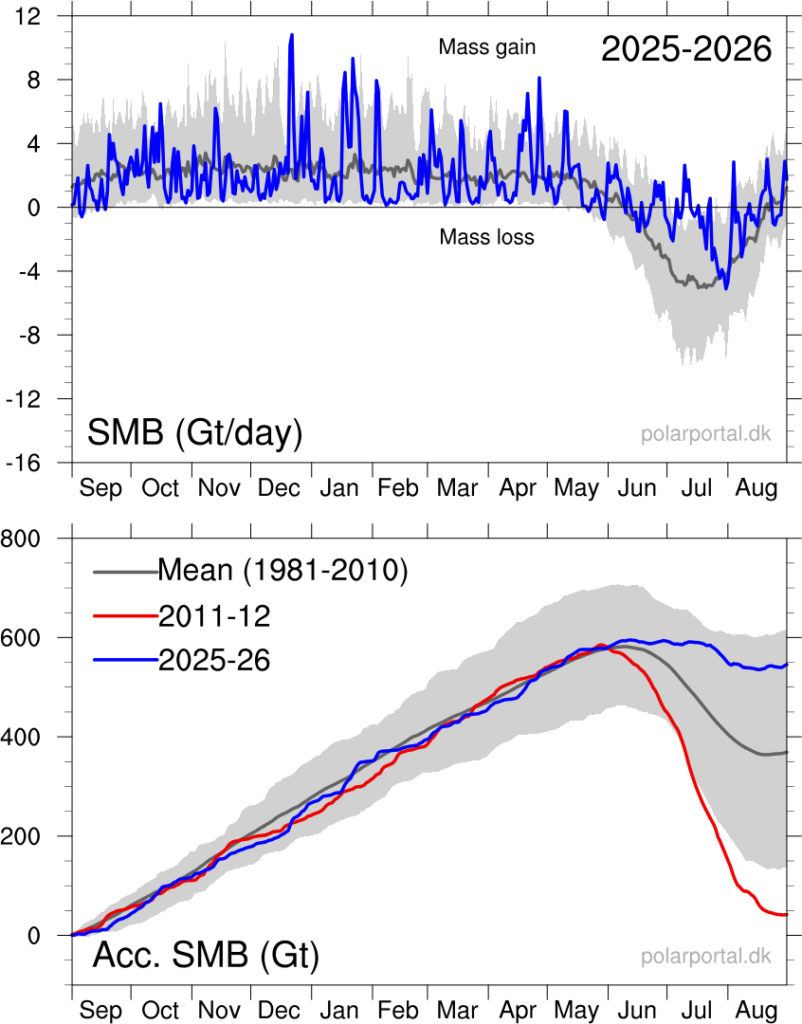
Greenland ended 2025-26 with an overall surface mass balance of 519bn tonnes.
This is the sixth highest in a dataset stretching back 46 years and about 178bn tonnes above the 1981-2010 average of roughly 350bn tonnes.
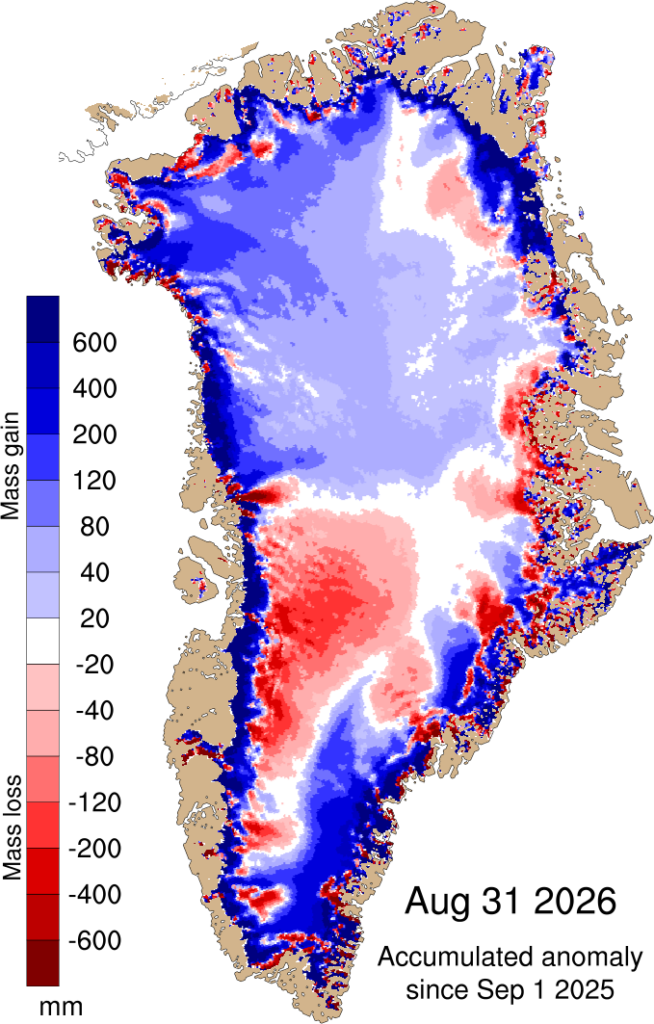
The map below shows the difference between the surface mass balance in 2025-26 and the 1981-2010 average, where blue shows ice gain and red shows ice loss.
The blue lines in the charts below show the surface mass balance throughout 2025-26 for individual days (top) and cumulatively throughout the year (bottom). They highlight how Greenland gained ice between September 2025 and May 2026, before starting to lose ice from June onwards.
Total mass balance
Another way scientists measure the health of the Greenland ice sheet is by looking at its “total mass balance”.
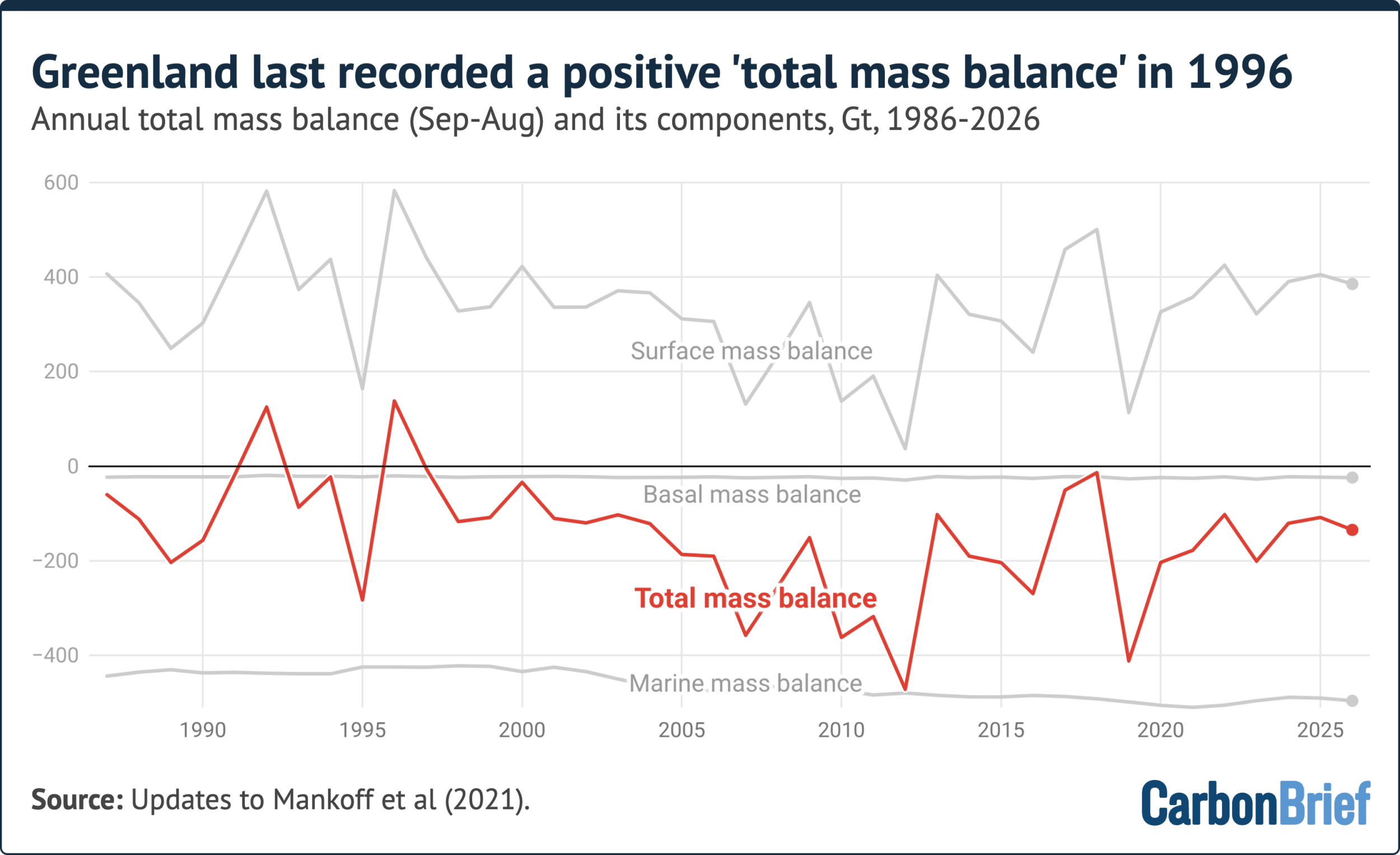
This calculation accounts for ice loss at the surface, as well as the calving of icebergs and the melting of glacier fronts where they meet warm seawater. The latter two components are known as the “marine mass balance”.
It also accounts for a small amount of ice melt at the underside of the ice sheet. This is known as the “basal mass balance”.
In recent decades, Greenland’s total mass balance at the end of the ice cycle year has been negative.
The 12 months to August 2026 were no different. Once all these factors are considered, Greenland lost around 135bn tonnes of ice.
We reached this figure using the same method featured in previous Carbon Brief analyses of Greenland ice cover. This approach is based on an average of three climate models.
However, for the first time, this year’s update includes a separate estimate for Greenland ice loss, based on data from one climate model and automatic weather stations, satellites, GPS data and observations from planes.
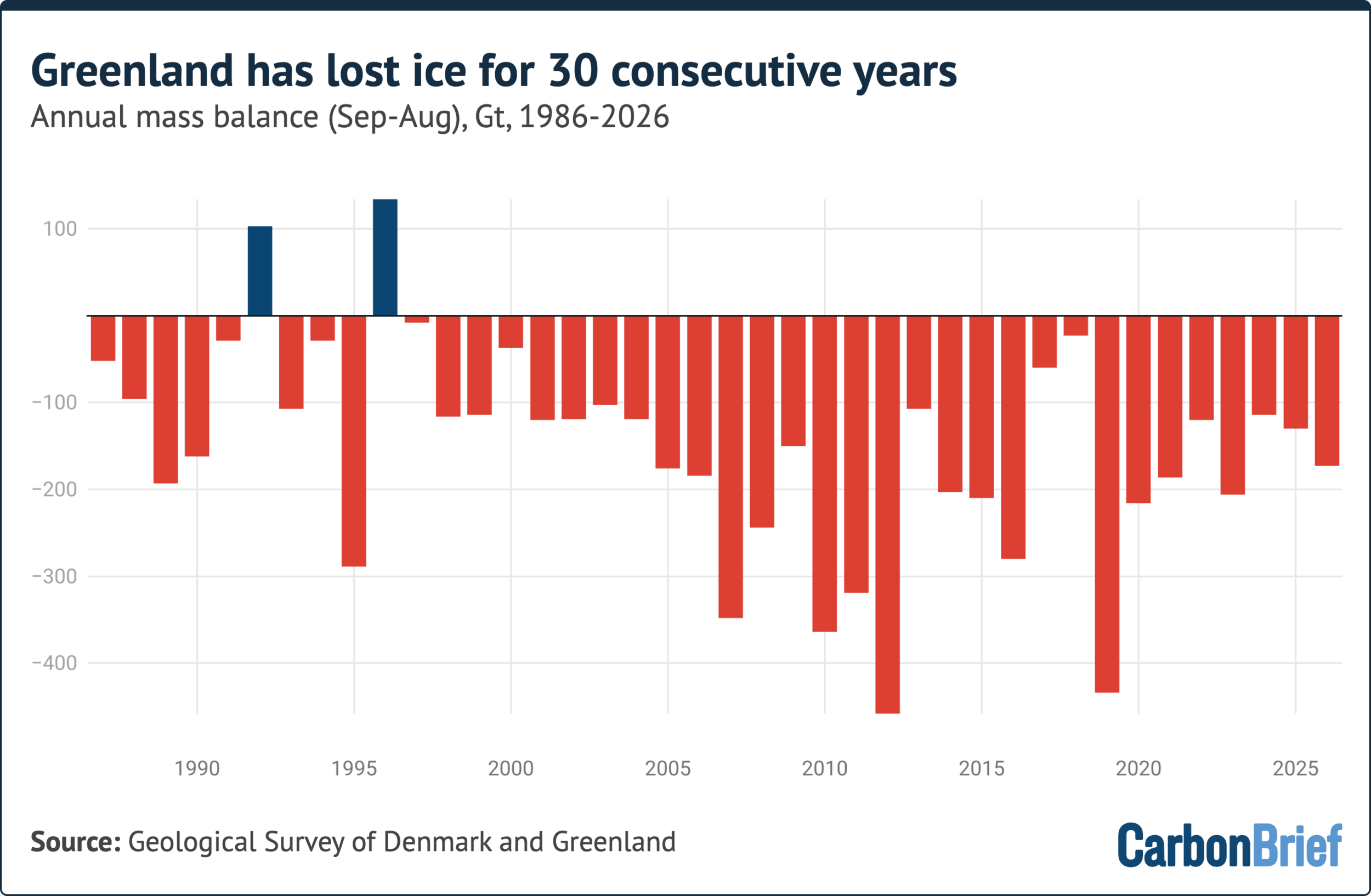
This approach estimates that the ice sheet lost an even greater 173bn tonnes of ice over 2025-26.
(Scientific estimates for ice loss in Greenland vary because there is incomplete information about how thick the ice sheet is, how fast it is moving as well as the rate at which it is melting at the surface. Scientists use different approaches for accounting for these uncertainties.)
The chart below shows how Greenland’s total mass balance has changed since 1985, featuring the higher 173bn estimate for the last ice cycle year.
It shows how 2025-26 was the 30th consecutive year of ice loss in Greenland, with 1996 the last year that saw an annual net gain of ice.
The chart below shows how Greenland’s surface mass balance, marine mass balance and basal mass balance have changed since 1985. All of these components are combined to calculate the ice sheet’s total mass balance (red).
Surface melt
Winter and early spring in 2025-26 were unusually dry in the southern half of Greenland, leaving around 40bn tonnes less snow on the ice sheet than normal.
Dry winters typically mean high ice melt rates later on, given that heavier winter snowfall often acts as a protective shield that prevents ice loss in the early part of summer.
However, the relatively dry winter was followed by a relatively cool start of summer. Frequent snowfall and extensive cloud cover limited the sun’s ability to warm the surface at the time of year when solar radiation is typically strongest.
The onset of the melt season – the first of at least three consecutive days with melting over more than 5% of the ice sheet – occurred on 5 June, nine days later than the 1981-2010 average.
From the end of June, the weather in Greenland changed markedly, as warm, sunny conditions took hold.
During the first 20 days of July, melting was well above the 1981-2020 average. At its peak on 22 July, melting covered 74.9% of the ice sheet.
(For comparison, July 2025 holds the record for melt area in Greenland, when 81.2% of the continent was melting simultaneously.)
However, the early season fresh snow in June helped to form a cold and bright buffer, reducing the subsequent summer ice melt and runoff.
The map below shows how roughly three-quarters of Greenland’s ice sheet – shaded in red – was experiencing surface melt on 22 July. The chart shows how surface melt on that date (blue line) outpaced the 1981-2010 average (grey line and shading).