

英国最后一座燃煤发电厂——诺丁汉郡的索尔河畔拉特克利夫火电厂(Ratcliffe-on-Soar Power Station)——于10月关闭,标志着英国142年燃煤发电时代的终结。
英国逐步淘汰煤电在国际上意义重大。它是首个实现这一里程碑的主要经济体,也是首个G7成员国。1882年,英国在伦敦霍尔本高架桥(Holborn Viaduct)上建成了世界上第一座燃煤发电厂。

Carbon Brief的分析显示,从1882年到索尔河畔拉特克利夫火电厂关闭,英国的燃煤电厂共燃烧了46亿吨煤炭,排放了104亿吨二氧化碳(CO2),这比大多数国家从所有来源产生的CO2都多。
英国对煤电的逐步淘汰,将有助于推动煤炭总需求达到17世纪以来的最低水平。
逐步淘汰建立在四个关键要素之上:替代电源的可用性、结束新煤炭产能建设、定价外部因素,以及明确和长期的政府政策。
随着英国致力于到2030年实现电力行业的完全脱碳,其在努力为气候行动建立另一个成功范例方面,既面临挑战,又面临机遇。
英国何时开始使用煤电?
长期以来,英国的资源禀赋就包括丰富的煤炭,但几个世纪以来煤炭的使用量一直很少。煤炭用于发电的时间要晚得多。
最早的蒸汽机从1700年左右开始使用。它通过燃煤将水从矿井中抽出,以便开采更深的煤矿。
这些蒸汽机的效率非常低,但詹姆斯·瓦特(James Watt)和乔治·史蒂文森(George Stevenson)等发明家对蒸汽机进行了改进,使煤的使用更加经济,也更广泛。
如下图所示,经历了上述过程,英国的煤炭使用量开始激增,为工业革命、大英帝国以及全球CO2排放量的激增提供了动力。
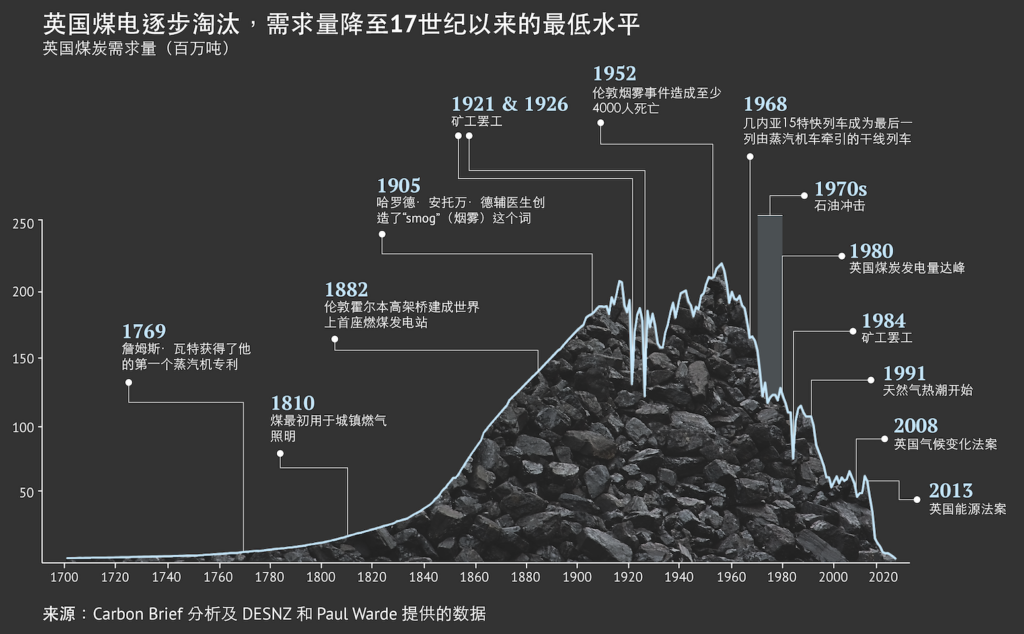
格拉斯哥大学(University of Glasgow)经济与社会史高级讲师、《煤炭之乡:战后苏格兰去工业化的意义和记忆》(Coal Country: The Meaning and Memory of Deindustrialization in Postwar Scotland)一书作者伊万·吉布斯(Ewan Gibbs)博士在接受Carbon Brief采访时说:“从英国工业革命的发展历程来看,煤炭对英国19世纪的工业经济发展绝对举足轻重。钢铁工业由煤炭提供动力。在18世纪晚期,当然也包括19世纪上半叶,英国成为了煤炭大国。这是世界上第一个以煤炭为动力的经济体。”
1810年,英国开始用煤生产城镇燃气以用于照明。从1830年开始,随着英国扩张其蜿蜒的铁路网,煤炭被用来提供燃料。
1882年,煤第一次被用来发电供公众使用。同年1月,世界上第一座燃煤发电厂在伦敦霍尔本高架桥开始运行。
除了工业能源之外,这些新用途(包括供热、照明和运输)推动了英国煤炭使用量的急剧上升。需求量从1800年的1490万吨增长到1900年的1.726亿吨,增长了十多倍。
在此期间,英国各地纷纷开设了小型燃煤发电厂。
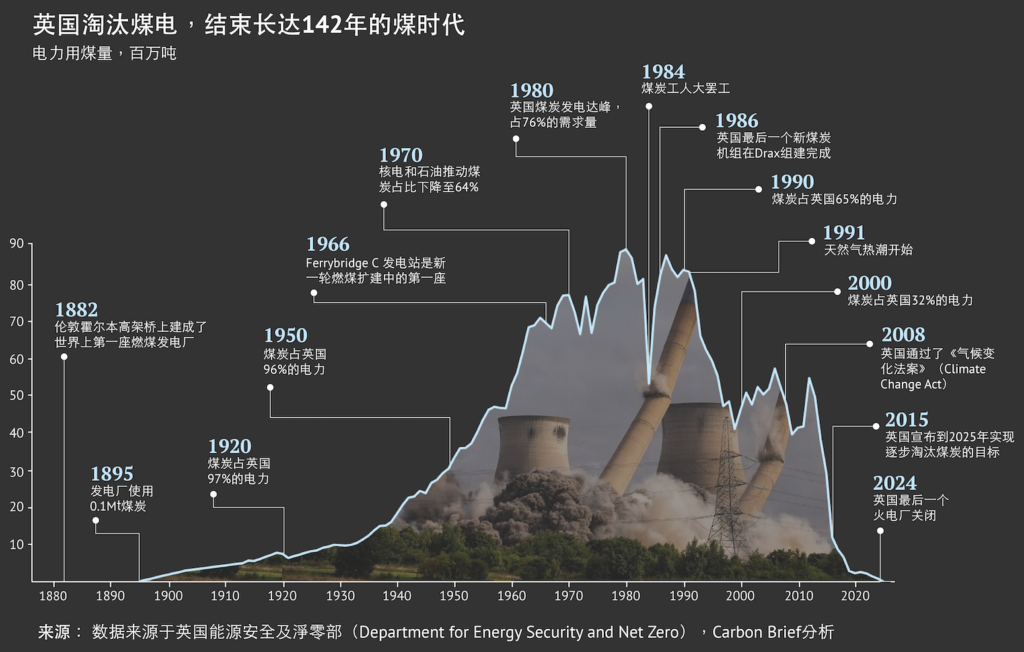
到1920年,英国的燃煤发电量达到4TWh,满足了全国97%的电力需求,其中大部分来自工厂。
在整个20世纪上半叶,英国的煤炭使用量持续增长。到1956年英国煤炭使用量达到2.21亿吨的峰值时,燃煤发电量仍然只占需求量的一小部分。炼钢、工业、城镇燃气、家庭供热和铁路占据了主导地位。
在20世纪下半叶,除电力外,所有这些用途的煤炭使用量都急剧下降。
这一时期英国煤炭使用量下降的原因,包括北海天然气的出现和蒸汽铁路的终结,以及日益加剧的全球化和去工业化。
战后煤炭使用量下降的另一个关键因素是,到1950年代,煤炭燃烧对环境的影响已变得过于显著和危险,不容忽视。
1952年伦敦烟雾事件已知造成约4000人死亡,实际死亡人数可能更多。
为此,英国议会颁布了《1956年清洁空气法令》(1956 Clean Air Act)。这从法律层面禁止了“烟雾滋扰”或“黑烟”,并对新熔炉的排放设定了限制。1968年,有关排放的法律得到进一步加强。
在随后的几十年里,随着更便宜和清洁的替代能源开始取代煤炭,家庭用暖、铁路运输和工业用煤持续减少。
在这些年里,城市的小型燃煤电厂也逐渐转为靠近煤矿的农村大型发电厂。虽然英国也是核电的先驱,但直到1957年,煤炭在年发电量中的占比才首次降至90%以下。
1960至1964年间,中央电力局(Central Electricity Generating Board)公布了兴建10座燃煤电厂的计划,一批新燃煤电厂随之在1966年至1972年间投运。
这些项目的建设使煤电装机容量在1974年攀升至57.5吉瓦(GW)的历史峰值。几年后的1980年,燃煤发电量达到212TWh的峰值。
英国最后一个新建燃煤发电厂位于德拉克斯(Drax),该厂于1975年投运,当时的装机容量为2GW,但在1986年翻番至4GW。
英国是如何停止使用煤电的?
20世纪下半叶,《清洁空气法令》的实施、从使用城镇燃气转向北海天然气、去工业化和全球化等因素共同推动了煤炭使用的减少。
但如上所述,在这一时期的大部分时间里,煤电继续蓬勃发展,因为其他发电来源无法满足不断增长的用电需求。
因此,燃煤发电量直到1980年才达峰,在1990年仍保持在类似水平。
然后,在主宰英国电力供应长达一个世纪之后,煤炭在两个快速但截然不同的阶段逐步淘汰,其间有一个长达十多年的平稳期。
第一阶段是1990年代的“天然气热潮”(Dash for Gas)。第二阶段则经历了可再生能源的发展、能源效率的提高,以及让燃煤电厂为污染买单的政策。
从1950年代开始,核电厂和燃油发电厂的扩张已开始侵蚀煤炭在英国电力结构中的份额。尽管如此,在整个1960年代和1970年代,随着全国各地燃煤发电厂的兴建,燃煤发电量仍在持续增长。
这批发电厂包括英国最后一家在运的燃煤发电厂索尔河畔拉特克利夫火电厂,它于1968年由中央电力局核准。
虽然1960年代在北海发现了天然气,但多年来,人们一直忽视和限制大规模使用天然气发电。
然而,到1980年代末,随着人们对酸雨的担忧日益加剧,欧盟1988年通过了《大型燃烧设备指令》(Large Combustion Plant Directive),要求减少二氧化硫排放。煤电厂是主要的排放源,而抑制此类排放的减排技术大大增加了煤电厂的运行成本。
与此同时,“联合循环”(“combined cycle”,将燃气轮机和蒸汽轮机组合起来的一种发电方式)燃气轮机技术不断进步,天然气价格不断下降,使得天然气不仅更清洁,而且比煤炭更便宜。
在新私有化的电力行业随之发生的“天然气热潮”,推动燃煤发电量在十年间减少了近一半。燃煤发电量从1990年的200TWh(占总发电量的65%)下降到2000年略高于100TWh(占总发电量的32%),而同期天然气发电量则从几乎为零上升到近150TWh。
世纪之交之后,英国的煤电进入了一个停滞期。燃煤发电量随着天然气价格的起伏而上升、下降、再上升。
2000年,英国现已解散的皇家环境污染委员会(Royal Commission on Environmental Pollution)发表了一份关于能源和“不断变化的气候”的报告,呼吁政府采取“快速部署替代能源”来取代化石燃料等方法,到2050年将英国的温室气体排放量减少至2000年水平的60%。
到2003年能源白皮书发布时,“到2050年减排60%”的目标已成为政府政策。“可再生能源义务”也纳入了到2010年可再生能源发电量占比达到10%的目标。
不过,2003年的白皮书也为使用碳捕集与封存技术(CCS)的“清洁煤”敞开了大门。
在英国煤电进入逐步淘汰的第二阶段之前,有十年的平稳期。该时期见证了一系列新政策的出台、一场大规模抗议运动,以及电力需求出现了意想不到却显著的下降。
其中一项政策进展是2005年生效的欧盟排放交易体系(EUETS),这是世界上首个大型碳市场。该体系最初效果不佳,尤其是在2008年金融危机之后出现了碳价格暴跌,但该体系确立了污染发电厂应为其CO2排放买单的原则。
另一项值得注意的政策是2001年欧盟对《大型燃烧设备指令》进行了更新。该政策对发电厂的空气污染设置了更严格的限制,于2008年生效。
当时,英国的许多燃煤发电厂已经老旧,它们选择使用“克减条款”(豁免权),即如果只运行有限的几个小时,就可以继续运行到2015年,而无需投资污染控制设备。
虽然这决定了一大批老旧发电厂的命运,但当时,在英国新建燃煤发电厂仍在议事日程之上。
2007年底,“金斯诺斯六人组”(Kingsnorth six)活动人士爬上了肯特郡一家现有燃煤发电厂的烟囱,以抗议在该地新建发电厂的计划。2008年1月,当地议会批准了该计划,这使其成为英国24年来第一个新建燃煤电厂。
2008年10月,英国通过了《气候变化法案》(Climate Change Act),其中包括一项具有法律约束力的目标,即到2050年将温室气体排放量减少到比1990年低60%的水平。该目标后来被加强至降低80%,并在2019年再次修订,改为实现“净零”排放。
智库E3G的政策顾问肖恩·雷-罗奇(Sean Rai-Roche)告诉Carbon Brief,该法案是第一个由一个国家制定的具有法律约束力的气候目标,是英国发展历程中的“开创性时刻”,其中便包括逐步淘汰煤炭。
到2009年,时任能源和气候大臣、现任能源安全和净零排放国务大臣埃德·米利班德(Ed Miliband)宣布,英国将不会新建任何不配备碳捕集与封存技术的燃煤电厂。
米利班德当时表示:“新建未减排的煤炭(工厂)的时代已经结束。”
2010年,金斯诺斯(Kingsnorth)发电厂被正式取消,英国再也没有新建任何煤炭项目。随着老发电厂的退役,这为更早的淘汰煤电铺平了道路。
由于英国没有新建燃煤电厂,许多旧的煤电厂也将关闭,而非进行成本高昂的升级改造以满足更严苛的空气污染规定,因此,在替代能源出现后,煤电将进入淘汰的第二阶段。
2013年的《能源法案》通过一项排放性能标准(EPS),正式宣告了无减排措施的煤电项目的终结。该标准规定新建发电厂每千瓦时CO2排放量不得超过450克,这约为未减排煤炭排放量的一半。
智库“能源气候情报组织”(Energy and Climate Intelligence Unit)分析总监西蒙·克兰-麦克格里欣博士(Dr Simon Cran-McGreehin)告诉Carbon Brief,空气污染法规、碳捕集与封存技术的成本和碳定价的综合作用,使得目前的燃煤发电“缺乏竞争力”。
“持续的煤电根本不是一个选项,因为它的成本太高……甚至与天然气和核能相比都没有竞争力,更不用说新兴的可再生能源了。”他说。
2013年的《能源法案》恢复了一些新的核电计划,并扩大了对低碳发电的支持。可再生能源发电量在五年内翻了一番,从2013年的约50TWh增至2018年的110TWh。联合政府还在2013年引入了“碳价下限”,为电力行业的CO2排放增加了额外价格,使天然气比煤炭更受青睐。
Ember智库认为,这一额外的碳价格对英国的煤电产生了“重大影响”,并在随后几年里推动了发电量的急剧减少。
英国电力结构中煤电的占比从2012年的近40%,到2015年降至22%。
除了可再生能源的增长,英国煤电得以迅速淘汰的另一个因素,是自2005年以来电力需求的下降。
事实上,英国的电力需求在2018年已降至1994年以来的最低水平,相对于之前的趋势节省了约100TWh。
电力需求的下降得益于能效法规的实施、LED照明的普及和一些高耗能产业的离岸外包。
这一快速的转变使得在2015年,时任能源和气候变化大臣的安伯·拉德(Amber Rudd)宣布了到2025年实现逐步淘汰煤炭的目标。
2016年,在欧盟的《大型燃烧设备指令》导致最后一家发电厂关闭之后,煤电占年发电量的比例骤降至仅9%。
这一年也见证了自霍尔本高架桥发电厂于1882年投运以来,英国出现首个无煤电小时。随后,英国在2017年迎来了首个无煤电日,2019年迎来了首个无煤电周,2020年迎来了首个无煤电月。
在此之后,煤电淘汰目标在2021年被提前至2024年10月,2020年煤炭发电量仅在电力结构中占到1.8%。
如下图所示,在此期间,继续有燃煤发电厂被关闭。2023年底,英国倒数第二家燃煤发电厂——北爱尔兰的基尔鲁特(Kilroot)——停止了燃煤发电,仅剩下索尔河畔拉特克利夫火电厂。
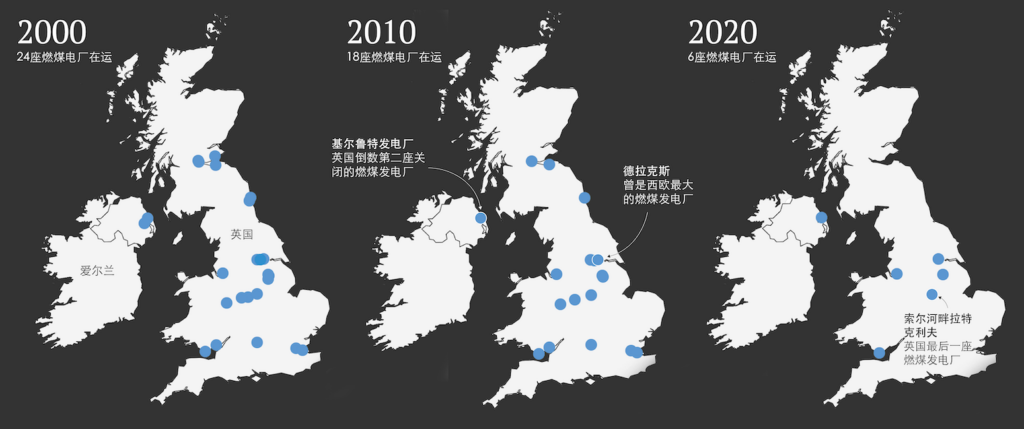
该电厂于10月1日前关闭,这将结束英国长达142年的煤电历史。与多年来许多误导性的新闻标题相反,英国并没有因此出现停电。
值得注意的是,英国逐步淘汰煤电,以及关闭该国仅存的几个位于威尔士塔尔伯特港(Port Talbot)和林肯郡斯肯索普(Scunthorpe)的高炉,将有助于将2024年的总煤炭需求降至17世纪以来的最低水平。
Carbon Brief的分析显示,在这142年间,英国的燃煤发电厂总共消耗约46亿吨煤炭,产生104亿吨CO2。
如果把英国的燃煤发电厂比作一个国家,那么它们的化石燃料累计排放量将位居世界第28位。这意味着这些燃煤发电厂对当前气候变化的历史责任要大于阿根廷、越南、巴基斯坦或尼日利亚等国家。
英国现在从哪里获得电力?
如今,英国的电力系统与几十年前大不相同,可再生能源在发电组合中日益占据主导地位。
2023年,可再生能源创下新纪录,在全国电力供应的占比达到44%,高于2018年的31%和2010年的7%。Carbon Brief的分析显示,可再生能源今年的发电量将从2023年的约135TWh增加到150TWh以上。
相比之下,化石燃料发电仅占电力供应的三分之一,在电力结构中所占比例达到创纪录低的33%,其中煤电略高于1%。
这一略低于20%的降幅使化石燃料供应量降至104TWh,这是自1957年以来的最低水平,当时95%的电力供应来自煤炭。
下图显示了英国电力结构在一个世纪以来的变化。值得注意的是,虽然石油、核能和天然气都曾在压缩煤电方面发挥了重要作用,但可再生能源现在是(能源转型的)主力。
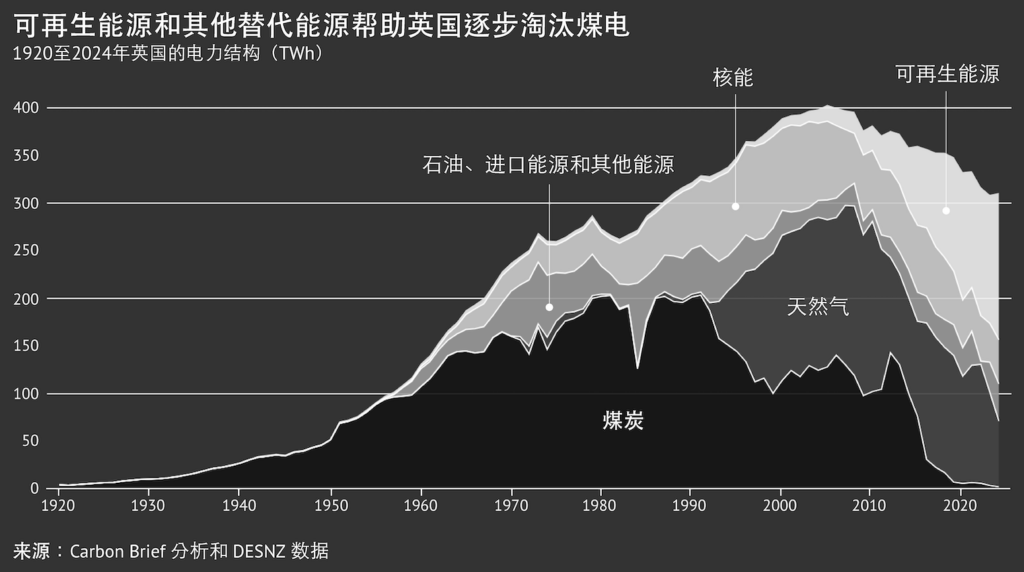
事实上,所有其他发电来源现在都在衰退:随着英国老化的反应堆即将寿终正寝,核电也在衰退;随着可再生能源的扩张,天然气和煤炭也在下降。
2024年,可再生能源在电力结构中所占的比例将继续增加,Carbon Brief对今年迄今为止的数据进行的分析表明,可再生能源将首次占到电力供应的50%左右。
英国电力的下一步是什么?
在成为第一个逐步淘汰煤炭发电的主要经济体后,英国寻求更进一步,到2030年前实现电力产业完全脱碳。
在保守党政府执政期间,英国的目标是到2035年实现电力部门完全脱碳。新的工党政府将这一目标提前到2030年。
与此同时,随着交通和供暖等行业日益电气化,电力行业将需要开始扩张,以满足这些行业的需求。
前气候变化委员会(CCC)首席执行官、现任政府2030年电力目标“任务控制”负责人克里斯·斯塔克(Chris Stark)于 9 月中旬在伦敦市中心的一次活动中表示,他认为这一目标“可能实现”,但“极具挑战性”。
据CCC称,到2035年,英国的电力需求预计将增长50%。
要满足这一增长需求,英国需要大幅增加可再生能源发电能力,并安全运转靠风能和太阳能发电为主的电网。要实现这一目标,还需要在六年内逐步淘汰未减排天然气发电。目前,天然气的发电占比约为22%。淘汰天然气的速度大约需要是淘汰煤炭速度——从2012年的39%降至2024年的0%——的两倍,如下图所示。
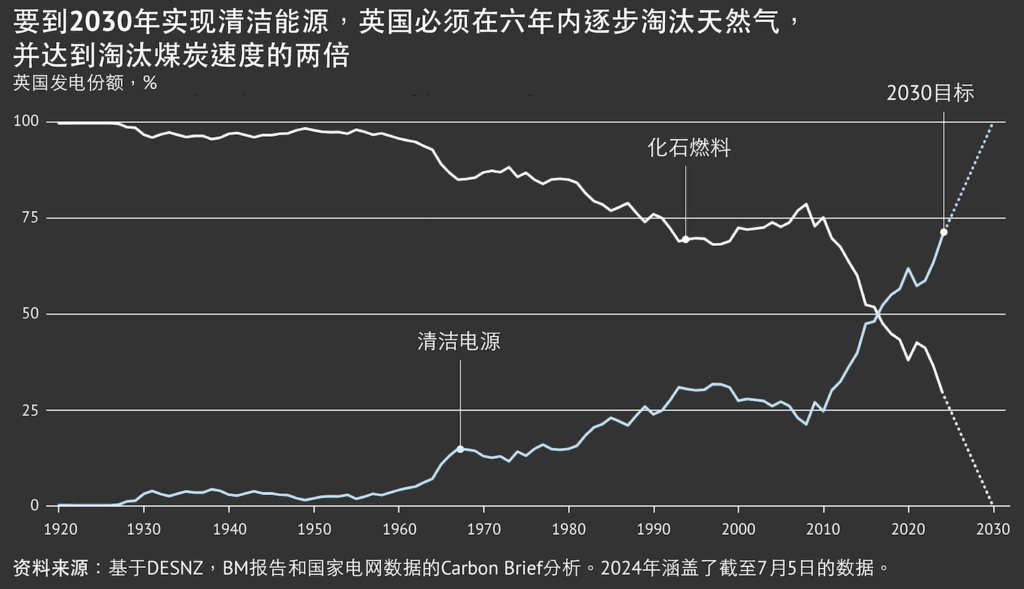
为了实现2030年目标和更广泛的英国气候目标,工党政府已承诺将陆上风电容量增加一倍,太阳能增加三倍,海上风电增加四倍。
政府的“差价合约”(“contracts for difference”)计划继续支持可再生能源的扩张。工党政府还支持新的核项目、碳捕集与封存技术和“天然气发电站战略储备”(“strategic reserve of gas power stations”),以保证电力供应安全。
其他国家可以从英国学到什么?
索尔河畔拉特克利夫火电厂的关闭标志着英国142年煤炭发电时代的结束。
除了象征意义之外,英国的煤炭淘汰在实质上也很重要,因为它表明快速摆脱煤炭发电是可能的。
1990年至2000年间,煤炭在英国发电中的份额减少了一半,随后,煤炭的占比从2012年的五分之二下降到2024年底的零。
这一进展暗示着其他国家——乃至全世界——有可能复制英国的成功,并在此过程中为气候行动做出重大贡献。
有四个关键因素促成了英国的淘汰:
- 建设替代性发电来源,且使其数量足以满足甚至超过电力需求增长。
- 停止建设新的燃煤电厂。
- 通过政策和法规让燃煤电厂承担其产生的空气污染和温室气体排放的成本。
- 发出明确的政治信号,让市场也参与其中。
随着英国开启电力行业的下一个重大挑战——到2030年实现清洁能源——它还可能为世界提供另一个成功的气候研究方案。
本文是一篇概要,点击此处阅读原文。

The post Q&A:英国如何成为首个淘汰煤电的G7国家 appeared first on Carbon Brief.

Climate Change
“Sink or swim”: WA Gov hugely underestimating decline in regional gas demand while sleeping on green exports, new report finds
PERTH, Tuesday 13 October 2026 — A new report from Greenpeace Australia Pacific and Springmount Advisory reveals green commodity exports are an untapped economic opportunity for Western Australia in a declining Asian gas market, while offering a genuine solution for decarbonising Asia.
From Gas to Green: Building Western Australia’s Future State is a comprehensive analysis of the declining gas market in Asia, and the untapped economic opportunity for WA to become a global leader in green commodity exports while driving the regional shift away from fossil fuels.
The report offers key recommendations for the WA Government to support regional decarbonisation through an orderly phase out of gas exports in favour of green iron and other green exports. It comes as global climate leaders from across business, politics and advocacy prepare to meet for the Global Citizen Now: Perth event focused on decarbonising WA.
Key findings:
- Gas demand is falling across WA’s core markets in Asia: Gas demand fell in 2025 and is projected to continue to decline, driven by a combination of global geopolitical factors and domestic concerns.
- Policy shifts in key markets since the war on Iran now prioritise renewables and nuclear over gas: Japan, South Korea and China have legislated energy plans that prioritise renewables and nuclear over gas.
- New WA gas would arrive in a saturated, uncertain Asian market filled with cheaper gas: The US is now the world’s largest liquefied gas producer and plans to double its capacity as it also targets Asian markets.
- Green commodities offer a real solution to sustain WA’s economy: WA can lead Australia’s green commodity exports, which by 2060 could be worth almost a trillion dollars.
- Exporting more WA gas is likely to delay or impede Asia decarbonisation: Despite claims by the gas industry, there is no evidence that WA gas is displacing coal in Asia, and in fact diverts resources from genuine decarbonisation options.
Geoff Bice, WA Campaign Lead at Greenpeace Australia Pacific said: “As our export partners in Asia shift away from expensive and polluting gas, the WA Government has a golden opportunity to pivot our economy to green exports, like green iron, which is the most effective way to help our region to decarbonise.
“The writing is on the wall: gas is in decline, renewables are our future. In this context, it makes zero sense for the government to encourage high risk projects like Woodside’s reckless Browse gas proposal at Scott Reef.
“This report clearly shows that the WA Government faces a choice: sink or swim. They can either allow the gas industry to keep ripping off West Australians and continue propping up its decline, or choose the path that will deliver enormous benefits to the state and the world by becoming a leader in the rapidly expanding green economy.”
Tom Quinn, Managing Director of Springmount Advisory: “Western Australia prospers when it looks to the future and builds for future demand. Twenty years from now, what the world needs is green commodities made using WAs abundant renewable resources. Just like it did with iron ore in the 1950s and gas in the 1970s, WA should look to the future and build what the world will need, not sunsetting industries like gas that are already past their peak.”
-ENDS-
Media contact
Kate O’Callaghan on 0406 231 892 or kate.ocallaghan@greenpeace.org
Lucy Keller on 0491 135 308 or lucy.keller@greenpeace.org
A report from Greenpeace Australia Pacific and Springmount Advisory reveals the untapped green economic opportunity for Western Australia in a declining Asian gas market, which also offers a genuine solution for decarbonisation in Asia.
Is Western Australia clinging to a fading gas industry while a thriving green future passes it by? As major Asian trading partners rapidly pivot away from volatile gas imports toward cheap solar and battery storage, this report exposes a high-stakes choice: risk becoming stranded in an oversupplied fossil fuel market, or harness WA’s unmatched sun and wind to lead the global clean energy transition.
Summary
From Gas to Green: Building Western Australia’s Future State reveals that Western Australia (WA) faces a critical juncture as falling Asian gas demand, geopolitical gas supply volatility and accelerating renewable energy deployment undermine the long-term economic viability of gas exports. By harnessing its world-class wind and solar resources, the report demonstrates that WA can execute an orderly phase-out of gas and pioneer a green commodity export economy that could generate $987 billion in economic value by 2060, create 24,000 ongoing jobs, and drive a 9.6% reduction in global greenhouse gas emissions.
Key Findings
- Gas demand is falling in Asia – WA can no longer rely on gas exports: Gas demand in core Asian markets fell in 2025 and is projected to continue to decline in 2026. Legislated energy plans in Japan, South Korea, and China now prioritise renewables and nuclear over gas.
- Asia is increasing renewables, importing gas just gets in the way: Evidence from markets like Thailand suggests that gas