

The European Commission has put forward new plans to cut emissions under the EU carbon market more slowly, from 2031 onwards.
On 17 July, the commission presented its long-awaited proposal for reform of the EU’s Emissions Trading System (ETS).
It recommended a number of changes, including giving companies free allowances to cover their emissions for longer than previously planned, conditional on climate investment plans.
The proposal offers a more business-friendly and “savvy” approach, argued EU climate commissioner Wopke Hoekstra in a press conference.
But critics believe it could “weaken” the system and put EU climate targets at risk.
Alongside the proposal, the commission also announced a new target for electricity to make up 46% of energy consumption by 2040, doubling the current rate of 23%.
This could cut EU spending on imported fossil fuels by €260bn annually, according to the commission.
In this Q&A, Carbon Brief outlines the details of the new ETS proposal – which is subject to negotiation with member states – and explores what it could mean for climate action.
- What is the EU Emissions Trading System?
- What did companies and countries want from the ETS review?
- What is in the new proposal from the European Commission?
- What could the changes mean for greenhouse gas emissions?
- How was the proposal received?
- What is ‘ETS2’?
- What happens next?
What is the EU Emissions Trading System?
The EU ETS is a carbon market, which puts a price on the greenhouse gas emissions of companies in power generation, industry, aviation and other sectors.
It covers everything from electricity generation to steel production, as well as flights within the EU and a handful of other European countries.
Emissions in these sectors have halved since the ETS launched in 2005, according to the European Commission.
A European parliament briefing describes the system as a “cornerstone” of EU climate policy, covering around 40% of the bloc’s overall emissions.
It applies to emissions in all 27 EU countries alongside Iceland, Liechtenstein, Norway and electricity generation in Northern Ireland. (The UK established its own ETS after Brexit.)
The ETS operates as a “cap and trade” system, which puts a limit on the amount of carbon dioxide equivalent (CO2e) that can be emitted within the sectors it covers.
The “cap” on emissions gradually decreases each year until, eventually, they are expected to reach zero.
The currency of trade within the system is “allowances”. One allowance is equal to one tonne of CO2-equivalent emissions.
At present, around 57% of these allowances are bought by companies in auctions. The EU generated around €43bn in revenue from these auctions in 2025.
The remaining 43% of allowances are given to companies for free, to cover some or all of their emissions.
This is intended to prevent “carbon leakage” – the idea that companies operating in countries with strict climate policies will relocate to countries with looser rules.
The amount of free allowances varies by sector, depending on factors including the level of competition with overseas firms that do not face a carbon price.
What did companies and countries want from the ETS review?
Countries and companies have been divided on how they wanted the ETS to evolve.
Some pushed for more ambition to help meet European climate goals. Others called for it to be rolled back, amid rising costs for businesses.
In March, 10 countries including Italy, Hungary and Poland wrote a letter to the commission calling the ETS an “existential risk” for key industrial sectors, reported Euronews.
Italy had earlier even called for the system to be suspended outright.
France and other countries favoured introducing a slower descent towards bringing the emissions cap to zero by 2039.
Some steel and chemical companies also criticised the cost burden of the ETS.
Other organisations focused on calls for stability and predictability in the system.
In recent weeks, Spain, the Netherlands and five other countries called on the commission to “resist gutting” the ETS in its review, said E&E News. They said the ETS should be strengthened to “ensure long-term investment predictability and regulatory stability”.
Weakening the system could “undermine investment signals and leave Europe more exposed to fossil-fuel shocks”, said a March 2026 briefing from climate thinktank E3G.
Another E3G briefing said the “risk” is that politicians weaken the system as a short-term economic fix, “undermining one of the EU’s main tools for delivering on its industrial transformation ambitions”.
Dozens of investment organisations called on EU countries to facilitate a “robust and predictable” ETS. They said that “policy stability is the cheapest investment stimulus available to the EU”.
In its list of priorities for ETS reform, the NGO Carbon Market Watch said that “now is not the time to backslide” on its aims and terms.
What is in the new proposal from the European Commission?
The commission’s proposal outlines a number of changes to the ETS, to bring it in line with the EU’s climate goal to cut emissions to 90% below 1990 levels by 2040.
The review will “bring relief to industry”, the commission says, while also continuing the ETS’ “essential” role in climate action.
However, others are more sceptical about the impacts it could have on climate action.
Below, Carbon Brief details the main aspects of the proposal.
Free allowances extended
The European Commission proposes to extend free allowances beyond a previously agreed date.
Free allocations were due to reduce from this year and be fully removed by 2034.
However, the commission has proposed to extend this to 2038, on the condition that companies receiving free allowances set out how they will invest in decarbonising their EU operations.
It proposes that from 2031 onwards, 80% of free allowances in the system would be given to companies that have submitted plans for investment in EU decarbonisation.
The remaining 20% of free allowances would only be allocated to those that can prove they followed through with planned investments and achieved the emissions reductions they had previously outlined.
This move is a “step in the right direction”, says Dr Kirsten Scholl, the director for EU affairs at thinktank Epico, but it must not “impose excessive administrative burdens”.
The EU’s carbon border adjustment mechanism (CBAM) was designed to replace the existing system of free allowances in the ETS.
It is a tax applied to certain imported goods, based on the amount of CO2 emissions released during their production. It began to be phased in at the start of 2026.
As a result, free allocation is being gradually phased out from 2026-38.
However, the commission has proposed that 15% of free allocations due to be removed because of CBAM should be reintroduced from 2028, to “reduce the speed at which CBAM is phased-in and mitigate the remaining carbon leakage risk”.
The commission says that preventing carbon leakage “remains a crucial element” of the ETS.
Pushing back the phase-out of free allowances and the full implementation of CBAM “risks squandering the EU’s credibility with investors and trading partners alike”, says Francesco Lombardi Stocchetti, a policy advisor on sustainable economy at the Bellona Foundation, an environmental NGO.
“Europe cannot lead the clean industrial transition just by moving the goalposts,” he adds in a statement.
Slowing path to reach zero emissions by a decade
The commission has proposed to cut emissions in the ETS more slowly from 2031 onwards.
This could mean new allowances are able to enter the scheme into the 2040s, instead of ending in 2039 as previously planned.
But the planned changes are still “aligned” with the EU’s 2040 climate target and net-zero requirement by 2050, says the commission.
The overall ETS cap on emissions was reduced by 1.7% each year up to 2020 and then by 2.2% annually since 2021.
It is then agreed to drop by 4.3% over 2024-27 and 4.4% from 2028 onwards.
Maintaining similar rates after 2030 would not be “realistic”, says the commission’s proposal.
Instead, it suggests that the cap should fall by 3.7% per year over 2031-35 and by just 1.7% annually over 2036-40.
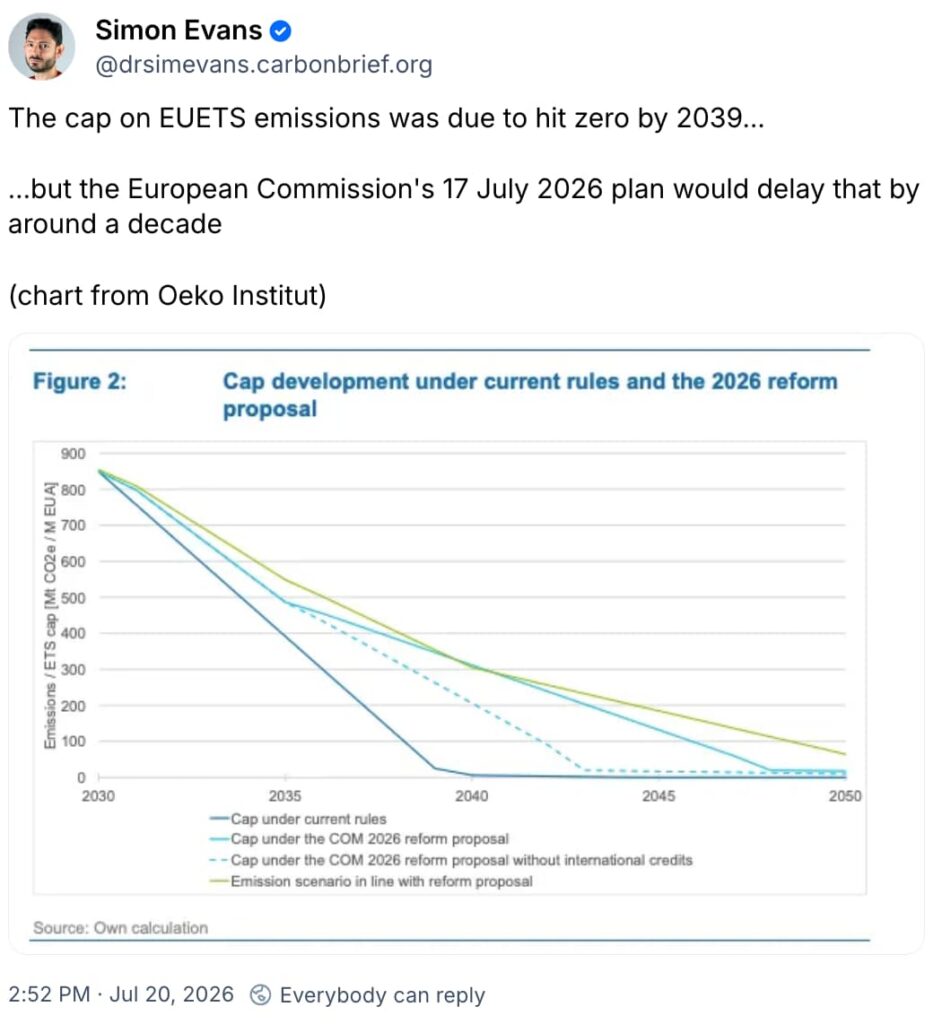
This will make the path to zero emissions within the ETS “more gradual and aligned with domestic climate ambition level”, claims the commission.
But WWF says that the proposal would allow an extra 2bn tonnes of CO2e to be emitted. (See: What could the changes mean for greenhouse gas emissions?)
Aviation
The commission has proposed plans to incorporate more airline emissions into the ETS.
The plan outlines that, from 2029, all flights departing from the European Economic Area (EU, Iceland, Liechtenstein and Norway) and landing in other countries within 5,000km of a point in central Europe should be added to the ETS.
This distance means that the changes would not apply to flights landing in China or the US. (Both the US and China have opposed the expansion of ETS coverage for flights.)
The commission also proposes including emissions from private jets and other “business flights” in the ETS.
It notes that aviation currently accounts for 14% of EU transport emissions. This is expected to skyrocket to around 90% by 2050, given it is more difficult to decarbonise than other modes of transport.
Some aviation emissions have been included in the ETS since 2012. This included emissions from air travel within the EEA and flights departing from Switzerland and the UK.
The airline industry did not respond favourably to reports of plans to expand beyond this scope.
On 8 June, the biggest airlines in Europe urged commission president Ursula von der Leyen not to extend the ETS to cover international flights, saying that it would raise ticket prices.
A study commissioned by Carbon Market Watch found that the ETS encompassing all flights departing from the EEA, not just those within it, would result in a “very small impact on ticket prices and passenger demand”.
Auction money
Under the proposed changes, EU countries would need to funnel half of the money they receive from ETS auctions towards decarbonising sectors covered by the system.
This would amount to more than €100bn in investment for decarbonisation before 2030, says the commission.
Around three-quarters of the money generated by the ETS has been allocated to EU countries since 2013, the proposal notes.
Since 2023, countries have been required to spend all of this money on climate and energy-related activities – at least on paper.
But the proposal says the “transparency and effectiveness” of this mechanism has been “insufficient”.
Currently, only around 5% of the ETS money “directly supports industrial decarbonisation in sectors such as steel, chemicals and fertilisers”, it adds.
Going forward, the proposal says that 50% should be put towards actions aiding clean-energy plans, industrial decarbonisation and improved waste management, as some examples.
A briefing by thinktank Institut Montaigne noted that the money generated within the system for EU countries to help finance the energy transition should be “at the heart” of ETS discussions, amid budget constraints in many EU countries at the moment.
CO2 removals
The commission has proposed integrating permanent carbon removals into the ETS to “give additional flexibility” for certain sectors that struggle to decarbonise. This action was previously agreed within the terms of the EU’s 2040 climate target.
“Permanent” removals refer to direct air capture with carbon storage and similar measures, rather than temporary removals such as planting trees.
The removals would be integrated into the system by increasing the allowance cap by an amount equivalent to the number of removals purchased.
This will set up “additional emission space” for hard-to-abate sectors and also support the “scale-up of the carbon removals industry”, outlines the proposal.
It also proposes that certain companies, such as shipping and aircraft operators, could compensate for their emissions with their own certified carbon removals.
These emissions would not be permitted to “go beyond zero”, adds the proposal.
Sven Harmeling, the head of climate at Climate Action Network (CAN) Europe, says that adding carbon removals “would weaken the ETS impact, undermine the carbon price and create new loopholes for polluters instead of accelerating the transition away from fossil fuels”.
The proposal “fails to ensure that only high-integrity removal technologies would be considered”, he adds in a statement.
However, the director of the Potsdam Institute for Climate Impact Research, Prof Ottmar Edenhofer, describes the move as “an important step”, saying:
“For the first time, it creates a credible and long-term investment framework for carbon-removal technologies in Europe.”
International credits
The commission proposes that firms covered by the ETS could make use of “high-integrity” credits bought on the global carbon market from 2036 onwards.
This relates to the EU’s 2040 climate target, in which up to 5% of the 90% reduction in GHGs can come from global carbon credits.
Amélie Laurent, a policy advisor in carbon accounting at the Bellona Foundation, says in a statement that these credits “should be in a strategic last resort reserve, not an excuse to avoid doing our homework”.
Aurora D’Aprile, the EU policy director at the International Emissions Trading Association, notes in a statement:
“For international credits, early preparation on governance and procurement and greater certainty around a pilot from 2031, will be essential to establish a credible demand signal.”
Other sectors extended
The commission has outlined plans to expand the inclusion of the maritime sector in the ETS.
Maritime accounts for around 4% of the EU’s total emissions. The new proposals for the sector include adding certain small ships of 400-5,000 tonnes to the system.
The proposal also outlines plans to incorporate more waste incineration into the ETS on a gradual basis from 2031.
Since 2024, some waste-burning companies have been required to monitor and report their emissions under the ETS. But they did not have to purchase credits.
Now, the commission proposes introducing the sector on a gradual basis.
Under the proposals, companies would require allowances for 25% of their emissions in 2031, 50% in 2032, 75% in 2033 and 100% from 2034 onwards.
Market stability reserve review
The market stability reserve was added to the ETS in 2019 to help stabilise the flow of allowances.
It acts like an overflow container holding extra allowances. If the number of allowances in the market falls below a certain threshold, more are brought out from the reserve to balance things out.
Equally, if the market is flooded with too many allowances, depressing prices, then some are removed and put into the reserve.
The commission has proposed a reform of the reserve, including changing the upper and lower limits for when allowances are released or removed.
It wants to reduce the rate at which allowances are withdrawn from auctions when they exceed a certain threshold from 24% to 12% from 2028.
This means that the permits would be able to stay in the market for longer.
As shown in the chart below, the price of carbon in the EU increased tenfold over 2017-2021, exceeding €80 (£68) per tonne of CO2.
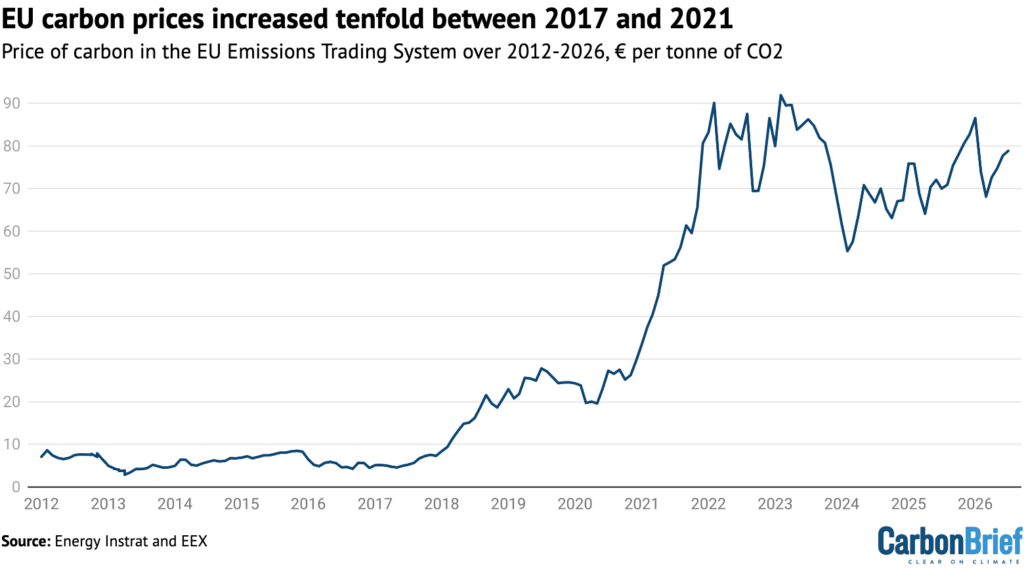
Nevertheless, the commission proposal says the reserve was “effective in mitigating price shocks” on the ETS caused by the Covid-19 pandemic and the surge in energy prices after Russia invaded Ukraine in 2021.
UK-EU ties
The EU and UK have agreed in principle to link their carbon markets, but the commission’s proposal says negotiations are still “under progress”.
It adds that the commission “foresees” future financial contributions from the UK to the EU’s ETS, if a final agreement is reached.
Many companies have called for the systems to be linked. In June, dozens of carbon-capture organisations and industry groups signed a letter calling for greater certainty on EU-UK links to ensure cross-border carbon-capture and storage projects are covered, for example.
Switzerland’s ETS has been linked to the EU since 2020.
What could the changes mean for greenhouse gas emissions?
The European Commission says the ETS plays a “crucial role” in meeting its climate targets “cost-effectively”.
The system contributed to a 41% reduction in EU industrial emissions over 2021-23, a decrease of around 800m tonnes of CO2 per year, according to recent analysis from the London School of Economics.
As highlighted in the chart below, the EU’s overall GHG emissions have dropped by 40% since 1990.
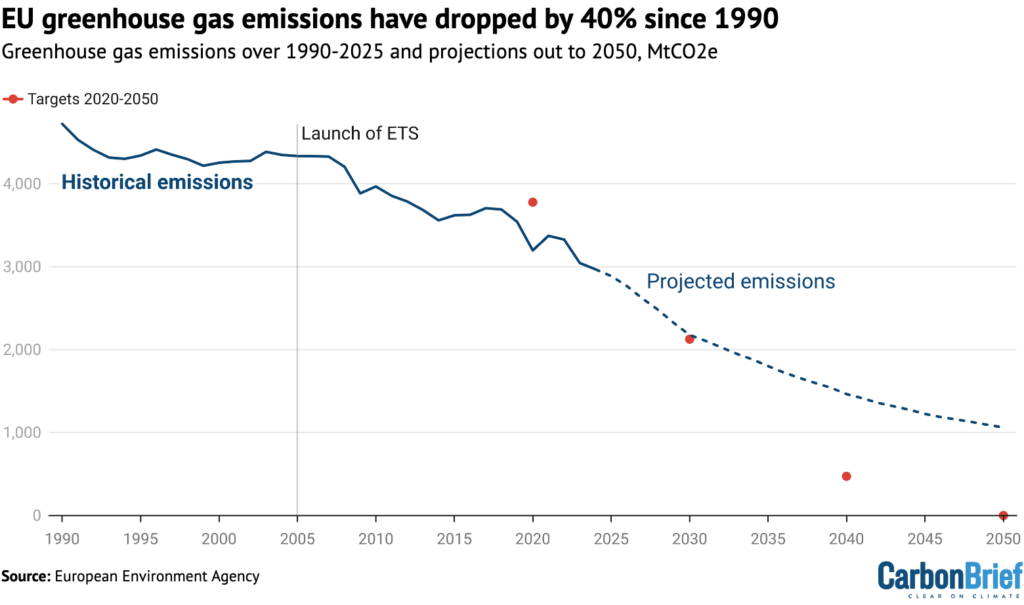
Climate commissioner Hoekstra told a press briefing that the proposal is “fully aligned” with the EU’s target to cut GHGs to 90% below 1990 levels by 2040. He called the plan “completely climate-law proof”.
He also noted that no other EU policy has contributed to reducing emissions on the scale of the ETS, describing it as a “phenomenal asset”.
But campaigners and experts are concerned that the proposed changes could slow decarbonisation and put the EU’s climate goals at risk.
Carbon Market Watch says the plans would “severely weaken” the ETS and “risk undermining the achievement of the EU’s 2040 and 2050 climate targets”.
The proposals “would represent a major setback for EU climate ambition, weakening incentives to cut emissions, extending reliance on fossil fuels and putting the 2040 climate target at risk”, says a statement from WWF.
WWF estimates that 2bn extra tonnes of CO2 would be emitted if the proposals were approved in the EU.
Michael Bloss, a German member of the European parliament (MEP) for the European Greens, says the plans would release around 1.4bn tonnes of extra CO2. He describes the proposal as “climate vandalism”.
Chiara Martinelli, the director of CAN Europe, says:
“Every extra tonne of CO2 allowed under the ETS makes Europe’s climate challenge harder and more expensive. Weakening the ETS now is a gift to polluters that have prioritised shareholder payouts instead of investing in cleaner production.”
How was the proposal received?
The European Commission’s new ETS proposal has been met with a mixed response.
Scholl from Epico says the proposal has “important flexibilities that can help address competitiveness challenges and provide greater certainty for industrial investment”. But she adds in a statement:
“Concerns remain about whether the proposed changes preserve the long-term investment signal of the ETS and sufficiently recognise companies that have already committed to ambitious decarbonisation pathways.”
Edenhofer from the Potsdam Institute for Climate Impact Research adds that the proposals provide “clarity on the contribution that emissions trading is intended to make towards the 2040 climate target”.
Elisa Giannelli, a programme lead at E3G, says in a statement:
“Today’s proposal might please some, but it risks increasing both the long-term cost and the time needed to deliver the EU’s growth strategy.”
Pepe Escrig, a senior researcher, also at E3G, adds that the commission held onto some of the ETS’ “essential foundation”, but “yielded to political pressure to weaken it as a quick fix to broader challenges”.
This has left the plan “pull[ing] in two directions: strengthening support for industrial investment while weakening parts of the framework meant to drive it”, says Escrig.
Andrea Spignoli, the policy manager of sustainable markets at Bellona Europa, says the proposal risks “weakening green investments” and putting a larger decarbonisation burden onto other sectors that are not covered by the ETS.
Greg Van Elsen, a senior industrial policy coordinator at CAN Europe, says in a statement:
“Free pollution permits were never meant to become a permanent subsidy. Extending them until 2038 rewards delay instead of industrial decarbonisation.”
Lobby groups also had mixed reactions to different aspects of the proposal.
The International Air Transport Association says it is “deeply frustrated” with the proposal.
The organisation’s director general, Willie Walsh, claims the consequences will be “harmful”, “sowing acrimony over extraterritoriality, slowing global decarbonisation and sapping European competitiveness”.
WindEurope says the proposal risks “slowing decarbonisation and failing to channel billions in ETS revenues to industrial electrification”.
BusinessEurope’s director general, Markus J Beyrer, says some aspects “raise concerns”. For example, he says the “new conditionalities for free allocations risk increasing bureaucratic complexity and the uncertain role for international carbon credits”.
What is ‘ETS2’?
ETS2 is a separate emissions trading system to the main ETS. It is due to take effect in 2028 and is not affected by the current ETS review or resultant proposals.
It will operate under a similar system as the existing ETS, covering emissions from transport, buildings and smaller industries in other sectors.
One key difference, however, is that ETS2 will not provide any allowances for free. They will all be auctioned and bought by companies.
On 15 July, 10 countries, including Italy and Poland, had urged the commission to also reconsider the ETS2 during this review. They were unsuccessful.
Similar to the original ETS, the commission believes the carbon price under the new ETS2 system will “provide a market incentive for investments in building renovations and low-emissions mobility”.
However, in June, member-state governments and the European parliament agreed on a number of “safeguards” to support price stability.
For example, if allowance costs under the ETS2 exceed €45 per tonne of CO2, they agreed that 40m allowances will be put into the system from a reserve to normalise the supply – double the amount previously agreed.
A European Environment Agency briefing said the ETS2 will “affect fuel prices and mobility costs” and that money will be syphoned into a social climate fund to “support vulnerable households and investments”.
What happens next?
EU countries will now negotiate over the terms of the commission’s proposal before it goes to a vote in the European parliament.
Ireland, which recently took over the six-monthly rotating presidency of the Council of the EU, has stated that it wants the ETS proposals to be signed off by the end of this year.
A previous document from the council, which represents member-state governments, outlined a target to agree a deal by the first quarter of 2027.
Clean Energy Wire says that this would be an “unusually ambitious timetable for one of the bloc’s most technically complex pieces of climate legislation”.
Politico notes that “months of arguing” is likely to occur.

The post Q&A: What the EU’s carbon market review means for climate action appeared first on Carbon Brief.
Q&A: What the EU’s carbon market review means for climate action

Three countries have been named by the Paris Agreement’s compliance committee for failing to submit a nationally determined contribution (NDC) and repeatedly snubbing offers of help with their climate plans.
After months of internal debate over whether to identify serial non-responders, the Paris Agreement’s Implementation and Compliance Committee (PAICC) named the three countries which have failed to engage with it over their NDCs on Friday.
It named Democratic Republic of Congo, Senegal and North Korea in a footnote of its annual report, adding that it decided to name them “with a view to facilitating engagement”, adding that representatives of the three nations had been invited to its meeting in early 2027 “with the purpose of identifying any challenges and constraints”.
“The Committee noted the importance of Parties engaging with the Committee in a timely manner, while noting that some delays may be due to the national capabilities and circumstances of the Parties”, the report said.