


Article Contents

Scientists have found that the deadly floods across parts of West Africa in recent weeks were made more likely and intense by human-driven climate change, while the expansion of cities into flood-prone areas amplified the devastation, raising the thorny problem of how to better protect poorer urban communities.
A report from the World Weather Attribution (WWA) group highlighted how the floods hit some of West Africa’s most densely populated coastal regions, where rapid urbanisation has pushed formal and informal settlements dangerously into floodplains, while converting land into farms has reduced drainage.
Since May, West African countries including Ghana, Togo, Côte d’Ivoire and Nigeria have experienced weeks of torrential rain and deadly flash floods. Homes have been submerged, thousands of people displaced and over 70 people killed.
WWA scientists said climate models showed that human-induced climate change increased the intensity of the rainfall, with what was once a rare amount of rain falling in just three days – a downpour that can now be expected every two to four years.
-
A strong El Niño spells more climate pain for the Philippines
As forecasters warn that the weather phenomenon will bring more extreme weather, its effects are already being felt in a country reeling from a series of disasters -
Southern Africa floods intensified by warming highlight climate injustice, scientists say
Climate change is fuelling extreme rainfall in the region, while insufficient adaptation and aid cuts have left people highly exposed to floods
“The event is not rare already today and therefore the flood risk is certainly not going away but will increase in particular with additional pressures from growing populations and urbanisation,” said Friederike Otto, a professor of climate science at Imperial College London.
Impact made worse by informal settlements
On top of climate change, scientists said urbanisation, inadequate drainage, poor waste management and the expansion of informal settlements into floodplains have left millions more people exposed to flooding.
Informal settlements are neighbourhoods which develop without authorisation from government authorities. More commonly known as slums or shanty towns, they often lack land tenure and services like running water and electricity and tend to be home to poorer communities.
Across West Africa and much of the developing world, as people have moved from rural areas to cities in search of work, these settlements have expanded into wetlands, flood-retention areas and riverbanks. This has further heightened flood risks across West African cities.
Kiswendsida Guigma, technical advisor at the Red Cross Red Crescent Climate Centre, said West Africa’s coastal cities are being “squeezed between repeated flooding and rapid urban growth”, pushing infrastructure beyond its limits and making it harder for communities to recover.
Roussel Teguia, a post-doctoral research fellow at Canada’s Université Laval, said the recent floods have exposed longstanding failures in urban planning across West Africa’s fast-growing coastal cities where much of the region’s economy is concentrated.
Campaigners oppose Dangote’s planned Kenya refinery over climate and ecological risks
Teguia said the floods are deadlier due to factors including rapid urbanisation in low-lying areas, lack of affordable housing alternatives and the long-standing marginalisation of poor communities. He also condemned the destruction of wetlands, mangroves and floodplains for roads and buildings when instead these natural bodies “should be treated as critical public safety infrastructure”.
“These floods should not be understood only as natural disasters,” he said. Residents of informal settlements must stop being treated as the problem, since they are often the first victims of “an urban model that exposes them to risk and then blames them for being exposed”, he added.
Short-sighted approach to relocation
Cote d’Ivoire’s capital Abidjan recorded 59 of the deaths, with about 20 dying in the densely-settled slope neighbourhood of Mossikro. Local media reported that authorities had previously relocated residents from this area due to fears about vulnerability to deadly landslides and flooding, but some people had returned to previously evacuated sites and died when the hillside collapsed due to the rain.
Local authorities have since started demolishing houses in the area, to the anger of many locals who say they were not consulted or warned about the demolitions, which are costing them their properties and livelihoods. “If you destroy this place, where am I supposed to go?” one unnamed resident told Al Jazeera.
The government says many of the structures were built illegally in flood and landslide-risk zones and it plans to move 3,000 people first and 2,000 more later. Municipal official Yue Hilaire told the TV channel the municipality has been trying to persuade them to leave for a long time. “Frankly we are tired,” he said. “The mayor instructed us to evict them because we don’t want to witness another tragedy every year.”
Loss and damage fund delays first project approvals as needs dwarf resources
Guigma said that to avoid people returning, the government should ensure that “where people are relocated they also have relatively good economic opportunities for them to stay”.
Demolishing poor people’s homes without offering real alternatives is not prevention, Teguia argued, calling on governments to provide safe, serviced and affordable land close to jobs and transport, stop the occupation of wetlands and regulate powerful land owners and users.
Relocation programmes often fail because they are designed as land-clearing or security operations rather than social processes, he explained.
Governments must move from reactive crisis management measures to a long-term comprehensive approach to risk, Teguia said. Relocation policies need to be just, fairly compensated, include affected communities and encompass economic and social networks – otherwise they “simply move the vulnerability elsewhere”, he warned.
Finance gap limits flood response
The WWA scientists said deadly floods will continue unless governments do more to reduce people’s exposure and vulnerability, calling for investments in safe and affordable housing, improved drainage and sanitation, stronger enforcement of building regulations, more effective early warning systems and greater involvement of at-risk communities in planning.
Joyce Kimutai, research associate in extreme weather and climate change at Imperial College London, said the study is a clear example of “the need for international cooperation on climate justice”, adding that developed countries have a responsibility to help nations like Togo, Cote d’Ivoire and Ghana to adapt to a worsening problem that, as low emitters of greenhouse gas, they did not cause.
But significant financial support for countries grappling with increasing climate disasters may still be some way off. Earlier this month, the UN’s fledgling Fund for Responding to Loss and Damage (FRLD) postponed approving its first round of projects after requests for support far exceeded the money available.
One of the roughly 180 submissions the fund received was a Nigerian recovery and resilience project to address flood losses and damage in Lagos which is prone to yearly flooding.
Otto of Imperial College London said such situations where the role of climate change is certain “should be the kinds of events where this fund should pay and help, but of course, that would require first money to be in the fund”.
Ghana and Togo have also identified increasingly frequent flooding as a major climate risk in their national adaptation plans, prioritising investments in drainage, resilient infrastructure, flood management, early warning systems and climate-resilient urban planning.
Most “zombie credits” locked out of new UN carbon market after China and India snub
But while these adaptation plans acknowledge that delivering the proposed measures requires more international aid, wealthy nations are likely to have missed their 2025 goal of doubling adaptation finance for developing countries. Funding reached just over $30 billion in 2024, far below the target of $40 billion by 2025.
The WWA findings underscore the urgent need to speed up support for vulnerable communities who have done little to cause climate change, said UN Climate Change Executive Secretary Simon Stiell, adding that “all climate finance commitments must be delivered in full”.
The post Flood deaths in West African cities raise fraught issue of slum evictions appeared first on Climate Home News.
Flood deaths in West African cities raise fraught issue of slum evictions
Continue Reading
An older teaching about land acknowledgement
As I have come to understand the spirit and intention of land acknowledgement, I often return to fond memories of my grandmother and her words of wisdom. She taught that the health of the places we call home comes first, because the wellbeing of the people depends on it.
In her teaching, land acknowledgement began with the land. Long before it became a paragraph read at the start of a meeting, it was a way of recognizing a homeland: its waters, its species, its seasons, and the spirit that revealed whether the place was well.
Her teaching echoes a practice found across many Indigenous Nations. Haudenosaunee gatherings, for example, have long opened with the Ohén:ton Karihwatéhkwen, the Thanksgiving Address, often translated as “the words that come before all else.” The speaker greets and gives thanks to the people, the earth, the waters, the plants, the animals, the winds, the sun, the moon and the stars. Only after everything that sustains life has been acknowledged does the gathering turn to its own business.
That order changes what an acknowledgement is for. Its purpose was to share the story of a place with neighbours and to draw them into the work of tending it. People entered the story second, as the ones responsible for what had just been named.
Understood this way, an acknowledgement does more than open a meeting. It asks us to reconsider where we stand, and what we owe the ground beneath us.
Nations among nations
In her teaching, people are one nation among many. The salmon are a nation. So are the cedars, the bison, the medicine plants, and the pollinators. Each belongs to a place, carries its own responsibilities, and offers gifts no other nation can give.
This idea of kinship runs through many Indigenous philosophies. The phrase “all my relations,” heard in ceremonies and gatherings across Turtle Island, is a reminder that family extends beyond people to the animals, plants, waters and lands that make life possible. Some Indigenous languages carry the same understanding in their grammar, speaking of many plants, animals and natural forces as living beings rather than objects.
Sovereignty, understood through this relationship, is a kind of standing more than a form of control. Each nation belongs fully to its place and carries its share of that place’s life. No nation thrives alone, and none thrives by taking over the whole.
The land is also the source of instruction. Over generations, people watched how a river valley or a stretch of prairie kept itself well: who arrived when, who fed whom, and how much could be taken before the giving stopped. In my grandmother’s telling, those observations became instructions, and those instructions helped shape law and protocol. They guided when to harvest, where to camp, how to enter a neighbour’s territory, and what was owed in return.
Indigenous legal scholars today often describe this as law that comes from the land itself, learned by watching how living systems sustain one another. A plainer name for it is knowing how to live somewhere.
The host and the guest
One of the clearest teachings in this understanding of the world is the relationship between host and guest. My grandmother invited us to recognize that relationship in the lives of plants and animals.
A host prepares the place before anyone arrives. A beaver family dams a stream, and the pond becomes a home for fish, frogs, birds and plants. A fallen tree becomes a nurse log, feeding the next generation of seedlings as it returns to the soil.
A host offers first. A flowering plant sets out nectar. A berry bush ripens fruit. These provisions come in their own season, not whenever a visitor happens to want them.
A host also makes its presence known. Birdsong, scent and the marks left along a trail tell newcomers that a place is already inhabited. The visitor does not arrive in an empty world.
The guest has responsibilities too. A guest attends to the season and to what the place can offer. A guest does not assume that everything within reach is theirs to take. A guest leaves something that helps sustain the relationship.
A bee takes nectar and carries pollen. Read through this teaching, that exchange offers an image of visiting well: receiving a gift while helping the host continue its life.
Many Indigenous harvesting protocols carry the same ethic into daily practice: ask before taking, take only what is needed, offer thanks, and leave enough for others and for the plant or animal to recover.
None of this suggests that every relationship in nature is peaceful or generous. These are ways of seeing responsibilities that people can learn to carry.
Everyone is both
No being is only a host or only a guest.
A tree makes room for other life while depending on soil, water, sunlight, fungi, and relationships beyond itself. People, too, may welcome others into their homes while remaining dependent on the larger homeland that sustains them.
The distinction between host and guest is therefore about roles, not ranks. Everyone receives. Everyone has something to give.
The question is whether the exchange sustains the place.
A visitor who takes without restraint leaves less for those who come next. A host who neglects the place has less to offer. Both have responsibilities, and neither can fulfil them alone.
This is the heart of reciprocity, a principle found across Indigenous philosophies: relationships stay healthy when gifts move in both directions. The Haudenosaunee teaching of the seventh generation extends that exchange across time, asking that decisions made today leave the place well for those not yet born.
Mutual benefit begins here, with the recognition that different beings carry different gifts and obligations.
What people carry forward
My grandmother’s teaching connects these relationships to the ways people meet their neighbours.
The host prepares a place, offers food and rest, and explains where the visitor has arrived. The guest makes themselves known, explains why they have come, listens to the terms of the visit, and brings something in return. The gift may be material. It may also be labour, knowledge, news, or a commitment to help.
Nations around the Great Lakes carried this ethic into treaty. The Dish with One Spoon, an agreement among the Haudenosaunee, Anishinaabe and allied Nations, describes shared hunting grounds as a single dish. Everyone eats from it with one spoon, takes only what they need, leaves enough for others, and keeps the dish clean. The Two Row Wampum, between the Haudenosaunee and European newcomers, shows two vessels travelling side by side on the same river, each keeping its own ways and neither steering the other.
In this understanding, acknowledgement is more than naming the people associated with a territory. It is learning enough about a homeland to behave responsibly within it.
Whose home is this? What sustains it? What laws and agreements guide our presence? What can we receive, and what must we return?
These questions make acknowledgement a relationship rather than a recital.
They also make it diplomatic. A guest who recognizes the host’s homeland recognizes that they have entered a place with its own relationships and responsibilities. A host who welcomes the guest makes room for an encounter governed by those relationships.
Neither arrives without standing. Neither arrives without obligations.
Beginning with place
I write from the shores of the Bay of Quinte. Here, the teaching asks me to begin with the water, the shoreline, and the life they sustain. Before I describe myself, I must attend to where I am.
That does not make people or history less important. It places them within the homeland that gives them meaning. The people, their laws, their agreements, and their responsibilities all belong to the place.
In a time of longer fire seasons, troubled waters, and uncertainty about what the next season will bring, this teaching asks something difficult and useful of us: pay attention before you speak.
An acknowledgement cannot tell the story of a place if the speaker has stopped noticing it.
The land came first. Beginning there again means learning to name what sustains us, and accepting that what sustains us also asks something of us.
By Rye Karonhiowanen Barberstock
Photo by Andrik Langfield on Unsplash
The post The Land Came First appeared first on Indigenous Climate Hub.
Carbon dioxide (CO2) emissions from fossil fuels and cement are projected to fall by around 0.4% in 2026 to 38.2bn tonnes of CO2 (GtCO2), according to new figures from the Global Carbon Project.
This guest post is by:
- Dr Zeke Hausfather, Carbon Brief’s climate science contributor
- Prof Pierre Friedlingstein, chair of mathematical modelling of climate systems at the University of Exeter and part of the Global Carbon Project team.
Carbon dioxide (CO2) emissions from fossil fuels and cement are projected to fall by around 0.4% in 2026 to 38.2bn tonnes of CO2 (GtCO2), according to new figures from the Global Carbon Project.
The 21st edition of the annual “global carbon budget” report, published today, says that this small decline is largely due to a 1.9% drop in emissions from oil and the energy shock triggered by the Iran conflict and the closure of the strait of Hormuz.
Emissions from coal continue to increase slightly.
The Global Carbon Project’s projections for fossil fuel and cement CO2 emissions in 2026 are preliminary, with a range that spans a fall of -1.5% to a rise of +0.6%.
This means a small increase in emissions can not be ruled out.
Emissions from land-use change, such as deforestation, are projected to rise in 2026.
This is primarily driven by peat fires and forest degradation in south-east Asia and is linked to the development of a strong El Niño event this year.
As a result, total CO2 emissions from fossil fuels and land use are projected to reach a record high of 43.3GtCO2 in 2026 – marginally above 42.8GtCO2 in 2025.
Research published alongside the report by the same team in Nature Climate Change finds that the growth in solar, wind and electric vehicles (EVs) now offsets around two-thirds of the emissions that would otherwise come from rising energy demand.
However, the deployment of these technologies is not yet enough to push global emissions into a sustained decline, according to the study.
The 2026 global carbon budget report also estimates that:
- Fossil emissions are projected to fall in China (-0.9%), the US (-1.3%) and the EU (-1.5%) in 2026, but rise by 4.4% in India.
- Oil emissions are projected to fall in every major region, with the largest drop in China (-4.6%).
- Land-use emissions averaged 4.9GtCO2 per year over 2016-25, around 21% lower than the decade before.
- Total CO2 emissions (fossil and land-use) grew by an average 0.3% per year over the past decade (2016-25), compared with 1.7% per year over the decade before.
- The remaining carbon budget to limit warming to 1.5C is 150GtCO2, or less than four years of current emissions.
- The land sink in 2025 was the highest on record, rebounding after being weakened during the 2023-24 El Niño. The current El Niño is expected to weaken the land sink in 2027.
- The concentration of CO2 in the atmosphere is set to reach 427.7 parts per million (ppm) in 2026, 54% above pre-industrial levels.
(For more on previous editions of the Global Carbon Project’s annual report, see Carbon Brief’s coverage in 2025, 2024, 2023 and 2022.)
Total emissions edge up as land-use emissions rise
Total global CO2 emissions, which combines fossil fuels and land-use change, are projected to reach a record high of 43.3GtCO2 in 2026, up from 42.8GtCO2 in 2025.
The increase in 2026 comes entirely from a projected rise in land-use emissions, which are more challenging to estimate than fossil emissions.
(The global carbon budget groups emissions from fossil fuels and cement production as “fossil emissions”. Carbon Brief follows this convention throughout this piece.)
If land-use emissions had stayed at 2025 levels, total emissions would have fallen slightly in 2026 to around 42.6GtCO2.
Each edition of the global carbon budget updates the historical record as new data and methods become available. The chart below shows total emissions in this year’s budget compared with the five previous editions.
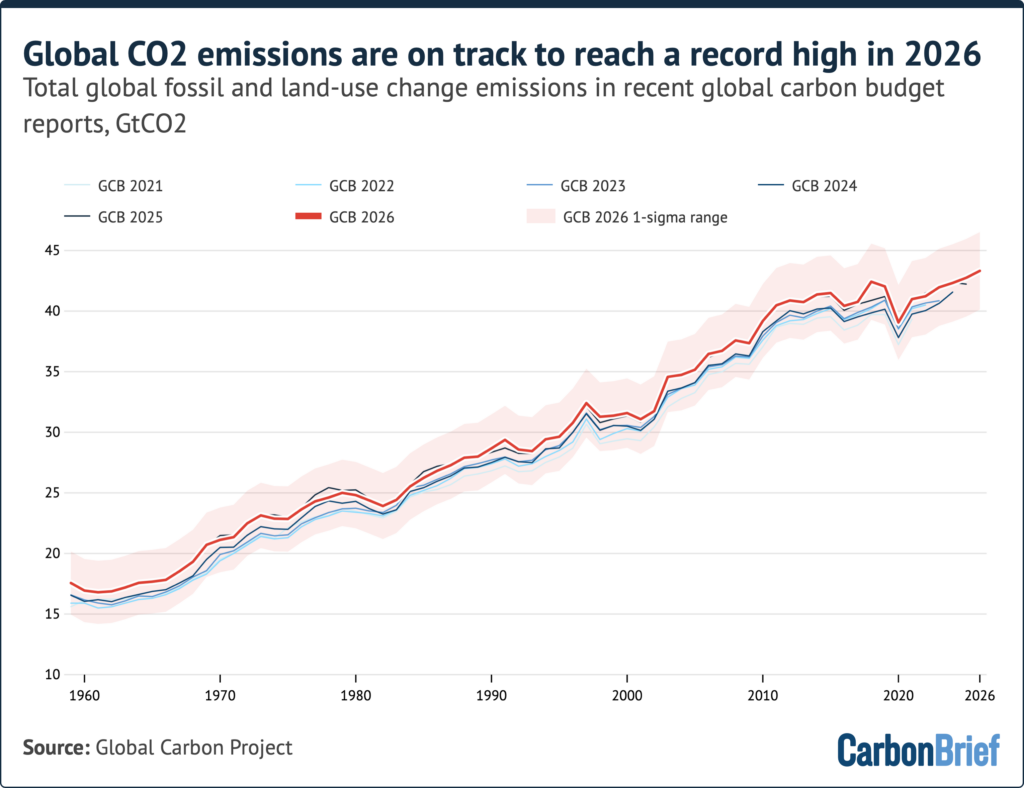
This year’s estimates of historical fossil emissions are around 0.3GtCO2 per year higher than in last year’s budget.
This is largely because the report now estimates a smaller “cement carbonation” sink in the wake of research published this year in Communications Sustainability. In other words, it estimates that cement is able to slowly reabsorb less CO2 over its lifetime than previously thought.
Estimates of land-use emissions have also been revised, including a spike in 2018 – visible in the chart above – linked to updated cropland data for Colombia.
The updated numbers show that total emissions have grown by 0.3% per year over the past decade (2016-25), compared with 1.7% per year over 2006-15.
Fossil emissions grew about 0.9% per year in the past decade, compared with 1.9% the decade before. Over the same period, land-use emissions have declined.
While the slowdown reflects real progress, a plateau in emissions is still a long