

China’s annual lianghui (两会) – also known as the “two sessions” – ended on 11 March, drawing the curtain on a key political event that saw limited climate targets set for 2024.
The “two sessions” political gathering, which usually takes place every March, gives an indication of China’s broad policy direction for the year, covering topics from the economy to industrial strategy to environmental protection.
In this article, Carbon Brief outlines the key signals from the 2024 “two sessions” on China’s plans for meeting climate targets, developing coal power, exporting clean-energy technology and more.
The article also assesses the impact of China’s goal of reducing energy intensity by 2.5% this year – described by analysts as “very soft-ball” – on its broader targets for reducing energy intensity and carbon intensity by 2025.
This is an update of Carbon Brief’s 7 March China Briefing newsletter, expanded with additional key points the government made about its approach to climate policy, as well as interpreting political signals sent throughout the “two sessions”.
- Why is the “two sessions” important?
- Does this year’s ‘government work report’ include hard climate targets?
- Is the report ambitious on climate?
- Will China continue to boost ‘green’ innovation?
- How will China manage geopolitical tensions around climate?
- What were other high-ranking policymakers saying about climate and energy policy at the “two sessions”?
- What next?
Why is the “two sessions” important?
The “two sessions” is the annual gathering of two bodies: China’s top legislative body, known as the National People’s Congress (NPC), and the Chinese People’s Political Consultative Conference (CPPCC), an advisory body similar to the House of Lords in the UK, but without any voting rights on legislation.
The gathering usually lasts for several days in Beijing and is attended by Chinese communist party members, as well as members of other political parties, academics, independent politicians and other prominent figures.
The “nearly 3,000” delegates represent the “democracy of China” and are given space to advance their own ideas. A select number of ministers are also given the opportunity to highlight their priorities in “minister’s corridor” press conferences.
Its centrepiece is the annual “government work report”, a speech traditionally delivered by the premier, who is the second most powerful leader in China. This speech underscores successes from the previous year and outlines priorities for the year ahead. It is also traditionally when China’s GDP growth target for the year is announced.
Alongside the government work report, China’s top economic planner, the National Development and Reform Commission (NDRC), also announces more detailed plans for meeting the coming year’s other development targets.

Does this year’s ‘government work report’ include hard climate targets?
One of the few quantitative climate targets China set in this year’s government work report is to reduce energy intensity – its energy consumption per unit of GDP – by 2.5% over the coming year, a target that Bloomberg described as “modest”. The target was lower than analysts’ expectations of 4%, the outlet added.
Previous analysis for Carbon Brief found that China would need to reduce its energy intensity by 6% per year to meet its 2025 target of a 13.5% drop, with energy demand needing to fall in absolute terms.
The NDRC report says that the 2.5% target was set “after considering energy consumption in economic development, renewable energy substitution, and the need to make a green and low-carbon transition”. It also said that the goal reflects the fact that energy consumption will increase this year.
It acknowledges shortcomings in efforts to meet energy and carbon intensity targets in 2023, adding that this was due to “rapid growth of industrial and civilian energy consumption”.
The NDRC also significantly altered the energy intensity target, which will now “exclud[e] non-fossil fuels and coal, petroleum and natural gas consumed as raw materials”.
This shift means the government has “redefined” the energy intensity target to mean “fossil fuel intensity”, Lauri Myllyvirta, senior research fellow at the Asia Society Policy Institute (ASPI), tells Carbon Brief, making the 2025 target “very soft-ball”.

Myllyvirta states that the report does not address the bigger problem – accelerating growth in energy intensive sectors to support China’s economy during the Covid-19 pandemic.
This growth – particularly in the exports, heavy manufacturing and construction sectors – would need to be “reversed” to make gains in energy intensity, he says, “but that’s not what they’re talking about [in the report]”.
By his estimate, if China’s energy intensity – under the new calculation – does fall by 2.5%, this would translate to “at best” a 3% fall in carbon intensity – the emissions per unit of GDP. This would be “very far from the 7% [fall] they need”, per his recent Carbon Brief analysis, to meet the 2025 target of an 18% reduction in carbon intensity.
Is the report ambitious on climate?
The government work report makes no significant changes to China’s direction of travel on climate and energy policy. Instead, the language around these policies continues to balance tensions inherent to China’s energy transition.
It signals that China will continue to manage the relative prioritisation of “both high-quality development and greater security”. It also asks policymakers to balance “actively” and “prudently” reach climate targets.
Efforts will be made to reduce carbon emissions and pollution, as well as to develop large-scale wind and solar bases and distributed energy, the government work report says.
China will also develop methods to measure carbon emissions and a “carbon footprint management system”; push the “green transformation” of industry, energy, transport and construction; and expand the scope of the national emissions trading market.
But, at the same time, the report also doubles down on the commitment to fossil fuels. Coal will continue to play a “crucial role in ensuring energy supply”, it says, while China increases development of oil, gas and strategic minerals in the name of security.
“You could almost see the government struggling with the language”, Li Shuo, director of ASPI’s China climate hub, tells Carbon Brief. He adds that there “seems to be an increasing lack of consistency” both in the report and in other policy papers.
He attributes this to the increasingly challenging economic situation facing the government and competing interests within the political system.
In addition, the lack of targets around air pollution, forestry and other environmental issues, could be interpreted as a “deprioritisation” of climate issues, he adds, or “as a reflection that the government has been distracted by some of the other competing issues, in particular economic challenges”.
“We’re getting very concerned” about China’s ability to meet its wider climate goals, Li says. Based on the recent surge in energy consumption, “it is going to be very challenging for China to hit [its energy and carbon intensity] targets. They certainly will not be able to meet those targets if they stick to…2.5% [annual] energy intensity reduction.”
Will China continue to boost ‘green’ innovation?
The government work report trumpets China’s clean-energy development in 2023, including growing installations of renewable energy, its contributions to the global energy transition and the 30% growth in exports of the “new three” industries of lithium-ion batteries, solar panels and electric vehicles (EVs).
(Previous analysis for Carbon Brief found that clean technologies – particularly the new three – were the top driver of China’s economic growth last year.)
Research and development of gas turbines and “generation IV” nuclear power units are also singled out as areas in which China has seen “substantial progress”.
Going forward, China will “consolidate and enhance [its] leading position” in industries such as electric vehicles and hydrogen, and “create new ways of storing energy”, the report says. This was the first time either energy storage or hydrogen have been mentioned in an annual government work report at the “two sessions”.
“I [can’t] think of a[nother] country where the economic agenda and the climate agenda are so aligned,” Li tells Carbon Brief. “The challenge for China is when and how and how fast will the positive[s]” lead to the “phasing down or the phasing out of the dirtier [aspects]”.

How will China manage geopolitical tensions around climate?
The greater emphasis placed on clean-tech exports comes as tensions with western countries grow around China’s dominance in solar and electric vehicle (EV) supply chains.
The European Commission recently required that imported China-made EVs register with customs, which could signal an intention to apply retroactive tariffs if they are believed to have received unfair subsidies.
The UK is planning a similar probe into Chinese EV subsidies. The US is deciding whether to increase tariffs on Chinese EVs, with commerce secretary Gina Raimondo arguing they could also pose data security risks.
More broadly, language in the government work report around foreign policy is notably assertive. It underscores that “protectionism and unilateralism were on the rise” in 2023, adding that these tensions “exerted a more adverse impact on China’s development”.
It also states that China will “oppos[e] all hegemonic, high-handed and bullying acts” in 2024 – words that did not appear in the government work report either last year or in 2022.
At the same time, China also pledges to continue to “implement…‘small and beautiful’ projects” in Belt and Road Initiative (BRI) partner countries, the majority of which are located in the global south.
The Panda Paw Dragon Claw newsletter, says that the government work report “covered much of the language we would expect” in terms of the BRI. It adds, however, that “less prominent individuals in the [CPPCC] offered slightly more nuanced perspectives”.
What were other high-ranking policymakers saying about climate and energy policy at the “two sessions”?
This year is the first time in decades that China cancelled its most-widely followed press conference at the “two sessions”, usually held by the premier and offering a rare opportunity for the media to interact directly with top leaders in China.
While the spotlight on 5 March was still on premier Li’s government work report, the domestic media gave more attention to the president, Xi Jinping.
One of the few meetings at the “two sessions” to be publicly announced was Xi’s meeting with the “group of environment and resources”, a new sub-group within the advisory CPPCC. It currently has 85 members, including party and government leaders, scientists, and industry leaders, according to analysis by China Energy Net.
Xi gave a speech at the meeting, in which he said group members “should make new contributions to strengthening ecological environmental protection, and support high-level protection alongside high-quality development”.
One member of the new group is Ministry of Ecology and Environment (MEE) head Huang Runqiu, who gave a speech on behalf of the members on 9 March. Huang argued that the “construction of a ‘Beautiful China’ is a long-term task” and that the construction of a ‘Beautiful China’ zone, balancing high-level protection and high-quality development, is a priority piece of work.
Huang also participated in a “minister’s corridor” press conference, during which he said that China will “synergistically push forward carbon reduction, pollution reduction, green expansion and growth”.
He added that focus areas for the MEE include: fighting “the battle against pollution”; promoting the construction of “Beautiful China” zones; encouraging green, low-carbon and high-quality development; and “supervising” ecosystem protection and restoration.

Meanwhile, National Energy Administration (NEA) director Zhang Jianhua submitted a proposal at the “two sessions” on how to “improve” the way China communicates its position on climate change with the outside world.
His proposal argues that China needs to address “injustices in global carbon reduction [efforts]” and “promote global fair and just carbon reduction”, and better communicate the “effectiveness of China’s [energy] transformation”.
The proposal is notable because, traditionally, the MEE leads on climate diplomacy in conjunction with the Ministry of Foreign Affairs (MFA), while the NEA focuses on domestic policy. Nevertheless, the NEA has commented in the past on geopolitics in relation to energy security concerns and participated in bilateral energy dialogues.
Zheng Shanjie, director of the National Development and Reform Commission (NDRC), also spoke at a press conference, choosing to highlight that “China’s ‘new three’ exports…[demonstrated] China’s strength in its manufacturing exports”.
However, China’s leadership also warned against “unfettered” industrial development at the “two sessions”, while top solar company Longi called on the government to “crack down on low prices and ensure panel quality”.
Xi said at the meeting with delegates from Jiangsu province that China “must prevent local rush and oppose irrational, blind investments that create bubbles”.
Xi did not link his comments to China’s clean energy industries explicitly but, as well as being politically important, Jiangsu province is “known for its exports, advanced manufacturing [and] clusters of new industries including solar and new energy vehicles”, the Hong Kong-based South China Morning Post added.
What next?
The government work report merely sets the framework for the year and functions as a signal for the general public, especially for industries, investors and corporations.
In the closely watched report, premier Li expressed concern that “achieving this year’s targets will not be easy, so we need to maintain policy focus, work harder, and mobilise the concerted efforts of all sides”.
An article in the Wall Street Journal said the speech “doesn’t show [a] clear path to recovery” and the Economist said China’s “confidence crisis goes unfixed”.
Following the central-level gathering, ministries and local governments must now develop concrete policies to meet its goals and encourage investors and industries to follow its lead.
Whether and how China progresses towards its “dual carbon” goals and other targets will depend on how this implementation proceeds.


The post Q&A: What does China’s ‘two sessions’ mean for climate policy in 2024? appeared first on Carbon Brief.
Q&A: What does China’s ‘two sessions’ mean for climate policy in 2024?

Scientists have vowed to keep working on the next flagship set of reports for the Intergovernmental Panel on Climate Change (IPCC), after a political row over the timeline for their release saw its latest session suspended on Friday evening without agreement.
During the weekend, government officials and scientists alike expressed disappointment over the inability to reach a compromise before some delegates from developing countries and small island states had to leave the week-long meeting in Ethiopia to catch flights home.
The disagreement – which has persisted since early 2024 – turns on whether the three key parts of the AR7 assessment should all be published before the conclusion of the UN’s next Global Stocktake of global climate action, which is due to be completed in late 2028.
The IPCC issued a statement after the close of the session, saying that “key agenda items” – the timelines for the three AR7 reports, as well as the IPCC budget – remain open and under discussion. It said the IPCC’s plenary session and its deliberations on the pending agenda “will resume at the earliest opportunity”, giving no further details of when.
IPCC Chair Jim Skea told delegates in closing remarks that recent months had been some of the most turbulent for the climate science panel and that, if there were stronger words than “profound disappointment” he would use them, according to a summary published by the Earth Negotiators Bulletin (ENB). IPCC discussions happen behind closed doors.
IPCC scientists remained committed
In an open letter, issued on Monday, a group of nearly 120 scientists – from a total of 664 AR7 authors – said they “stand committed to continue working to deliver the AR7 reports in a manner that is rigorous, timely and inclusive, in line with our mandate to be policy-relevant”.
“An assessment that arrives after the decisions it is meant to inform cannot serve its purpose,” they emphasised. “The second Global Stocktake in 2028 is such a decision point, and the world should not have to face it without the IPCCʼs latest assessment.”
Europe, small islands and the least developed countries, plus many Latin American and developed nations, want the IPCC to meet this deadline, arguing that the findings from the UN climate science body are irreplaceable in the UN climate policy-making process.
However, around a dozen developing countries plus Russia have argued that the reports should come later in order to allow for greater research input from the Global South – something that, in their view, would make the findings fairer. They also claim that a shorter timeline would put excessive pressure on experts.
-
Who shapes climate science? The equity question facing the IPCC
Early completion of the next global climate science assessment reports risks excluding research from the Global South, which is key to ensuring the findings are fair -
Governments that support climate science must stand firm against naysayers
The IPCC is meeting to decide the timing of its next major report, as some countries try to delay it and weaken the case for faster emissions cuts


The most vocal of this group at last week’s meeting were India and Saudi Arabia, according to the ENB summary and a developed country diplomat. Critics see this push for a longer timeline as an excuse to deprive government decision-makers of the latest science and ease pressure on emerging economies to raise their ambition, particularly on cutting emissions.
Commenting on last week’s meeting, France’s ambassador for climate negotiations Benoît Faraco said a broad coalition of developed and developing countries from all five continents, “united in their support for science and the timeline proposed by scientists”, had withstood pressure “from a few countries” seeking to slow down the process of adopting the IPCC reports.
He added that France would not back down and would “continue to fight tirelessly for science, protect the integrity of information, and convince our partners that without the best available scientific data, we will be less effective in tackling climate change and protecting our populations”.
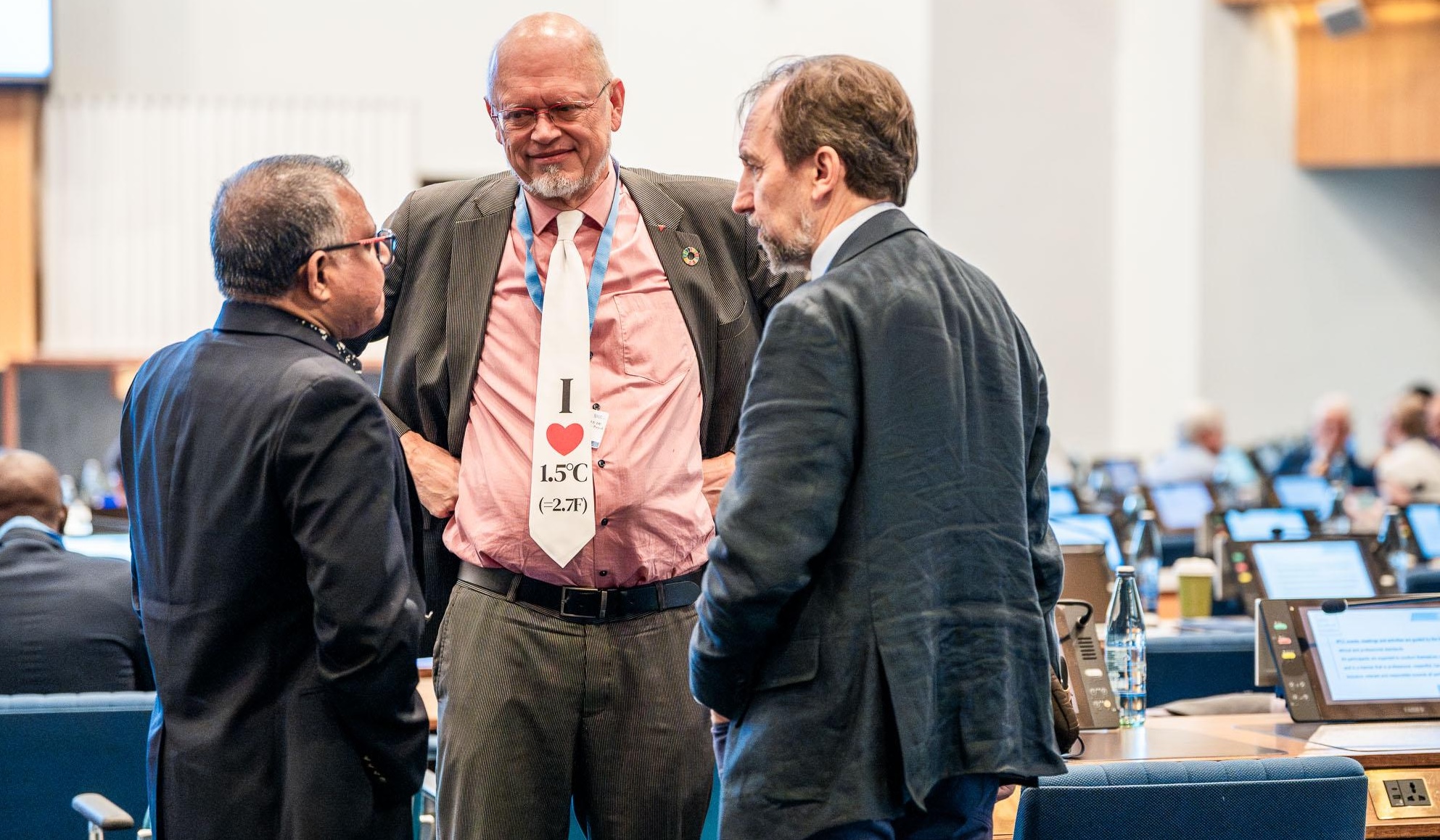
Inclusivity proposal stalled
In a bid to unlock a solution for the AR7 timeline, countries discussed ways to improve the inclusivity of the IPCC’s work. One option put on the table was for the IPCC to expand its funding for delegates from developing countries to attend some or all of its sessions from one to two participants, according to the ENB summary and a delegate speaking to Climate Home News.
That would increase the costs for the IPCC to complete AR7 by up to a quarter, according to an assessment shared by the secretariat. The panel’s budget is under severe strain and its officials have warned that, without additional voluntary contributions, it risks running out of money before it can deliver on this assessment cycle.
Climate Home News understands that some of the IPCC’s traditional donors – which mainly include European countries, Japan and Australia – indicated a willingness to support funding for an additional developing country participant. But without an agreement over the budget or the timeline for the reports, that option was ultimately not adopted.
‘Disappointed and worried’
The three reports are managed by working groups that collate and draw overall findings from the latest scientific studies and data on the physical effects of global warming around the world, how to adapt to it, and pathways for cutting planet-heating emissions in order to meet the temperature goals of the Paris Agreement.
Winston Chow, an urban climate professor at Singapore Management University who co-chairs Working Group II on adaptation, wrote in a LinkedIn post that he was “disappointed and worried” for the IPCC authors who have worked “extraordinarily hard” to assess the relevant climate science over the past two years.
He said he shared their concern that “the rigour, time and goodwill they’ve invested are now being put at risk by the Panel’s stalemate”.
As science comes under attack at UN talks, climate movement splits over how to respond
For Working Group II, a meeting for 250 experts writing that report is scheduled for January 2027, followed by the approval of a special report on cities and climate change in Singapore next March.
But because the IPCC’s budget has not been confirmed due to uncertainty about the AR7 schedule, travel support for those researchers is at risk, wrote Chow. “If they cannot participate, our assessments will lose vital expertise, perspectives and scientific breadth, and the collective effort of our authors will be undermined,” he warned.
Scientific work continues
Despite the political holdups, he – together with French climate scientist Robert Vautard, co-chair of Working Group 1 – agreed with IPCC head Skea who told the IPCC’s closing session on Friday: “The engine room of the IPCC is working, and it’s healthy.”
Vautard commented in a separate post on LinkedIn after it ended: “The boat is at full steam.” Working groups I and II are due to start revising the first drafts of their reports, while Working Group III on reducing emissions is finalising its first draft which will be out soon, he wrote.
“The most exciting two years of the cycle are ahead, for the authors. The momentum in the engine room is here and now. Trust the engine room!” he added.
The IPCC and some scientists report that progress has been made towards achieving an equitable balance of authors from the Global North and the Global South.
The group of researchers who signed the open letter on Monday noted that “inclusivity is at the heart of how we work”, with author teams bringing together experts from developed and developing countries with diverse backgrounds and at different stages of their careers.
Plea to overcome political differences
The signatories include several scientists from some of the countries opposed to the alignment of all IPCC reports with the Global Stocktake.
“We are committed to an assessment in which the knowledge, experience and priorities of every region are fully reflected, a commitment we share with the leadership of the IPCC.
Equity is built into how our assessment is being drafted,” they added.
They appealed to governments that make up the IPCC “to overcome their political differences and work together as we do as a global scientific community, so that we can deliver the IPCC reports the world needs to hear”.
In a statement published on Monday, IPCC chair Skea said reaching consensus on the schedule for the reports is “vital”. He added that the assessments provide authoritative scientific evidence to inform national climate policies, strengthen adaptation and resilienc