

China’s central government listed “boosting consumption…and stimulating domestic demand” as its first “major task” for 2025, at the recently closed “two sessions”.
As part of this focus – and amid slowing economic growth – the State Council made specific mention of China’s “two new” (两新) policy.
The policy was first announced in 2023, but was heavily promoted last year. President Xi Jinping reportedly “stressed the importance” of a national recycling company as part of the policy in 2024, because it “facilitates green, low-carbon and circular development”.
Carbon Brief explains what the policy is, how it works and what its impact will be. An abridged version of the article appeared in China Briefing on 20 March.
What is ‘two new’?
The “two new” policy is short for “large-scale equipment upgrades and trade-in of consumer goods”. It is designed to boost domestic demand to prop up growth, at the same time as improving the efficiency of equipment so as to lower emissions.

According to the Communist party’s leading magazine on ideology Qiushi, the idea was first raised in 2023 at an economic conference held by the State Council for “improving technology, energy consumption, emissions and other standards”.
It became well-known after Xi reiterated the idea in early 2024. In March 2024, the policy then became an “action plan – a document illustrating specific methods for executing a political goal.
Prof Bai Quan, director of energy transition at the Academy of Macroeconomic Research – a research institution under the direct supervision of the State Council – told Carbon Brief in 2024 that there are four aspects of “two new”:
- Updates to equipment such as large boilers, turbines, heat pumps and lighting used for manufacturing;
- Trade-in of consumer goods, including fridges and air conditioners;
- Recycling of old or high-emission items;
- Improving standards for product efficiency and emissions, as well as for recycling, “to prevent people from re-purchasing outdated equipment with low energy efficiency”.
He added that the first three aspects directly “promote carbon reduction” and the last one “indirectly serves energy saving and carbon reduction goals”.
Under the policy, government subsidies are provided for manufacturers and consumers to trade-in old inefficient goods and purchase new ones. Other financial and tax support is given to recyclers to increase recycling.
-
Sign up to Carbon Brief’s free “China Briefing” email newsletter. All you need to know about the latest developments relating to China and climate change. Sent to your inbox every Thursday.
In 2025, the State Council updated the “two new” policy and increased the funds available to consumers and businesses.
It also expanded the range of trade-in products, adding more and older petrol cars for instance, as well as pledging to release a more detailed trade-in standard covering 294 items by the end of the year.
Li Gang, an official from the Ministry of Commerce, is quoted by the state news agency Xinhua saying at the press conference on the expansion that it would “help stimulate consumer spending and boost domestic demand. All enterprises, domestic or foreign-funded, private or state-owned, are welcome to participate in the scheme.”
How does equipment upgrade work?
A fundamental mechanism of “two new” is providing funding that enables consumers and businesses to trade-in and upgrade goods, as well as recycling the old equipment.
For example, under the policy, a consumer can trade in an old, inefficient petrol car and receive subsidies to upgrade to a new electric vehicle (EV) instead.
The government “work report” delivered by premier Li Qiang at the “two sessions” says that “ultra-long special treasury bonds totaling 300bn yuan ($41bn) will be issued to support consumer goods trade-in programmes” in 2025.
Meanwhile, another 700bn yuan ($96bn) will be allocated for a sister programme, known as “two major [projects]” (两重), which supports infrastructure construction, including roads and railways.
In a more detailed “two new” paper, the State Council says it will provide about 90% of the funds and the rest shall be covered by local governments.
A sum of cash will be given when old “high-emission” goods, such as ships, trucks, tractors and buses, are sent for recycling, depending on the age and emission levels. Some discounts will also be given when purchasing new lower-emission replacements.
Separately, companies can apply for a low-interest loan for large-scale equipment upgrades.
The State Council paper also eases the rules around low-interest loans for equipment upgrades, making it easier for small and medium-sized enterprises to access them.
According to the paper, projects that can apply funds from the cash pool include “equipment renewal in the field, as well as energy conservation, carbon reduction and safety transformation in key industries”, such as transports and agriculture.
The policy also allocates around 7.5bn yuan ($1bn) for the “recycling and treatment of waste electrical and electronic products”. This extends beyond the list of trade-in items.
How does ‘two new’ support recycling?
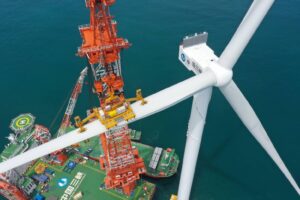
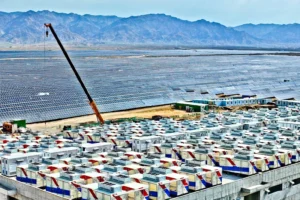
As the world’s largest renewable energy producer, China has so far built some 1,408 gigawatts (GW) of wind and solar capacity. About 35m tonnes of waste from decommissioned wind and solar equipment will need to be recycled in China by 2030.
A research paper in the journal Waste Management suggests building up sufficient capacity to recycle this waste could generate “significant economic benefits”.
However, Shanghai-based outlet the Paper reports that only a limited number of recyclers are on the market, due to the high costs and long payback periods.
Despite Beijing issuing policies in 2023 and 2024 to encourage businesses, a stronger recycling market is needed for “advancing” the “two new”, according to prof Du Huanzheng, director of the Circular Economy Research Institute of Tongji University.
In 2024, a state-owned recycling company, China Resources Recycling Group, was established to handle scrap steel, EV batteries and decommissioned renewable energy equipment.
But “challenge[s]” remain for private recyclers, Bai told Carbon Brief. One obstacle is missing a “first receipt”, which is the purchase receipt from manufacturers that enables recyclers to claim value-added tax deductions, he said.
A supporting policy for the “two new” from 2024 allows qualified recyclers to use their purchasing invoice in place of “first receipt” for tax claims.
Bai said this policy “solved the problem” and “is a very important incentive to meet the 2027 goals” of the “two new” policy.
The 2027 goals, written by the State Council, include a 25% increase in new equipment investment across key sectors and a doubling in the share of cars being recycled:
“By 2027, the scale of equipment investment in industries such as industry, agriculture, construction, transportation…will increase by more than 25% compared with 2023; the energy efficiency of major energy-consuming equipment in key industries will basically reach the energy-saving level, and the proportion of production capacity with environmental protection performance reaching Class A will be greatly increased…The amount of scrapped cars recycled will increase by about one-fold compared with 2023.”
How does trade-in work under ‘two new’?
Li Shuo, director of China Climate Hub at the Asia Society Policy Institute (ASPI), tells Carbon Brief that this is not the first time China used subsidies and “similar initiatives” to “stimulate consumption, address product oversupply and enhance energy efficiency”.
In 2025, the categories of eligible trade-in goods under “two new” is expanding from eight to 12, including mobile phones and fridges that are closely related to daily usage. Up to 500 yuan ($70) subsidies apiece can be applied when purchasing new digital products from 2025.
Electric vehicles (EVs), which can greatly decarbonise road transport, remain on the list. In addition, scrappage subsidies have been extended to more and newer types of petrol cars – including cars registered from 2012-14 rather than 2011-2013.
Li adds that the latest expansion of the policy “highlights the rapid pace of industrial upgrades in China and the mutually reinforcing dynamics of industrial productivity, a favorable regulatory framework, and the sheer scale of the Chinese market”.
Bloomberg says that “the cash-for-clunkers program gave a big boost to sales – especially of EVs and hybrids – after its introduction last year” and “manufacturers and investors had been eagerly waiting to see whether the subsidy” would be renewed in 2025.
The buyer rebates for vehicles, including EVs and more efficient petrol cars, remain at the same level as in the second half of 2024, after a rise last August.
Buyers can receive up to 20,000 yuan ($2,730) for EVs and plug-in hybrids or 15,000 yuan ($2,073) for petrol cars with an engine smaller than two litres.
(The Chinese EV industry receives a complicated range of subsidies, read more in Carbon Brief’s Q&A on the sector.)
What is the impact?
Xinhua says that the trade-in scheme boosted sales of cars in 2024, with new energy vehicles (NEVs, mainly EVs and plug-in hybrids) accounting for more than 60% of the new vehicles bought under the initiative in 2024.
Meanwhile, products certified with the “highest energy-efficiency level” made up more than 90% of sales by revenue under the home appliance trade-in scheme, adds the report.
An analysis by Goldman Sachs says the trade-in subsidies have “accelerated” the rising share of NEVs in Chinese car sales. It says the policy will help raise the NEV share from 48% in 2024 to about 60% in 2025.
Subsidies for NEVs under “two new” have amounted to 90bn yuan ($12bn), accounting for about 60% of the total “trade-in money”, according to Goldman Sachs.
In his 2024 analysis for Carbon Brief, Lauri Myllyvirta, lead analyst at the Centre lead analyst at the Centre for Research on Energy and Clean Air (CREA), wrote that the trade-in subsidy scheme would “free up household cash for other types of spending, but it also directs household spending in the most energy-intensive direction”.
He tells Carbon Brief that the policy, after the 2025 expansion, is still a “much more limited measure than the kinds of income transfers that would be needed to substantially boost the role of household consumption in driving economic growth”. He adds:
“[It] targets the most energy-intensive part of household spending, purchases of energy-intensive manufactured goods, while leaving out spending on services and other less energy intensive sectors.”
Lynn Song, chief economist for Greater China from market research firm ING, tells Carbon Brief that it is “hard to quantify [the impact of ‘two new’] until we have more specifics rolled out such as what level of subsidies will be applied”. He says:
“The 300bn budget for the programme sounds a little small at first thought – under 1% of total retail sales last year – but it will boost sales beyond the 300bn [yuan] spent, so it should result in a fairly significant bump in my view.
“Looking at last year’s performance once the policies started ramping up in the second half of the year, we saw autos and home appliances easily outperform the headline retail sales growth.”
Song adds that the trade-in subsidies under “two new” can “lead to improved demand for these categories this year”.
In his 2024 interview with Carbon Brief, Bai called the “two new” a “sign” of the government using policy support to stimulate lower-carbon consumption. He added:
“Another vital policy is the ‘guidelines to ramp up green transition of economic, social development’… It is a blueprint of China’s transition in industry, building [construction], transportation, energy and many other areas. Together with the ‘two new’, which is an implementation document for this top-level design, we now have both a direction and a manual for the energy transition.”
The guideline aims to “achieve ‘remarkable results’ in the green transition” by 2030 and establish a “green, low-carbon and circular development economic system” by 2035.
(Read more about the guideline in China Briefing.)
An official release says that the “two new” policy “saved about 28m tonnes of standard coal and reduced carbon dioxide [CO2] emissions by about 73m tonnes” in 2024. It says the “effect” of supporting the low-carbon transition was “obvious”.

The post Q&A: How China’s ‘two new’ policy aims to help cut emissions appeared first on Carbon Brief.
Q&A: How China’s ‘two new’ policy aims to help cut emissions

Three countries have been named by the Paris Agreement’s compliance committee for failing to submit a nationally determined contribution (NDC) and repeatedly snubbing offers of help with their climate plans.
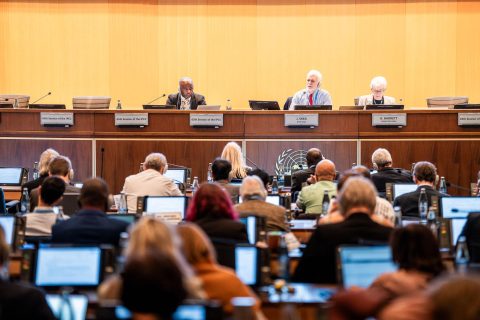
After months of internal debate over whether to identify serial non-responders, the Paris Agreement’s Implementation and Compliance Committee (PAICC) named the three countries which have failed to engage with it over their NDCs on Friday.
It named Democratic Republic of Congo, Senegal and North Korea in a footnote of its annual report, adding that it decided to name them “with a view to facilitating engagement”, adding that representatives of the three nations had been invited to its meeting in early 2027 “with the purpose of identifying any challenges and constraints”.
“The Committee noted the importance of Parties engaging with the Committee in a timely manner, while noting that some delays may be due to the national capabilities and circumstances of the Parties”, the report said.
-
Under US pressure, World Bank says it will back gas “where appropriate”
The US wants the World Bank to expand its gas support while climate campaigners are pushing for it to end – its head spoke this week of limited backing for the fossil fuel -
IPCC scientists vow to press on with climate reports despite political deadlock
After governments again failed to agree a timeline, nearly 120 IPCC authors pledged to complete their assessment on time and with full scientific rigour -
Paris Agreement committee snubbed over missing NDC climate plans
Many governments have still not submitted a nationally determined contribution to the UN, breaching a key requirement of the Paris Agreement


In July, PAICC said 12 countries had ignored its repeated attempts to discuss why they had not published an NDC as required every five years under the 2015 Paris accord.
Members of the committee had been divided over whether to name them, but at a September meeting decided to do so in their annual report to the annual climate COP summit.
By the time the report was published on Friday, only Congo, Senegal and North Korea “had not communicated an NDC or submitted a [Biennial Transparency Report] and had not yet responded to any of the Committee’s notifications, despite several reminders issued by the Committee in this regard”.
Rainforest and renewable energy ambitions
The silence from Congo and Senegal is notable because the former is home to much of the Congo Basin rainforest while the latter has sought billions of dollars in climate finance to support its renewable energy ambitions.
After Brazil, Congo has more rainforest than any country in the world. This forest, and the country’s peatlands, absorb huge amounts of greenhouse gas but are fast being lost to expanding farmland, charcoal production, logging and mining.
Senegal signed a Just Energy Transition Partnership with Canada and wealthy European nations in 2023, to help it meet its renewable energy targets under the-then government of Macky Sall. It was chair of the Least Developed Countries group between January 2022 and December 2023.

Tejas Rao, who is researching the PAICC as part of a doctoral thesis at Cambridge University, said the governments of the three countries should engage with the committee.
“Engagement costs these governments very little and the committee has shown it will listen,” he said.
“Silence leaves the committee with no basis to help, and it leaves the [governments] exposed to the narrative that they are simply disengaged,” he told Climate Home News.
Paris Agreement requirement
The 2015 Paris Agreement requires all parties to publish an NDC every five years outlining their emissions reduction targets, with each plan meant to be more ambitious than the country’s last NDC.
The latest set – the third round of plans, with new targets for 2035 – was due in February 2025. While most countries missed this deadline, all but around 30 – mostly small emitters but including Egypt, Vietnam and Argentina – have now submitted them.
Over the year, the PAICC – which is made up of government climate officials from developed and developing countries – has been communicating with governments that have not submitted NDCs and trying to overcome barriers to them doing so.
Some nations have cited exceptional circumstances as the reason for not submitting an NDC, a process that requires a significant amount of work in tracking emissions and consulting on how to curb them across the economy. For example, a letter from a Sudanese official to the PAICC, seen by Climate Home News, said that the country’s civil war had led to the suspension of its NDC preparation.
-
IPCC scientists vow to press on with climate reports despite political deadlock
After governments again failed to agree a timeline, nearly 120 IPCC authors pledged to complete their assessment on time and with full scientific rigour -
Under US pressure, World Bank says it will back gas “where appropriate”
The US wants the World Bank to expand its gas support while climate campaigners are pushing for it to end – its head spoke this week of limited backing for the fossil fuel -
Who shapes climate science? The equity question facing the IPCC
Early completion of the next global climate science assessment reports risks excluding research from the Global South, which is key to ensuring the findings are fair
The US and Iran are not signed up to the Paris Agreement and so do not have active NDCs, nor does Taiwan, which is not a UN member state.
Rao said that because the PAICC is “facilitative and non-punitive”, naming the countries “is meant to open a door, not close one – the invited consultation is the point”.
“In recent months, governments that explained their constraints, whether capacity, finance or domestic process, have been met with follow-up and support rather than sanction, and the number of silent governments has fallen sharply,” Rao said.
The post Paris Agreement committee names three countries snubbing it over NDCs appeared first on Climate Home News.
Paris Agreement committee names three countries snubbing it over NDCs