

Welcome to Carbon Brief’s China Briefing.
China Briefing handpicks and explains the most important climate and energy stories from China over the past fortnight. Subscribe for free here.
Key developments
Record power and gas demand
DOMESTIC TURBINES: China’s top economic planning body, the National Development and Reform Commission (NDRC), expects both electricity demand and gas demand to hit the “highest level yet recorded in winter”, reported Reuters. Data from a sample of coal plants nevertheless showed a recent drop in output year-on-year. Meanwhile, China has developed a “high-efficiency” gas turbine which will “strengthen[ China’s] power grid with low-carbon electricity”, said state news agency Xinhua. According to Bloomberg, the turbine is the first to have been fully produced in China, helping the country to “reduce reliance on imported technology amid a global shortage of equipment”.
‘SUBDUED’ OIL GROWTH: Chinese oil demand is likely to “remain subdued” until at least the middle of 2026, reported Bloomberg. Next year will see “one of the lowest growth rates in China in quite some time”, said commodities trader Trafigura’s chief economist Saad Rahim, reported the Financial Times. Demand is set to plateau until 2030, according to research linked to “state oil major” CNPC, said Reuters. In the building materials industry, carbon dioxide (CO2) emissions are “projected to fall by 25%” in 2025 relative to pre-2021 levels, China Building Materials Federation president Yan Xiaofeng told state broadcaster CCTV.
FLAT EMISSIONS GROWTH: China’s CO2 emissions in 2024 grew by 0.6% year-on-year, reported Xinhua, citing the newly released China Greenhouse Gas Bulletin (2024). This represented a “significant narrowing from the 2023 increase and remains below the global average growth rate of 0.8%”, it added. (The bulletin confirms analysis for Carbon Brief published in January, which put China’s 2024 emissions growth at 0.8%.)

China-France climate statements
CLIMATE BONHOMIE: During a visit by French president Emmanuel Macron to China, the two countries signed a joint statement on climate change, reported Xinhua. It published the full text of the statement, which pledged more cooperation on “accelerating” renewables globally, as well as “enhancing communication” in carbon pricing, methane, adaptation and other areas. It also said China and France would support developing countries’ access to climate finance, adding that developed nations will “take the lead in providing and mobilising” this “before 2035”, while encouraging developing countries to “voluntarily contribute”.
MORE COOPERATION: China and France issued separate statements on “nuclear energy” cooperation, Xinhua reported, as well as on expanding cooperation on the “green economy”, according to the Hong Kong-based South China Morning Post.
EU’s new ‘economic security’ package
NEW PLANS, SAME TOOLS: Meanwhile, the EU has issued new plans to “boost EU resilience to threats like rare-earth shortages”, said Reuters, including an “economic security doctrine” that would encourage “new measures…designed to counter unfair trade and market distortions, including overcapacity”. A second plan on critical minerals will “restrict exports of [recyclable] rare-earth waste and battery scrap” to shore up supplies for “electric cars, wind turbines and semiconductors”, according to another Reuters article. Euractiv characterised the policy package as a “reframing of existing tools and plans”.
-
Sign up to Carbon Brief’s free “China Briefing” email newsletter. All you need to know about the latest developments relating to China and climate change. Sent to your inbox every Thursday.
‘NOT VERY CREDIBLE’: EU climate commissioner Wopke Hoekstra told the Financial Times that the latest push against the bloc’s carbon border adjustment mechanism (CBAM), which the outlet said is “led by China, India and Saudi Arabia”, was “not very credible”. A “GT Voice” comment in the state-supporting Global Times said the CBAM exposed a dilemma around the “absence of a globally accepted, transparent and equitable standard for measuring carbon footprints”. It called CBAM a “pioneering step”, but said climate efforts needed “greater international coordination, not unilateral enforcement”.
FIRST REVIEW: The EU has undertaken its first “formal review” of the tariffs placed on Chinese-made electric vehicles (EVs), assessing a price undertaking offer submitted by Volkswagen’s Chinese joint venture, reported SCMP. Chinese EVs – including both hybrid and pure EVs – saw their “second-best month on record” in October, with sales coming down slightly from September’s peak, said Bloomberg.
More China news
- ECONOMIC SIGNALS: At the central economic work conference, held in Beijing on 10-11 December, President Xi Jinping said China would adhere to the “dual-carbon” goals and promote a “comprehensive green transition”, reported Xinhua.
- EFFORTS ‘INTENSIFIED’: Ahead of the meeting, premier Li Qiang also noted earlier that energy conservation and carbon reduction efforts must be “intensified”, according to the People’s Daily.
- JET FUEL: A major jet fuel distributor is being acquired by oil giant Sinopec, which could “risk slowing [China’s] push to decarbonise air travel”, reported Caixin.
- SLOW AND STEADY: An article in the People’s Daily said China’s energy transition is “not something that can be achieved overnight”.
- ‘ECO-POLICE’: China’s environment ministry published a draft grading system for “atmospheric environmental performance in key industries”, including assessment of “significant…carbon emission reduction effects”, noted International Energy Net. China will also set up an “eco-police” mechanism in 2027, China Daily said.
- INNOVATION INITIATIVE: The National Energy Administration issued a call for the “preliminary establishment of a new energy system that is clean, low-carbon, safe and efficient” in the next five years, reported BJX News. The plan also noted: “Those who take the lead in [energy technology] innovation will gain the initiative.”
Spotlight
Interview: How ‘mid-level bureaucrats’ are helping to shape Chinese climate policy
Local officials are viewed as relatively weak actors in China’s governance structure.
However, a new book – “Implementing a low-carbon future: climate leadership in Chinese cities” – argues that these officials play an important role in designing innovative and enduring climate policy.
Carbon Brief interviews author Weila Gong, non-resident scholar at the UC San Diego School of Global Policy and Strategy’s 21st Century China Center and visiting scholar at UC Davis, on her research.
Below are highlights from the conversation. The full interview is published on the Carbon Brief website.
Carbon Brief: You’ve just written a book about climate policy in Chinese cities. Could you explain why subnational governments are important for China’s climate policy in general?
Weila Gong: China is the world’s largest carbon emitter [and] over 85% of China’s carbon emissions come from cities.
We tend to think that officials at the provincial, city and township levels are barriers for environmental protection, because they are focused on promoting economic growth.
But I observed these actors participating in China’s low-carbon city pilot. I was surprised to see so many cities wanted to participate, even though there was no specific evaluation system that would reward their efforts.
CB: Could you help us understand the mindset of these bureaucrats? How do local-level officials design policies in China?
WG: We tend to focus on top political figures, such as mayors or [municipal] party secretaries. But mid-level bureaucrats [are usually the] ones implementing low-carbon policies.
Mid-level local officials saw [the low-carbon city pilot] as a way to help their bosses get promoted, which in turn would help them advance their own career. As such, they [aimed to] create unique, innovative and visible policy actions to help draw the attention [of their superiors].
They are also often more interested in climate issues if it is in the interest of their agency or local government.
Another motivation is accessing finance [by using] pilot programmes, if their ideas impress the central-level government.
CB: Could you give an example of what drives innovative local climate policies?
WG: National-level policies and pilot programme schemes provide openings for local governments to think about how and whether they should engage more in addressing climate change.
By experiment[ing] with policy at a local level, local governments help national-level officials develop responses to emerging policy challenges.
Local carbon emission trading systems (ETSs) are an example.
One element that made the Shenzhen ETS successful is “entrepreneurial bureaucrats” [who have the ability to design, push through and maintain new local-level climate policies].
Even though we might think local officials are constrained in terms of policy or financial resources, they often have the leverage and space to build coalitions…and know how to mobilise political support.
CB: What needs to be done to strengthen sub-national climate policy making?
WG: It’s very important to have groups of personnel trained on climate policy…[Often] climate change is only one of local officials’ day-to-day responsibilities. We need full-time staff to follow through on policies from the beginning right up to implementation.
Secondly, while almost all cities have made carbon-peaking plans, one area in which the government can make further progress is data.
Most Chinese cities haven’t yet established regular carbon accounting systems, [and only have access to] inadequate statistics. Local agencies can’t always access detailed data [held at the central level]…[while] much of the company-level data is self-reported.
Finally, China will always need local officials willing to try new policy instruments. Ensuring they have the conditions to do this is very important.
Watch, read, listen
BREAKNECK SPEED: In a conversation with the Zero podcast, tech analyst Dan Wang outlined how an “engineering mindset” may have given China the edge in developing clean-energy systems in comparison to the US.
QUESTION OF CURRENCY: Institute of Finance and Sustainability president Ma Jun and Climate Bonds Initiative CEO Sean Kidney examined how China’s yuan-denominated loans can “ease the climate financing crunch” in the South China Morning Post.
DRIVING CHANGE: Deutsche Welle broadcast a report on how affordable cleantech from China is accelerating the energy transition in global south countries.
EXPOSING LOOPHOLES: Economic news outlet Jiemian investigated how a scandal involving the main developer of pumped storage capacity in China revealed “regulatory loopholes” in constructing such projects.
$180 billion
The amount of outward direct investment Chinese companies have committed to cleantech projects overseas since 2023, according to a new report by thinktank Climate Energy Finance.
New science
- A new study looking at battery electric trucks across China, Europe and the US showed they “can reach 27-58% reductions in lifecycle CO2 emissions compared with diesel trucks” | Nature Reviews Clean Technology
- “Shortcomings remain” in China’s legal approach to offshore carbon capture, utilisation and storage, such as a lack of “specialised” legal frameworks | Climate Policy
China Briefing is written by Anika Patel and edited by Simon Evans. Please send tips and feedback to china@carbonbrief.org

The post China Briefing 11 December 2025: Winter record looms; Joint climate statement with France; How ‘mid-level bureaucrats’ help shape policy appeared first on Carbon Brief.

Drought and heatwaves occurring together – known as “compound” events – have “surged” across the world since the early 2000s, a new study shows.
Compound drought and heat events (CDHEs) can have devastating effects, creating the ideal conditions for intense wildfires, such as Australia’s “Black Summer” of 2019-20 where bushfires burned 24m hectares and killed 33 people.
The research, published in Science Advances, finds that the increase in CDHEs is predominantly being driven by events that start with a heatwave.
The global area affected by such “heatwave-led” compound events has more than doubled between 1980-2001 and 2002-23, the study says.
The rapid increase in these events over the last 23 years cannot be explained solely by global warming, the authors note.
Since the late 1990s, feedbacks between the land and the atmosphere have become stronger, making heatwaves more likely to trigger drought conditions, they explain.
One of the study authors tells Carbon Brief that societies must pay greater attention to compound events, which can “cause severe impacts on ecosystems, agriculture and society”.
Compound events
CDHEs are extreme weather events where drought and heatwave conditions occur simultaneously – or shortly after each other – in the same region.
These events are often triggered by large-scale weather patterns, such as “blocking” highs, which can produce “prolonged” hot and dry conditions, according to the study.
Prof Sang-Wook Yeh is one of the study authors and a professor at the Ewha Womans University in South Korea. He tells Carbon Brief:
“When heatwaves and droughts occur together, the two hazards reinforce each other through land-atmosphere interactions. This amplifies surface heating and soil moisture deficits, making compound events more intense and damaging than single hazards.”
CDHEs can begin with either a heatwave or a drought.
The sequence of these extremes is important, the study says, as they have different drivers and impacts.
For example, in a CDHE where the heatwave was the precursor, increased direct sunshine causes more moisture loss from soils and plants, leading to a drought.
Conversely, in an event where the drought was the precursor, the lack of soil moisture means that less of the sun’s energy goes into evaporation and more goes into warming the Earth’s surface. This produces favourable conditions for heatwaves.
The study shows that the majority of CDHEs globally start out as a drought.
In recent years, there has been increasing focus on these events due to the devastating impact they have on agriculture, ecosystems and public health.
In Russia in the summer of 2010, a compound drought-heatwave event – and the associated wildfires – caused the death of nearly 55,000 people, the study notes.

The record-breaking Pacific north-west “heat dome” in 2021 triggered extreme drought conditions that caused “significant declines” in wheat yields, as well as in barley, canola and fruit production in British Columbia and Alberta, Canada, says the study.
Increasing events
To assess how CDHEs are changing, the researchers use daily reanalysis data to identify droughts and heatwaves events. (Reanalysis data combines past observations with climate models to create a historical climate record.) Then, using an algorithm, they analyse how these events overlap in both time and space.
The study covers the period from 1980 to 2023 and the world’s land surface, excluding polar regions where CDHEs are rare.
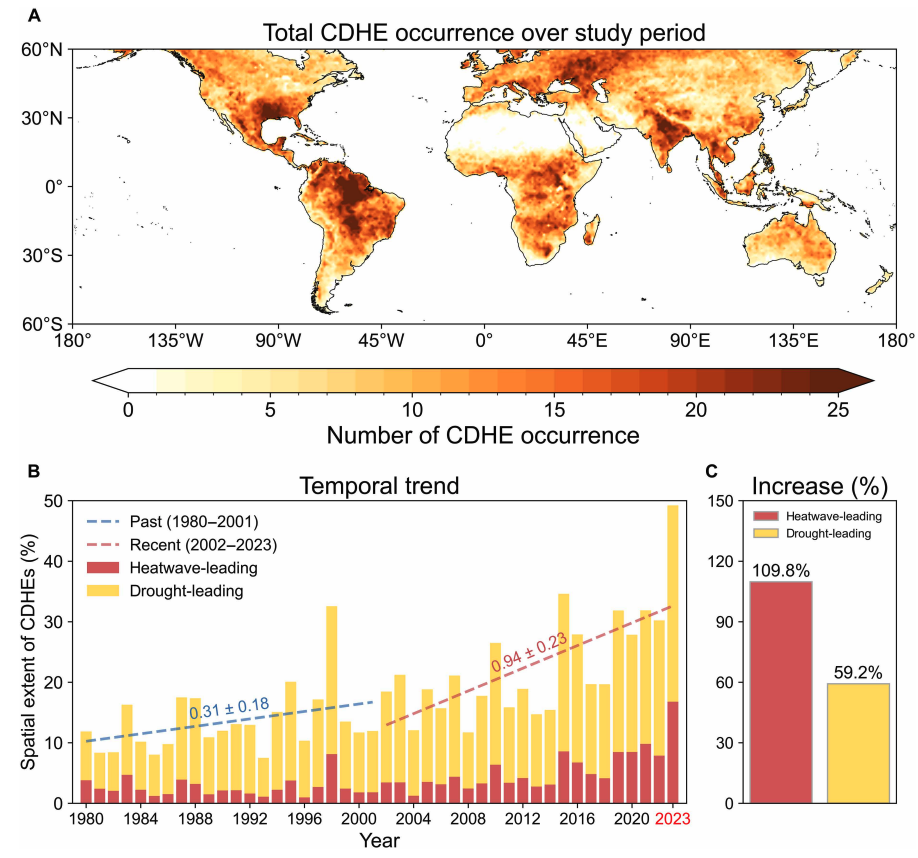
The research finds that the area of land affected by CDHEs has “increased substantially” since the early 2000s.
Heatwave-led events have been the main contributor to this increase, the study says, with their spatial extent rising 110% between 1980-2001 and 2002-23, compared to a 59% increase for drought-led events.
The map below shows the global distribution of CDHEs over 1980-2023. The charts show the percentage of the land surface affected by a heatwave-led CDHE (red) or a drought-led CDHE (yellow) in a given year (left) and relative increase in each CDHE type (right).
The study finds that CDHEs have occurred most frequently in northern South America, the southern US, eastern Europe, central Africa and south Asia.
Threshold passed
The authors explain that the increase in heatwave-led CDHEs is related to rising global temperatures, but that this does not tell the whole story.
In the earlier 22-year period of 1980-2001, the study finds that the spatial extent of heatwave-led CDHEs rises by 1.6% per 1C of global temperature rise. For the more-recent period of 2022-23, this increases “nearly eightfold” to 13.1%.
The change suggests that the rapid increase in the heatwave-led CDHEs occurred after the global average temperature “surpasse[d] a certain temperature threshold”, the paper says.
This threshold is an absolute global average temperature of 14.3C, the authors estimate (based on an 11-year average), which the world passed around the year 2000.
Investigating the recent surge in heatwave-leading CDHEs further, the researchers find a “regime shift” in land-atmosphere dynamics “toward a persistently intensified state after the late 1990s”.
In other words, the way that drier soils drive higher surface temperatures, and vice versa, is becoming stronger, resulting in more heatwave-led compound events.
Daily data
The research has some advantages over other previous studies, Yeh says. For instance, the new work uses daily estimations of CDHEs, compared to monthly data used in past research. This is “important for capturing the detailed occurrence” of these events, says Yeh.
He adds that another advantage of their study is that it distinguishes the sequence of droughts and heatwaves, which allows them to “better understand the differences” in the characteristics of CDHEs.
Dr Meryem Tanarhte is a climate scientist at the University Hassan II in Morocco, and Dr Ruth Cerezo Mota is a climatologist and a researcher at the National Autonomous University of Mexico. Both scientists, who were not involved in the study, agree that the daily estimations give a clearer picture of how CDHEs are changing.
Cerezo-Mota adds that another major contribution of the study is its global focus. She tells Carbon Brief that in some regions, such as Mexico and Africa, there is a lack of studies on CDHEs:
“Not because the events do not occur, but perhaps because [these regions] do not have all the data or the expertise to do so.”
However, she notes that the reanalysis data used by the study does have limitations with how it represents rainfall in some parts of the world.
Compound impacts
The study notes that if CDHEs continue to intensify – particularly events where heatwaves are the precursors – they could drive declining crop productivity, increased wildfire frequency and severe public health crises.
These impacts could be “much more rapid and severe as global warming continues”, Yeh tells Carbon Brief.
Tanarhte notes that these events can be forecasted up to 10 days ahead in many regions. Furthermore, she says, the strongest impacts can be prevented “through preparedness and adaptation”, including through “water management for agriculture, heatwave mitigation measures and wildfire mitigation”.
The study recommends reassessing current risk management strategies for these compound events. It also suggests incorporating the sequences of drought and heatwaves into compound event analysis frameworks “to enhance climate risk management”.
Cerezo-Mota says that it is clear that the world needs to be prepared for the increased occurrence of these events. She tells Carbon Brief:
“These [risk assessments and strategies] need to be carried out at the local level to understand the complexities of each region.”



The post Heatwaves driving recent ‘surge’ in compound drought and heat extremes appeared first on Carbon Brief.
Heatwaves driving recent ‘surge’ in compound drought and heat extremes
Greenhouse Gases
DeBriefed 6 March 2026: Iran energy crisis | China climate plan | Bristol’s ‘pioneering’ wind turbine
Welcome to Carbon Brief’s DeBriefed.
An essential guide to the week’s key developments relating to climate change.
This week
Energy crisis
ENERGY SPIKE: US-Israeli attacks on Iran and subsequent counterattacks across the Middle East have sent energy prices “soaring”, according to Reuters. The newswire reported that the region “accounts for just under a third of global oil production and almost a fifth of gas”. The Guardian noted that shipping traffic through the strait of Hormuz, which normally ferries 20% of the world’s oil, “all but ground to a halt”. The Financial Times reported that attacks by Iran on Middle East energy facilities – notably in Qatar – triggered the “biggest rise in gas prices since Russia’s full-scale invasion of Ukraine”.
‘RISK’ AND ‘BENEFITS’: Bloomberg reported on increases in diesel prices in Europe and the US, speculating that rising fuel costs could be “a risk for president Donald Trump”. US gas producers are “poised to benefit from the big disruption in global supply”, according to CNBC. Indian government sources told the Economic Times that Russia is prepared to “fulfil India’s energy demands”. China Daily quoted experts who said “China’s energy security remains fundamentally unshaken”, thanks to “emergency stockpiles and a wide array of import channels”.
‘ESSENTIAL’ RENEWAB