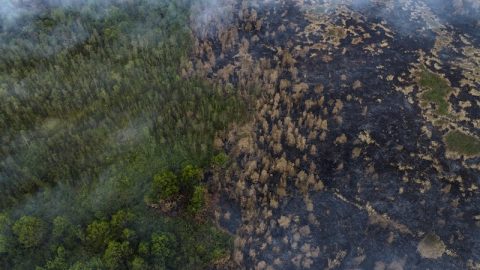
In a cosy cinema room at the Bełchatów coal-fired power station in central Poland, a promotional video played to curious visitors boasts that the open-pit mine which feeds the power station is one of the largest holes ever dug in the ground.
The caverns of the Bełchatów coal mine are wide enough to fit around 5,000 full-sized football pitches and are rich in lignite – a soft, brown and wet type of coal which looks and feels like tree bark but is particularly damaging to human health when burned.
After more than 40 years of mining, the lignite is running out and plans are being made to wind down operations at the site.
PGE, the Polish state-owned utility which runs the mine and adjacent power plant – the largest and dirtiest in Europe – has a 45-year plan to turn the mining pits into the country’s deepest lake and the coal heaps into a series of hills for recreational use.
In 2070, PGE envisions visitors will be able to ski in the winter, golf, cycle, kayak, quad-bike, horse ride, climb and even scuba dive down to see the soon-to-be-underwater old mining machines.

PGE’s visualisation of what the redeveloped Bełchatów site will look like (Photos: PGE)
But local governments officials and researchers warn that the plans risk failing to deliver the green and economically fair transition deserved by Bełchatów communities whose livelihoods have depended on coal. They argue the plans could waste the site’s huge renewable energy potential while the tourist attraction fails to replace the at least 7,500 jobs that will be lost when the mine and power plant close, potentially driving away the region’s young people.
As deputy director of the Just Transition Fund Department of Łódź province where Bełchatów is located, Malgorzata Misiak’s job is to cushion the blow of the region’s transition away from coal and make sure the benefits of what replaces it are shared as equally as possible.
She told Climate Home PGE’s plan to let the mine gradually fill over decades overlooks the many more jobs that could be created in a much shorter time-frame with renewable energy investment.
Anabella Rosemberg, a senior adviser on just transition at Climate Action Network International, said: “PGE is pledging an investment on a timeline by which time all its executives will be retired, so won’t be held accountable if it fails. By then, the communities dependent on Bełchatów would have already joined the thousands considering that the transition is paid by poor people.”
Forum Energii analyst Aleksandra Gawlikowska-Fyk warned that PGE’s plan would also overlook the region’s need for clean energy.
PGE did not respond to a request from Climate Home for comment for this article, while a spokesperson for the white-collar Kadra trade union declined to comment by the time of publication.
Europe’s biggest polluter
Opened in what was then the Polish Peoples’ Republic in 1980, Bełchatów (pronounced Bel-hat-ov) grew to become the biggest coal mine and coal power station in Europe. It still employs about 7,500 people directly today and sustains many more jobs indirectly.
In recent years, the power plant has produced nearly a fifth of Poland’s electricity. Its importance to the nation’s energy security is such that, given the perceived threat from Russian spies, visitors including Climate Home News, are warned not to publish any photos of the site.
Because of its size, and coal’s status as the top polluting fossil fuel, Bełchatów is also by far Europe’s biggest greenhouse gas emitter. Its power plant pumps out 35 million tonnes of carbon dioxide equivalent a year – more than Mozambique’s total emissions.
But its coal is running out and because lignite is very difficult to transport, both the mine and power plant will soon shut down – although exactly when is unclear.
The local government’s 2021 just transition plan says the coal plant will gradually scale down operations through the 2030s until its closure in 2036, while mining will end by 2038.
For Misiak, this is the “official reality” – but in practice, things could turn out differently. “The real pace is dependent on many factors,” she said.
Two hours down the road from Bełchatów, Rybnik coal power plant was scheduled to close in 2030. Last month, PGE announced it would shut by the end of 2025 instead. The chair of Poland’s Solidarity trade union called it a “catastrophe for the region” as about 500 jobs will be lost at the plant, with more in the nearby mines and other suppliers.
People in Bełchatów fear the same fate, Misiak said. Researchers at the University of Łódź and a women’s community group called ‘Yes for Bełchatów’ conducted a survey of over 350 local women earlier this year for a report on the gender aspects of the region’s transition away from coal. It found they “are really afraid of negative consequences”.
From pits to ponds
Turning the mine into a leisure park offers a “nice picture” of what environmental rehabilitation can achieve, said Misiak. But the timescale involved is so long that it doesn’t offer the thousands of people who still earn their living from coal jobs any viable alternatives.
“People will not wait for work in tourism,” she said, adding “they will die” before then.
Even if the project did get off the ground, activities such as scuba diving and kayaking might not be an economic match for what the coal industry has been to the region in recent times, she said.
Over a lunch of dumplings and cheesecake in a hotel near the mine, Misiak delivered a presentation on Bełchatów’s transition to researchers who had travelled to Poland from around the world to learn about its approach to supporting communities affected by the shift away from coal.
The word “depopulation” followed by three exclamation marks stood out on one of her slides. The University of Łódź study found that young women in the region are already leaving for big cities inside Poland or going abroad, leaving behind an ageing community.
And the outflow of people could get worse. The researchers surveyed 65 women working in the energy industry – of which nearly a third said they were planning to leave the region when the mine and power plant shut down.
Listening to Misiak’s presentation in the hotel was Martha Mendrofa, of the Indonesian Institute for Essential Services Reform. Indonesian coal companies too have rehabilitated old mines as tourism assets, she said – from opening mining museums to eco-tourism experiences.
But the number of jobs and revenue generated has not met locals’ expectations nor made-up for the lost coal industry, she said.

The Geierswalder lake in Germany is on the site of an old coal mine, photographed on August 24, 2024 (Photo: IMAGO/Max Gaertner/via Reuters Connect)
In Germany and Australia, old coal mines have also been turned into lakes.
But converting the Polish site into a clean-energy generation hub would be a better long-term investment for the region, Misiak said.
A 2022 analysis by BloombergNEF (BNEF) lays out what replacing the coal mine and plant with solar and wind power, along with a bit of nuclear or gas generation, might look like.
It found that 6-11 gigawatts (GW) of renewable energy capacity could be built on the site, exceeding the coal plant’s 5 GW. But currently PGE plans to install just 0.7 GW of renewables capacity. Gawlikowska-Fyk said this was “far less than needed in the region and far less than possible”.
The BNEF report said solar panels could be installed on the shallower edges of the mine and around the main pits. As rainwater fills the deeper pits, floating solar farms could also be considered. “PGE could go significantly beyond its current plan to build [0.6 GW] of solar at Bełchatów,” the BNEF report concluded. The region could produce 5-15 GW of wind power too, it found.
Australian renewables pioneer Adelaide bids to host COP31 climate summit
Like all fossil-fuel power plants, Bełchatów is already equipped with infrastructure like transmission lines designed to transport electricity from where is is produced to where it is needed, such as the nearby steel mill in Częstochowa.
Permanently ending power generation on the site would let this expensive infrastructure go to waste, the BNEF analysis warned.
Outside of energy
Installing renewable energy infrastructure might create more local jobs than PGE’s lake plans, but even this might not be enough to replace lost coal employment, Misiak said.
Ensuring the region isn’t left behind in the energy transition would require attracting other investors and stimulating small businesses, she added.
Fortunately, Poland has access to European pots of funding for that purpose. The European Union’s Just Transition Fund is giving the province €369 million ($400m) to invest in activities like support for small businesses, research laboratories, retraining coal workers and deploying electric buses. Poland as a whole will get €3.85 billion ($4.16bn) to move to a lower-carbon economic model.
To capture renewable energy gains, Africa must invest in battery storage
The EU’s funds will stretch to pay for training, including driving lessons, to help local people find new jobs and cover entrepreneurs’ childcare so they can keep their businesses open longer, said Misiak.
The Polish government offers coal miners “generous” retraining opportunities, severance payments and pension schemes, she said, adding that the Belchatów miners will be comfortable in their retirement. But money isn’t everything – and many will feel “frustrated” at being jobless after years of hard graft, she explained.
Elsewhere around the world, governments are trying to transition communities away from coal without the huge resources Belchatów can tap into to help them.
Indonesia, for example, has a donor-backed Just Energy Transition Partnership bringing in billions of dollars from wealthy governments like the EU and international investors – but that money is likely to come mostly as loans for energy infrastructure. According to researcher Mendrofa, there is nothing like the EU’s Just Transition Fund with its emphasis on social justice.
“The money we do have right now is not really focused on the socioeconomic aspect of coal transitions,” she said, “so it’s very interesting for me to see how the money can be a catalyst for the economic transformations agenda.”
(Reporting by Joe Lo; editing by Chloe Farand and Megan Rowling)
The post Plans to turn Europe’s biggest coal mine into a leisure lake prove divisive appeared first on Climate Home News.
Plans to turn Europe’s biggest coal mine into a leisure lake prove divisive

Climate Change
“Sink or swim”: WA Gov hugely underestimating decline in regional gas demand while sleeping on green exports, new report finds
PERTH, Tuesday 13 October 2026 — A new report from Greenpeace Australia Pacific and Springmount Advisory reveals green commodity exports are an untapped economic opportunity for Western Australia in a declining Asian gas market, while offering a genuine solution for decarbonising Asia.
From Gas to Green: Building Western Australia’s Future State is a comprehensive analysis of the declining gas market in Asia, and the untapped economic opportunity for WA to become a global leader in green commodity exports while driving the regional shift away from fossil fuels.
The report offers key recommendations for the WA Government to support regional decarbonisation through an orderly phase out of gas exports in favour of green iron and other green exports. It comes as global climate leaders from across business, politics and advocacy prepare to meet for the Global Citizen Now: Perth event focused on decarbonising WA.
Key findings:
- Gas demand is falling across WA’s core markets in Asia: Gas demand fell in 2025 and is projected to continue to decline, driven by a combination of global geopolitical factors and domestic concerns.
- Policy shifts in key markets since the war on Iran now prioritise renewables and nuclear over gas: Japan, South Korea and China have legislated energy plans that prioritise renewables and nuclear over gas.
- New WA gas would arrive in a saturated, uncertain Asian market filled with cheaper gas: The US is now the world’s largest liquefied gas producer and plans to double its capacity as it also targets Asian markets.
- Green commodities offer a real solution to sustain WA’s economy: WA can lead Australia’s green commodity exports, which by 2060 could be worth almost a trillion dollars.
- Exporting more WA gas is likely to delay or impede Asia decarbonisation: Despite claims by the gas industry, there is no evidence that WA gas is displacing coal in Asia, and in fact diverts resources from genuine decarbonisation options.
Geoff Bice, WA Campaign Lead at Greenpeace Australia Pacific said: “As our export partners in Asia shift away from expensive and polluting gas, the WA Government has a golden opportunity to pivot our economy to green exports, like green iron, which is the most effective way to help our region to decarbonise.
“The writing is on the wall: gas is in decline, renewables are our future. In this context, it makes zero sense for the government to encourage high risk projects like Woodside’s reckless Browse gas proposal at Scott Reef.
“This report clearly shows that the WA Government faces a choice: sink or swim. They can either allow the gas industry to keep ripping off West Australians and continue propping up its decline, or choose the path that will deliver enormous benefits to the state and the world by becoming a leader in the rapidly expanding green economy.”
Tom Quinn, Managing Director of Springmount Advisory: “Western Australia prospers when it looks to the future and builds for future demand. Twenty years from now, what the world needs is green commodities made using WAs abundant renewable resources. Just like it did with iron ore in the 1950s and gas in the 1970s, WA should look to the future and build what the world will need, not sunsetting industries like gas that are already past their peak.”
-ENDS-
Media contact
Kate O’Callaghan on 0406 231 892 or kate.ocallaghan@greenpeace.org
Lucy Keller on 0491 135 308 or lucy.keller@greenpeace.org
A report from Greenpeace Australia Pacific and Springmount Advisory reveals the untapped green economic opportunity for Western Australia in a declining Asian gas market, which also offers a genuine solution for decarbonisation in Asia.
Is Western Australia clinging to a fading gas industry while a thriving green future passes it by? As major Asian trading partners rapidly pivot away from volatile gas imports toward cheap solar and battery storage, this report exposes a high-stakes choice: risk becoming stranded in an oversupplied fossil fuel market, or harness WA’s unmatched sun and wind to lead the global clean energy transition.
Summary
From Gas to Green: Building Western Australia’s Future State reveals that Western Australia (WA) faces a critical juncture as falling Asian gas demand, geopolitical gas supply volatility and accelerating renewable energy deployment undermine the long-term economic viability of gas exports. By harnessing its world-class wind and solar resources, the report demonstrates that WA can execute an orderly phase-out of gas and pioneer a green commodity export economy that could generate $987 billion in economic value by 2060, create 24,000 ongoing jobs, and drive a 9.6% reduction in global greenhouse gas emissions.
Key Findings
- Gas demand is falling in Asia – WA can no longer rely on gas exports: Gas demand in core Asian markets fell in 2025 and is projected to continue to decline in 2026. Legislated energy plans in Japan, South Korea, and China now prioritise renewables and nuclear over gas.
- Asia is increasing renewables, importing gas just gets in the way: Evidence from markets like Thailand suggests that gas imports are increasingly crowding out cheaper renewable energy investments and battery storage rather than displacing coal, locking in more emissions over time.
- Green commodities offer a real solution to decarbonise Asia – this is a major win for WA: With world-class renewables, WA can lead Australia’s green commodity exports, which by 2060 could be worth almost a trillion dollars ($987 billion) and support a genuine 9.6% reduction in global emissions.
Recommendations to WA government
Recommendation 1: Plan an orderly gas phase-out aligned with a trading partner pivot plan
Implement a managed, orderly phase-out of gas exports aligned with trading partners’ decarbonisation pathways, rather than waiting for demand to collapse, by:
- Developing and implementing a staged phase-out of gas facilities aligned with feedstock supply expiry or typical end of facility lifespans.
- Committing to no new gas development for gas expansion, including Browse and Kimberley fields.
- Developing new, reciprocal trade relationships with existing gas trade partners, structured to progressively replace gas exports with green commodities – integrated with recommendation 2.
Recommendation 2: Develop an integrated green commodity export strategy, positioning WA as a global green iron manufacturing hub
Establish an integrated green commodity export strategy that immediately prioritises green iron development, positioning WA as a global green iron manufacturing hub, by:
- Committing to green commodity export targets to give industry and investors a clear demand signal.
- Prioritising green iron as the lead sector within the broader green commodity strategy, given WA’s iron ore endowment and first-mover potential.
Recommendation 3: Reject false solutions such as carbon dumping (CCS) and blue hydrogen
Reject carbon dumping (also described as carbon capture and storage, or CCS) and blue hydrogen as viable decarbonisation technologies, and prioritise green hydrogen and proven renewables for clean energy and fuel production by:
- Excluding blue hydrogen projects (and CCS-dependent projects) from all government support programs.
- Requiring existing hydrogen-based production (including ammonia, methanol, synthetic fuels) to have clear, near-term transition timelines to switch to green hydrogen production.

What you can do
Together, we can push for a prosperous green future.
You can help by:
- Sending an email to Environment Minister Murray Watt and Prime Minister Anthony Albanese, calling on them to reject Browse.
- Sharing this story to help more Australians understand what’s at stake.
- Encouraging your friends and family to take action.
REPORT: “From Gas to Green” Building Western Australia’s Future State
Cleaner cooking projects in the UN carbon market will have to set aside a share of their credits to insure against the risk that the trees they save are lost to fire, drought or logging, after the market’s regulator rejected calls to exempt the sector.
The requirement is part of a new rulebook that the Paris Agreement carbon market regulator – the Article 6.4 Supervisory Body – approved last Friday for programmes that aim to cut emissions by distributing new and cleaner cookstoves in regions that still burn wood or charcoal for cooking.
These are the UN mechanism’s first rulebooks for cookstoves, one of the carbon market’s most popular credit types and also one of its most criticised for overstating climate benefits.
They consist of two methodologies: one for programmes that aim to cut greenhouse gas emissions by distributing more efficient cookstoves that burn less wood or charcoal, and a separate methodology for projects shifting households to lower-emissions cookers running on electricity or liquid petroleum gas (LPG).
Mkhuthazi Steleki, the South African chair of the Supervisory Body, said “this decision gives cleaner cooking projects a new pathway under the UN carbon market, with clear rules to ensure that each credit represents a real and credible emission reduction”.
Industry and NGOs lobby to weaken UN carbon credit rules in “coordinated” push
In copycat submissions and a private briefing to government officials, the groups have opposed a proposal to tighten safeguards for emissions offsets