

Palantir Technologies (PLTR) has become one of the most talked-about tech companies of 2025. Known for its data analytics and artificial intelligence (AI) software, the company has seen its stock surge more than 300% in the last year.
Investors see Palantir as more than just a government contractor. It is positioning itself as a leader in using AI for business, climate, and sustainability challenges.
Let’s explore Palantir’s stock momentum and how the company expands its markets. Lastly, let’s unravel how ESG goals and net-zero commitments are opening new opportunities for its software.
Riding the AI Wave: Palantir’s Stock Momentum
Palantir’s stock has climbed sharply since late 2024. Much of the growth comes from strong demand for its AI-driven Foundry and Gotham platforms. These systems help governments and companies make better choices. They analyze large amounts of data in real time.
The company has also shifted from relying mostly on government contracts to building a much larger commercial business. Palantir’s U.S. commercial revenue grew over 70% in the past year. Analysts note that this kind of growth is rare for a company of its size.
This expansion has turned Palantir into what some investors call a “cult stock.” It has gained a loyal base of supporters who believe the company’s tools can transform industries. They admire its work in AI, defense, and data analytics, which gives Palantir a devoted following. The company’s leadership style and the secrecy around some contracts also add to its mystique.
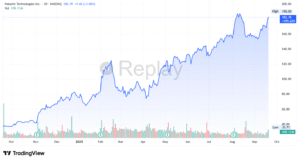
What causes the stock to climb higher?
Palantir’s stock rose about 300% over the past year and is up roughly 130–140% year-to-date in 2025. Retail investors have poured it into their portfolios, ranking it among the top three for net inflows behind Nvidia and Tesla. CEO Alex Karp has sold around $1.9 billion in shares since early 2024, highlighting the company’s high value.
Palantir’s stock has also climbed due to a major £750 million ($950 million) contract with the UK Ministry of Defence, finalized this month. This deal is ten times larger than its previous UK contract and will expand AI integration across military, health, and law enforcement systems.
The agreement positions London as Palantir’s European defense hub, supports up to 350 new jobs, and strengthens Western AI and defense partnerships. Combined with its commercial growth and strong ESG positioning, this contract adds another reason why investors are bullish on Palantir’s stock.
While these excitements fueled the company’s share price, it is Palantir’s role in ESG and sustainability that could define its long-term growth. Investors increasingly look at how the company manages carbon, energy use, and ethical practices alongside financial performance.
- RELATED: Palantir (PLTR Stock): AI for Carbon Neutrality – A Software Giant’s Sustainable Footprint in 2025
Why ESG Data Is Palantir’s Secret Weapon
The global push toward net zero is changing the way businesses operate. Over 140 countries have set net-zero targets. Also, thousands of companies have pledged to reduce carbon emissions. Tracking and meeting these goals requires accurate data, clear reporting, and advanced forecasting tools.
This is where Palantir fits in. Its software can integrate data from across supply chains, energy use, shipping, and raw materials. By giving companies a complete picture of their environmental footprint, Palantir helps them track progress on emissions reduction and prepare for stricter climate regulations.
For example, Palantir can:
- Monitor Scope 1, 2, and 3 emissions across global supply chains.
- Run simulations to test how business decisions affect carbon output.
- Help companies meet new reporting rules, such as the EU’s Corporate Sustainability Reporting Directive (CSRD).
- Support governments in planning renewable energy infrastructure and grid optimization.
Palantir’s ESG focus makes it key in the global push for sustainability. This also gives investors another reason to back the stock. Here are the company’s emission reduction and energy efficiency works in connection to its software:
-
Trafigura Supply Chain Tracking: Built a platform with Palantir Foundry to model and report lifecycle carbon intensity. Covered 10 million carbon pathways across crude oil, refined metals, and more. Helps companies understand and reduce Scope 3 emissions.
-
Tree Energy Solutions (TES) Partnership: Supports green hydrogen and e-natural gas projects. Foundry used for supply chain management, site selection, asset management, and carbon tracking. Improves efficiency and lowers carbon costs globally.
-
Nuclear Energy Collaboration: Co-developing a Nuclear Operating System (NOS) to speed up reactor construction. Improves safety, lowers costs, and supports faster clean energy deployment to cut emissions.
-
Utility Grid Modeling: A European utility used Foundry to combine control system and geographic data. Built network models that improved outage management, maintenance, and planning. Reduced downtime and wasted energy.
-
EV Charging Optimization: Foundry helps plan charging station locations. Cuts unnecessary infrastructure and costs. Supports EV adoption and reduces transport emissions.
Net-Zero Policies: Fuel for Foundry’s Growth
Governments worldwide are tightening climate policies. In the United States, the Inflation Reduction Act is channeling billions of dollars into clean energy and carbon tracking. In Europe, regulators are making carbon disclosures mandatory for many large firms. Meanwhile, in Asia, countries like Japan and Singapore are setting frameworks for voluntary carbon markets.
As companies work to comply, they are turning to advanced software to handle the complex data. Palantir’s Foundry platform helps energy companies manage renewable projects. It’s also used by manufacturers to track emissions.
McKinsey & Company estimates that the semiconductor industry alone could reduce emissions by up to 90% if it meets net-zero goals by 2050. Similar targets exist across industries such as automotive, steel, and logistics. To meet them, we need digital solutions that can handle millions of data points. Palantir excels in this area.
Palantir is also showing significant progress in cutting its own carbon footprint. It has achieved carbon neutrality in 2024, cutting emissions by 31% from its 2019 baseline. That year, it reported 23,018 metric tons of CO₂e, a small rise from 2023 due to increased travel. However, emissions per employee dropped 57% since 2019, now just 6 tCO₂e.

As a software company without factories, Palantir’s direct emissions are low, mostly from office energy use. Its largest impact is Scope 3, especially travel and cloud services.
Cloud emissions fell 32% between 2022 and 2023 thanks to energy-efficient data centers. To offset residuals, Palantir buys verified carbon credits supporting renewable energy and waste projects.

Why Investors Care
For ESG-focused investors, Palantir offers a mix of strong financial performance and sustainability potential. Its ability to connect AI with climate challenges is becoming a major selling point.
The ESG angle makes the story even stronger. Palantir helps businesses measure and reduce emissions. This puts the company in a strong spot as the world moves toward net zero. Investors looking for both growth and impact see this as a rare combination.
The Future of Palantir: AI at the Heart of Net Zero
Palantir is no longer just a defense contractor or niche software provider. It is becoming a mainstream AI company with a major role in the sustainability economy. The ability to link financial goals with ESG progress is a key advantage.
Looking ahead, Palantir’s growth will likely come from three main areas: commercial expansion, sustainability solutions, and government partnerships.
Palantir’s rise is more than just a stock story. It reflects a shift in how businesses and governments use AI to tackle climate change and net-zero goals. By giving organizations the tools to track emissions, improve efficiency, and meet ESG standards, Palantir has positioned itself at the center of two powerful trends: AI adoption and sustainability.
The post Palantir (PLTR) Stock Soars 300% in 2025: Can AI Drive ESG and Net-Zero Progress? appeared first on Carbon Credits.

For most businesses, the emissions that matter most sit outside their own walls. Scope 3 emissions, everything generated across your value chain, from the suppliers who make your inputs to the customers who use your products, typically make up the majority of a company’s total carbon footprint. Under the Corporate Sustainability Reporting Directive (CSRD), those value-chain emissions now have to be measured and disclosed with a rigour that spend-based estimates alone struggle to satisfy. This guide sets out how to improve Scope 3 data accuracy for CSRD: the calculation methods open to you, how to move from estimates to verified supplier data, and how to govern that data so it holds up to audit.

A carbon credit is a commitment that extends well into the future. The tonne of CO₂ compensated for today from a nature-based carbon project must remain out of the atmosphere for good, which means the forest behind the credit has to remain standing long after the transaction is complete. For any buyer, this raises a defining question: What ensures that the forest endures?

What replaced the cheap REDD credit on the boardroom slide deck, and why procurement is leading the rewrite.
Three years ago, a corporate slide showing a portfolio of cheap REDD+ credits could carry a board meeting. The number was big, the price was low, and the press release wrote itself. Today, that same slide gets sent back with questions. The questions are uncomfortable, the answers are unclear, and your general counsel is suddenly in the room.
Conventional carbon offsets are not dead. The voluntary carbon market retired 202 million tonnes in 2025, and the Morgan Stanley Institute for Sustainable Investing survey published in January 2026 confirmed that interest from corporate buyers remains substantial. What changed is the credibility threshold. The integrity floor has risen, the disclosure scrutiny has tightened, and the buyer profile has shifted. This article tracks what changed, what sophisticated buyers now ask before signing, and what serious corporates are putting on the board slide instead.
What boards used to buy, and why it stopped working
The 2020 to 2022 model was simple: buy a large tranche of avoidance credits at low single-digit prices, retire them against the company footprint, announce the carbon-neutral claim, and move on. Most of those credits came from REDD+ projects, renewable energy installations in countries where the renewable energy was already economic, or methane projects with thin documentation.
Several things broke that model. Academic research published in 2023, including a widely cited Science paper, found that the majority of REDD+ credits issued under the most common methodologies did not represent additional reductions when tested against rigorous counterfactuals. The Voluntary Carbon Markets Integrity Initiative published its Claims Code of Practice, which sets requirements for what companies can credibly claim from credit use. The European Union finalised its Green Claims Directive, restricting how companies can describe products as climate-neutral. France’s Décret 2022-539 already restricts carbon neutrality advertising. California’s AB 1305 imposes disclosure requirements on any company making net-zero or carbon-neutral claims while doing business in the state.
The collective effect: the cheap credit no longer buys the announcement, and the announcement now carries litigation risk.
The integrity reset: ICVCM, VCMI, and what changed
The Integrity Council for the Voluntary Carbon Market published the Core Carbon Principles in 2023 and began assessing methodologies against them in 2024. The first methodologies received the CCP label later that year. The point of the label is to give corporate buyers a defensible quality screen they can cite in disclosure.
The Voluntary Carbon Markets Integrity Initiative complements this on the demand side. Its Claims Code of Practice defines what a buyer can say (Silver, Gold, or Platinum claims, with associated requirements) based on the quality of credits used and the underlying decarbonisation strategy. Together, CCP and VCMI build a quality stack: CCP on the supply, VCMI on the claim, with the science-based target sitting underneath both.
The reset is not a ban on offsets. It is a ratchet. Credits that meet the new bar continue to clear; credits that do not, do not. The Morgan Stanley survey found that 61% of current buyers like the CCP label concept but that supply of labelled credits remains limited. That supply constraint is now visible in pricing.
What sophisticated buyers ask before they sign
The questions on the procurement scorecard have changed. A 2022 buyer might have asked about price, vintage, and project type. A 2026 buyer asks five different questions before any of those.
- What does the counterfactual look like, and who validated it.
- What is the permanence regime, and what is the buffer pool exposure.
- What is the leakage risk, and how is it mitigated.
- What rating has the project received from the independent ratings agencies (Sylvera, BeZero, Calyx Global), and what was the rationale.
- What is the documentation discipline that survives an audit four years from now when the procurement team that signed the contract has moved on.
If the vendor cannot answer those five questions on a first call, the conversation ends. Conversely, if the vendor can answer them with documented specificity, the conversation often expands beyond a single transaction toward a multi-year engagement.
Where this leaves your near-term commitments
You probably have near-term commitments that pre-date the integrity reset. Public targets to be carbon neutral by 2025 or 2030. Product-level claims that ran in last year’s marketing. Disclosed reduction trajectories that assumed continued access to cheap credits.
You have three workable paths. The first is to re-baseline your strategy, replacing the most exposed credits with higher-quality alternatives and adjusting the public language to match what you can defend. The second is to shift the underlying spend from offsetting outside your value chain to investing inside your value chain, where reductions count against Scope 3 directly and the audit trail is cleaner. The third is to keep the strategy and absorb the risk, which is increasingly the most expensive option once you price in litigation, restatement, and reputational exposure.
Most serious buyers are choosing the second path. It moves the carbon spend from a compliance cost to a procurement and resilience investment, and it removes the central failure point of the legacy model: the disconnect between where the emissions occurred and where the reductions sat. Nature-based supply chain investments, structured under the GHG Protocol Land Sector and Removals Standard and aligned to the SBTi FLAG Guidance, are the asset class that fits this brief. They generate inventory-grade reductions, they produce audit-grade documentation, and they survive the new claim restrictions because the carbon math sits inside the value chain that the disclosure already covers.
If you are reassessing a carbon strategy under the new integrity bar, or rebuilding a board narrative that has to survive a more skeptical audience, the carbon and sustainability experts at Carbon Credit Capital can help. The Dual-Value Model gives you a defensible alternative to legacy offset purchases, with the documentation and operational integration that survives the procurement scorecard and the audit. Schedule a consultation.



-
Greenhouse Gases11 months ago
Guest post: Why China is still building new coal – and when it might stop
-
Climate Change11 months ago
Guest post: Why China is still building new coal – and when it might stop
-

 Greenhouse Gases2 years ago
嘉宾来稿:满足中国增长的用电需求 光伏加储能“比新建煤电更实惠”
-

 Climate Change2 years ago
嘉宾来稿:满足中国增长的用电需求 光伏加储能“比新建煤电更实惠”
-
Climate Change2 years ago
Bill Discounting Climate Change in Florida’s Energy Policy Awaits DeSantis’ Approval
-

 Renewable Energy9 months ago
Sending Progressive Philanthropist George Soros to Prison?
-

 Carbon Footprint2 years ago
US SEC’s Climate Disclosure Rules Spur Renewed Interest in Carbon Credits
-
Greenhouse Gases1 year ago
嘉宾来稿:探究火山喷发如何影响气候预测