


Palantir Technologies marked a major milestone in the second quarter of 2025. The company hit a milestone by posting quarterly revenue over $1 billion for the first time. They reported $1.004 billion, marking a 48% increase from last year and a 14% gain from Q1. This result beat analyst expectations, which averaged around $940 million.
Beyond financial performance, the company reaffirmed its climate commitments. It aims for net-zero emissions in all operations. Also, it is focused on decarbonizing its value chain as part of its 2030 sustainability target.
U.S. Momentum: AI Demand Drives Growth
The company’s adjusted earnings per share (EPS) came in at $0.16, exceeding forecasts of $0.1. Net income hit $327 million, reflecting a 33% profit margin.
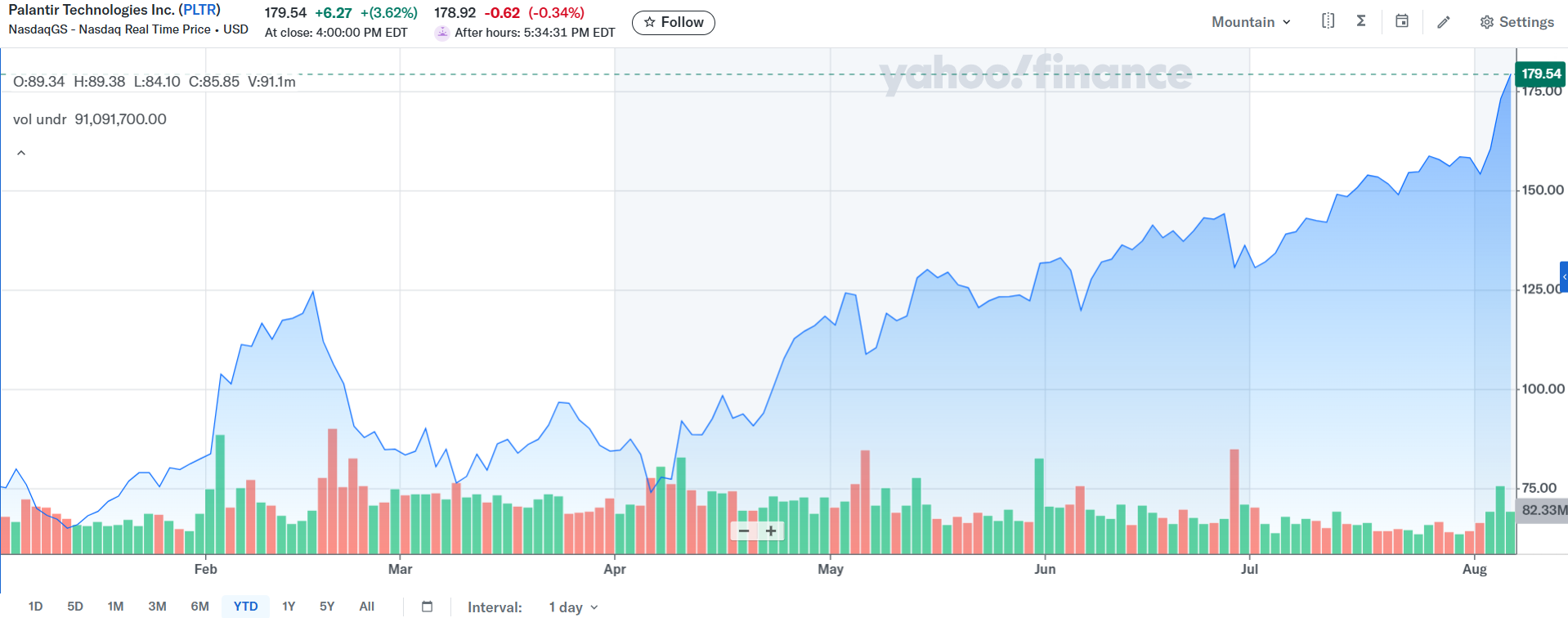
The strong earnings helped push Palantir’s stock up 5–8% after the announcement. The stock is now up more than 130% year-to-date, placing it among the top performers in the S&P 500.
Palantir announced strong customer deal activity in Q2. They secured 157 contracts, each worth at least $1 million. Among these, 66 contracts reached $5 million or more, and 42 exceeded $10 million. This added up to a record $2.27 billion in total contract value, up 140% year-over-year.
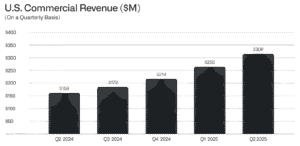
Palantir’s commercial momentum, especially in the United States, played a large role in the quarter’s results. U.S. revenue grew 68% year-over-year, reaching $733 million. U.S. commercial revenue grew 93% to $306 million, while U.S. government revenue rose 53% to $426 million.
The company’s success comes from the rising demand for its AI platforms. This includes the Artificial Intelligence Platform (AIP) and Agora. These tools help businesses and government agencies. They use large language models, real-time data, and advanced analytics for decision-making.
Palantir also reported a Rule of 40 score of 94%. This score combines growth and profitability. Investors use it to measure the health of software companies.
Adjusted free cash flow hit $569 million, with a 57% margin. Palantir also raised its full-year revenue forecast to between $4.14 billion and $4.15 billion. Adjusted income from operations is expected to be $1.912 billion to $1.92 billion.
Green at Scale: Achieving Carbon Neutrality and Emission Reductions
While growing quickly, Palantir has also made progress in cutting its environmental impact. The company became carbon neutral across its global operations in 2024, a key goal in its 2021 Climate Pledge.
- SEE MORE: Palantir (PLTR Stock): AI for Carbon Neutrality – A Software Giant’s Sustainable Footprint in 2025
Total greenhouse gas emissions in 2024 were 23,018 metric tons of CO₂e, slightly up from 22,635 metric tons in 2023. This rise was mainly due to resumed office activities and travel after the pandemic.

However, emissions per employee dropped by 57% since 2019. Now, each employee is responsible for about 6 metric tons, a decrease from earlier years.
To achieve carbon neutrality, Palantir buys verified carbon credits. It also shares its Scope 1, 2, and some Scope 3 emissions data publicly. The company aligns its reporting with standards set by S&P Global and climate transition assessment frameworks.
Carbon credits the company buys support certified climate projects. These include reforestation, renewable energy, and methane capture. They help remove or prevent emissions around the globe.
Palantir picks only verified credits. Meaning, they are certified by trusted standards like Verra’s Verified Carbon Standard (VCS) or Gold Standard. This choice ensures transparency, permanence, and a real impact on the environment. These investments reduce the company’s carbon footprint. They also help global efforts to grow nature-based and tech climate solutions.
Using AI Technology for Climate Impact
Palantir doesn’t just work on its own footprint. Its technology also helps clients reduce theirs. Through platforms like Agora, Palantir helps companies:
- Track and manage carbon emissions
- Optimize energy use and grid systems
- Deploy electric vehicle networks
- Manage ESG and climate-related risks
These tools are used in industries such as manufacturing, logistics, utilities, and government. The company’s software helps clients gather real-time sustainability data, improve decision-making, and meet net-zero goals faster.
Palantir also integrates sustainability into internal operations. The company uses recyclable and sustainable materials for events. It donates old computer equipment to underserved communities. Also, it includes ESG funds in employee retirement plans.
Balancing Rapid Growth With ESG Goals
Palantir maintains a strong focus on governance and responsible business practices. It takes part in S&P Global’s Corporate Sustainability Assessment (CSA) and often gets above-average ESG scores for a software company.
The company’s policies cover data ethics, human rights, responsible AI, and environmental sustainability. Palantir has a dedicated Responsible Business and Sustainability team. It regularly updates its policies to keep up with new technologies and regulations.
However, Palantir is under scrutiny for its government contracts. This includes contracts related to surveillance, defense, and immigration enforcement. These concerns have led to calls for greater transparency and human rights safeguards. In response, Palantir has highlighted its commitment to responsible AI development and stakeholder engagement.
Palantir’s Q2 2025 results show the company achieving rapid growth through strong AI product adoption while also making progress on its climate and ESG commitments. Palantir is growing in the commercial sector and strengthening ties with government clients. It aims to be a leader in AI innovation while focusing on sustainability.
Challenges remain, including maintaining trust, improving ESG transparency, and navigating public concerns about its contracts. But with over 700 active AI pilots, a strong ESG integration track record, and carbon neutrality already in place, Palantir’s next phase may balance financial growth with environmental responsibility.
The post Palantir (PLTR) Stock Rally After $1B Q2 Revenue, ESG and Net‑Zero Strategy Advances appeared first on Carbon Credits.

EU carbon credit claims changed on 27 September 2026, the day the Directive (EU) 2024/825 began to apply across the European Union. The change is narrow. It changes how a company can talk about the credits it buys. A product can no longer be called neutral on the strength of compensation alone; however, every specific, evidenced statement about what a company measured, reduced, and funded stays fully available.

The post Promoting Improved Cooking Practices in Nigeria appeared first on Terrapass.



-
Climate Change1 year ago
Guest post: Why China is still building new coal – and when it might stop
-

 Greenhouse Gases2 years ago
嘉宾来稿:满足中国增长的用电需求 光伏加储能“比新建煤电更实惠”
-
Greenhouse Gases1 year ago
Guest post: Why China is still building new coal – and when it might stop
-

 Climate Change2 years ago
嘉宾来稿:满足中国增长的用电需求 光伏加储能“比新建煤电更实惠”
-

 Renewable Energy12 months ago
Sending Progressive Philanthropist George Soros to Prison?
-
Climate Change2 years ago
Bill Discounting Climate Change in Florida’s Energy Policy Awaits DeSantis’ Approval
-
Greenhouse Gases1 year ago
嘉宾来稿:探究火山喷发如何影响气候预测
-

 Climate Change2 years ago
Analysis: China’s CO2 falls 1% in Q2 2024 in first quarterly drop since Covid-19