


Featured image sourced from the Oklo company website
Oklo Inc. (NYSE: OKLO) is changing how industries get clean, affordable power. The company builds compact fast fission reactors. These reactors generate electricity, cut down nuclear waste, and supply key materials for medicine and energy.
The company has attracted investors with two key partnerships. One is with Liberty Energy Inc., and the other is with Vertiv. These alliances address energy needs for data centers, factories, and large utility users. They blend Oklo’s advanced nuclear designs with dependable natural gas and modern cooling systems. This highlights Oklo’s commitment to tailored energy solutions for today and a sustainable future.
Powering Now and the Future: Liberty Energy Joins Forces with Oklo
This partnership offers complete energy solutions for businesses with high energy needs. This includes data centers and heavy industries. The plan starts with Liberty’s natural gas systems for quick energy. Then, it shifts to Oklo’s clean nuclear generation for long-term stability.
Liberty’s Forte℠ platform provides reliable power and adjusts energy use in real time. This helps customers avoid outages and improve efficiency. Over time, Oklo’s Aurora microreactors will provide consistent, zero-carbon energy.
Combining these power sources provides customers with dependable energy now and a cleaner future. This dual approach is essential for industries that cannot afford downtime.
Jacob DeWitte, Co-Founder and CEO of Oklo, said,
“This collaboration gives large-scale power users a turnkey alternative that integrates generation, backup, grid interaction, and optimization, all through a single provider. We’re delivering a next-generation approach to energy that gives customers the ability to scale power with confidence and offers a clear path to zero-carbon energy.”
Building Better Data Centers: Oklo and Vertiv Reimagine Energy Use
Oklo has teamed up with Vertiv (NYSE: VRT). Vertiv is a global leader in critical infrastructure for digital services. They focus on systems that keep data centers running, such as power supply and cooling solutions.
Oklo and Vertiv will develop new power and cooling systems for next-gen data centers. These centers will focus on high-performance computing and artificial intelligence. Their aim is to create systems that are efficient, modular, and eco-friendly. They will use Oklo’s clean nuclear energy as the main power source.
A key part of this plan includes a pilot demonstration at Oklo’s first Aurora reactor site. This project will test how nuclear-generated steam and electricity can directly support data centers and power cooling systems.
What makes this partnership unique is its co-design strategy. Instead of retrofitting old systems, they are creating new energy and cooling technologies from the ground up. By placing Oklo’s reactors near customer facilities, they enhance efficiency and speed of deployment.
Vertiv will provide advanced cooling systems, smart analytics, and scalable designs, while Oklo will deliver stable, emissions-free energy. Together, they aim to reduce energy waste, cut emissions, and improve uptime, which are the key priorities for modern data centers.
Forging Powerful Partnerships to Fuel a Greener Tomorrow
Both partnerships show Oklo’s dedication to tackling energy challenges. Instead of a one-size-fits-all method, it works with companies that serve big energy users. Together, they create systems that mix reliability and sustainability.
Liberty provides an energy roadmap from proven fossil solutions to zero-carbon power. This approach helps industries feel sure about a steady energy supply. This way, they can get ready for a greener future.
Ron Gusek, Chief Executive Officer of Liberty, said,
“Our strategic alliance with Oklo advances a power strategy aimed at accelerating deployment for sophisticated, large load customers. This innovative approach redefines how today’s most energy-intensive industries can scale efficiently with cost-effective, next-generation power solutions, combining rapid deployment, intelligent load management, and integrated grid management. We are excited to offer developers unmatched speed to market, price stability, and a future-ready energy platform.”
Secondly, Oklo is working with Vertiv to create energy-smart data centers. These centers are crucial for the expanding digital economy. The new designs will reduce energy and environmental costs for large AI and cloud platforms and will help customers gain a competitive edge in sustainability.
Oklo’s Role in the Clean Energy Transition
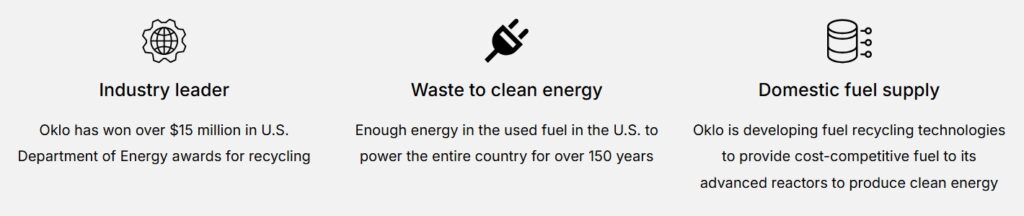
Oklo has made significant progress in nuclear technology by collaborating with national labs and the DOE on nuclear fuel recycling.
It was the first company to receive a site use permit from the DOE for a commercial advanced reactor. It also obtained used nuclear fuel from the Idaho National Laboratory. They submitted a combined license application for an advanced reactor to the U.S. Nuclear Regulatory Commission.
This effort may allow the reuse of spent fuel from traditional reactors in Oklo’s designs. It turns waste into energy and addresses long-term storage issues.
Furthermore, Oklo’s stock jumped 12% after announcing its partnership with Liberty Energy. Earlier that day, the stock had already risen 3%, showing growing investor confidence.
By combining nuclear energy with natural gas and advanced infrastructure solutions, it shows that the energy transition can be smart, strategic, and tailored to real needs.
Aurora Reactors: Leading the Way in Advanced Nuclear Technology
Oklo’s Aurora reactors are compact and efficient. They can run for long periods without needing frequent fuel changes. As the operator and owner, Oklo can deploy these reactors near customers. This gives businesses more control over power and enables faster responses in markets needing reliable, low-emission energy.
Whether it’s keeping data centers operational or aiding large utility operations, Oklo is emerging as a key player in nuclear energy innovation.
The post OKLO Stock Surges on Liberty Energy and Vertiv Partnerships: Nuclear Power’s Next Big Move appeared first on Carbon Credits.

EU carbon credit claims changed on 27 September 2026, the day the Directive (EU) 2024/825 began to apply across the European Union. The change is narrow. It changes how a company can talk about the credits it buys. A product can no longer be called neutral on the strength of compensation alone; however, every specific, evidenced statement about what a company measured, reduced, and funded stays fully available.

The post Promoting Improved Cooking Practices in Nigeria appeared first on Terrapass.



-
Climate Change1 year ago
Guest post: Why China is still building new coal – and when it might stop
-

 Greenhouse Gases2 years ago
嘉宾来稿:满足中国增长的用电需求 光伏加储能“比新建煤电更实惠”
-
Greenhouse Gases1 year ago
Guest post: Why China is still building new coal – and when it might stop
-

 Climate Change2 years ago
嘉宾来稿:满足中国增长的用电需求 光伏加储能“比新建煤电更实惠”
-

 Renewable Energy12 months ago
Sending Progressive Philanthropist George Soros to Prison?
-
Climate Change2 years ago
Bill Discounting Climate Change in Florida’s Energy Policy Awaits DeSantis’ Approval
-
Greenhouse Gases1 year ago
嘉宾来稿:探究火山喷发如何影响气候预测
-

 Climate Change2 years ago
Analysis: China’s CO2 falls 1% in Q2 2024 in first quarterly drop since Covid-19