The northernmost town in the world, Ny-Ålesund, has for more than 30 years hosted the UK’s Arctic Research Station – the nation’s only permanent infrastructure at the Earth’s northern pole.
Located on the Norwegian island of Svalbard – one of the most rapidly warming regions on Earth – the station acts as a base for UK scientists studying the Arctic’s ice, ecosystems and atmosphere.
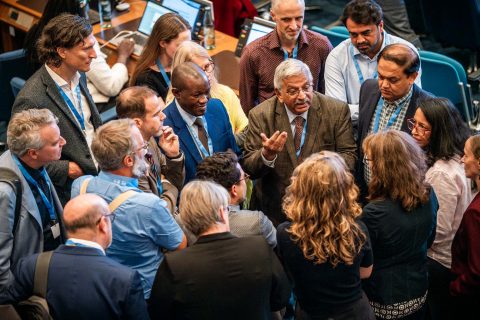
On 7 February, Carbon Brief was invited to the British Antarctic Survey (BAS), the UK’s national polar research institute in Cambridge, to hear more about what life is like for UK scientists living in the Arctic Circle.
BAS’s Arctic Day also offered a chance to hear about how researchers are working to understand the complex impacts of climate change on the land’s most northern edge.
UK Arctic base
Formerly a mining town, Ny-Ålesund now hosts Arctic research stations for a range of countries including China, France, Germany, India, Italy, the Netherlands, Norway and the UK.
It is accessible via a flight on a 14-seater plane that leaves four times a week from Longyearbyen, the largest town in Svalbard.
Speaking at BAS’s Arctic Day, the institute’s Arctic operations manager Iain Rudkin explained that the town is famous for being the starting point for a number of “crazy” Arctic expeditions.
This includes the expeditions of Roald Amundsen, the Norwegian explorer who was the first man to successfully navigate the treacherous Northwest Passage through the Arctic to North America by boat in 1905.

The UK’s Arctic Research Station was built in 1991. It consists of seven bedrooms, three laboratories, a sitting room, an office and storage space. The station can be explored room by room using this 3D virtual tour tool.
According to station lab manager Guy Hillyard, the labs consist of a general space, a microscopic lab and a wet lab suitable for processing dirty soils and sediments.
The station also has an annex for drying mosses and soils, freezers at temperatures from -18 to -25C for storing ice cores and separate freezers for storing frozen sediment, he added.

Until recently, Ny-Ålesund was a town of “radio silence”, meaning there was no wifi, bluetooth or other kinds of internet access. However, last year, a decision was made to install a 4G mast.
Although many living at Ny-Ålesund appreciated the radio silence, the decision was made to make it easier for people out in the field to call for help if in danger and to allow scientists to use scientific equipment that communicates via the internet, Rudkin said.
Algae, AI and invisible ecosystems
BAS’s Arctic Day saw a number of UK-based scientists briefly explain the purposes of their research at Ny-Ålesund in the past and coming few months.
Dr Jaz Millar, a postdoctoral researcher at the University of Bristol, travelled to Ny-Ålesund in July 2023 as part of their research into how climate change could be affecting algal blooms on glaciers, which are vast rivers of frozen ice.
The algae that Millar studies is dark purple, meaning it lowers the “albedo” on the surface of glaciers. Albedo is a term for describing the proportion of sunlight that is reflected away from a surface, with bright white having a high albedo and dark colours having a low albedo.
When the albedo on the glacier’s surface is lowered, it absorbs more sunlight. This causes it to melt faster.
It is possible that presence of meltwater induces the growth of more algae – potentially representing a self-reinforcing “worrying positive feedback loop”, Millar explained.
Around Ny-Ålesund, Millar’s team visited three glaciers. They studied algal growth with a range of techniques, including bringing microscopes directly into their field sites and taking ice samples.
Millar’s research has not yet been published, but the results suggest that the relationship between glacier melt and algal bloom growth may be more complex than just a linear positive feedback loop.
Elsewhere, Prof Kate Hendry, a chemical oceanographer at BAS, explained more about her research into how the melting of glaciers could be altering the flow of key nutrients into coastal waters – eventually impacting marine ecosystems.
She explained that glacier meltwater typically contains nutrients that are needed by diatoms – single-cell algae that act as food for tiny marine creatures called zooplankton – which in turn support a wide range of fish, bird and mammal species, including whales. These nutrients include iron nitrate and silicic acid.

As glaciers melt at an increasingly rapid rate because of climate change, this may impact the growth of diatoms – in turn affecting species higher up the food chain, she said.
To study this, Hendry’s team visited Ny-Ålesund in 2023 to collect more than 1,000 samples from glaciers, the ocean and sediments. Her team will return this year to look further at how the availability of iron and silicon in fjord environments could be affected by climate change.
At the sidelines of the presentations, Carbon Brief spoke to Martin Rogers, a machine-learning scientist at BAS, about his research using AI to map changes to Arctic sea ice in higher resolution than is currently available.
The AI tool can search through different types of satellite imagery, offering scientists the highest-resolution image available when considering factors such as cloud cover, which can obscure views of the sea ice, he explained.
In the future, this tool could be used to help scientists understand in greater detail the extent to which sea ice is declining because of climate change, he added:
“The big question is about the decline in sea ice extent. With this product, you can get the sea ice extent in high fidelity. Then you’ve got more precise information about how the sea ice extent is changing between years.”
Finally, the conference heard from Laura Molares Moncayo, a PhD student at the Natural History Museum and Queen Mary University of London.
Her research is centred around the question of whether the Arctic’s atmosphere could be supporting an ecosystem that is invisible to the human eye.
For decades, researchers assumed that glaciers were devoid of complex lifeforms, she explained. However, research has revealed that they actually support a vast array of microorganisms, which are well adapted for harsh, frozen environments.
How did these microorganisms find their way into glaciers?
Glaciers grow by receiving rain and snow from the atmosphere. In fact, glaciers could be considered a “condensed version of the atmosphere”, Molares Moncayo explained.
It is possible, she continued, that the microorganisms found in glaciers may have fallen from the atmosphere. Such microorganisms would, in theory, already possess the adaptations required to survive the tough conditions of the Arctic air.

In a week’s time, she will travel to Ny-Ålesund to try to establish whether the Arctic atmosphere is home to an invisible ecosystem of microorganisms.
To do this, she will use a range of equipment, including dry air samplers, which collect any solid particles present in air into a filter.
She will then use DNA sequencing techniques to identify which microorganisms are present in her air samples. She will also study the microorganisms’ functional genes, which will offer clues into whether the microorganisms are interacting with each other when still in the air.
The post Ny-Ålesund: How UK scientists are studying climate change in the Arctic appeared first on Carbon Brief.
Ny-Ålesund: How UK scientists are studying climate change in the Arctic
Climate Change
Planned offshore oil and gas expansion threatens key marine ecosystems, report
Ocean and coastal creatures are being put at risk by the spills, noise, dredging and shipping associated with new offshore oil and gas infrastructure, says a new report by a group of environmental NGOs.
The report by a group of twelve environmental groups analysed planned new offshore oil and gas blocks covering 430,000 square kilometres – an area the size of Sweden – in 11 countries.
Blocks in countries such as Kenya, Indonesia and Australia overlap with some of the planet’s hotspots for marine biodiversity, home to mangroves, coral reefs, sea turtles, sharks and whales.
Oil and gas expansion is advancing in spite of the legal protections already in place, the report says, with a third of the area being licensed overlapping with marine and coastal protected areas.
“It is alarming to see the research findings and the sheer scale of fossil fuel expansion trajectories threatening the health and future of our shared ocean,” said Tyson Miller, Executive Director of Earth Insight, one of the environmental NGOs involved in the report.
At the first conference on Transitioning Away from Fossil Fuels in Santa Marta, around 60 countries floated the idea of creating “fossil-fuel-free zones”, which would seek to place limits on coal, oil and gas in areas where development would lead to severe social and environmental harm.
As part of the landmark Kunming-Montreal biodiversity deal, governments have also pledged to protect 30% of the planet’s land and marine ecosystems by 2030. This could be used as an opportunity to limit oil and gas expansion in sensitive areas, Miller said.
The report says the findings “reinforce the need for governments, financial institutions and companies to stop funding and supporting offshore oil and gas expansion”, and calls for the creation of fossil-fuel-free zones in “high-value marine and coastal areas”.
Oil bidding in biodiversity hotspots
As one of the case studies, Kenya — which is set to host the Our Ocean Conference in Mombasa later this month — has opened 50 offshore oil and gas blocks for bidding in the Lamu Basin, one of East Africa’s marine biodiversity hotspots.
These blocks overlap with all the region’s mangroves and coral reefs, the report says, which provide nursery habitats for fish, sea turtles and the vulnerable dugong.
These ecosystems are already under severe stress from climate change-related ocean heating and increased water acidity and could now face seismic surveys, offshore drilling, dredging, increased shipping traffic, oil spills, chemical discharge and underwater noise pollution.
The government estimates that oil production will start by 2026, aligning with “global best practices”, and has said the Lamu basin has vast “untapped potential”. The country is expected to open bidding for the first 10 blocks by September.

Muturi wa Kamau, network coordinator for the Kenya Oil and Gas Working Group, said in a statement that the country “is preparing to open ecologically sensitive areas for fossil fuel exploration” while positioning itself as a leader in ocean diplomacy.
“The question is: at what cost are we willing to risk these fragile ecosystems and the livelihoods of coastal communities who have depended on them for generations?” Kamau said.
Australia’s Otway Basin
After a four-year pause, Australia — which will act as co-presidency of the COP31 climate summit — resumed offshore exploration in the Otway basin last year, with American energy firm ConocoPhillips among the operators approved for exploratory drilling off the country’s southern coast.
The sites under exploration are as close as one kilometre from a series of marine reserves known as sanctuaries for pygmy blue whales, who travel thousands of kilometres to reproduce in those waters. Orange roughy, a deep-sea fish that can live for over 140 years, may also be harmed.
In total, the report analysed new LNG export projects in Argentina, Alaska, Mexico and Tanzania, as well as expanded offshore oil and gas licensing in Australia, Cameroon, Indonesia, Jamaica, Kenya, Norway, and Trinidad and Tobago.
The post Planned offshore oil and gas expansion threatens key marine ecosystems, report appeared first on Climate Home News.
Planned offshore oil and gas expansion threatens key marine ecosystems, report
Climate Change
The scramble to stockpile critical minerals could drive up energy transition costs
As competition for minerals needed to produce clean energy technologies intensifies, a growing number of countries have resorted to an age-old mechanism to cope with the threat of scarcity: stockpiling.
The world’s biggest economies are racing to shore up reserves of cobalt, lithium, graphite and rare earths, which are needed to produce batteries, electric vehicles, wind turbines and electric systems to wean the global economy off fossil fuels. The same minerals are also increasingly sought after to manufacture military hardware and chips for AI, adding further pressure on supplies.
But the cutthroat scramble to build up reserves threatens to drive up the costs of the energy transition by intensifying competition and pushing up prices of key materials needed to produce clean energy technologies, research published today has found.
“If you undermine the financial viability of [clean energy] projects through higher raw material costs, you’re going to delay their roll-out,” co-author Hugh Miller, the critical minerals lead at the Centre for Economic Transition Expertise at the London School of Economics and Political Science, told Climate Home News.
Stockpiling “is happening, whether we like it or not”, said Miller. “But if we’re going to do it, we need to have it in a coordinated manner that means we don’t have massive market volatility and adverse implications from every country trying to go at it alone,” he added.
The rise of stockpiles
A growing number of governments have adopted national stockpiling programmes in response to heightened geopolitical tensions around mineral supply chains.
Earlier this year, US President Donald Trump announced the establishment of a critical mineral reserve known as “Project Vault” to protect American businesses from shortages after China imposed export restrictions on rare earth supplies.

Beijing suspended the measures until November as part of a trade truce with Washington but the episode spooked Western governments and exposed how strategic materials can be weaponised to achieve geopolitical objectives.
Australia, China, the EU and India have also announced measures to create strategic mineral reserves. Japan and South Korea already have long-standing mineral stockpiling programmes.
“Legitimate concerns”
“There are legitimate concerns with regards to potential global shortages of these minerals,” said Miller, citing rapidly rising and concurrent mineral demand for the energy transition, AI, data centres, and military technologies, combined with underinvestment in new supplies for some minerals, such as copper.
While stockpiling can serve as an emergency response mechanism during acute shortages, it does nothing to address the underlying concentration risks in mineral supply chains. The Democratic Republic of Congo holds around 70% of the world’s cobalt reserves, for example, while China dominates the processing of 19 out of 20 minerals deemed critical by a large number of nations.
Uncoordinated stockpiling programmes risk heightening the price volatility they are designed to hedge against, according to the report.
Researchers found that if Australia, China, the EU, India, Japan, South Korea and the US simultaneously built reserves of minerals to cover six months of imports, the aggregate stockpile demand could represent up to 34% of global annual cobalt supply and over 10% of global lithium, graphite and copper supply. That could cause a shock to the market, triggering the shortages and price spikes they are trying to avoid.
Miller said it was unlikely that every country would stockpile at that rate, but aggregate stockpiling demand of just 5% of global mineral supply would have an impact on prices.
Coordinating stockpiles: a role for the IEA?
Researchers found that avoiding the negative impacts of stockpiling requires global coordination over how mineral stocks are accumulated and released – a mechanism which already exists for other commodities, including oil.
Coordination should include agreed rules for countries to build up their stocks over a slow and staggered timeline and pre-agreed conditions for releasing reserves to provide market predictability and reduce the risk of price spikes.
The International Energy Agency (IEA), which was established after the 1970s oil crisis to coordinate emergency oil stock releases among member countries, is best placed to oversee such a mechanism, they say.
Earlier this year, IEA member countries called on the agency to strengthen its work on critical minerals, including by providing support to countries “that choose to establish and expand critical minerals stockpiling systems”.
But Miller and his co-author Pau Morandi, a policy fellow at the Centre for Economic Transition Expertise, argue that members should go one step further and mandate the IEA to coordinate the security of supplies, rather than only helping individual governments.
The IEA has been contacted for comment.
A call to action for the G7
Miller said he hoped the research could be picked up by the G7 group of wealthy countries, which could lead on mandating the IEA to take on this coordination role.
France, which is presiding over the group this year and is hosting leaders in Evian on the shores of Lake Geneva in mid-June, has made strengthening the resilience of critical minerals value chains a priority.
In a communique last month, finance ministers agreed to “deepen and expand our cooperation among G7 members and with like-minded partners” to strengthen and diversify critical mineral supply chains and to continue discussions “on how to best organise analytical cooperation”.
Sebastien Treyer, executive director of the Paris-based Institute for Sustainable Development and International Relations (IDDRI), said he hoped the G7 leaders’ summit can help move the discussion on critical minerals towards greater international cooperation to secure the resources the world needs to build a clean economy.
From inclusive and mutually beneficial partnerships to mine resources to stockpiling minerals, “we need to coordinate more like a trade organisation than something that is about securing supply,” he said.
The post The scramble to stockpile critical minerals could drive up energy transition costs appeared first on Climate Home News.
The scramble to stockpile critical minerals could drive up energy transition costs
Climate Change
DeBriefed 5 June 2026: UK eyes 2040 emissions cut | US ‘dismantling’ oceans research | China’s solar slump
Welcome to Carbon Brief’s DeBriefed.
An essential guide to the week’s key developments relating to climate change.
This week
UK proposes new emissions target
‘ON COURSE’: The UK government has proposed reducing the country’s greenhouse gas emissions to 87% below 1990 levels by 2040, reported the Associated Press. The newswire cited scientists saying that the goal “puts the UK on course to meet its 2050 net-zero target”. To meet this target, the UK would “need to invest around £880bn over 25 years…but doing so would yield benefits worth £1,620bn”, according to an in-depth analysis of the plans by Carbon Brief.
UPCOMING ‘FLASHPOINT’: The Financial Times noted that, for the target to become “legally binding”, it must be approved by parliament. While the UK’s previous carbon budget “received cross-party support”, this time the proposal is “expected to become a flashpoint among lawmakers”, it added, with both the Conservatives and Reform pledging to “scrap” net-zero policies.
DRIVING FORCE: Separately, a new report by consultancy Confederation of British Industry (CBI) Economics has valued the UK’s “net-zero economy” at more than £100bn a year, reported the Guardian. It added that, by a broad measure, the UK energy transition supports 1.1m jobs and provides “nearly 4% of the UK’s economic output”.
US ‘dismantling’ oceans data
SYSTEMS OFFLINE: The Trump administration is “dismantling” a “$368m deep-ocean observation system” that, among other things, allows scientists to monitor the ocean currents that affect the global climate and understand how the “ocean is absorbing greenhouse gases from the atmosphere”, said the New York Times. Bloomberg reported that Trump’s efforts to close the National Center for Atmospheric Research (NCAR), a key climate science research institution, has been “temporarily blocked” by a judge.
RULE ROLLBACK: The US Securities and Exchange Commission (SEC), an independent body that regulates US securities markets, has proposed repealing the climate-disclosure rule, which “requires some public companies to report their greenhouse gas emissions and the risks they face from global warming”, said the Associated Press. The Trump administration also announced plans to allocate $700m to support “clean, beautiful coal” power and export infrastructure, said BBC News.
Around the world
- EU EXEMPTIONS: The EU will allow member states to breach the bloc’s fiscal rules to “cope with high energy prices stoked by the Iran war”, as long as the measures they use help “accelerate the transition away from fossil fuels”, reported Bloomberg.
- SLOW SPENDING: The German government has only paid out €24bn of the €37bn it was “supposed to disburse” in 2025 from a special fund for infrastructure and “climate neutrality”, reported Clean Energy Wire.
- URGENT WARNING: UN secretary-general António Guterres said a likely upcoming El Niño weather event must be treated as the “urgent climate warning it is”, said Al Jazeera.
- HOEKSTRA ON COP: The outcomes of many of the most recent COPs have been “underwhelming”, EU climate commissioner Wopke Hoekstra has said, according to Reuters. COPs should be supplemented by “smaller groups…who are willing to move faster”, he added.
3,400
The number of excess deaths across India caused by a single day of extreme heat, according to coverage in the Hindustan Times of a new study.
30,000
Excess deaths caused if the extreme heat lasts five days.
Latest climate research
- In a 1.5C warmer world, the timing of floods will shift by more than seven days across half of the world’s landmass | Nature Communications
- Temperature and rainfall together account for more than 13% of methane generated from landfills in Incheon, South Korea | Atmospheric Chemistry and Physics
- The postponed International Maritime Organisation “net-zero framework” could increase biofuel use in shipping to 40% by 2050 | Nature Energy
(For more, see Carbon Brief’s in-depth daily summaries of the top climate news stories on Monday, Tuesday, Wednesday, Thursday and Friday.)
Captured
China’s carbon dioxide emissions grew by 2% in the first quarter of 2026 due to a rise in “wasted” wind and solar generation, according to new analysis for Carbon Brief. However, emissions remain below their March 2024 peak, it added.
Spotlight
Why China’s solar boom is slowing down
China made headlines in 2025 for installing record levels of solar. But in 2026, new capacity is expected to be lower than last year’s figures.
This week, Carbon Brief examines what is behind China’s lower 2026 solar additions.
Solar power has been a major element of China’s renewables buildout since the mid-2010s.
The country installed 315 gigawatts (GW) of new capacity in 2025, adding more than half of all new solar globally. The year before, it added 277GW.
But the picture in 2026 to date is very different. Installations in March fell 56% year-on-year to 9GW, while new capacity in April totalled 10GW, a 79% drop compared to a year earlier, according to Carbon Brief’s analysis of official data.

Domestic uncertainty
The lower pace in 2026 had been anticipated by analysts.
In previous years, massive solar installations were driven by strong policy support for renewables, including a fixed-price tariff for generators.
In February 2025, the government announced that new solar and wind projects would instead be financed through a new “contract for difference” (CfD)-style system.
Under the new system, power from a certain amount of renewable capacity will be purchased for a fixed “strike price”, which to date has been far lower than previous guaranteed tariffs. Further projects will need to secure their own contracts on the open market.
While the new system is posing challenges for developers in the short term, it is part of a longer-term shift towards market-driven pricing for renewables, which has already made them cheaper than coal.
The change led to a rush of new project installations ahead of the June 2025 cut-off date, so that they could fall under the old fixed-price regime.
New solar additions totalled 45GW in April 2025 and 93GW in May 2025, before falling to 14GW in June 2025, according to Carbon Brief analysis of government data.
Additions also spiked in December, in both 2024 and 2025, as developers raced to meet completion deadlines including those under the 14th five-year plan.
Some reports have attributed the precipitous drop this year to falling demand for solar in China.
But this is a “major oversimplification”, David Fishman, principal at energy consultancy the Lantau Group, wrote on LinkedIn.
The real challenge, he said, is that “developers and banks [are] still figuring out how to finance and build projects without policy-backed revenue guarantees”.
Yang Biqing, energy analyst for Asia at thinktank Ember, agrees, telling Carbon Brief that the new CfD-style system has created “greater uncertainty” for developers, compounded by fierce competition and a growing push for “consolidation” in the industry.
The government set a target for 200GW of new solar and wind capacity in 2026.
Fishman told Carbon Brief that this will be “difficult” for the government to achieve, though not impossible. Current levels of solar additions – reaching perhaps 120GW for the year – plus an “ambitious” 80GW of new wind power, could help China to hit the target, he said.
Others are more bullish. The China Photovoltaic Industry Association forecasts 180-240GW of new solar in 2026.
But few believe additions will match the breakneck pace of 2025.
“China’s solar industry is no longer a story of capacity expansion”, said Yang, with officials now “increasingly” focused on integrating current generation into the grid.
Soaring exports
Meanwhile, China’s solar exports are still going strong.
China exported almost 1.2m tonnes of solar cells in April 2026, according to Reuters. Although down from a record high in March, it represented a 60% rise year-on-year, added the newswire.
This signals solar’s attractiveness globally in the face of rising energy prices caused by the Iran-US conflict, analysts have said.
High demand for panels has been reported across several continents, including Europe, Asia and Africa.
For example, in the Philippines, the conflict is “driving” solar uptake, one analyst told the Associated Press, adding:
“People want solar and people want solar now.”
A version of this article is also available on the Carbon Brief website.
Watch, read, listen
EL NIÑO IMPACTS: An interactive piece from BBC News described how the forecasted “super” El Niño could impact global climate and weather in the coming months.
‘CAUTIONARY TALE’: Two researchers wrote in Climate Home News that “Indonesia’s failing Just Energy Transition Partnership is a cautionary tale”.
‘CULTURE WAR’: Time magazine spoke to London mayor Sadiq Khan about how he “survived the climate culture war”.
Coming up
- 8 June: World Ocean Day
- 8-18 June: Bonn climate talks, Bonn, Germany
- 11 June: Climate Adaptation Innovation in Latin America and the Caribbean webinar, online
Pick of the jobs
- The New York Times, climate policy correspondent | Salary: $124,980-$160,000. Location: Washington DC
- Regulatory Assistance Project, associate, electricity systems and electrification | Salary: €50,000-€60,000. Location: Madrid and remote
- Future Energy Networks, head of policy | Salary: £75,000-£100,000. Location: London and remote
DeBriefed is edited by Daisy Dunne. Please send any tips or feedback to debriefed@carbonbrief.org.
This is an online version of Carbon Brief’s weekly DeBriefed email newsletter. Subscribe for free here.
The post DeBriefed 5 June 2026: UK eyes 2040 emissions cut | US ‘dismantling’ oceans research | China’s solar slump appeared first on Carbon Brief.
-
Climate Change10 months ago
Guest post: Why China is still building new coal – and when it might stop
-
Greenhouse Gases10 months ago
Guest post: Why China is still building new coal – and when it might stop
-
Greenhouse Gases2 years ago嘉宾来稿:满足中国增长的用电需求 光伏加储能“比新建煤电更实惠”
-
Climate Change2 years ago嘉宾来稿:满足中国增长的用电需求 光伏加储能“比新建煤电更实惠”
-
Climate Change2 years ago
Bill Discounting Climate Change in Florida’s Energy Policy Awaits DeSantis’ Approval
-
Renewable Energy7 months agoSending Progressive Philanthropist George Soros to Prison?
-
Carbon Footprint2 years agoUS SEC’s Climate Disclosure Rules Spur Renewed Interest in Carbon Credits
-
Greenhouse Gases11 months ago
嘉宾来稿:探究火山喷发如何影响气候预测