Connect with us

Published

on

nvidia

NVIDIA is leading the way in using AI to change transportation and cloud computing. At the IAA Mobility conference, it showed how its cloud-to-car solutions are helping vehicles become safer and smarter. Its partnerships with OpenAI and Oracle are also growing, helping build more AI data centers around the world. With new technology like the energy-saving Rubin CPX GPU, NVIDIA is setting higher standards for AI speed and efficiency.

Let deep dive into these innovations that are making NVIDIA the biggest player in the AI-driven future.

How NVIDIA Is Driving AI-Powered Mobility with Leading Automakers

Vice President Ali Kani explained at the IAA Mobility conference held in Munich how cloud-to-car solutions improve safety, intelligence, and trust on the road. The focus is on making vehicles rely more on data centers than on mechanical parts.

He highlighted that the industry is moving from horsepower to compute power, using software-driven designs for smarter and safer vehicles.

Here are quick updates on how NVIDIA is improving autonomous driving safety:
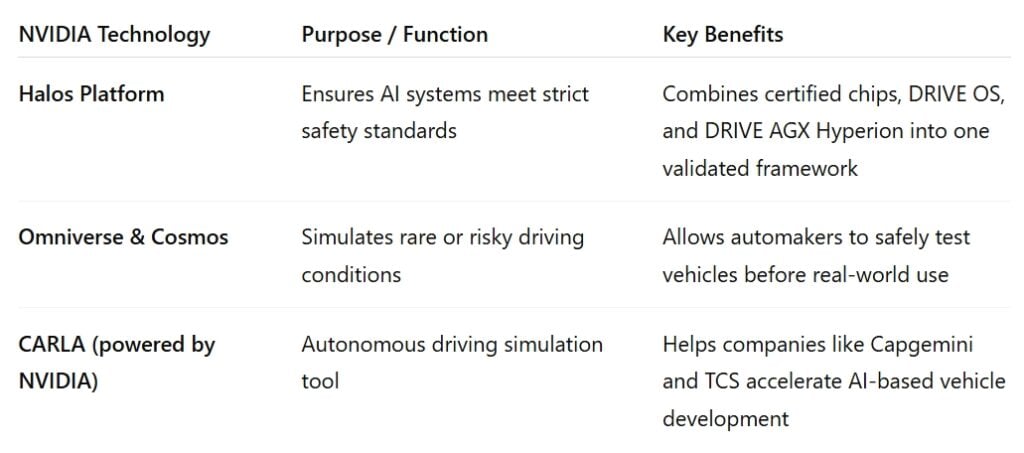
nvidia

Leading carmakers and innovators are racing to integrate NVIDIA’s cloud-to-car AI solutions, transforming how vehicles operate and interact on the road.

  • Lucid Motors showcased its all-electric Gravity SUV powered by NVIDIA DRIVE AGX and the cutting-edge Blackwell architecture for superior performance.
  • Mercedes-Benz introduced its new GLC and expanded CLA lineup, built on NVIDIA’s AI software and accelerated compute platforms.
  • Volvo Cars enhanced safety and driver-assistance features in its latest models using NVIDIA DRIVE AGX and DriveOS.
  • Lotus is pushing the boundaries with high-performance EVs like the Eletre SUV and Emeya hyper-GT, leveraging AI-driven mobility solutions.
  • ZYT is developing autonomous vehicle platforms powered by NVIDIA DRIVE AGX, expanding access to smarter, safer driving technologies.

This wave of adoption proves how NVIDIA’s AI tools are becoming essential across both established and emerging players in the automotive industry.

OpenAI and Oracle Fuel NVIDIA’s Rise

 As demand for AI infrastructure is rising worldwide, NVIDIA’s partnerships with OpenAI and Oracle are driving growth.

Bloomberg reported that NVIDIA and OpenAI plan to invest billions of dollars in UK data centers. This comes ahead of U.S. President Donald Trump’s visit and reflects the need for more AI support.

At the same time, Oracle’s AI cloud expansion is boosting NVIDIA’s future. Oracle’s cloud contract backlog jumped 359% to $455 billion. Their AI superclusters use NVIDIA’s powerful GB200 and Blackwell GPUs. Oracle’s five-year, $300 billion deal with OpenAI makes NVIDIA a key supplier in this space.

  • Oracle expects 77% revenue growth and is expanding its multi-cloud AI strategy. This shows how NVIDIA’s chips are key to the global AI cloud boom.

Rubin CPX: Energizing AI with Power and Efficiency

NVIDIA’s Rubin CPX GPU is a breakthrough for AI tasks that need to handle large amounts of data, like video creation and coding. Together with NVIDIA Vera CPUs in the Vera Rubin NVL144 CPX platform, it offers 8 exaflops of AI power and over 100TB of memory bandwidth for fast and efficient performance.

NVIDIA CEO Jensen Huang says Rubin CPX is as revolutionary as RTX graphics. It helps AI models process millions of tokens at once.

  • Its energy-efficient design makes Rubin CPX perfect for smarter, scalable AI tools that are changing how software is developed.

Rubin CPX GPU

Rubin CPX GPU
Source: NVIDIA

NVDA Stock Gains as AI Cloud Demand Soars

Nvidia stock (NVDA), already highly valued, got an extra boost as analysts quickly shifted from negative to positive. On Thursday morning, its shares rose 0.6% in premarket trading to $178.43, after jumping 3.9% the previous day.

Analysts say that the rise comes as investors react to Oracle’s massive cloud-computing forecast, which is shaking up the AI industry. As the top AI chipmaker, Nvidia stands to gain the most from this growing demand. Analysts are now more optimistic about its future.

NVIDIA NVDA stock
Source: Yahoo Finance

Oracle’s Cloud Deal Sparks Excitement

Oracle reported a record $317 billion in future cloud contracts for the quarter ending August 31st. This signals huge interest in AI-driven cloud services and how much companies need powerful computing.

And this strengthens Nvidia’s growth story. With cloud providers racing to secure GPU resources, the chip giant can inevitably benefit. Concisely, this is exactly driving the recent NVDA stock upgrades.

The post NVIDIA Stock (NVDA) Surges: Driving AI Mobility and Cloud Growth with OpenAI and Oracle Partnerships appeared first on Carbon Credits.

Continue Reading

Carbon Footprint

Insetting vs Offsetting: Which Actually Counts Toward Your Scope 3 Targets

Published

on

The accounting differences that decide whether your nature investment shows up in inventory, in BVCM, or nowhere at all.

The question reaches a procurement team about three weeks before the next sustainability committee meeting. Someone has read about insetting. Someone else has just signed off on an offset purchase. The CSO wants to know if the two are interchangeable. The answer is no, and the GHG Protocol Land Sector and Removals Standard is the reason why.

This article walks through what each term means at audit-grade specificity, what the standards actually say about how each gets counted, and how to decide which tool fits which target. The insetting vs offsetting question is one of the most-searched in corporate climate strategy, and one of the most poorly answered. By the end of this piece, you should be able to brief a committee on the difference without notes.

The two definitions, in plain English

Offsetting means buying carbon credits generated outside your value chain and retiring them against your residual emissions. The reduction happens somewhere else, financed by you, and the credit is the receipt.

Insetting means investing in emission reductions or removals inside your own value chain, typically with suppliers, where the reduction is directly linked to the products and services you buy. The reduction happens inside the boundary of your Scope 3 inventory, and the accounting treatment is fundamentally different.

The shorthand from the University of Oxford’s Nature-based Insetting Initiative is useful: insetting is what you do with the supply chain you have; offsetting is what you do with the supply chain you do not have.

What the GHG Protocol Land Sector Standard actually says

The GHG Protocol Land Sector and Removals Standard, finalised in 2024 after a multi-year pilot, sets the rules for how land-based emission reductions and removals enter corporate inventories. The Standard distinguishes between inventory accounting (Scope 1, 2, and 3) and project or intervention accounting (a separate methodology for crediting).

For insetting, the practical implication is that supplier-level interventions, when properly measured and attributed, can reduce your Scope 3 category 1 (purchased goods and services) emissions in your inventory. The reduction is not a credit retired against the inventory; it is a lower inventory number, period.

For offsetting, the credit is retired separately. It can be reported as a contribution toward a net-zero claim under the SBTi Beyond Value Chain Mitigation framework or as part of a VCMI Carbon Integrity claim, but it does not lower the inventory number.

A practical consequence: if your Science Based Target requires a 50% absolute reduction in Scope 3 emissions by 2030, insetting moves you toward the target. Offsetting does not. This single point of difference reshapes the procurement decision.

When insetting counts toward Scope 3 (and when it does not)

Insetting counts toward Scope 3 only when several conditions are met:

  • The intervention must occur with an entity in your value chain.
  • The emissions reduction or removal must be measured against a defensible baseline.
  • The reduction must be attributed to your share of that supplier’s output, not double-counted with other buyers.
  • It must follow the inventory accounting rules in the GHG Protocol Land Sector Standard, not the project accounting rules used to generate credits.

The most common failure mode is double counting. If your supplier sells the same reduction as a credit on the voluntary market and also reports it to you as a Scope 3 reduction, the math breaks. The Standard requires you to address this risk, typically by purchasing and retiring the supplier-issued credit as part of your inventory or by contractual provisions that prevent the supplier from selling the reduction twice.

When insetting does not count toward Scope 3: when the intervention sits with a supplier you do not buy from, when the baseline is not defensible, when the attribution is unclear, or when the documentation does not survive audit. Those cases default to Beyond Value Chain Mitigation, which is still useful but operates on a different ledger.

The procurement and supplier engagement question

Insetting is harder than offsetting. That is the unfashionable truth most buyers eventually confront. Offsetting is a transaction; insetting is a relationship.

To run an insetting program, you need supplier mapping precise enough to know which farms or facilities sit at which Scope 3 boundary. You need an engagement model that gets suppliers to participate, which usually requires multi-year commitments and shared economics. You need an MRV architecture that measures the right things and produces audit-ready documentation. And you need a contractual structure that prevents double counting and protects both sides.

The trade-off you receive in return is significant. Reductions count against your inventory rather than your residual. Supplier relationships deepen, which protects sourcing continuity. Yield and quality improvements often follow regenerative interventions, which reduces your input cost over time. And the regulatory file, under CSRD, CSDDD, EUDR, and the SBTi FLAG Guidance, is materially stronger.

Choosing the right tool for the right target

A practical decision rule. If your target is a science-based Scope 3 reduction and you operate in a FLAG sector or source FLAG commodities, insetting is the structurally correct tool. If your target is a net-zero claim that includes neutralising hard-to-abate residual emissions outside your value chain, BVCM via high-integrity offsets is the structurally correct tool. Most companies with material Scope 3 exposure need both, in different proportions, sequenced over time.

The sequencing matters. Insetting takes longer to stand up but produces a permanent reduction in the inventory. Offsetting can be transacted faster but does not change the inventory and now sits under tighter claim restrictions. Treat them as complementary tools with different jobs, not as substitutes. The Accountability Framework Initiative and the IUCN Global Standard for Nature-based Solutions both provide useful guardrails for the insetting side, with biodiversity, human rights, and benefit-sharing requirements that go beyond carbon math.

If you are mapping a Scope 3 reduction roadmap and need to scope which interventions count toward your inventory versus which sit in Beyond Value Chain Mitigation, the carbon and sustainability experts at Carbon Credit Capital can help you structure a nature-based supply chain investment program that fits your FLAG exposure, your target architecture, and your audit horizon. Schedule a consultation.

Continue Reading

Carbon Footprint

Net zero needs nature: a carbon credit guide

Published

on

Net zero is often described as a balancing act: cut what you can, account for the rest, and reach zero on the ledger. That framing is useful, but it leaves something out. It treats every tonne of carbon as interchangeable and every route to zero as equally sound, while the science tells a more specific story.

Continue Reading

Carbon Footprint

Deforestation in Malawi: causes and solutions

Published

on

Malawi has lost a striking share of its forests over the past three decades. Woodlands that once covered well over a third of the country now cover less than a quarter, and the pressure on what remains is increasing. Behind those figures sit two practical questions: what is driving the loss, and what reverses it?

Continue Reading

Trending

Copyright © 2022 BreakingClimateChange.com

