


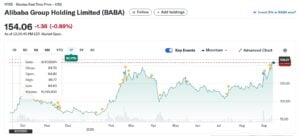
Alibaba (BABA) has been making headlines with an eye-catching 31% stock surge over the past month. From $118.64 on August 11, 2025, to $155.43 on September 11, 2025, BABA shares hit their highest levels since March 2025.
- For the year, BABA has gained 83%, making it one of the top-performing tech stocks in China’s fast-growing market.
This rally is no coincidence. It’s driven by Alibaba’s strategic focus on artificial intelligence (AI), cloud computing, and environmental, social, and governance (ESG) leadership. Below, we explore how these factors are shaping BABA’s growth story and why analysts are bullish on its future.
Alibaba AI Outpaces Rivals with Faster Reasoning, Challenging Google Gemini
The company just unveiled its next-generation artificial intelligence architecture, claiming a breakthrough that delivers ten times the performance at one-tenth the cost compared to its predecessor.
As per reports, the company open-sourced its Qwen3-Next-80B-A3B model, directly challenging Google’s Gemini and positioning itself as a formidable competitor in the global AI race.
The company simultaneously released Qwen3-Max-Preview, a commercial model with over one trillion parameters that marks Alibaba’s entry into the elite tier of frontier AI models. This dual release strategy demonstrates Alibaba’s commitment to both open-source development and commercial AI applications
Raises $3.2 Billion to Expand Cloud and AI Capabilities
Reported by Reuters, Alibaba announced plans to raise $3.2 billion through a zero-coupon convertible bond to fund its data center ambitions. It’s the largest of its kind this year. Dealogic data shows it surpasses DoorDash’s $2.75 billion deal from May.
Nearly 80% of the proceeds will support expanding data centers, upgrading infrastructure, and meeting growing cloud demands. The rest will boost Alibaba’s e-commerce efficiency and international presence.
With a 27.5% to 32.5% conversion premium above its U.S.-listed share price, the bond signals investor trust in Alibaba’s roadmap.
BABA Stock Rally Explained: AI and Cloud Computing at the Core
The biggest fuel behind the recent surge is its cloud computing division, Alibaba Cloud, and its innovative AI offerings. In Q1 2025, Alibaba Cloud delivered 26% year-over-year revenue growth, reaching RMB 33.4 billion ($4.7 billion)—an acceleration from the 18% growth in the previous quarter.
Even more compelling, AI-related services posted triple-digit growth for the eighth consecutive quarter, signaling sustained demand for data-driven solutions.
Gaining AI Independence with Custom Chips
A game-changer is its development of proprietary AI chips. With rising U.S. export restrictions, Alibaba’s move to reduce reliance on Nvidia chips is a bold bet on technological self-reliance.
This effort not only shields Alibaba from geopolitical risks but also strengthens its ability to compete globally in AI-powered services.
Wall Street’s Bullish Stance
Analysts are betting heavily on Alibaba’s technology play. Mizuho increased its price target from $149 to $159, while Barclays gave it a major boost, lifting its target from $145 to $190. Their confidence stems from Alibaba’s robust cloud infrastructure and AI-driven growth.
More significantly, its commitment to invest RMB 380 billion over three years in cloud and AI technologies reinforces its long-term strategy.
Thus, analysts are overwhelmingly positive on Alibaba’s future, rating BABA as a “Strong Buy.” The average price target stands at $162.28, suggesting a 19% upside. The highest target of $195 hints at a potential gain of 43%.
This consensus reflects confidence in Alibaba’s ability to balance innovation with sustainability.
Betting Big on Instant Commerce: A New Growth Avenue for Alibaba Stock
Alibaba is making bold investments in instant commerce through its platform Taobao, aiming for one-hour product deliveries. Despite near-term pressure on profit margins, the company sees this as a trillion-yuan opportunity over the next three years.
By competing with players like Meituan and JD.com, the Chinese e-commerce giant is redefining customer expectations and setting the stage for future expansion.
China’s Economic Recovery
Alibaba’s rally isn’t driven by technology alone. Improving consumer sentiment and supportive government policies have created a favorable environment for growth.
China’s retail sales rose 5.0 percent year-on-year in H1, with e-commerce playing a key role. Policy incentives and stimulus measures are helping domestic businesses expand, giving Alibaba the tailwinds it needs to scale.
Alibaba’s Carbon Neutrality Roadmap: Clear Targets, Measurable Impact
Alibaba has a strong climate plan to cut emissions across its business. It wants to reach carbon neutrality in its own operations by 2030 and reduce emissions from its partners by half compared to 2020. It also plans to help its customers and suppliers cut 1.5 gigatons of emissions by 2035.
By making sustainability a key part of its strategy, the company is turning environmental goals into new growth opportunities. So far, it has already made good progress with lower emissions and better energy use.
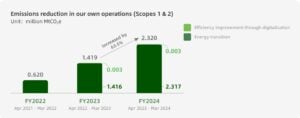
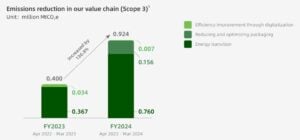
- Clean electricity usage also surged, accounting for 39% of the company’s total consumption. Alibaba was recognized by BloombergNEF as China’s top clean energy buyer in 2023.
- MUST READ: Alibaba Cuts Carbon Emissions By 13%, Reveals So-Called Scope 3+
Financing Sustainability
Alibaba’s commitment to sustainability extends beyond operations. In 2023, it issued $1 billion in sustainability-linked bonds, tied to renewable energy and emissions reduction targets.
By aligning financial incentives with environmental outcomes, Alibaba reinforces its credibility with investors and stakeholders alike.
Green Cloud Computing: A Win for Customers and the Environment
Alibaba Cloud is helping customers reduce their carbon footprint while improving efficiency.
A 2022 Carbon Trust report found that customers switching from traditional computing setups to Alibaba Cloud cut emissions by 85.5%, thanks to better energy usage and lower electricity demand.
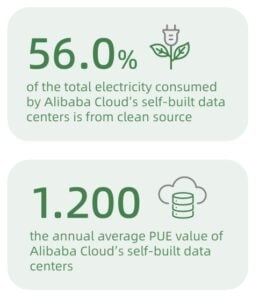
- Last year, 56% of Alibaba Cloud’s self-built data centers’ energy came from clean sources. Its power usage effectiveness (PUE) improved to 1.200, one of the best in the industry.
Alibaba plans to power its cloud operations entirely with clean energy by 2030, with PUE not exceeding 1.3.
Renewable Energy Consumption
LEED Gold Certifications and Green Infrastructure Supporting
Since 2022, Alibaba has committed that all newly built campuses meet LEED Gold standards for energy efficiency and sustainability. As of FY2024, it has achieved 238,000 square meters of certified space.
These investments in eco-friendly infrastructure are helping Alibaba create long-term value while promoting responsible growth.
The company’s focus on ESG is a key reason investors are drawn to the company. It has earned top ratings from major agencies, showing it is a leader in sustainable growth.
For example,
- It has a BBB rating from MSCI, a 50/100 score from S&P CSA, a low-risk score of 18.2 from Sustainalytics, and a B rating from the CDP on climate.
- Its environmental risk score of 3.8 is especially strong, highlighting how well the company manages climate-related challenges.
Alibaba’s recent stock rally is more than a short-term boost—it reflects deep-rooted structural growth powered by technology and sustainability.
The company’s AI and cloud initiatives are unlocking new opportunities, while its ESG leadership builds trust with investors and customers alike. For those seeking exposure to innovation, resilience, and environmental responsibility, Alibaba (BABA) stands out as a compelling investment.
With a clear vision, strong governance, and supportive market trends, Alibaba is well-positioned to lead the next phase of digital transformation while safeguarding the planet.
The post Alibaba Takes on Google Gemini: How AI, Instant Commerce, and Green Tech Are Powering the BABA Stock Rally appeared first on Carbon Credits.

EU carbon credit claims changed on 27 September 2026, the day the Directive (EU) 2024/825 began to apply across the European Union. The change is narrow. It changes how a company can talk about the credits it buys. A product can no longer be called neutral on the strength of compensation alone; however, every specific, evidenced statement about what a company measured, reduced, and funded stays fully available.

The post Promoting Improved Cooking Practices in Nigeria appeared first on Terrapass.



-
Climate Change1 year ago
Guest post: Why China is still building new coal – and when it might stop
-

 Greenhouse Gases2 years ago
嘉宾来稿:满足中国增长的用电需求 光伏加储能“比新建煤电更实惠”
-
Greenhouse Gases1 year ago
Guest post: Why China is still building new coal – and when it might stop
-

 Climate Change2 years ago
嘉宾来稿:满足中国增长的用电需求 光伏加储能“比新建煤电更实惠”
-

 Renewable Energy12 months ago
Sending Progressive Philanthropist George Soros to Prison?
-
Climate Change2 years ago
Bill Discounting Climate Change in Florida’s Energy Policy Awaits DeSantis’ Approval
-
Greenhouse Gases1 year ago
嘉宾来稿:探究火山喷发如何影响气候预测
-

 Climate Change2 years ago
Analysis: China’s CO2 falls 1% in Q2 2024 in first quarterly drop since Covid-19