

Flora Vano is country manager at ActionAid Vanuatu.
We are living at a time when women and girls are experiencing significant rollbacks of their rights across the board, in health, climate action, education, politics; you name it, it’s happening all around us.
As the world’s attention is fixed on the geopolitical issues dominating news headlines, important decisions affecting women’s futures are being made and women are not in the room. Women’s hard-won freedoms through the years are being stripped away either in broad daylight or in the darkness of the night.
But there is hope. A generation of women is organising in resistance. A generation aware that strength lies in numbers and that collective power can bring real, concrete change. This International Women’s Day marks a moment to reflect on the power of collective determination.
When women thrive, so do communities.
In my country, Vanuatu, we face constant climate crises that continue to wreak havoc across the board, affecting livelihoods and women’s participation in critical sectors of society.
Off-grid solar lights up Lawital
Most stories that come out of Vanuatu tend to focus on the adverse impacts of the climate crisis and other socio-economic challenges. It is well documented how tropical cyclones, droughts and earthquakes, among other climate change-induced disasters, have affected our people.
However, amid these crises, a powerful narrative of resilience is being written, led by women.
Over the past year, ActionAid – in partnership with the Australian government, PowerWells and the Women I Tok Tok Tugeta (WITTT) Network – has implemented a women-led, off-grid solar project in Vanuatu’s Lawital village on Tanna Island. The project has transformed the community which previously had no electricity. It has ignited hope.

Every single one of the 115 homes in Lawital is now connected to off-grid solar power, thanks to the women-led project designed to improve safety, livelihoods, education and wellbeing in the community of 800 people.
For those who could not afford kerosene lamps, their children were unable to study or do their homework at night. Once the sunlight vanished, the books were closed and their day was over. It was a similar story for women’s market stalls which had to close at the setting of the sun.
The narrative has changed.
Breaking traditional barriers
The impact of the solar project has been nothing short of transformative, positioning women as the primary leaders of transformation in their communities. By mastering the technical skills needed to install solar systems, the women have fundamentally altered the trajectory of their daily lives.
The introduction of reliable solar-powered light has revolutionised education for the children in this community. Children who once had to rush toward the road to catch the fading daylight for their schoolwork can now study safely and comfortably at home after sunset.
Moreover, the solar project has fostered a more stable social environment. Women are earning additional income and operating their businesses and markets into the night. The streets are safer now too, thanks to better lighting.
-
World leaders invited to see Pacific climate destruction before COP31
Pre-COP meetings will be held in Fiji and Tuvalu in October with a separate event in Palau in August -
Vanuatu pushes new UN resolution demanding full climate compensation
The Pacific island nation wants the UN General Assembly to enforce last year’s landmark court decision on states’ climate responsibility, a first draft shows


In a region like ours, where cyclones are a constant threat and often result in property damage, these women have also been trained to protect their investments.
In the past, a storm meant the destruction of infrastructure across our communities. To safeguard the gains of this project, the women were trained in rapid-response protocols to safely uninstall the solar systems before a storm hits and reinstall them when the skies clear.
The sight of local women climbing ladders, securing mounting brackets, and wiring panels has done more than provide electricity, it has shifted the social fabric of the community.

Women-led change needs sustainable funding
The resilience and tenacity of the women in Lawital are commendable and serve as a clear reminder that with the right tools and support, women-led initiatives are the key to tackling challenges where the women themselves are the most affected.
As we commemorate International Women’s Day and Women’s Month, governments and stakeholders must ensure that movements led by women get sustainable funding to mobilise effectively and create lasting change.
The women trained under this project are now an inspiration in their communities and are leading a revolution. This is proof that, with adequate resources and opportunities for women-led interventions, the foundations can be set to achieve the United Nations’ theme of “Rights. Justice. Action. For ALL Women and Girls“.
The post How women transformed a Vanuatu community with off-grid solar appeared first on Climate Home News.
How women transformed a Vanuatu community with off-grid solar

A group of farmers plans to sue the developers of the East African Crude Oil Pipeline (EACOP) in a British court, claiming the project breaches the Ugandan constitution and climate and environment law.
In a previously unreported letter before action, sent to the developers’ UK-based arm in January, the farmers say they and their livelihoods risk being harmed by climate change which the pipeline will worsen by generating millions of tonnes of greenhouse gas emissions.
Their law firm, London-based Leigh Day, plans to file a formal claim in the next few months, in which it will ask for construction of the pipeline – which will cost around $5.6 billion to build, spans Uganda and Tanzania and is four-fifths complete – to be halted.
The lawsuit has been crowdfunded by donations from over 40,000 people, coordinated by the Avaaz campaign group, which promote the case as “one final chance to stop one of the worst oil pipelines on the planet”.
-
Where East African oil pipeline meets sea, displaced farmers bemoan “bad deal” on compensation
The oil export project has pushed up the price of land, so compensation is too low to maintain affected villagers’ standard of living

The pipeline is a joint venture led by French company TotalEnergies, with smaller stakes owned by Uganda, Tanzanian and Chinese national oil firms. But it is operated by EACOP Ltd, a company registered to an office in Canary Wharf, the tallest building in London’s financial district.
Leigh Day solicitor Joe Snape, who represents the group of farmers, said EACOP highlights how corporations in the Global North are profiting from fossil fuel extraction projects in the Global South which also suffer most from their worsening of climate change.
Ugandan law tested in UK court
The group of four farmers accuses EACOP Ltd of breaching their right to a clean and healthy environment under the Ugandan constitution, as well as its legal obligations under Uganda’s National Environment Act and National Climate Change Act.
Leigh Day solicitor Joe Snape, who represents the farmers, told Climate Home News that Ugandan law has novel clauses allowing people to make environmental claims without having to demonstrate a precise link to their own loss. They just have to show that the action complained of threatens, or is likely to threaten, efforts to reduce emissions or adapt to climate change, he said.
However, these clauses have not yet been tested in court, so it will be up to British judges, if they accept the case, to interpret how they apply in practice.
Leigh Day is keen to use the UK’s legal system because it perceives it as more impartial and efficient than that of Uganda, Snape said. A climate lawsuit filed in Uganda more than a decade ago by a group of young people has yet to conclude.
EACOP has been subject to repeated lawsuits in several countries, none of which have succeeded. A case at the East African Court of Justice, brought by campaign groups against Uganda and Tanzania, was rejected on procedural grounds last November.
A separate ongoing lawsuit in TotalEnergies’ home country of France – a refiled version of an earlier failed claim – cannot stop EACOP going ahead, but it does seek damages from TotalEnergies for affected communities.
Thousands already displaced
The pipeline, which will link Uganda’s Lake Albert oil fields to Africa’s east coast in Tanzania, is around 80% completed according to its developers, with first oil exports possible as early as October.
Thousands of people have already been displaced by the pipeline, with compensation paid and many training schemes – whose quality has been criticised – already completed.
Despite this progress, the farmers’ legal team say that a court could still stop the pipeline from being completed. Any contractual or compensation issues arising from the stoppage and the billions of dollars of sunk costs would have to be dealt with separately, said Snape.
Gerald Barekye, a farmer, researcher and campaigner, from the pipeline-affected Hoima district, will be one of the claimants. He said that Ugandan communities were already living with flooding, drought and food insecurity caused by climate change.
“Allowing these oil companies to complete the construction of the EACOP pipeline and extract millions of barrels of oil, which will produce millions of tonnes of emissions, will only make this situation in this region worse and deepen our suffering,” he said.
Agriculture, which makes up a fifth of Uganda’s GDP and employs two-thirds of its population, is likely to be affected by falling yields, rising plant pests and diseases, reduced suitable for crop growing and changes to growing seasons caused by climate change.
As well as the climate impacts, they will argue that the pipeline will have a significant impact on local nature and wildlife from possible oil spills, habitat fragmentation, noise pollution and new infrastructure, and poses a threat to major water resources.

Michel Forst, UN Special Rapporteur on environmental defenders under the Aarhus Convention, has raised further concerns about “serious allegations of persistent and widespread attacks and threats” against environmental defenders in Uganda over the project.
In 2022, Ugandan police arrested nine activists protesting against EACOP. One protester, Nabuyanda John Solomon, told Climate Home News at the time that police had broken one man’s arm and hit another in the eye with a baton.
EACOP Limited did not respond to a request for comment.
The post Ugandan farmers use British court to try to stop oil pipeline appeared first on Climate Home News.
Ugandan farmers use British court to try to stop oil pipeline
Pepukaye Bardouille is the Director of the Bridgetown Initiative and Special Advisor in the Prime Minister’s Office of Barbados. Kerrie Symmonds is Barbados’ Minister of Energy and Business and Senior Minister coordinating Productive Sectors.
When conflict erupts in one region, consequences can reverberate across the globe. Beyond the tragic human toll, the economic impact is palpable. In 2022, the war in Ukraine illustrated this clearly: fractured supply chains and soaring oil prices sent fuel import bills skyrocketing. And again, today, as oil prices spike amidst conflict in the Middle East, the stakes could not be higher, in particular for Small Island Developing States (SIDS).
For SIDS, resilience and energy have always been inseparable. When a hurricane hits, power lines fall. When shipments stall, oil dependence becomes a liability. Yet these countries also hold a strategic advantage in the form of abundant wind, sun, waves, and in many cases geothermal resources.
Harnessed effectively, these can power entire economies cost-effectively. With this in mind, SIDS have set some of the world’s most ambitious climate targets, with several pledging 100% renewable electricity within the next decade or two. And they have made progress: installed renewable capacity across SIDS tripled from 3.3 GW in 2014 to 9.4 GW in 2024.
But execution and financing still lag well behind ambition – and in the midst of an oil shock, closing that gap isn’t a policy preference for SIDS. It’s a matter of survival.
Lessons from Barbados
Barbados offers an example of what a credible pathway looks like. Its 50MW Lamberts and Castle project will be the country’s first utility-scale onshore wind farm and one of the largest in the Caribbean – building on a renewables base that already supplies 16% of power capacity.
Developed as a public-private partnership, it evolved from a 10MW concept into a utility-scale investment. That journey holds several lessons for other SIDS looking to accelerate their energy transition.
First, be honest about what is politically palatable and ensure the population shares in the upside. Many SIDS operate state utilities that view private power producers as threats to sovereignty or revenue. But private actors often bring the capital and expertise that large-scale projects require.
The answer is smart design. Barbados models this well, pairing private generation ownership with structures that ensure national benefit, including opportunities for citizens to invest directly.
-
Middle East war is another wake-up call for fossil fuel-reliant food systems
Much of the world’s food production depends on fossil fuels for fertiliser and transportation, and the crisis in the Gulf will push up prices – and, in turn, hunger -
India sets achievable green electricity and emissions intensity targets
While most analysts hailed the 2035 goals, some said they are too easy to meet given the progress India is already making


Second, ensure that the financials really work. Small islands face high per-megawatt costs, which logistics compound: transporting and installing large wind turbines can require port reinforcements, specialist cranes, and road widening.
These numbers rarely appear in headline budgets but can quietly kill a deal. Financing packages must therefore cover not just generation, but storage, grid upgrades, and the full logistics chain. These are too often treated as afterthoughts when they are, in practice, the difference between a project that gets built and one that doesn’t.
Collaboration required
Third, development partners must streamline energy transition support without compromising sustainability. Environmental and social studies, bird and bat surveys, community consultations, and grid analyses all take time, and rightly so. But their multiyear development timelines before a tender is issued are incompatible with 2030 or even 2035 energy targets.
SIDS need simplified processes with upfront permitting clarity, clearer regulatory pathways, and predefined safeguards. Development partners must move from project-by-project structuring to practical, time-sensitive and replicable models that reduce procedural drag while upholding environmental rigor.

Fourth, recognize that land access is critical to national energy security. In land-constrained countries, which most SIDS are, a handful of parcels can determine whether critical capacity is built. In Barbados, we expanded the Lamberts and Castle wind project site from 30MW to 50MW through careful planning and negotiation. These decisions can make or break a project’s financials, so landowners must be partners in the process, not obstacles to it.
Finally, mandate ‘all of government’ teams with the stamina to deliver. The Lamberts and Castle project advanced because the Ministry of Energy and Business, Barbados National Energy Company, Barbados Light and Power, community stakeholders and International Finance Corporation – the government’s transaction adviser – worked as a unified team.
Cheaper electricity and greater security
Energy transition projects need cross-agency partners empowered to make timely decisions, and a shared mission – all cemented by the ability to remove bottlenecks at the highest level. Institutional collaboration is not a nice-to-have, it is the engine of delivery.
Resilience cannot be outsourced, nor achieved through pledges alone. It must be built: panel by panel, battery by battery, turbine by turbine, grid by grid.
Building on the progress at Lamberts and Castle, Barbados is exploring the possibility of tripling its wind energy capacity through a public–private partnership model. Importantly, this expansion will not compromise food security. Wind turbines typically occupy less than 5% of the land area, allowing the remaining space to continue supporting agricultural production, another key resilience priority for Barbados.
In Barbados, new turbines will soon turn in the same trade winds that once powered sugar windmills, this time delivering cheaper electricity, greater economic security, and the ability to meet climate goals on our own terms. By putting renewables at the heart of resilience, SIDS can secure energy independence and lead the world in climate and economic security.
The post How small island states can make renewables the bedrock of resilience appeared first on Climate Home News.
How small island states can make renewables the bedrock of resilience
For the past two decades, low-level cloud cover has been declining, increasing the amount of sunlight absorbed by Earth and amplifying global warming.
As global temperatures have reached record highs in recent years, there has been concern that the decline in cloudiness may be enhancing warming more than previously expected.
In a new study, published in Atmospheric Chemistry and Physics Letters, we investigate how the decline in global cloudiness affects the Earth’s “energy imbalance” – the difference between absorbed solar energy and heat radiated into space that results in global warming.
This imbalance has more than doubled over the past 20 years, as greenhouse gases have trapped more heat in the atmosphere.
We find that, since 2003, the decrease of cloudiness has been responsible for half of the increase of Earth’s energy imbalance.
Analysing the drivers of global changes to cloud cover, we find that the decrease in cloudiness over the past two decades has been primarily driven by humans, rather than being caused by natural variations in Earth’s climate.
Taken together, our findings mean that scientists can even more confidently attribute recent warming to human activities.
Low-level clouds and warming
Low-level clouds are those that have a base below 6,500 feet (2,000 metres) above Earth and include stratus, stratocumulus and cumulus. They are typically found over large areas of the global ocean, where there is a large moisture supply from evaporation.
These clouds have a powerful impact on the Earth’s climate because they reflect a substantial fraction of incoming sunlight back into space.
By acting as the Earth’s “sunscreen”, they keep the climate cooler than it would otherwise be.
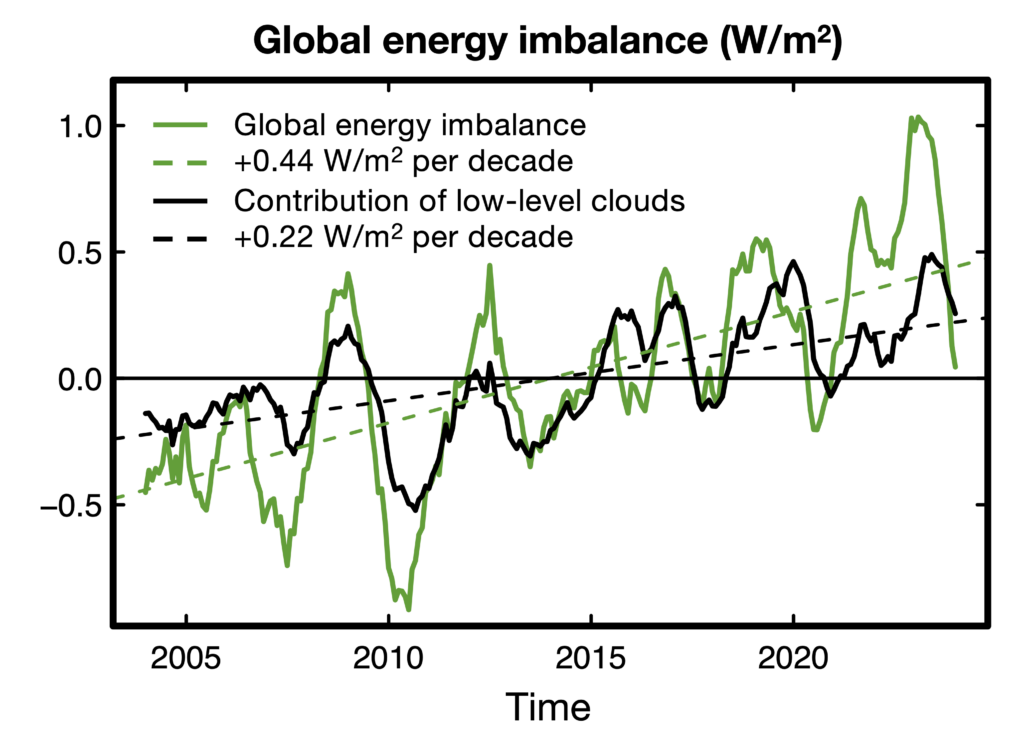
Satellite observations reveal a global decline in these low-level clouds since the turn of the millennium. This is shown in the chart below, where the black line represents the average percentage of the Earth covered by low-level clouds and the dashed line the downward trend.
Our research shows that the decline in cloudiness over the past 20 years has played a major role in increasing the Earth’s energy imbalance and, therefore, warming.
The Earth’s energy imbalance is the difference between the amount of energy arriving at the Earth from the sun and what is reflected and radiated back to space.
Rising greenhouse gas emissions from human activity are upsetting this balance by trapping more energy in the atmosphere, leading to warming.
A less cloudy atmosphere also helps supercharge the energy imbalance, because it means more sunlight reaches the Earth.
In our research, we use a simple model to assess how changes in low-level clouds between July 2003 and June 2024 contributed to the Earth’s energy imbalance.
We find that, averaged globally, changes in low-level cloudiness caused an extra 0.22 watts per metre squared (W/m2) per decade of absorbed sunlight. This amounts to exactly half of the concurrent increase in Earth’s energy imbalance over the same time period.
This is shown in the chart below, where the green line represents the increase in the Earth’s energy imbalance over 2003-24 and the black line shows the contribution of low-level clouds to that trend.
Why is cloudiness changing?
Scientists have attributed declining cloud cover in the 21st century to three main causes.
The first is a decrease in human-caused aerosol emissions over recent decades. Aerosols – tiny, light‑scattering particles produced mainly by burning fossil fuels – influence the formation of clouds, by acting as “seeds” for cloud droplets to form.
In recent years, aerosol emissions have been reduced due to efforts to clean up air pollution, such as cleaner shipping fuel regulations. Cleaner air has resulted in a decline in cloudiness.
Second, increasing concentration of greenhouse gases in the atmosphere has led to a warmer and drier atmosphere, which also helps to dissipate clouds.
Although a warmer atmosphere generally holds more water vapour in absolute terms, what matters for clouds is the “relative humidity” of the air, which has been declining in many places. This is a measure of how “saturated” the air is, or how much water vapour the air contains compared to the maximum it could hold.
Finally, cloud cover decreases have also been linked to ocean surface warming, which affects atmospheric humidity and, thus, cloudiness. Reduced cloudiness leads to more sunlight being absorbed at the ocean surface – and more warming. This amplifying loop is known as a “cloud feedback”.
However, the exact strength of these three effects on cloud cover is still unclear.
In fact, cloud feedbacks are among the main uncertainties in climate model projections of global warming.
Attributing low-cloud cover changes
In the next step of our study, we explore how the three human-caused factors mentioned above – aerosols, greenhouse gases and cloud feedback – contributed to recent low-level cloud changes.
We also look at the extent to which cloud changes could be explained by natural climate variability, which causes substantial year-to-year fluctuations in cloudiness and energy imbalance.
To do this, we use a statistical technique known as “cloud-controlling factor analysis”.
This analysis involves calculating the sensitivity of clouds to their “controlling factors”, including meteorological variables, such as temperature, humidity and winds, as well as aerosol concentrations.
To calculate how each factor contributed to the bigger picture of declining cloud cover, we combine sensitivity calculations with observed trends in meteorology and aerosol emissions.
This analysis allows us to attribute trends in cloud cover to known physical drivers: either natural climate variability, or human activities linked to aerosols, greenhouse gases and cloud feedback.
Our research finds that about 40% of the low-level cloud decrease since 2003 was driven by warming of the ocean surface – in other words, the cloud feedback process. This is followed by the effects of greenhouse gases (21%) and aerosols (14%).
Natural climate variability accounts for just 3% of the low-level cloud trend.
(The remaining 23% of the trend cannot be explained by our statistical method. This could be due to the limitations of cloud, temperature, humidity and aerosol concentration observations.)
The chart below shows how human-driven factors – the sum of aerosol effects (red), greenhouse gas emissions (pink) and cloud feedback (burgundy) – were responsible for almost three quarters of the decrease in low-level cloudiness over 2003-24. Natural climate variability (blue), on the other hand, played a minor role.
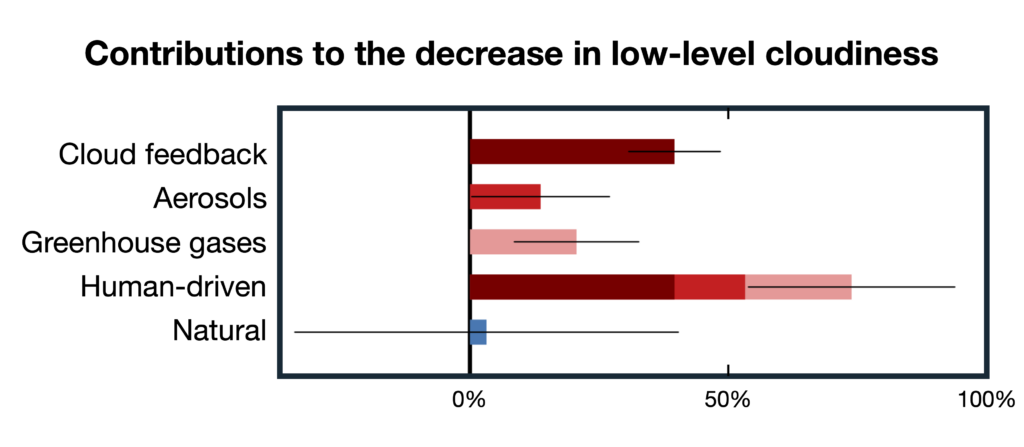
Thus, our analysis indicates that, at global scales, the observed cloud decrease is primarily driven by humans, rather than being caused by natural variations in Earth’s climate.
And, since low-level clouds contribute to half of the energy imbalance increase over the same period, it follows that a significant part of recent rises in energy imbalance can also be attributed to humans.
Clouds in climate models
So, should we be concerned that this cloudiness decrease means the Earth could see more warming than already anticipated?
To answer this, we looked at whether the climate models used by scientists to project future global warming accurately simulate recent declines in low-cloud cover.
While the models produce a wide range of outcomes, we found that, on average, the simulated changes in low-level cloudiness changes are in close agreement with real-world trends.
This is reassuring, as it means the effects of low-cloud cover are already accounted for in existing warming projections.
However, questions still remain around what is driving recent increases to the Earth’s energy imbalance, which have outpaced projections made by climate models.
Our findings rule out declines in low-level clouds as the reason that climate models have been underestimating the Earth’s energy imbalance, and, as a result, warming. But it is still possible that models are underrepresenting future global warming to some extent.
Low-level clouds are just one of several drivers of changes in energy imbalance. Future work will therefore need to assess other observed and simulated drivers of energy imbalance changes: for example, the impact of upper-level clouds, or changes in water vapour or sea ice.
Finally, it is important to stress that, while our findings are reassuring, they should certainly not make us complacent about the current global warming trend. The impacts of climate change are serious enough as they are – even if there is no evidence of a missing amplifying feedback in our projections.


The post Guest post: How declining cloudiness is accelerating global warming appeared first on Carbon Brief.
Guest post: How declining cloudiness is accelerating global warming



-
Greenhouse Gases8 months ago
Guest post: Why China is still building new coal – and when it might stop
-
Climate Change8 months ago
Guest post: Why China is still building new coal – and when it might stop
-

 Greenhouse Gases2 years ago
嘉宾来稿:满足中国增长的用电需求 光伏加储能“比新建煤电更实惠”
-
Climate Change2 years ago
Bill Discounting Climate Change in Florida’s Energy Policy Awaits DeSantis’ Approval
-

 Climate Change2 years ago
嘉宾来稿:满足中国增长的用电需求 光伏加储能“比新建煤电更实惠”
-
Climate Change Videos2 years ago
The toxic gas flares fuelling Nigeria’s climate change – BBC News
-

 Carbon Footprint2 years ago
US SEC’s Climate Disclosure Rules Spur Renewed Interest in Carbon Credits
-

 Renewable Energy5 months ago
Sending Progressive Philanthropist George Soros to Prison?