

How do I become a youth activist? Two lessons learned and five ways to get started!
Two former Youth Environmental Activists have come back to join the Climate Generation Team. We took some time to ask them what lessons they learned as youth organizers and how others can get started.

How did you become a youth activist?
I was always passionate about environmental and food systems at school, and I started looking for groups to get involved with – that’s when I found YEA! (Youth Environmental Activists). Being in the YEA program changed the trajectory of my life – it showed me how to organize.
What did you learn?
Walking into my first YEA! meeting, I thought maybe I’d learn something new about climate change. By then, I had learned some things about climate change but didn’t understand climate justice. I came to the program with some understanding of food systems and was interested in joining a community of youth.
I remember being asked by another student, “What is it that you want to do in your community?” At that moment, I realized I’d never asked myself how and why I wanted to make a difference. I had never been asked what I wanted.
I want to build a world where young people are believed in and respected and where we embody the world we want to live in now. I want to live in a world where we can gain power for the many and enact justice.
I left that first YEA! meeting with a new sense of what could be. As I continued working with a group of students and organizing others, it led me to see myself as a leader. YEA! taught me how to organize my peers and neighbors. I learned what it meant to understand institutions and map power.
By the time I graduated from high school and the YEA! program, I understood my climate story and how I wanted to enact change in the world. Working in a group to organize is so powerful, and that was a big lesson learned for me.


Throughout my three years as a part of YEA! and Climate Generation, I gained a holistic climate justice education, and I began to take action and organize around the racist HERC trash burner. The same HERC trash burner we are still resisting today, almost ten years later. YEA! drove me to study political science so I understood political institutions and power more deeply.
A story is a powerful thing. My career path has led me to craft narratives to elevate the causes of nonprofit organizations, and now I’ve come full circle to advance the work of Climate Generation. When people understand the “personal” in a policy through a story – it builds trust, connection, engagement, and ultimately action. Climate Generation uplifts and inspires conversation through storytelling and organizing about what the climate movement needs right now – in our local community here in the Twin Cities in the YEA! program or on a global scale at COP.
Climate Generation puts so much into the youth, educators and community it serves. I can’t wait to start a new chapter of my story with you, Climate Generation!

How did you become a youth activist?
When I first learned about the concept of climate change, it was through the lens of the Cedar-Riverside neighborhood in Minneapolis. In 2018, there was a significant push to establish gardens in my neighborhood because Cedar residents wanted access to more fresh food and produce. Witnessing this immediate need, I wanted to help, but with limited resources and tools, and lacking in-depth knowledge, it felt like I couldn’t assist the people who mattered most to me.
It was during a visit to the lunchroom by the YEA! Coordinator that I was encouraged to attend a Wednesday meeting of YEA! to learn more about their work and how I could get involved in the climate movement.
Hearing those words for the first time, “How I could get involved,” made me feel empowered for the first time like I was able to be part of the larger solution to help my communities and others around me.
Climate justice is not just about saving the world; it encompasses the intersecting values of why we do this work and why young people have powerful and brilliant ideas to bring to the table, not just in presence alone but through action as well.
As the years went on, with my learning and involvement through YEA!, I became part of a larger coalition of students called “MN Youth Climate Strike,” where we organized a student-wide walkout demanding divestments from fossil fuel companies.
What did you learn?
The moment students left their classrooms to march to the capital to be heard and seen made me realize the sense of community, visibility, and being heard.
That’s when I recognized the importance of YEA! because that coordinator asked me one question, and now my life is forever changed.


Now, I am a Youth Coordinator for Climate Generation, and I am dedicated to this work because I believe that the climate movement will be an ongoing, ever-intersectional fight. I aim to disseminate knowledge about the climate crisis and what I’ve learned to educate and support communities, placing care and intention at the center.
Here are some ways you can start taking action as a youth activist:
- Talk to your peers:
- Start by talking to your peers about it! A great way to get involved is to info share with you friends, peers and family members

- Start an ECO club at your school:
- One of the first way you can get involved is by working with other students around your school on the eco-systems at your school (Are they using a recycling system? How can you make that system better?)

- Join a group of other youth activists in your area
- A great way to build power and organize is connecting with people who are already doing the work. Check at your school or at local organizations if they have youth committees or programs specifically working on organizing and local and state level policy, like YEA!

- Research!
- There will always be grassroot level groups and organizations doing a lot of the same actions you are wanting to do. Try and find ways to get involved like canvassing or attending meetings.

- Talk to your lawmakers:
- An easy was to get involved is to find out who represents you in your district and advocating to them things happening in your community

Becoming climate activists changed both of our lives, and you can take action too! Interested in learning more about how youth-led community organizing works? Check out our YEA page!
The post How do I become a youth activist? appeared first on Climate Generation.

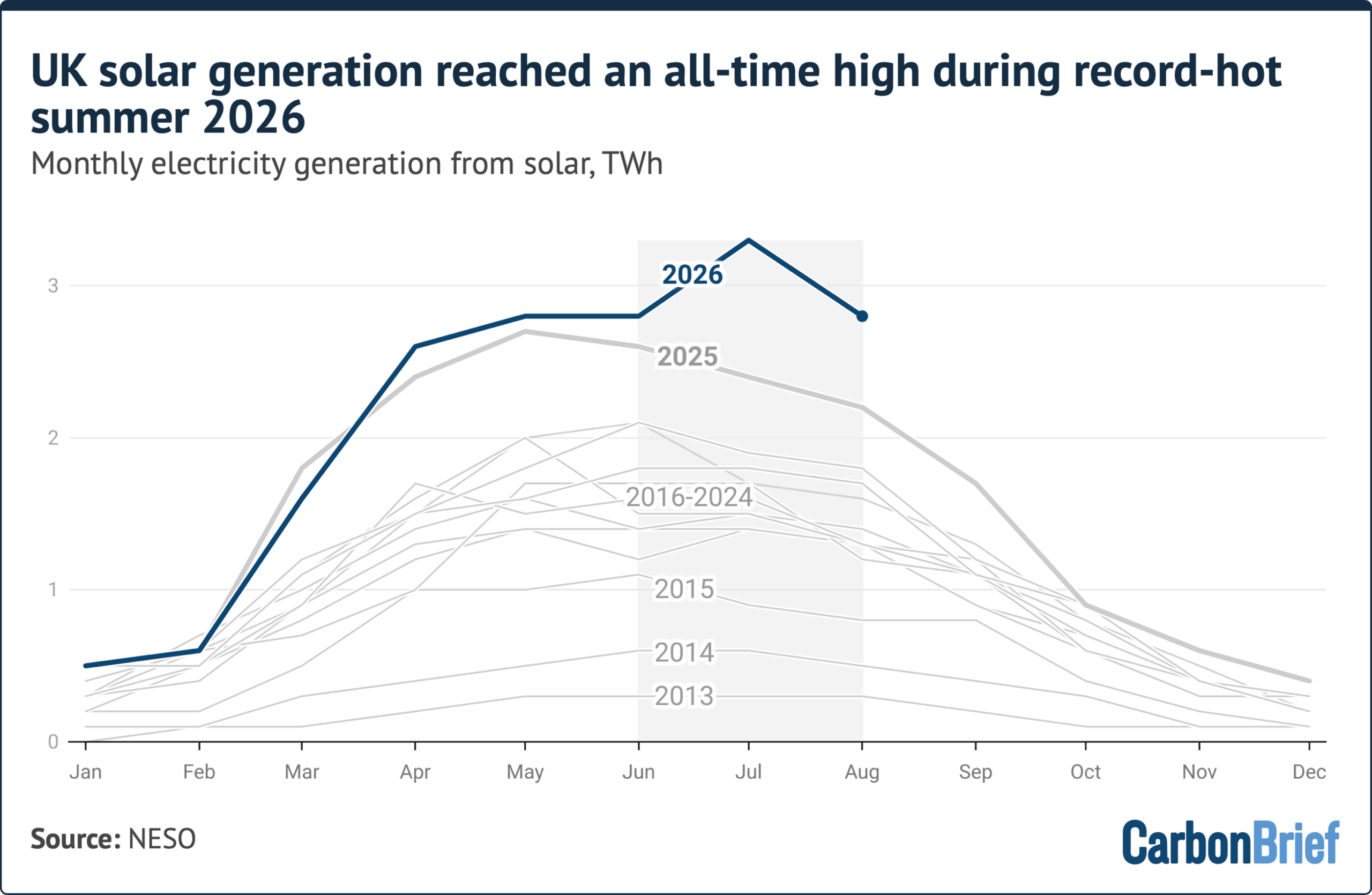
Solar power generation in the UK reached a new record over the summer of 2026, as temperatures across the nation soared, according to new analysis by Carbon Brief.
Collectively over June, July and August, solar farms and rooftops generated 8.8 terawatt-hours (TWh) of electricity in the UK*, as shown in the chart below.
Speaking to Carbon Brief, Chris Hewett, chief executive of trade association Solar Energy UK welcomed the new record, adding that it was driven by “clear skies and continued growth in deployment”.
This surge in generation took place amid the hottest summer on record in the UK, with five heatwaves between May and August.
Summer 2026 was the sixth sunniest on record, with more than 620 hours of sunshine, according to the Met Office. England and Wales – which experienced the most extreme heat – saw their second-sunniest summers on record.
June 2026 was the hottest June in England since records began in 1884, according to Met Office data, while Wales and the UK as a whole experienced their second-warmest June.
It was the driest July for England and Wales since records began in 1836, with some parts of London seeing no rain at all in the month, while Wisley in Surrey had no rain for 62 days.
In England, temperatures peaked at 38.1C at Kew Gardens in London on 13 August.
According to the Met Office, this summer’s record mean temperature was made 130 times more likely by climate change.
Amid these hot and sunny months, solar power generation increased 23% from the same period in 2025. This is double the level of solar generation over the summer of 2021, according to Carbon Brief analysis.
While solar panels can be affected by periods of extreme heat, the longer hours of daylight and higher levels of irradiation over the summer more than offset any efficiency losses.
June, July and August all saw solar set new monthly records for solar generation – July saw the highest solar generation in a calendar month ever, with 3.3TWh meeting 15% of overall electricity demand for the month.
As of the end of August, the total UK solar generation in 2026 stood at 17TWh – 13% higher than the same point in 2025.
The number of solar farms and rooftop installations has grown substantially in recent years, helping to boost generation. Domestic rooftop solar accounts for around 29% of total capacity.
In 2025, the UK’s solar capacity reached 21 gigawatts (GW) by the third quarter of the year, according to UK government figures. This is a jump of 3GW, or 18%, year-on-year, as Carbon Brief reported in January.
(Capacity is the maximum output possible from an electricity generation, whereas generation is what was produced over a certain time period, such as a day, month or year.)
According to the University of Sheffield, the installed solar capacity is now nearly 24GW.
This includes nearly 172,000 solar installations that have been fitted across the UK since the start of 2026, according to recent government figures. In July alone, more than 19,800 rooftop solar panels were installed – the equivalent of one installation every two minutes.
In total, nearly 1.7m households in the UK now have solar panels installed.
Over 26 heatwave days this summer – periods of at least three days when temperatures exceed the Met Office’s county-level heatwave temperature threshold – UK households with rooftop solar panels avoided an estimated £86.7m in electricity costs, according to analysis by Utility Bidder.
Talking about the surge in solar generation this summer, Hewett says:
“[It] not only kept bills down for people with solar and batteries in their homes, but helped keep overall power prices much lower than they would have been if Britain had been relying on more gas generation during the day”.
Despite the record generation, no new half-hourly solar power output record was set in the summer of 2026. This still stands at 15.2 megawatts (MW) on 23 April 2026.
* This article refers to the UK throughout, but strictly relates to the island of Great Britain, made up of England, Scotland and Wales. Northern Ireland is part of the separate, all-Ireland electricity system.
related
Factcheck: 10 flaws in the Conservative report on ‘cheap power’
Q&A: What is ‘long-duration energy storage’ – and why does the UK need it?
Q&A: What does China’s 15th ‘five-year plan’ for renewables mean for climate change?
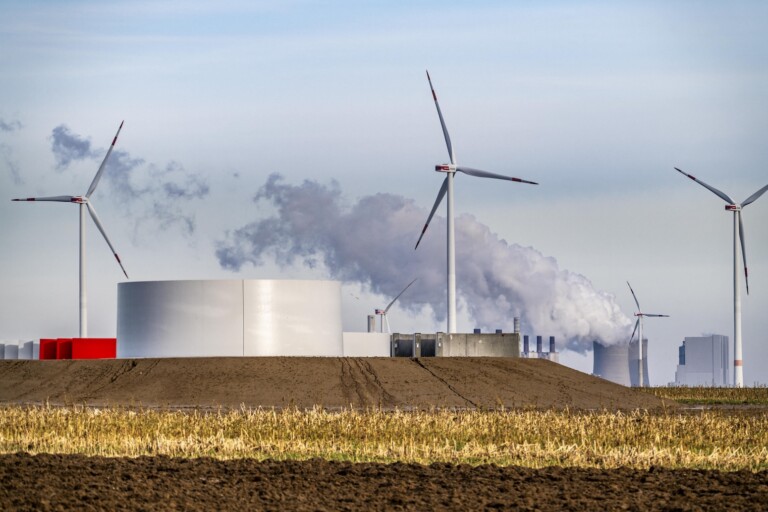
Analysis: Wind and solar power overtake fossil fuels in Germany for first time ever
The post Analysis: UK solar power hits record high over summer 2026 appeared first on Carbon Brief.
Farmers around Europe are dealing with the aftermath of a summer of extreme heat, drought and wildfires that were exacerbated by climate change.
Human-caused climate change is increasing the severity and likelihood of many extreme weather events around the world, which is increasing volatility for food producers.
This summer resulted in, for example, shrunken potatoes in the Netherlands, reduced carrot harvests in France, dried-up rice fields in Italy and scorched olive groves in parts of the Mediterranean region.
Global food prices are currently at their highest level since early 2023 due to “heatwaves and energy price dynamics”, according to the UN Food and Agriculture Organization.
Other factors such as blocked fertiliser supplies in the Strait of Hormuz and high fuel costs have also played a role in this year’s agricultural outputs.
In the six charts below, Carbon Brief provides a snapshot of the impact this summer’s extremes are considered to have had on crop production and yields across Europe.
1. Most EU countries expect to see declines in cereal production this year
2. Most countries are recording reduced crop yields
3. Around €2bn worth of cereal losses after June heatwave
4. UK yields of wheat, barley and oats are all due to drop in 2026
5. Maize production in France is due to hit a four-decade low
1. Most EU countries expect to see declines in cereal production this year
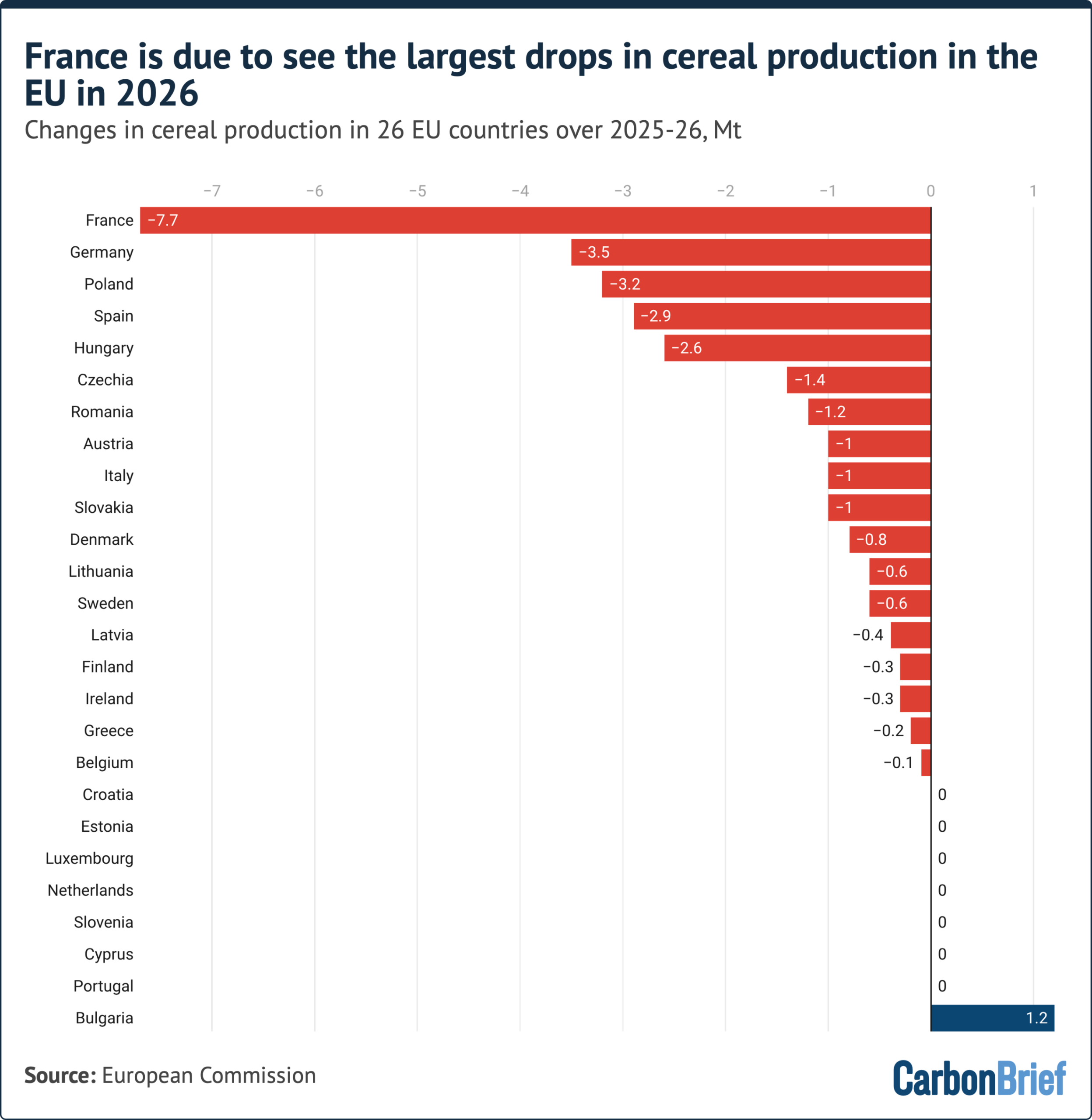
France, in particular, will see heavy losses in the amount of cereals – such as wheat, barley and oats – it produces this year, according to European Commission data.
French cereal production is expected to drop by almost 8 megatonnes (Mt) in 2026, compared to 2025.
The chart above shows that most European countries, aside from Bulgaria, will also see production losses this year.
Germany is due to see the second-largest losses in production, dropping by almost 4Mt compared to 2025.
Prof Til Feike, a cropping systems expert at the Julius Kühn-Institut, says many areas in Germany and Austria, as with other parts of Europe, have been “hit hard by a long-lasting dry period in combination with record-high heatwaves”.
This has resulted in dry grassland for animals and lower yields of maize, which is a “key fodder crop” for livestock. He tells Carbon Brief:
“In the long run, farming must adapt better to more extreme weather conditions, not only heat and drought, but also prolonged wet periods. So, there is no one-fits-all solution for climate change adaptation.”
2. Most countries are recording reduced crop yields
Heat and a lack of water have “substantially worsened” crop expectations this summer in western and most of central Europe, according to a recent bulletin from the EU Joint Research Centre.
Yields are expected to be “significantly reduced”, with local crop failures “likely” in areas such as France, southern Germany, northern and central Italy, and Hungary, it added.
The chart below shows that yields of cereal grains – which, here, refers to the tonnes of a grain grown per hectare of land – are expected to fall in most EU countries in 2026.
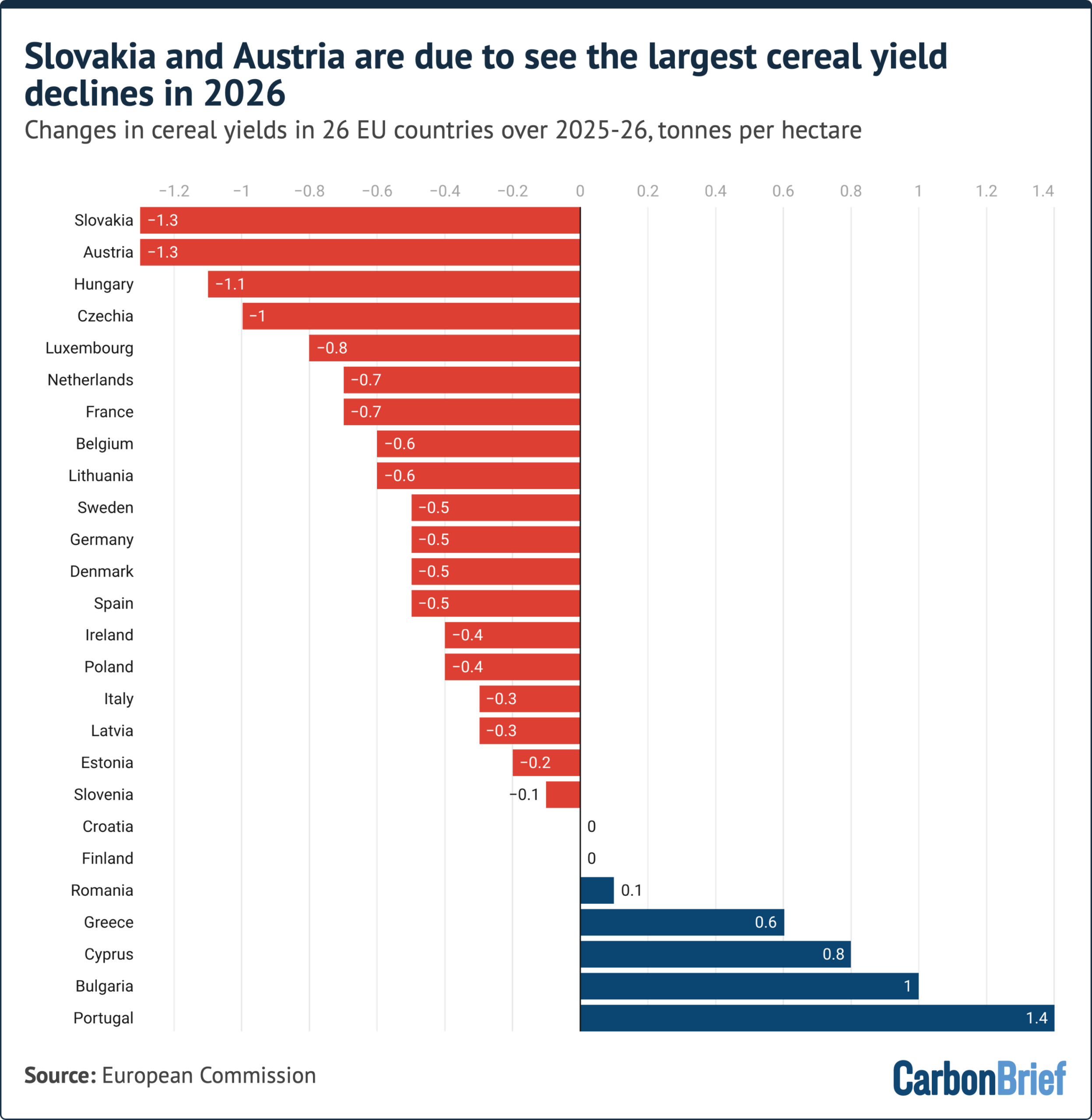
Slovakia, Austria and Hungary are expected to see the largest declines in cereal yields, reducing by more than one tonne per hectare in 2026 compared to 2025.
The recent EU bulletin noted that irrigated crops performed well in Portugal this summer – the country with the largest yield increases. Other crops relying on rainfall showed growing signs of heat stress, it added.
3. Around €2bn worth of cereal losses after June heatwave
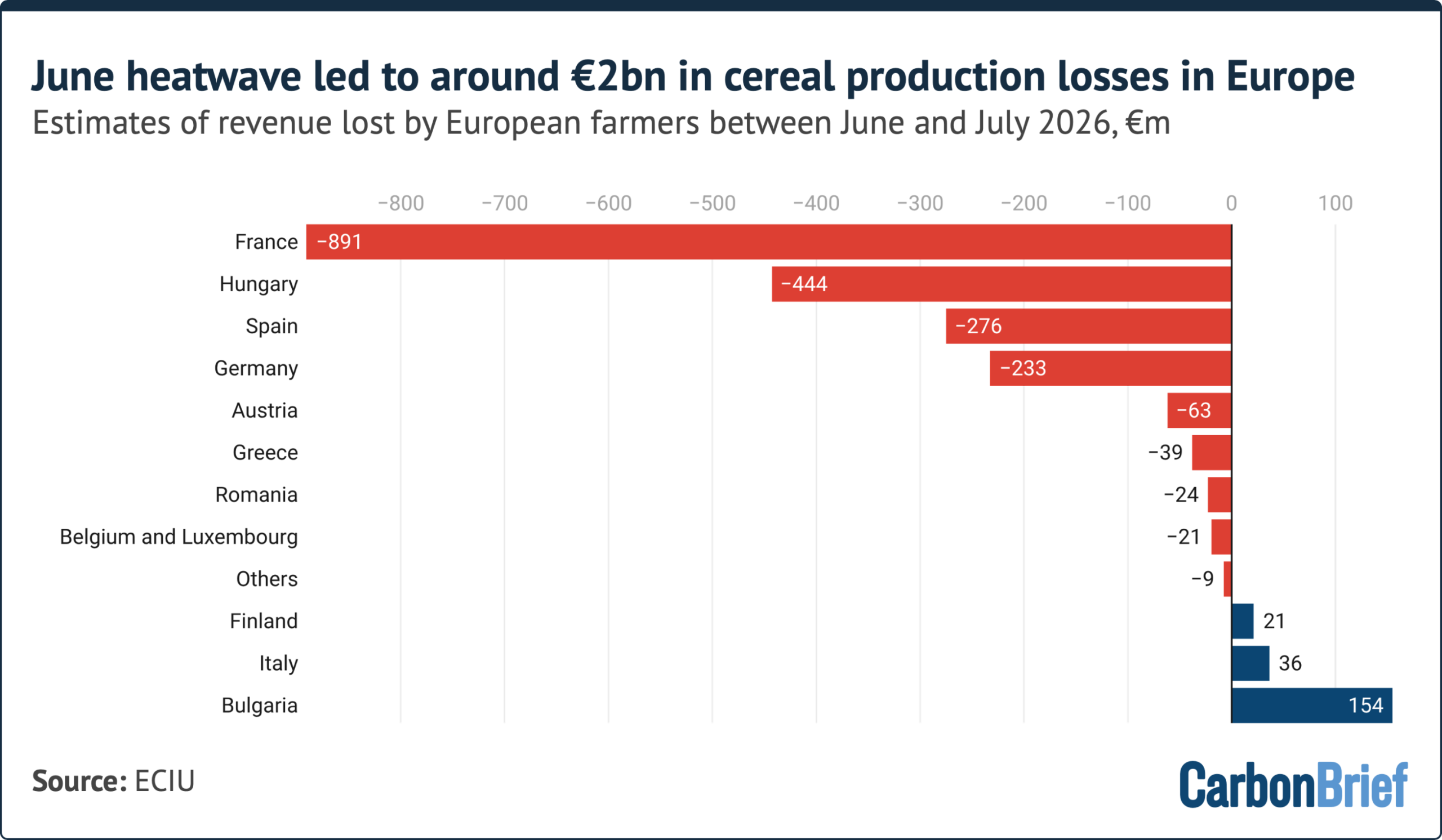
The record heatwave that hit many parts of Europe in June contributed to an estimated €2-2.3bn in cumulative grain production losses, as shown in the chart below.
The intense June heat in western Europe would have been “virtually impossible” just 50 years ago, according to a rapid climate attribution study. It was the region’s hottest June on record.
The Energy & Climate Intelligence Unit (ECIU) thinktank analysed June and July 2026 grain forecasts from Coceral, a European grain traders association.
ECIU estimated lost supply by multiplying the change in tonnes of grains between these two months by prices for harvest delivery in 28 European countries.
Major grain producers France, Germany, Hungary and Spain accounted for 86% of the lost revenue, according to the ECIU.
Extreme heat is also expected to have a wider economic impact across the continent. Analysis from Triodos Bank found that this summer’s extreme weather could reduce the EU’s gross domestic product (GDP) by around 1% this year, or around €180bn.
4. UK yields of wheat, barley and oats are all due to drop in 2026
If current trends continue, the average yields for cereals and oilseeds will result in the UK’s worst harvest since detailed records began in 1984, according to ECIU.
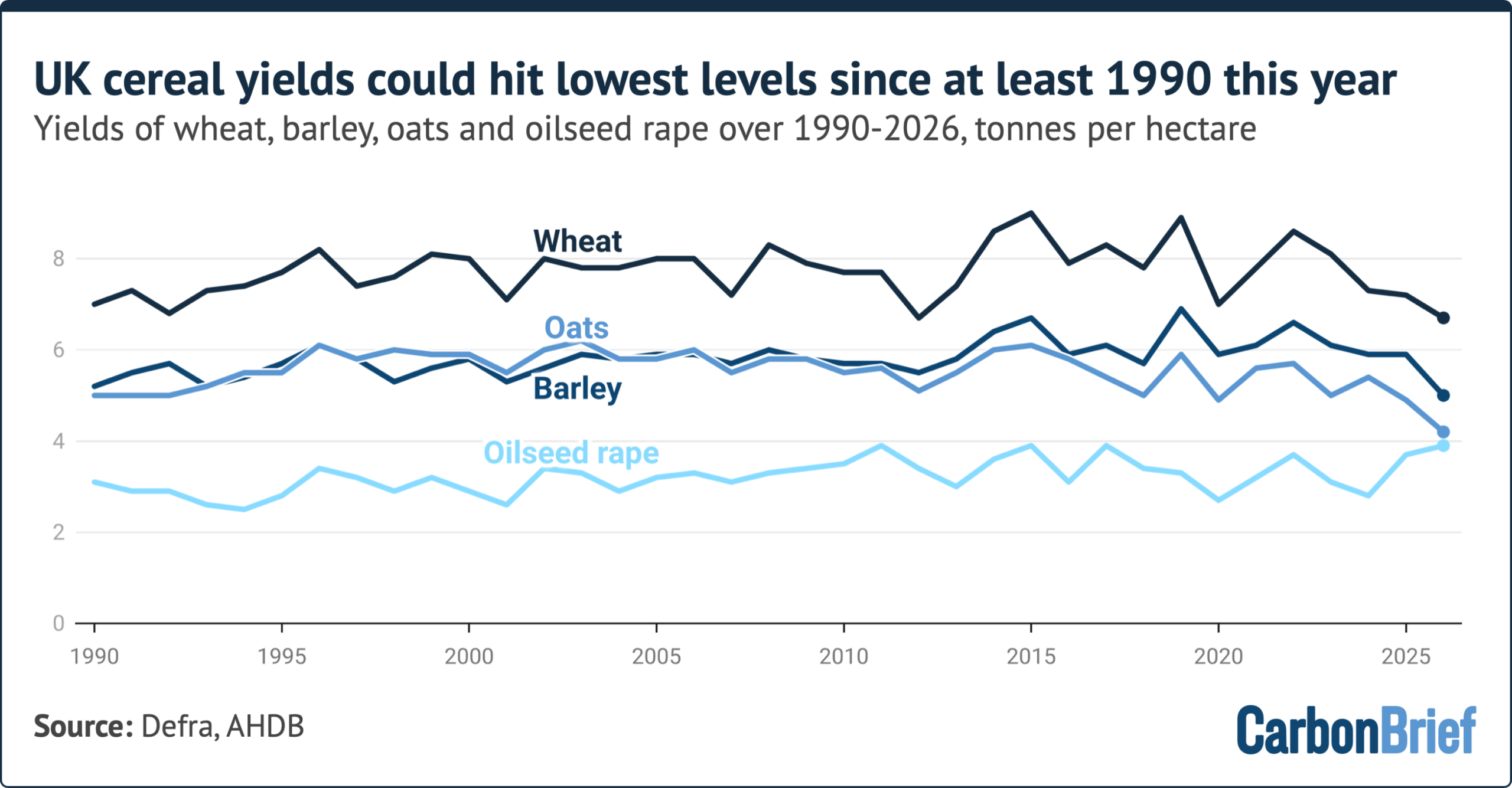
Barley yields could fall by 15%, oats by 14% and wheat yields by 6% year-on-year, according to 2026 harvest surveys from the Agriculture and Horticulture Development Board, a non-departmental public body that provides agricultural data to the UK government.
ECIU said that, even if the situation improves, this year is still expected to be one of the five worst harvests on record. This means that four of the five worst harvests in the UK have occurred in the past decade.
Consumers will likely see higher prices and/or smaller vegetables in supermarkets as a result, Tim O’Malley, chairman of UK company Nationwide Produce, told BBC News in August.
Other crops, such as berries, have grown successfully in the extreme heat. But the Guardian noted fears this could dip later this year “as plants become exhausted from heavy cropping during the heatwave”.
5. Maize production in France is due to hit a four-decade low
France has been acutely affected by this summer’s extreme weather, with more than 7,300 excess deaths during heatwaves and a record number of weather stations recording temperatures of above 40C.
The country is the EU’s largest agricultural producer, but heat, drought and wildfires have affected many crops.
The chart below shows that maize production is set to drop by more than one-third (35%) year-on-year.
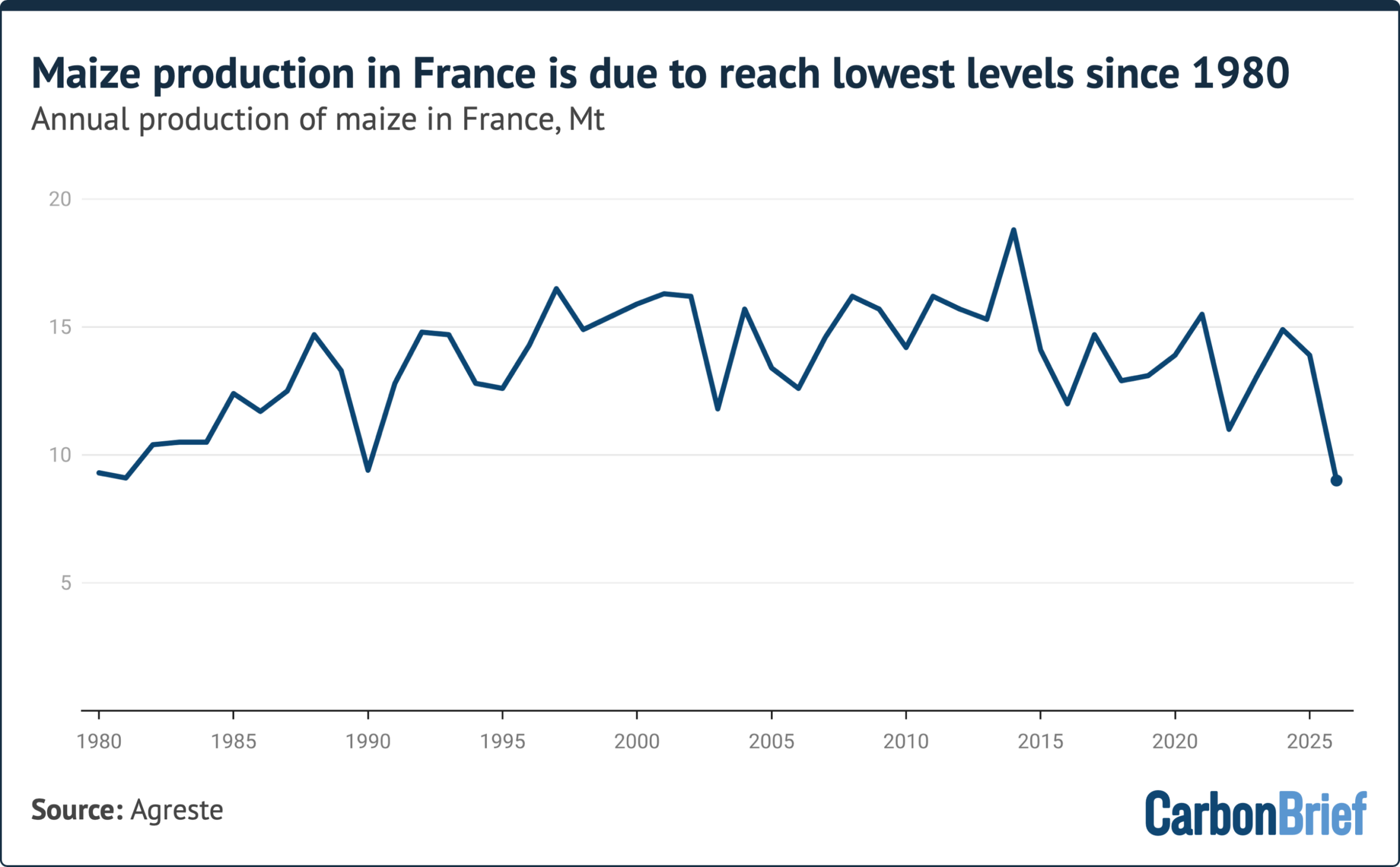
This could result in France’s lowest maize production since 1980, according to data from Agreste, the country’s agriculture ministry’s statistics service.
Due to the heat, “record-early” grape harvests have also been recorded in various parts of the nation since mid-July, reported Le Monde. In some cases, this means “smaller, less juicy grapes, which will yield less wine”, explained the newspaper.
6. Declines in EU grains since 2025
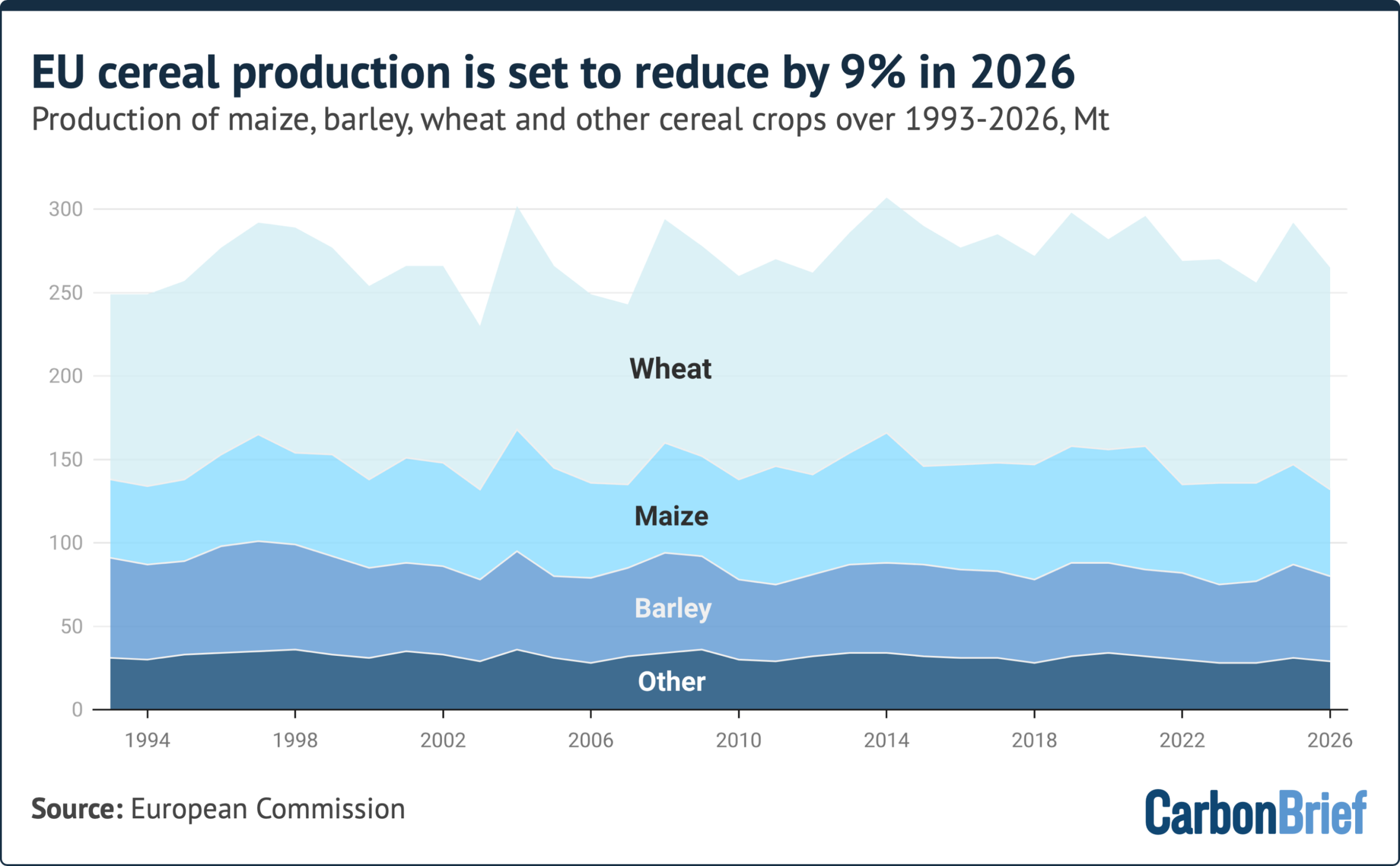
Overall in the EU, data and projections indicate declines in the output of cereal grains this year.
Cereal production is set to fall by 9% compared to 2025, according to the European Commission.
Just one year in the past decade – 2024 – recorded lower production levels.
Maize production is set to be particularly affected, with projections indicating a 13% drop, to 52Mt – the lowest level in the EU since 2007.

The post How this summer’s heat and drought impacted crops in Europe – in six charts appeared first on Carbon Brief.
How this summer’s heat and drought impacted crops in Europe – in six charts
The vast majority of Australians and all mainstream nature protection groups—including Greenpeace—agree that Australia should end native forest logging, and that governments should create vast new national parks to protect and manage some of our most magnificent remaining forests. But there is significant disagreement about how this transition should come about and now a decision is coming up before the Australian Parliament.
On 15 September the Australian Senate is due to vote on a motion about a new carbon credit method for forest protection—the “Improved Native Forest Management” (INFM) Method. Lifelong forest protection champions and people of good will and intentions find themselves on opposing sides of this debate. That’s okay–people of good faith can have legitimate differences of view, and this should be honoured in our democracy.
The NSW government has promised to create the Great Koala National Park on the Mid North Coast of the state. The government has also said that the final creation of the park is dependent on the successful registration of a carbon project under the Improved Native Forest Management (INFM) Method. The creation of the park will effectively mean an end to native forest logging in the region.

Native forest logging is not something on which Greenpeace has actively campaigned on in Australia for some decades, but we are making our position clear on this issue now, because it is a matter of significant public note that falls clearly within our environmental mission remit.
After careful consideration, Greenpeace believes this method should not be voted down by the Senate, and we call on Senators of all parties to vote against the disallowance motion.
To be abundantly clear, Greenpeace holds longstanding opposition to the carbon credit system, but in these circumstances we cannot in good conscience conflate that position with de facto opposition to the creation of massive new national parks. Although it is uncomfortable to do so, our position here is to recognise that suboptimal architecture can still be turned to good ends. We genuinely rejoice in the imminent possibility of new national parks, including the Great Koala National Park in NSW which so many community members and scientists have tenaciously argued for, over very many years, and which are so desperately needed for the forests and the wildlife which inhabits them.
In reaching our view, we also take strong notice of the opinion of the INFM among leading forest scientists, including leading forest ecologist Professor David Lindenmayer who supports the INFM as do a range of other experts. We have also taken special note of the position of the peak body for nature in New South Wales, the NSW Nature Conservation Council, and of local forest activist conservation groups, who support the INFM not being voted down in the Senate.
The politically fraught nature of forest protection
The fight to save Australia’s magnificent native forests from logging has been a decades-long battle. It has reshaped both the ecological and political landscape of the nation as vast forests have been levelled or–thankfully–sometimes saved, and political parties and leaders have risen and fallen on the back of moves to ruin or protect them.
It is no surprise then that the latest chapter in Australian forest protection has become politically fraught.
In 2024 Western Australia and Victoria officially ended native forest logging on the back of both overwhelming public pressure to do so combined with the clearly unviable financial state of the industry. This forest protection has not been bullet proof—some areas still being targeted under the guise of fire management and “salvage logging”–and other drivers of deforestation including for bauxite mining–remain a significant problem. Nonetheless, these announcements were still a very significant leap forward for forest conservation and to the credit of the advocates, communities, and scientists who fought for these outcomes–and the governments who made the decisions.
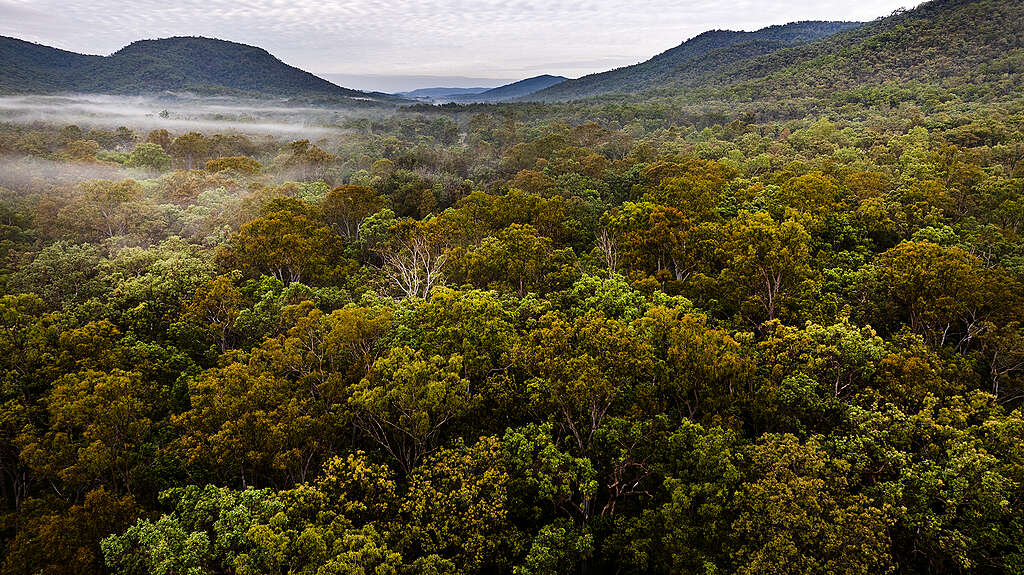
But native forests continue to fall to logging in Tasmania, New South Wales and to an extent in Queensland. So the political battle has now concentrated mostly on these states, with a renewed push by communities and environment groups to finally end native forest logging once and for all, including via the creation of large new national parks for the benefit of the whole community and for nature to flourish.
Protection with or without carbon markets?
In New South Wales, thanks to the extraordinary effort and vision of forest advocates and ecologists, proposals have been drawn up for two large national parks to protect forests currently targeted for logging and link them up with already protected areas—the Great Koala National Park in the north and the Great Southern Forest National Park in the south.
The creation of national parks requires resources. In the step up phase, the provision of public funding enables workers and communities to be supported to exit the logging industry. Significant funding is then required on a permanent basis to manage the National Parks that are created, including crucially to carefully manage fire to support forest health and regeneration, particularly as global warming continues to raise the risk of repeated catastrophic bushfires.
Along with many others, Greenpeace has a long held and strong view that nature should be protected for its own sake (rather than having to justify a monetary benefit) and that this funding should be provided by governments as a public good. Many forests and extraordinary places across Australia have been protected on this very basis for decades. Public funds for the shared good of nature protection for all Australians. Yet it is also the case that far too little public money is spent on taking care of nature.
Australians are not only justifiably proud of and love our natural heritage–our iconic wildlife and fantastic wild places–we also depend on the web of life for our own flourishing. And yet significantly less than 1% of all public money in Australia is spent on taking care of nature across our magnificent continent. It is inadequate to do what is needed in the face of the extinction crisis and the severe climate damage caused by global warming.
So, it is on the question of sources of revenue where fierce disagreement has emerged amongst forest champions. As noted above, the position taken by the New South Wales Government is that the creation of the Great Koala National Park hinges on raising the necessary funds by selling carbon credits to companies as an offset to the greenhouse gas emissions they are producing (recognising the value of carbon stored in forests). For this reason, whether the Great Southern National Park proposal progresses or not is also likely to depend on the ability to create carbon credits from it.
Some advocates are understandably steadfastly opposed and outraged that the creation of a National Park would rely on carbon credits to be established, while others see this a reluctantly pragmatic yet effective pathway to a rapid end to native forest logging, not just in New South Wales but also in Tasmania and elsewhere. People of good will can disagree–and on this, they do.
We also recognise that it is a difficult debate to have in the public realm–because those not across the debates over policy and principle will be fairly inclined to bewilderment that anyone who cares about nature could possibly oppose the creation of new national parks on what might seem like quite arcane grounds.

Australia’s troubled and troubling carbon market
Like forest protection, curbing Australia’s climate pollution has been another politically vexed problem for decades. Climate policies have come and gone, taking political leaders with them.
In 2011 the Carbon Farming Initiative was established by the Gillard Labor government and supported by the Greens (then led by Bob Brown and Christine Milne). This set up a system whereby farmers and Indigenous communities could generate carbon credits to better manage forests (including with better fire management) to receive funding from the Federal Government or corporations as a means of storing or reducing carbon emissions on the land, while also (ostensibly) protecting nature and creating regional jobs.
This scheme then morphed into the Abbott Coalition government’s Emissions Reduction Fund and Safeguard Mechanism in 2014. This policy was cynical in nature, designed to do virtually nothing given Tony Abbott’s aggressive rejection of the need for greenhouse gas emission reduction, essentially expanding a voluntary market where carbon polluters could buy carbon credits to offset their emissions. There was very little obligation for polluters to actually reduce emissions at site or be forced to buy carbon credits at all.
Then, in 2023 the Albanese government reformed the Safeguard Mechanism, setting stricter emission baselines for polluters and forcing many to buy carbon credits to offset their emissions.
The problem is this latest reform of the Safeguard Mechanism has not worked. This is partly due to the emission baselines being set too low but also because many polluters have simply been buying up carbon credits rather than attempting to actually reduce their emissions.
Furthermore, the very concept of carbon credits is highly problematic. Unlike fossil fuels found in their natural state, carbon and greenhouse gases stored in forests and the land are more volatile and exposed to rapidly being released to the atmosphere from fires, disease, floods and other natural or global heating-driven events. Greenpeace holds a longstanding position of deep scepticism about the efficacy of carbon credits. That has not changed.
In practice most of the existing carbon credit methods have been under sustained criticism from experts and scientists with deep knowledge of the system, arguing that currently, most projects are receiving credits for little or no actual storing of carbon in the land.
So when advocates for forest protection and climate action raise concerns about protecting forests via carbon credits, it’s clear why.

The INFM method
Chief public critic and whistleblower of the historic carbon credit system in Australia, Professor Andrew Macintosh, has been the lead architect behind the creation of the Improved Native Forest Management (INFM) which has been developed in partnership with the New South Wales Government. This is because despite having been a critic of the carbon credit system as it was operating, Professor Macintosh is not against carbon credits per se, but rather a poorly designed and executed system.
Regardless of what one thinks of the morality or efficacy of the method; the fiscal truth is that the INFM would create a new means for state governments to generate significant revenue by ending native forest logging in key areas and protecting and managing the forests.
Professor Macintosh and other supporters of the method argue that unlike other carbon credit methods, the INFM is of the highest integrity possible. That’s because the carbon that is credited is conservative, accounting for approximately 1/10th of potential carbon stored, a regional cap prevents logging simply commencing elsewhere, and significant financial penalties apply for non delivery of credits. If all the forests threatened by logging were protected by this method that would represent about 5% of carbon credits in the system. Significantly, the New South Wales Government has also pledged that no carbon credits from the Great Koala National Park would be sold to fossil fuel companies.
Leading ecologist and staunch forest advocate Professor David Lindenmayer also supports the method. Other prominent ecologists Professor Brendan Mackey, Dr Don Butler and Dr Heather Keith also provided input into the method.
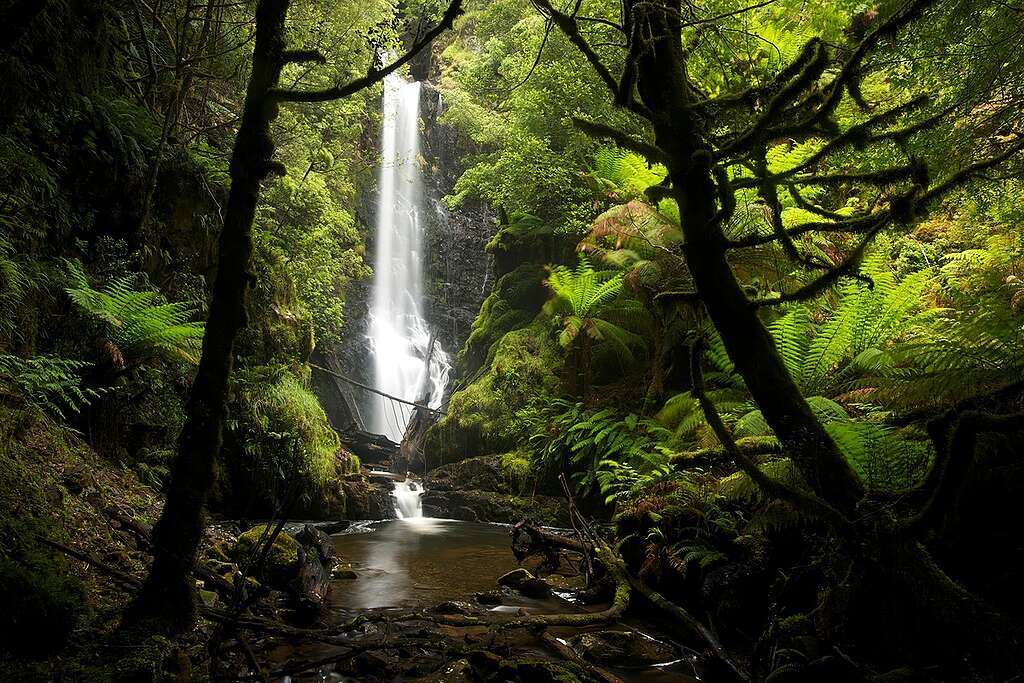
Key environmental groups in New South Wales such as the North East Forest Alliance and South East Forest Alliance as well as the Nature Conservation Council of NSW (which is the peak body for nature in NSW) strongly support the INFM and see it as key to creating large forest National Parks in the state and effectively ending native forest logging.
The logging industry is vehemently opposed to the method because they are rightly worried it will shut down what remains of this industry. They are supported by One Nation and the Nationals, both of which have pledged to vote against the method down when it comes to a vote in the Senate on September 15th.
The opponents to forest protection are also joined in the against camp by some climate and forest advocates, including the Australia Institute and Wilderness Australia, who are strongly against carbon credits overall, in particular relying on them to protect forests and are concerned at the potential for perverse outcomes in the context of the broader need to reduce Australia’s greenhouse gas emissions.
The Greenpeace Position
Greenpeace opposes carbon credits and accepts the analysis that the Safeguard Mechanism is failing. The creation of new forest National Parks should not be contingent on the commodification of nature and the sale of carbon credits. Nature should be protected for nature’s sake. Much more public funding should be available for the protection of nature. Our position will not change on the intrinsic value of ecology. Our mission is to secure an earth capable of nurturing life in all of its magnificent diversity.
However, we cannot in good conscience de facto oppose the creation of a massive new national park in these circumstances—especially when Australia’s leading forest ecologists, the foremost critic of carbon credits, and the grassroots forests activists from the jurisdiction in question support the outcome of moving ahead with the INFM to secure massive new national parks.
For that reason, in our view is that in these circumstances the Senate should not vote down the INFM method.
Further, fossil fuel companies should not have access to the INFM credits. The existing sham carbon credit methods should be urgently taken out of the system. The fight for more public funding for the protection of nature must go on until common sense prevails. And the Safeguard Mechanism should be substantially overhauled to significantly constrain the use of carbon credits more broadly and force polluters to rapidly reduce emissions on site. We believe that this is the fight which forest and climate advocates should be focussed on, together.



-
Climate Change1 year ago
Guest post: Why China is still building new coal – and when it might stop
-

 Greenhouse Gases2 years ago
嘉宾来稿:满足中国增长的用电需求 光伏加储能“比新建煤电更实惠”
-
Greenhouse Gases1 year ago
Guest post: Why China is still building new coal – and when it might stop
-

 Climate Change2 years ago
嘉宾来稿:满足中国增长的用电需求 光伏加储能“比新建煤电更实惠”
-

 Renewable Energy11 months ago
Sending Progressive Philanthropist George Soros to Prison?
-
Climate Change2 years ago
Bill Discounting Climate Change in Florida’s Energy Policy Awaits DeSantis’ Approval
-
Greenhouse Gases1 year ago
嘉宾来稿:探究火山喷发如何影响气候预测
-

 Carbon Footprint2 years ago
US SEC’s Climate Disclosure Rules Spur Renewed Interest in Carbon Credits