

The Caribbean region is among the most vulnerable to climate change, despite historically contributing less than half of one percent of global greenhouse gas emissions.
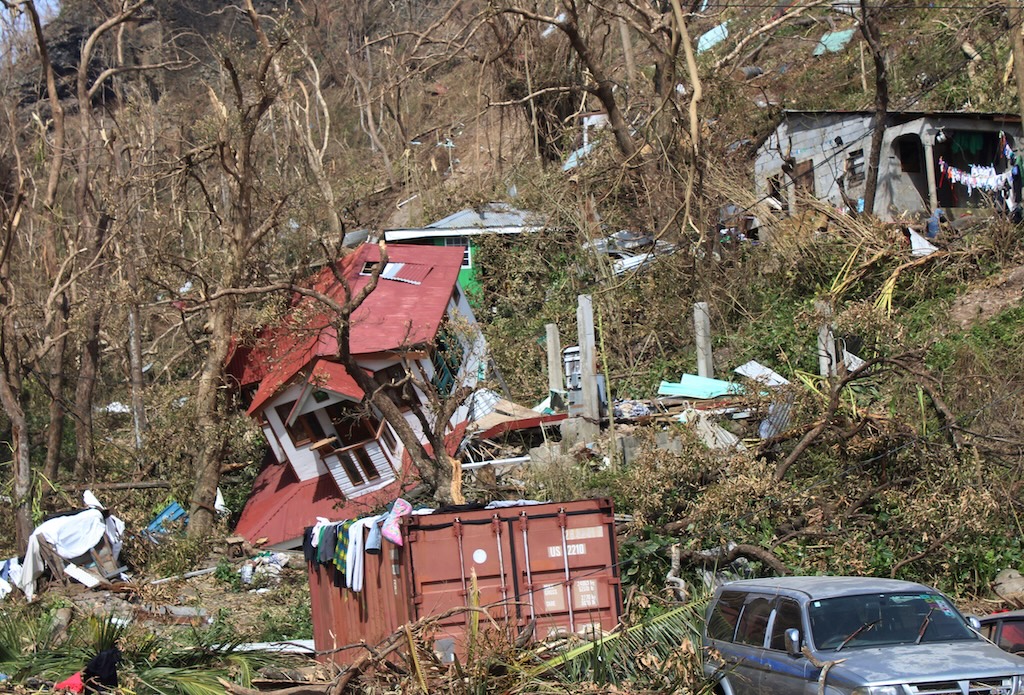
Rising sea levels, extreme heat and more frequent and intense storms – such as the 2024 Hurricane Beryl, which made landfall in Grenada – pose urgent and growing threats to the small island states, coastal nations and overseas territories that comprise the Caribbean region.
With global progress to address climate change still too slow, Caribbean countries are taking matters into their own hands by enacting more robust legislation to help protect against climate risks.
In a new study published in the Carbon and Climate Law Review, we identified 78 climate laws and legally binding decrees across 16 Caribbean states, as well as two constitutional references to climate change and a growing recognition of the right to a healthy environment.
Our analysis suggests that, together, these developments are not only enhancing resilience, but also positioning Caribbean states as influential actors in the global climate arena.
Caribbean climate laws on the rise
Climate governance in the Caribbean has expanded significantly in recent years. In the past decade, countries such as Cuba and the Dominican Republic have embedded climate obligations and programmatic guidelines into their national constitutions.
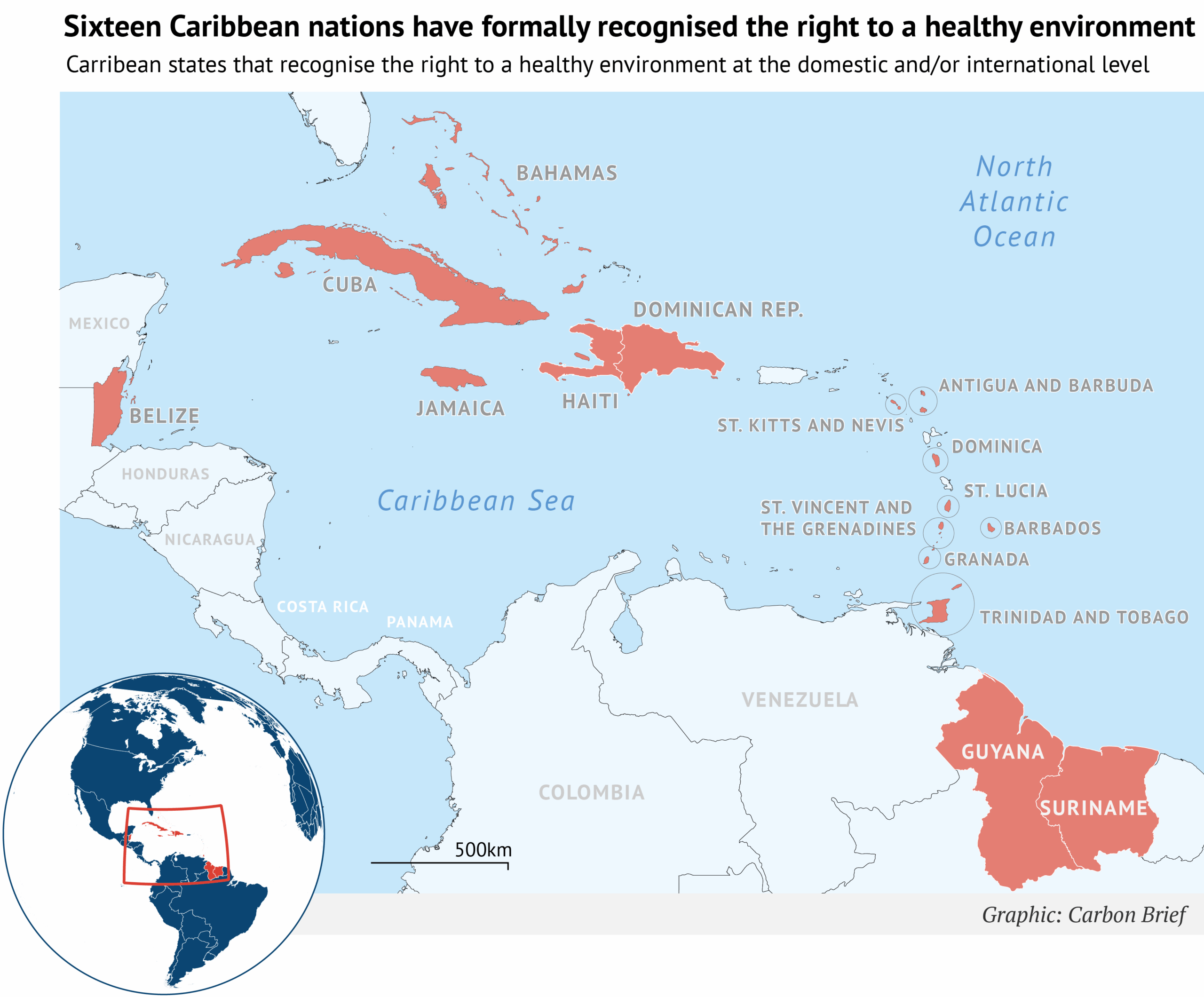
At the same time, legislative recognition of the human right to a healthy environment is gaining momentum across the region. Six Caribbean nations now affirm the right in their constitutions, while 15 have recognised it through international instruments, such as the UN Council, UN Assembly and the Escazu Agreement, as shown in the figure below.
More recently, there has been a notable rise in targeted, sector-specific climate frameworks that go beyond broader environmental statutes.
Saint Lucia stands out as the only country with a climate framework law, or a comprehensive national law that outlines long-term climate strategies across multiple domains. Meanwhile, several other Caribbean governments have adopted climate-specific laws that focus on individual sectors, such as energy, migration and disaster management.
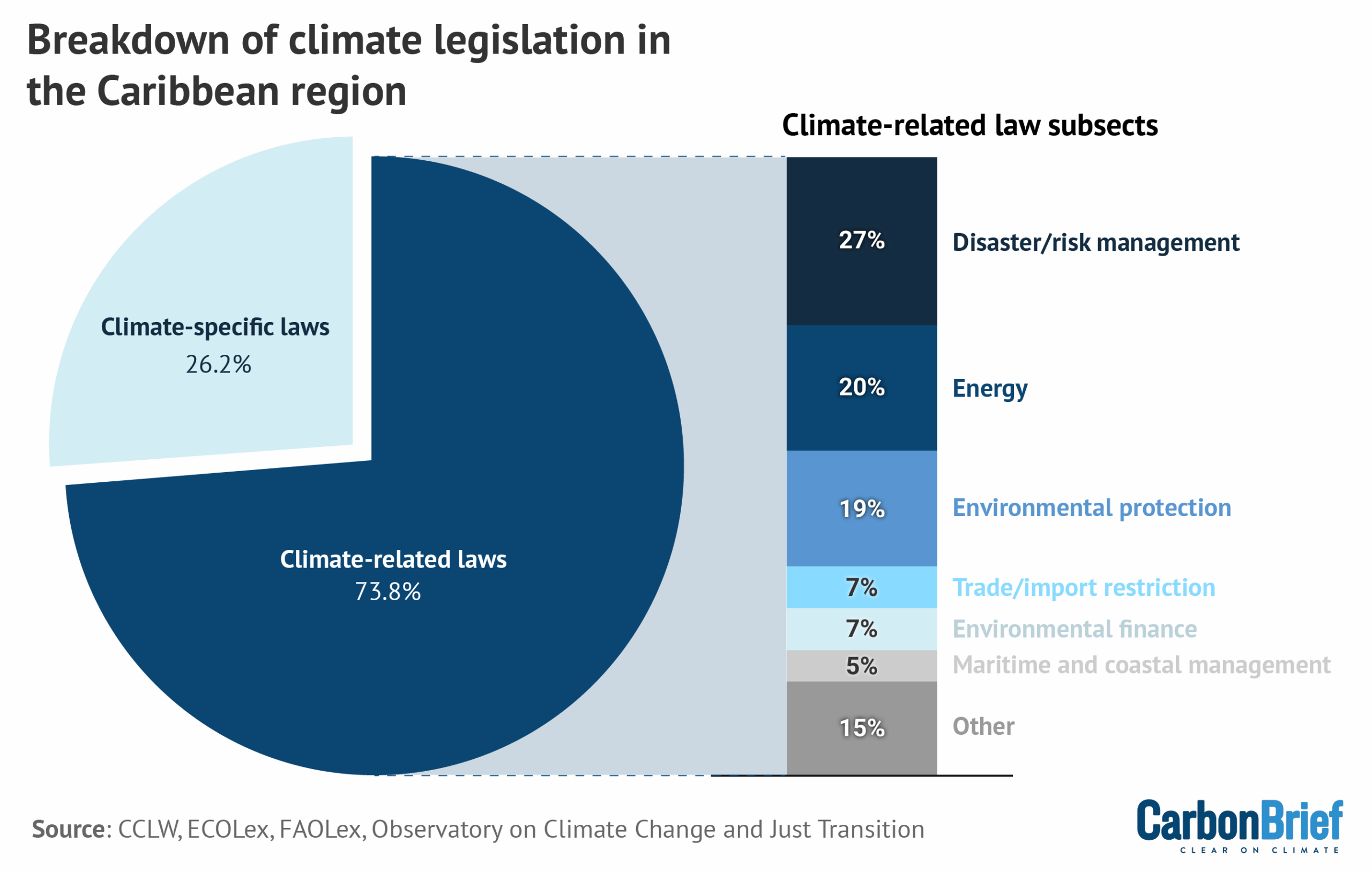
According to our analysis, more than a quarter of climate-relevant legislation in the region – comprising 21 laws and legally binding decrees – now has an explicit focus on climate change, as illustrated in the chart below.
Our research suggests that this represents an ongoing shift in legislative focus, reflecting changes in how climate legislation is being structured in one of the world’s most climate-vulnerable regions.
Caribbean nations are also advancing legal reforms to structure and institutionalise climate finance and market mechanisms directly into domestic law, aligned with Article 6.2 of the Paris Agreement.
For example, the Bahamas has introduced provisions for carbon credit trading, while Antigua and Barbuda, Barbados and Grenada have established national climate financing mechanisms to support mitigation and adaptation efforts.
Some states, including Belize and Saint Kitts and Nevis, have incorporated regional bodies such as the Caribbean Community Climate Change Centre – the climate arm of the intergovernmental Caribbean community organisation CARICOM – into national frameworks. This indicates an increasing alignment between regional cooperation and domestic law.
In addition to the influx of regulations specifically addressing climate change, Caribbean nations are also legislating broader environmental issues, which, in turn, could provide increased resilience from climate impacts and risks, as shown in the graph above.
Key trends in these types of climate-related laws include the expansion of disaster risk management governance, which addresses national preparedness for climate-induced weather events or related catastrophes. Likewise, energy law is an increasingly prominent focus, with countries including Antigua and Barbuda and Saint Vincent and the Grenadines integrating renewable energy and energy efficiency goals into national climate governance.
More broadly, many Caribbean nations have adopted wide-ranging and comprehensive environmental laws, many of which were developed in alignment with existing climate commitments. In combination, these legal developments reflect a dynamic and evolving climate governance landscape across the region.
Proactive vs reactive approaches
Despite general alignment with these broader regional trends, our research reveals distinct developmental pathways shaping domestic climate regulation.
In the eastern Caribbean, for example, we saw both proactive, long-term planning strategies and reactive, post-disaster reforms.
Saint Lucia’s multifaceted approach to climate resilience evolved steadily over the course of more than a decade. During this time, the country developed numerous adaptation plans, strengthened cross-sectoral coordination and engaged in institutional climate reforms in areas such as energy, tourism, finance and development.
More recently, the passage of Saint Lucia’s Climate Change Act in 2024 marked a milestone in climate governance, by giving legal force to the country’s obligations under the UNFCCC, the Kyoto Protocol and the Paris Agreement – making Saint Lucia one of the few small island states to incorporate global climate commitments into domestic law.
Our research indicates that this strategy has not only positioned the country as a more climate-resilient nation, but also solidified its access to international climate financing.
In contrast, Dominica’s efforts evolved more rapidly in the aftermath of Hurricane Maria in 2017, which destroyed over 200% of the country’s GDP. The storm’s impacts were felt across the country and hit particularly hard for the Kalinago people – the Caribbean’s last Indigenous community – highlighting the role of socioeconomic disparities in shaping climate vulnerability and resilience.
In response, the government passed the Climate Resilience Act, creating the temporary Climate Resilience Execution Agency for Dominica (CREAD).
Beyond establishing an exclusively climate-focused institution, the act aimed to embed resilience into governance by mandating the participation of vulnerable communities – including Indigenous peoples, women, older people and people with disabilities – in shaping and monitoring climate resilience projects.
As noted in a recent statement by the UN special rapporteur on Climate Change, Dr Elisa Morgera, these frameworks underscore the government’s ambition to become the world’s first “climate-resilient nation.”
Although challenges persist, Dominica’s efforts demonstrate how post-disaster urgency can drive institutional change, including the integration of rights and resilience into climate governance.
Uneven progress and structural gaps
Despite significant progress, our research shows that several key opportunities for climate governance across the Caribbean continue to exist, which could enable improvements in both resilience and long-term ambition.
The region’s legal landscape remains somewhat heterogeneous. While Saint Lucia has enacted a comprehensive climate framework law, the rest of the region lacks similar blanket legislation. This includes some states that entirely lack climate-specific laws, instead relying on related laws and frameworks to regulate and respond to climate-related risks.
Other nations have yet to adopt explicit disaster-risk management frameworks, leaving Caribbean populations vulnerable before, during and after climate emergencies. Most have yet to enshrine the right to a healthy environment at the national level.
Our research suggests that outdated legal frameworks are further limiting progress in addressing current climate risks. Because many of the longer-standing environmental laws in the region were adopted well before climate policy became a mainstream concern, some fail to address the nature, frequency and intensity of modern climate challenges, such as sea-level rise, tropical storms, wildfires, floods, droughts and other impacts.
More broadly, many Caribbean climate laws include limited integration of gender equity, Indigenous rights and social justice. As Caribbean nations such as Grenada and the Dominican Republic begin to link climate resilience with these issues, the region has an opportunity to lead by example.
Ultimately, capacity and resource constraints persist as significant barriers to implementation and adaptation.
The Caribbean region faces debt that exacerbates ongoing development challenges, a burden made heavier by the repeated economic shocks of climate-related disasters. Along with regional debt-for-resilience schemes, increased funding from high-emitting countries to support adaptation measures in climate-vulnerable nations – as endorsed under the Paris Agreement – is likely to be critical to ensuring the region’s climate laws can be executed effectively.
Global implications of Caribbean climate law
Our research suggests that Caribbean countries are outpacing other regions in terms of the scope and ambition of their climate laws. This legislation has the potential to serve as a model for climate-vulnerable nations worldwide.
Continuing efforts in the region show that legal frameworks in the field can not only drive resilience, embed rights and strengthen claims to international finance, but also highlight how regional cooperation and diplomacy can enhance global influence.
These findings demonstrate that innovation in climate law need not wait for action from major emitters, but can instead be led by those on the front lines of climate change.




The post Guest post: How Caribbean states are shifting climate legislation appeared first on Carbon Brief.
Guest post: How Caribbean states are shifting climate legislation

Marcelo Behar is the COP30 Special Envoy for Bioeconomy and co-founder of Ambition Loop Brazil.
Can we be the generation to end the rampant deforestation that is harming the planet’s ecosystems and climate? Back in February, the Brazilian COP30 Presidency opened a call for submissions on its proposed Roadmap for Halting Deforestation and Forest Degradation, which closes today.
What might look like a technical step quickly drew significant attention, with more than 100 responses submitted by governments, civil society organisations, businesses and other stakeholders.
This level of engagement is telling. It reflects both the urgency of the issue and the recognition that this process could shape whether the global goal to end deforestation by 2030 finally moves from ambition to delivery.
As a Brazilian, I see this moment with both pride and realism. Brazil has played a central role in elevating forests on the climate agenda, and the COP30 Presidency has shown leadership in carrying this issue forward far beyond the Belém summit.
COP30 rainforest fund unlikely to make first payments until 2028
But last year also offered a sobering signal. Despite strong efforts from the Brazilian Presidency, the proposed roadmap did not secure consensus in the final outcome of COP30. That outcome underlined a simple truth: while there is broad recognition of the importance of forests, agreeing on how to move forward remains complex. The road ahead is still long and likely uneven.
That is precisely why this moment matters.
Progress on commitments falling short
The world is not short of commitments. Over the past decade, countries have repeatedly pledged to halt and reverse deforestation by 2030. There is a growing body of experience through the REDD+ (Reducing Emissions from Deforestation and Degradation) programme, including the emergence of jurisdictional approaches that are beginning to connect forest protection with finance at scale.
Initiatives such as the Forest and Climate Leaders’ Partnership have helped sustain political attention and cooperation among countries, while national strategies continue to evolve, and Indigenous Peoples and local communities remain at the forefront of protecting forests.
And yet, progress is still falling short.
The gap is not only one of alignment. It is also one of political will – and of having a credible, shared pathway that brings together these efforts in a way that drives implementation at scale.
Civil society is watching this process closely. For many organisations working across climate, nature and conservation, this is not just another initiative – it is a priority. After years of advocating to end deforestation, there is a strong sense that this moment cannot be lost. The expectation is clear: this roadmap must move beyond intention and help unlock real progress.
The opportunity now is to ensure that it does exactly that. This cannot become another report.
Implementation key to roadmap success
A detailed assessment of pathways and challenges, however valuable, will not be enough to change outcomes on the ground. What is needed is an implementation roadmap, one that connects existing commitments, aligns incentives and provides clarity on how to move from ambition to delivery between now and 2030.
The consultation process is an important step. But its value will ultimately be judged by what it produces.
If the roadmap is to succeed, several priorities should guide its development.
-
With no COP30 roadmap, hopes of saving forests hinge on voluntary initiatives
The world is falling short of a target to halt deforestation by 2030, but the “Amazon COP” failed to agree a concrete global plan to save rainforests despite backing by over 80 nations -
Deep in the Amazon, forest protection cash must vie with glitter of illegal gold
The TFFF fund launched at COP30 aims to pay communities to protect the rainforest, but will it be enough? On French Guiana’s border with Brazil, the profits to be had from mining are far higher


First: policy. It must be designed as a tool for implementation. That means going beyond diagnosis to define concrete action: who needs to act, by when, and how progress will be tracked. The solutions are not new, but coordination has been missing.
Second: accountability. It should bring coherence to the existing landscape. The value of a roadmap lies not in creating new commitments, but in connecting what already exists: global targets, REDD+ experience, national action plans, Indigenous leadership and supply chain initiatives. Reducing fragmentation is essential to accelerating delivery.
Early milestones needed
Third: finance. It must be grounded in economic reality. Halting deforestation will not happen without addressing the incentives that underpin it. Aligning public finance, private investment, and market demand with forest protection is not a technical detail; it is the core of the transition.
Fourth: transparency. Legitimacy will depend on openness. A credible roadmap cannot be developed behind closed doors. Governments, Indigenous Peoples and local communities, civil society, business and finance actors all have a role to play and must be able to see how their contributions shape the outcome.
Fifth: urgency. Progress must be visible in 2026. Without early milestones, momentum will fade. By the time climate negotiators gather in Bonn mid-year, the roadmap should have a clear structure, priority actions and growing political backing.
Governments must deliver on the plan
Finally, countries themselves will need to step forward. Last year’s outcome showed that support alone is not enough. Delivering this roadmap will require active political engagement. That means governments that are willing not only to participate in the process, but to help shape and implement it.
Brazil has created an important opening. It has also taken on the responsibility that comes with leadership: to help turn a widely supported idea into something that can deliver in practice.
The commitment to end deforestation by 2030 already exists. What is still needed is a path. And the courage to walk it.
The post How a Brazil-led roadmap can rescue global pledge to halt deforestation appeared first on Climate Home News.
How a Brazil-led roadmap can rescue global pledge to halt deforestation
A US biofuels producer that exports “green” aviation fuel to Britain and the European Union has purchased beef tallow from a Brazilian supply chain tied to illegal deforestation in the Amazon, shipping data and a court document show.
Diamond Green Diesel (DGD), a major provider of sustainable aviation fuel (SAF) and renewable diesel, has sourced hundreds of thousands of tonnes of beef tallow from Brazil, alongside waste fats from other sources, over the last three years, as global demand for biofuel feedstocks soars.
Reporting by Unearthed and nonprofit investigative outlet Repórter Brasil reveals DGD’s connection to a rendering plant that has sourced supplies from a meatpacker fined for buying cattle from an illegally deforested Amazon reserve. A previous investigation by Reuters and Repórter Brasil found DGD had bought animal fat from two other rendering factories linked to supplies of cattle from illegal ranches.
The newly identified factory, Pacífico Indústria e Comércio de Óleos e Proteínas Ltda, which is based in Cacoal, a small city in the far-western Amazon state of Rondônia, has been supplied by Rondônia meatpacker DistriBoi, a 2022 court document shows.
DistriBoi was fined two years ago for illegally purchasing cattle from the state’s Jaci-Paraná conservation reserve, which has been ravaged by illegal ranching.
There is no suggestion that the companies involved were aware of deforestation at farm level. But the findings suggest a traceability gap in the supply chain of feedstocks for sustainable fuels, where cattle by-products are subject to less oversight than the primary commodities of the cattle industry, such as meat and leather.

Pristine rainforest blanketed the Jaci-Paraná reserve when it was created 30 years ago to protect traditional forest activities such as rubber tapping and nut harvesting.
Today, illegal ranching has devoured nearly 80% of its forest cover and it has become a notorious example of the devastation wrought by land grabbers in the world’s largest rainforest.
“The damage to biodiversity has been devastating,” said local Indigenous activist Neidinha Suruí, who featured in the 2025 Emmy Award-winning documentary “O Território”.
“It is sad to see what has been lost,” she said.
Greener air travel?
The “renewable diesel” and sustainable aviation fuel (SAF) that are being exported by DGD – a joint venture between US oil refiner Valero Energy Corp and Texas-based Darling Ingredients – are classed as “green” because they are made from feedstocks classified as waste, including tallow, which consists of fat separated from cattle carcasses.
Many governments and airlines are pinning their hopes for greener flying on SAF made with organic waste materials, including Britain which introduced a compulsory blending requirement last year.
Top green jet fuel producer linked to suspect waste-oil supply chain
Air travel accounts for about 2.5% of global carbon emissions and in contrast to other transport sectors that can be electrified, shrinking aviation’s carbon footprint is much more difficult.
Waste products such as beef tallow and used cooking oil (UCO) are considered the greenest of viable SAF feedstocks on the grounds that they do not create competition with foodstuffs such as soy oil or palm oil, nor increase deforestation pressure.

But there is concern that the global rush to ramp up SAF use could indirectly exacerbate deforestation pressure by increasing demand for feedstocks such as tallow and UCO.
That could increase the profit margins of cattle ranches – including illegal ones – and have other unintended consequences, such as encouraging fraud in supply chains, as Climate Home News has reported.
An investigation published in March by Climate Home News and Swedish broadcaster SVT found that Finnish biofuels giant Neste is sourcing key ingredients for its SAF from an opaque supply chain that enables fresh palm oil to be passed off as used, waste oil.
Because tallow is classified as waste by regulators in markets including the UK and EU, the green fuel industry’s most widely used certification scheme – International Sustainability and Carbon Certification (ISCC) – does not assess whether forests were cleared to rear the cattle that produced it in the first place.
-
Amazon fires threaten initiatives to raise cash for rainforest protection
Brazil’s Tropical Forests Forever Facility (TFFF) and other innovative finance tools will be showcased at COP30, but surging wildfires in the Amazon pose a threat to their success, climate experts warn -
Deep in the Amazon, forest protection cash must vie with glitter of illegal gold
The TFFF fund launched at COP30 aims to pay communities to protect the rainforest, but will it be enough? On French Guiana’s border with Brazil, the profits to be had from mining are far higher -
Funding gap threatens next round of IPCC climate science reports, chair warns
The latest IPCC session in Bangkok was clouded by persistent differences over when its flagship reports should be published and concern over cost-cutting proposals


This allows tallow from cattle to qualify as a sustainable feedstock for green fuels, even if they were raised on illegally deforested land.
“There is clearly an oversight within the rules if the products, in this case animal tallow, are originally coming from deforested land,” said Cian Delaney, a campaign coordinator at the clean transport and energy advocacy group Transport & Environment.
That means government SAF mandates aimed at stemming air travel emissions could help boost the earnings of cattle ranchers linked to illegal deforestation in Brazil, where ranching and other forms of agriculture have been the main driver of forest loss.
Land grabbers clear way for ranchers
Once covered by an unbroken rainforest canopy, Rondônia’s Jaci-Paraná reserve has been decimated by illegal deforestation driven by cattle ranching – a major cause of tree loss in the Amazon.
Land-grabbers have seized – often violently – and cleared more than three-quarters of its forest for pasture, as ranching has steadily advanced into the southern Amazon.
Suruí, the local Indigenous activist, said companies that buy products derived from illegal activities perpetuate environmental crimes in the rainforest.
“If there were no meat processors buying illegally sourced cattle, there would be no land grabbing and no deforestation,” Suruí told Repórter Brasil, which partnered on the new investigation with Unearthed, and a team of journalists supported by JournalismFund Europe.
Lawsuits and linked supply chains
Brazilian President Luiz Inácio Lula da Silva has pledged to end all deforestation in the country by 2030, in part by strengthening environmental enforcement in the world’s biggest rainforest.
In Rondônia, authorities have launched more than 50 lawsuits related to land-grabbing and deforestation in the Jaci-Paraná reserve alone. Local slaughterhouse DistriBoi is named in 31 of the lawsuits, including the 2024 case in which it was fined.
According to the 2022 court document, which concerned an unrelated labour dispute, lawyers for Pacífico refer to DistriBoi as the rendering plant’s “largest supplier of raw materials”.
US-based DGD received almost 15,000 tonnes of tallow from Pacífico from 2023 to 2025 at its Texas refinery, as well as used cooking oil from various countries and sources, according to trade database Panjiva.

Darling Ingredients is also a parent company of Pacífico since its 2022 acquisition of Brazilian rendering company FASA Group.
A spokesperson for Darling Ingredients denied that Pacífico had sourced beef residues from DistriBoi’s Ji-Paraná slaughterhouse – one of two that the meatpacker operates in Rondônia.
“The rendering plant Pacífico does not source any materials from the slaughterhouse Distriboi in Ji-Paraná,” the spokesperson said in an emailed response, without providing evidence or commenting directly on the content of the 2022 court document.
Darling did not respond to a follow-up question about Distriboi’s other slaughterhouse in the region, which, according to cattle transfer documents, has also bought from a farm that has illegally cleared forest within the extractive reserve.
“Our relationships are typically with the slaughterhouse, several levels removed from cattle ranchers. Regardless, we are committed to ensuring our raw materials are deforestation free. We expect our raw material suppliers to abide by our supplier code of conduct. In addition, we are in the process of requiring all [the] raw materials to attest that their material is deforestation free,” the spokesperson said in a statement.
DistriBoi said in an apparent reference to the pending Jaci-Paraná lawsuits that “the matters mentioned … are already under review, including by higher courts”. It has previously denied wrongdoing. The company’s statement did not address a question about its commercial ties to Pacífico.
Valero Energy, the major refiner that co-owns DGD with Darling Ingredients, did not respond to requests for comment, nor did DGD itself.
From slaughterhouse to SAF
In an effort to rein in carbon emissions from air travel, regulators in Britain and the EU have mandated progressively increasing SAF blending quotas in the years ahead, creating a new market for feedstocks including beef tallow.
Brazil’s exports of tallow to the US have risen sharply in recent years, up from less than 10,000 tonnes in 2021 to almost 400,000 tonnes last year, according to Panjiva, reflecting growing demand for biofuels like SAF.
In the UK, Europe’s biggest aviation market by seat capacity, jet fuel was required to contain 2% SAF by the end of 2025, rising to 10% by 2030 and 22% by 2040.
DGD shipped 134,000 tonnes of SAF worth nearly $90 million from Texas to the UK in 2025, according to trade data from Panjiva. The company also exported smaller amounts of renewable diesel to Britain.
The EU received biofuels, including small quantities of SAF, worth over $1.1 billion from DGD’s Texas refinery last year, figures show.
Is the world’s big idea for greener air travel a flight of fancy?
Unearthed’s investigation could not identify which airlines or airports buy DGD’s SAF once it arrives in Britain.
Valero, DGD’s other parent company, is positioning itself as a key player in the transition to lower-carbon fuels in the UK, where it markets its renewable diesel under the Texaco brand.
It has been an active participant in SAF policy discussions and has criticised the government’s planned cap on waste fat sources in SAF, calling them “the world’s most cost-effective production route for SAF” in a submission to parliament.
Helping to cut emissions?
Even tighter oversight over SAF feedstocks is crucial to ensure that blending mandates such as Britain’s are effectively lowering emissions, said Anna Krajinska, a director at Transport & Environment UK.
Forests store vast amounts of carbon; when they are cut down or burned this carbon is released into the atmosphere.
“If there’s tallow coming from land that’s been deforested, then those emissions might be so high that you might not be getting to the greenhouse gas reduction threshold,” Krajinska said.

But as the world’s appetite for flying keeps on growing, some experts say SAF is the only viable means to reduce aviation emissions at present.
Referring to the deforestation links identified in Unearthed’s investigation, Wouter Dewulf, an aviation economist at Belgium’s University of Antwerp, said it “would be important to assess how large this infraction is”.
“I’m quite sure you have aberrations,” Dewulf added. “But biofuels are the best alternative for the moment.”
T&E’s Delaney said there needs to be less opacity and better oversight from regulatory authorities. “Right now, there are just too many blindspots,” he added.
The post UK imports of “green” jet fuel linked to Amazon deforestation appeared first on Climate Home News.
UK imports of “green” jet fuel linked to Amazon deforestation
A company has proposed to build a crude oil pipeline crossing the Canadian border near where the long-contested project would have entered the United States.
No project better embodies the nation’s wild swings in climate and energy policy than the Keystone XL pipeline.



-
Climate Change8 months ago
Guest post: Why China is still building new coal – and when it might stop
-
Greenhouse Gases8 months ago
Guest post: Why China is still building new coal – and when it might stop
-

 Greenhouse Gases2 years ago
嘉宾来稿:满足中国增长的用电需求 光伏加储能“比新建煤电更实惠”
-
Climate Change2 years ago
Bill Discounting Climate Change in Florida’s Energy Policy Awaits DeSantis’ Approval
-

 Climate Change2 years ago
嘉宾来稿:满足中国增长的用电需求 光伏加储能“比新建煤电更实惠”
-
Climate Change Videos2 years ago
The toxic gas flares fuelling Nigeria’s climate change – BBC News
-

 Renewable Energy6 months ago
Sending Progressive Philanthropist George Soros to Prison?
-

 Carbon Footprint2 years ago
US SEC’s Climate Disclosure Rules Spur Renewed Interest in Carbon Credits