Connect with us

Published

on

What’s not to love about a solid dress in your wardrobe? A dress can be dressed up (or down), layered (or not) and when topped with the right top, can even transform into a skirt. Plus a dress is arguably the easiest outfit to put together that still looks put together. The right sustainable dress is a closet staple you’ll reach for when you *no idea* what to wear or you just want something breathable.

From casual t-shirt dresses and house dresses to chic midi frocks and fun mini’s for a night out, this roundup of sustainable dresses has just about everything.

So if you’re looking for that perfect eco-friendly dress to complement your wardrobe this year, I’ve got you covered with this guide to sustainably and ethically-made dresses. This guide has brands with both casual and fancier dresses, but if you’re shopping for exclusively special occasion dresses, I would recommend checking out this guide to ethical formal dresses.

What Qualifies As (More) Sustainable Dresses?

Wearing what we have in our closets is the most sustainable approach! But if you’re here, you probably already evaluated that option and you’re looking to add something to your closet for whatever reason.

Secondhand Dresses are Sustainable Dresses

The second most sustainable option is to look secondhand. ThredUp is a solid option for lower priced items and The RealReal is my favorite choice for premium and more luxury brands.

Online secondhand marketplaces like Poshmark or Depop are also good options — just something to watch out for peer-led secondhand marketplaces, is that they can contain new fast fashion disguised as “vintage” sometimes too so it can require some additional digging or questioning.

Find my full guide to secondhand clothing retailers in this post.

If you’re looking for a new sustainably-made dress, here are some considerations:

  • Materials: what is it made from? Is it made with a natural fabric like hemp, linen, or organic cotton? Perhaps made from deadstock or upcycled materials?
  • Production Practices: does the brand take efforts to not overproduce? (no matter how “eco” the material is, if a brand is throwing away 30% of their stock, that’s not sustainable!)
  • Timelessness Over Trends: this doesn’t mean boring! it just means: does the brand constantly hop on every single trend and push you to buy more and more? or do they encourage slow mindful consumption with well-designed dresses?
  • Manufacturing: most brands do not produce their own clothing, but are they sourcing from facilities that use renewable energy? how about their shipping emissions?
  • Quality: is the sustainable dress made to last? (fashion instructor Zoe Hong shared some tips for spotting high quality clothing on the podcast)
  • Ethical Production: who made the dress? were they paid fairly and were they working in safe conditions? do they have worker’s rights, such as the right to organize? how does the brand ensure this?
  • Ownership: is it a small sustainable business or big fashion brand owned by billionaires? is the brand marginalized owned? what are your values when it comes to where your money is going?

I know that’s a lot of questions! But these are just things to start looking for as you browse through brands. This isn’t about perfection — it’s just about learning and doing the best we can.

My Top Picks for Ethical and Sustainable Dresses

To help you out (because I get it — it’s complicated!) I’ve curated retailers and brands with sustainable and ethical dresses. These brands aren’t necessarily perfect, but they’re doing things better for people and the planet. I’ve included “Conscious Qualities” by each brand or retailer, so you can get an idea about why the brand is on the list and which sustainability criteria they meet.

This Guide’s Price Range Key:

  • $ = Dresses under $100
  • $$ = Dresses $100 – $200
  • $$$ = Dresses $200+

This article features affiliates and partners. As always, we only feature brands that meet high standards for sustainability that we love — and that we think you’ll love too!

1. Christy Dawn

Crafting “dresses you want to live in”, Christy Dawn’s pieces are a fairytale come true with their flowy fit and dreamy prints. The sustainably-minded brand sources organic cotton as well as regenerative organic cotton grown in India by their partners Oshadi Collective. This “Farm-to-Closet” collection is also vegetable-dyed and block-printed in India using traditional time-honored practices.

Conscious Qualities: Organic & Regenerative Fabrics, Local & Ethical Production

Size Range: XS-3XL
Price Range: $$$

2. Whimsy + Row

Los Angeles-based sustainable fashion brand Whimsy + Row manufacturers their clothing in limited batches just a few miles away from their office. The brand sources upcycled fabrics (i.e. deadstock) and eco-minded materials (such as linen and organic cotton) for their flirty, feminine clothing.

Conscious Qualities: Eco Fabrics, Local & Ethical Production

Size Range: XS-XL
Price Range: $$-$$$

blue linen dress

3. Tradlands

Created out of co-founder Sadie’s desire for classic, high-quality pieces, Tradlands is designed with longevity and versatility top of mind. And their effortless dresses are just as simple to care for — Tradlands uses natural — but washable! — fibers like cotton and linen.

The 100% cotton tiered dress I have from Tradlands (this one’s similar) is one of my summer go-to’s — breathable, flattering, and easy to dress up or down. I can wear it as a house dress working from home, or paired with jewelry and elegant sandals to dinner.

Conscious Qualities: Natural Fibers, Small Batch Production, Extended Sizing

Size Range: XS-4XL
Price Range: $$

4. Magic Linen 

Versatile, breezy, and perfect for simmering temps, Magic Linen’s relaxed styles offer everything you need to feel calm and collected all summer long. Crafted from pure linen that has been stone-washed to provide unparalleled softness against your skin, these relaxed fits are the ideal intersection between vacation chic and functional style.

All of Magic Linen’s summer-ready pieces are created on a made-to-order basis, ensuring their garments are not overproduced. The brand also minimizes wastage by repurposing most of its fabric offcuts to create smaller items.

Conscious Qualities: Lower Impact Natural Materials, Woman-Owned, Made-To-Order

Size Range: US 2–18
Price Range: $$-$$$

Pink linen dress from Magic Linen

5. Rare & Fair

Made thoughtfully with time-honored practices by master artisans and craftspeople in small batches, Rare & Fair has truly exceptional sustainable dresses. Each piece is made in a fully transparent, traceable process from fiber to final stitch.

Conscious Qualities: Sustainable Fabrics & Processes, Artisan Made, Cultural Preservation

Size Range: XXS-XL
Price Range: $$$

sleek black midi dress

6. tentree

When warm weather approaches, all you want is a dress you can throw on. And if your style skews minimalist, all you desire is a dress that has interesting details but doesn’t make too much of a fuss or song and dance about itself. Lucky for you, tentree has an array of simple dresses that fit the bill.

Button-down, wrap, cami, or even hooded, these pieces make everyday dressing feel like a breeze. Made from breathable materials like modal, hemp, TENCEL™ Lyocell, linen, and organic cotton, these dresses are an ideal investment for the long haul.

Conscious Qualities: Eco Materials, Supply Chain Transparency, Plants Trees, Circularity Programs

Size Range: XS–XL
Price Range: $$-$$$

White sustainable dress

7. MATE

There’s nothing more satisfying than finding summer dresses that make you look instantly put together without much effort – and MATE’s curation checks every box.

From breezy maxi dresses to functional dresses that come with a removable belt bag, their styles are made using GOTS Certified Organic Linen, ideal for keeping the heat at bay when the mercury rises to unbearable temperatures.

What’s more? You can work up a sweat feeling relieved knowing that all of their pieces are made using non-toxic dyes that don’t rely on harmful chemicals like pesticides, BPA, PFAS, and formaldehyde.

Size Range: XS – XL
Price Range: $ – $$$
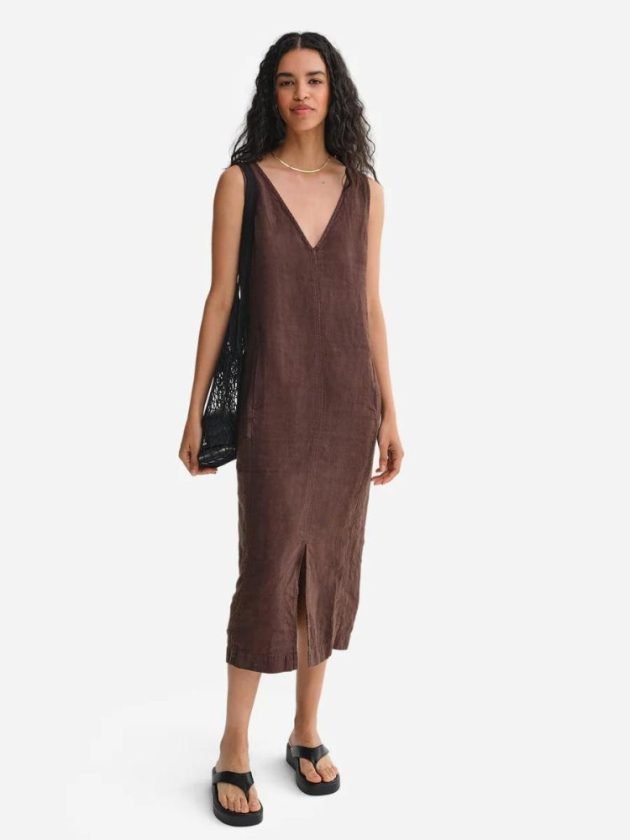
Brown v neck linen dress

8. OhSevenDays

All of OhSevenDays’ dreamy sustainable dresses are made from deadstock fabrics sourced from Istanbul, Turkey. The slow fashion brand also offers a transparent behind the scenes look at their production process, all done in-house by a team of four tailors.

Conscious Qualities: Reclaimed Fabrics, Transparent Production

Size Range: S-L + custom sizing
Price Range: $
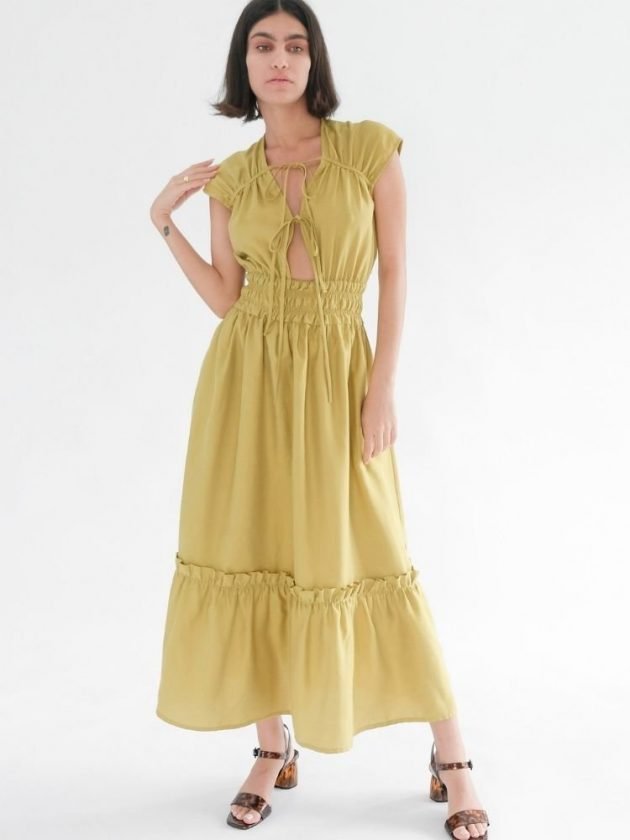
Yellow cotton dress from OhSevenDays

9. No Nasties

No Nasties creates 100% organic cotton fair trade dresses perfect for wearing to the beach with flip flops or pairing with heeled sandals for date night. Their versatile sustainable dresses are comfy, organic, and affordable with most pieces priced at under $100.

Conscious Qualities: Organic Fabrics, Traceable Supply Chain, Fair Trade

Size Range: XS-L
Price Range: $

10. LOUD BODIES

Crafting pieces in small batches using natural fibers in 15 different sizes, LOUD BODIES’ creates some of the best eco-friendly size inclusive dresses.

The brand will even produce pieces in custom sizes at no extra charge.

Conscious Qualities: Lower Impact Fabrics, Size Inclusive, Small Batch

Size Range: XXS-10XL
Price Range: $$

Woman with pink hair in light blue dress with ruffle

11. Míe

Defying typical design boundaries, Míe’s ethical dresses have a loose, comfortable fit but feature unique design elements like off-the-shoulder puff sleeves, making them the ultimate summer staples. And every dress is crafted responsibly in Nigeria using breathable, natural fibers like linen.

Conscious Qualities: Natural Fibers, Black Woman-Owned

Size Range: XS-3XL
Price Range: $$$

Eco-friendly pink dress from Mie

12. Reformation

Fun and flirty, Reformation has fashion-forward dresses for day or night and everything in between.

A leader in fashion for setting sustainability standards, Reformation used 97% recycled, regenerative, or renewable materials in 2023 and nearly 1 in 5 of their sales were resale, vintage, or rental. They also have partnerships with repair company Hemster and resale site thredUP. (Find more details in their sustainability report.)

Conscious Qualities: Responsible Material Sourcing, Circularity Initiatives, Traceability

Size Range: 0 – 12 and 14 – 24 in select styles
Price Range: $$$

Looking for accessories to go with that sustainable dress?

15 Brands with Ethical and Sustainable Sandals

The Best Eco-Friendly Vegan Bag Brands

Beautiful Fair Trade Artisan Jewelry Brands That Shine

The post The 12 Best Sustainable Dresses of 2026 for Any Budget appeared first on Conscious Life & Style.

The Best 11 Brands for Sustainable Dresses

Continue Reading

Green Living

The 2026 Drought, Region by Region

Published

on

Just over half the country is officially in drought, and about 155.7 million Americans—almost seven million more than last week—are now affected. The U.S. Drought Monitor’s April 23 report shows that 52.46% of the United States and Puerto Rico, and 62.78% of the Lower 48, are experiencing moderate drought or worse. According to NOAA, this is the worst spring drought on record for the continental United States.

This drought is not limited to one region. The Southeast just had its driest September-through-March since records began in 1895. The Colorado River system is only 36% full. Texas is 77% in drought, and Corpus Christi’s reservoirs have dropped to nearly 9%. Nebraska experienced its largest wildfire ever, fueled by dry grasslands. Oregon’s snowpack reached zero on April 1. In California, Tahoe City Cross melted completely by March 8, 40 days earlier than usual, after a record-breaking March heat wave caused rapid melting of an already low snowpack across most of the West.

The common factor is that from January through March, precipitation was below 70% of average across the lower 48 states, setting a new record. As a result, water restrictions are now broader and, in many places, more severe than usual.

The National Picture

The headline numbers come from the U.S. Drought Monitor, which is jointly produced by the National Drought Mitigation Center, USDA, and NOAA. As of April 21, drought conditions had worsened across the South, Southeast, Mid-Atlantic, High Plains, and West, with a 2.9% increase in coverage over the past week and an 11.7% increase over the past month. The Northeast and parts of Texas and the eastern Plains saw modest improvement; everywhere else trended drier.

Two main climate factors have caused this record drought. First, La Niña led to less rainfall from January to March, with totals below 70% of average—the lowest since records began in 1895, just surpassing the previous low in 1910. Second, spring temperatures in the Central Plains, Midwest, Northeast, and Mid-Atlantic were 5 to 10 degrees above normal, which sped up soil moisture loss and increased evaporation. This drought is not just about low rainfall; high temperatures are also drying out what little moisture remains.

The effects of the drought are already clear in the number of wildfires. By mid-April, over 1.7 million acres had burned across the country, nearly double the 10-year average. Nebraska’s Morrill Fire, which burned more than 640,000 acres in March, was the largest in the state’s history. In southeastern Georgia, the Highway 82 Fire destroyed at least 54 structures in Brantley County, which was the first county in the Southeast to reach exceptional drought (“D4”).

Southwest: The Colorado River Approaches a Threshold

The Colorado River Basin is facing water shortages not seen in modern times. The Bureau of Reclamation says the system is at about 36% of capacity. Lake Powell is only 23% full, and Lake Mead is about one-third full. Spring runoff into Lake Powell is expected to be just 22% of average. If this continues, 2026 could be one of the driest years in over sixty years, possibly even drier than 2002, which was the previous record.

In response, the Bureau of Reclamation announced in April that it plans to cut Lake Powell releases to 6 million acre-feet, the lowest in decades. They will also move water from Flaming Gorge to keep Lake Powell high enough for Glen Canyon Dam to generate hydropower. The dam provides electricity to about five million people, but water levels could drop too low by December if things do not improve. The seven states that share the Colorado River have not agreed on new rules for after 2026, when current guidelines expire. The Interior Department has said it may set new rules on its own if no agreement is reached this summer. Western states could be heading toward a conflict over water.

Local water restrictions are getting stricter. In March 2026, Erie, Colorado, moved to a Level 4 Emergency, the highest stage, which bans all residential sprinkler use. Aurora has completely banned new turf lawns. Denver Water started Stage 1 restrictions, asking residents to cut both indoor and outdoor water use by 20% until October 1. Along the Rio Grande, Elephant Butte is at 12.6% capacity, Falcon at 19.2%, and Amistad at 31.4%.

Source: UNLV Drought Monitor, April 28, 2026.

California: Permanent Rules Meet a Fourth Dry Year

California’s situation is more complex than just being in drought or not. In January 2026, the Drought Monitor showed no part of California in drought for the first time in 25 years. By April, Southern California was facing its fourth straight year of below-average rainfall. The statewide snowpack was only 18% of normal, and the State Water Project will limit water releases to 30% of normal.

What’s notable is that California’s restrictions no longer depend on whether a drought is officially declared. After the 2012-2017 drought, the state moved to a permanent year-round conservation framework codified by state law AB 1572 and the State Water Resources Control Board’s “Making Conservation a California Way of Life” rules.

Statewide baseline rules apply every year, regardless of conditions: no hosing down driveways or hardscape; no irrigation within 48 hours of rainfall; no irrigation runoff into streets or storm drains; mandatory shutoff nozzles on hoses; and recirculation requirements for fountains and decorative water features.

On top of these restrictions, the Metropolitan Water District of Southern California, which serves 19 million people, issued a Level 1 conservation notice in March 2026 to all 26 city and county agency members. State enforcement of the new water-budget rules is paused until 2027 to give utilities time to adjust.

California is in for a dry summer this year.

Southeast: A Recharge Season That Failed

The Southeast, usually a humid region, is now facing a record drought. Georgia, North Carolina, and South Carolina all had their driest September-through-March since 1895. Normally, the region relies on December through March to restore soil moisture, streamflows, and groundwater, but this year, that recharge mostly did not occur.

The result, as of April: 100% of North Carolina, 99.95% of Virginia, 99.34% of South Carolina, 98.99% of Florida, 98.13% of Georgia, 93.65% of Tennessee, and 88.66% of Alabama are in drought. In Georgia, extreme drought now covers 71% of the state, the highest reading since 2012. Some monitoring stations with 75 or more years of data are recording their driest six-month periods on record. Drought watches are active across Virginia, Tennessee, and Alabama, with mandatory rules likely if late-spring rainfall doesn’t materialize.

Texas and the Southern Plains: Cities at the Edge

Texas is 77% in drought as of mid-April. The Coastal Bend story is the one to watch closely. Combined storage at Choke Canyon Reservoir and Lake Corpus Christi has fallen to 8.7% as of April 2026 — among the lowest levels ever recorded. Corpus Christi has been under Stage 3 mandatory restrictions since December 2024, the most severe stage in the city’s standard drought contingency plan, which is triggered when combined reservoir storage drops below 20% capacity. Stage 3 bans all outdoor irrigation, home vehicle washing, and most non-essential outdoor water use; second and subsequent violations carry fines up to $2,000 each.

The bigger concern is what happens next. City models now predict a Level 1 Water Emergency by September 2026, when the water supply could be just 180 days from running out. On April 28, 2026, the City Council postponed a vote on a proposal that would require everyone—residents, businesses, and industry—to cut water use by 25% if Level 1 is declared. Many residents at the meeting said this cut would be impossible unless industrial users reduce even more.

If Corpus Christi runs out of water—a scenario city officials now consider possible—it would be the first modern American city to face this. There is no guidebook for what to do. In the worst case, the city could see rolling water shutoffs by district, water delivered by tanker trucks, and even managed evacuations. The largest industrial users, such as petrochemical refineries, would likely lose access to water first, potentially leading to lawsuits.

In other parts of Texas, Dallas has had a permanent rule since 2001 that only allows watering lawns two days a week, and no irrigation is allowed between 10 a.m. and 6 p.m. from April to October. In Oklahoma and Kansas, the Ranger Road Fire—the largest U.S. wildfire of 2026 so far—burned 283,283 acres in February, killed hundreds of livestock, and led to burn bans across central and eastern Oklahoma.

High Plains: Dust, Fire, and Lake Beds

Nebraska is experiencing conditions that one state climatologist said are unlike anything seen before. Fifty-six percent of the state is in extreme drought, similar to 2012 but with warmer temperatures. The Morrill Fire started in March and quickly spread through dry grasslands, burning over 640,000 acres—the largest wildfire in Nebraska’s history. In Sheridan County, some landowners say their private lakes have dried up completely for the first time since 2012.

The Black Hills in South Dakota are now in extreme drought. In southern Nebraska, southwest Kansas, and southeast Colorado, low rainfall combined with high temperatures and evaporation have made spring planting difficult in many areas. The U.S. Geological Survey reports that streamflows are below or much below normal across southwestern South Dakota, southern Nebraska, and central and western Kansas.

Mandatory urban restrictions in this region are still relatively rare, but burn bans are widespread, and ranchers are culling cattle herds rather than feeding them on pastures with no grass.

Pacific Northwest: A Snow Drought, Not a Rain Drought

The Pacific Northwest had more precipitation this winter than the Southwest, but most of it fell as rain instead of snow because of record-warm temperatures. This has caused a snow drought rather than a rain drought. Since the region relies on snowpack for summer water, this is a serious problem.

Across the broader Columbia River Basin, snowpack ranks in the second percentile. On April 8, Washington’s Department of Ecology declared a statewide Drought Emergency, citing snowpack at just 53% of the median and projected summer water supply below 75% of normal in many basins, including the Yakima. Junior water-rights holders in the Yakima Basin are projected to receive only 44% of their allotment. Idaho is facing what could be its fourth consecutive drought year in its northern basins.

For the Northwest, the effects go beyond just this summer. New research from Oregon State University predicts that by the end of the century, water will move from precipitation to streamflow about 18% faster on average. This happens because there is less snow and more rain, so water moves through the system more quickly instead of slowly melting from snowpack. As a result, there could be about 50% less water in rivers, lakes, and reservoirs during the summer growing season.

The shift toward earlier runoff seen in 2026 is not a one-time event. It is a preview of the more severe impacts that climate change could bring.

Where Restrictions Are Active

This is a partial snapshot as of April 27, 2026. Local utilities update stages weekly. Verify before relying on these figures.

Region Location Stage / Action Notes
Southwest Erie, CO Level 4 Emergency All residential sprinklers banned; most severe Front Range stage
Southwest Aurora, CO Stage 1 + turf ban New turf lawn installations prohibited
Southwest Denver, CO Stage 1 (through Oct. 1) Watering schedule by address
California MWD Southern Calif. region Level 1 conservation notice Issued March 2026; covers 19M residents
California San Francisco (SFPUC) Level 2 Tied to Hetch Hetchy levels
California Sacramento Stage 2 Folsom Lake at 48%
Southeast SW Florida (SWFWMD) Phase III (Apr 3 – Jul 1) Possible extension if summer rains fail
Southeast Raleigh, NC Mandatory Stage 1 (from Apr 20) Odd/even address watering schedule
Southeast Valdosta, GA Mandatory 1-day/week (from Apr 15) First Georgia city to move to mandatory rules
Texas Corpus Christi Stage 3 — Reservoir Crisis Reservoirs at 8.7%; 25% cut planned for September
Texas Dallas Permanent 2-day/week Ordinance since 2001; no irrigation 10am–6pm Apr–Oct
Pacific NW Washington (statewide) Drought Emergency (Apr 8) Snowpack at 53% of median; Yakima Basin junior rights cut to 44%
Pacific NW Oregon (snow drought) No statewide order yet Snow water equivalent at zero percentile on April 1

What You Can Do

Households use about 10% of all water in the U.S. Agriculture is still the biggest user, but in cities with restrictions, saving water at home can help prevent stricter rules, fines, or limits on businesses. The EPA’s WaterSense program says the average American family uses about 300 gallons a day, and simple upgrades can cut indoor use by 35%.

Indoor (immediate, no cost):

  • Check your home for leaks. On average, American homes waste over 11,000 gallons a year from running toilets and dripping faucets. A single toilet leak can waste 200 gallons a day. To test for leaks, put food coloring in the tank—if it shows up in the bowl without flushing, you have a leak.
  • Turn off the tap while brushing your teeth or shaving. This can save 8 to 10 gallons per person each day.
  • Only run your dishwasher and washing machine when they are full. You can also skip pre-rinsing dishes.
  • Take shorter showers. Reducing your shower by two minutes with a standard showerhead can save about 5 gallons of water.

Indoor (small investment):

  • Install WaterSense-labeled fixtures. Faucet aerators and showerheads use at least 20% less water and are inexpensive. The average family can save about 3,500 gallons of water and 410 kWh of energy each year just by using these.
  • Replace any toilet made before 1992. Older toilets use 4 gallons per flush, while WaterSense models use 1.28 gallons or less.

Outdoor (where most savings can happen):

  • Outdoor irrigation uses nearly 9 billion gallons of water a day nationwide. It makes up about 30% of household water use, and up to 70% in dry areas. Water your yard before sunrise or after sunset to reduce evaporation.
  • Consider replacing your lawn with drought-tolerant plants that are suited to your region. This type of landscaping uses less than half the water of a traditional lawn. Many cities, such as Aurora, Las Vegas, and Phoenix, offer rebates for replacing turf.
  • Install a smart irrigation controller with a rain shutoff or soil moisture sensor. These devices adjust watering based on real conditions instead of following a set schedule.
  • Add 2 to 3 inches of wood chips as mulch to your flower beds and vegetable gardens. This helps reduce evaporation and keeps weeds down.

Community and policy:

  • Find out your utility’s current drought stage and the rules that apply. Most utilities post this information online and let you report water waste, like irrigation during banned hours or broken sprinklers spraying onto pavement.
  • If you’re in an HOA, know your rights. California’s AB 1572 and Texas Property Code §202.007 prohibit HOAs from fining residents for brown lawns during active water restrictions. Other states are following this example.
  • Pay attention to how agriculture and industry use water in your area. While homes use only about 10% of water, decisions about the other 90%—used by farms and businesses—will shape whether household conservation efforts make a lasting difference.

The Big Climate Picture

Some may see the 2026 drought as just a mix of La Niña, a warm winter, and early snowmelt, with rain expected to return as conditions change and an El Niño watch begins for late summer. While this is partly true, the bigger pattern—record warmth, snow falling as rain, earlier and faster runoff, and reservoirs unable to keep up as demand rises during hotter, longer summers—is what climate science has predicted for nearly twenty years.

Lake Powell is at 23%. Oregon’s snowpack is gone. North Carolina is completely in drought. Corpus Christi is preparing for the chance of running out of water. These are not separate stories. They are all part of the same story, showing what aridification looks like when it becomes a daily reality instead of just a forecast.

Editor’s note: Drought conditions are evolving weekly. Statistics in this piece are current as of the U.S. Drought Monitor release dated April 21–23, 2026. Local water restrictions change frequently — verify with your utility before relying on the figures cited here.

The post The 2026 Drought, Region by Region appeared first on Earth911.

https://earth911.com/earth-watch/the-2026-drought-region-by-region/

Continue Reading

Green Living

How To Save Energy in Your Home With Smart Plugs

Published

on

Want to save time, money, and energy all while adding convenience to your life? Something as simple as using smart plugs throughout your home can help achieve these goals.

The average U.S. household has roughly 65 devices plugged in around the clock, quietly drawing about 770 kilowatt-hours of phantom power every year, about enough to run a refrigerator for nine months. At today’s average residential electricity rate of 17.47 cents per kilowatt-hour, that’s roughly $135 a year wasted on devices nobody uses.

Smart plugs are the simplest, cheapest way to stop electricity waste. The arrival of Matter, the cross-platform smart home standard backed by Amazon, Apple, Google, and Samsung, and the maturing of the low-power Thread wireless protocol mean a smart plug bought today should outlast the app it shipped with and work across whatever smart home ecosystem you switch to next. This updated article covers what changed, what to look for now, and which models are worth installing in 2026.

This article contains affiliate links. If you purchase an item through one of these links, we receive a small commission that helps fund our work.

How Smart Plugs Work

A smart plug sits between a wall outlet and whatever you plug into it — a lamp, a coffee maker, a space heater, an entertainment center. Inside is a relay that opens or closes the circuit on command, plus a wireless radio that listens for those commands from your phone or a smart speaker. Some plugs add an energy meter that reports real-time wattage and cumulative kilowatt-hours back to the app.

Older smart plugs relied entirely on 2.4 GHz Wi-Fi and the manufacturer’s cloud services, which meant a server outage or a Wi-Fi hiccup could leave you unable to turn off your lamp. Matter-certified plugs communicate locally over your home network and continue working even when the internet drops. Thread-based plugs go further, forming a self-healing mesh network in which each plugged-in device acts as a relay for the next, extending range and cutting response time, so there’s less waiting for your smart home app to make your smart home work.

Man operates smart plug with his smartphone
Smart plugs enable you to schedule when electrical devices go on and off throughout the day, whether you are home or not.

In late 2022, the Connectivity Standards Alliance released Matter 1.0, an open, royalty-free standard meant to end the era of locked smart home ecosystems. Matter-certified plugs pair with Apple Home, Amazon Alexa, Google Home, and Samsung SmartThings simultaneously, and it is configured by scanning a single QR code. No brand-specific app required, no separate hub for each platform.

Matter has matured quickly. Version 1.4 added home energy management as a first-class device category and introduced certified routers and access points that double as Thread border routers. Version 1.5, published in November 2025, expanded support to cameras, soil moisture sensors, and additional energy management features. As of 2026, Thread border router certification requires Thread 1.4, which lets security credentials to be passed between platforms, so a plug added through Apple Home can also be controlled from a SmartThings hub.

A Matter plug bought in 2026 should still work in 2030, even if you switch from an Amazon Echo to a HomePod or add a SmartThings station. By contrast, a proprietary Wi-Fi plug from a brand that goes out of business or sunsets its app is a paperweight. That’s a real consideration in a category where startups have come and gone — Wink, Insteon, and others left users stranded when their cloud services shut down.

How Much Energy They Actually Save

Smart plugs save energy only when you use them deliberately. The plug itself draws roughly 1 to 2 watts of standby power, so each one adds about $1.50 a year to your bill before it does any work. That cost is recovered many times over if the plug is used to schedule, monitor, or kill standby loads.

Three smart plug features do most of the work:

1. Cutting Standby Loads

The U.S. Department of Energy and the Natural Resources Defense Council estimate that standby power — the electricity devices draw when they’re switched off but still plugged in — accounts for 5% to 10% of residential electricity use, and as much as 23% in homes packed with always-on electronics. The NRDC estimates the national wasted energy spending at about $19 billion a year, or roughly $165 to $440 per household. Older devices, gaming consoles, set-top boxes, and audio equipment are the worst offenders.

A smart plug with energy monitoring lets you spot which devices are draining power in standby and either schedule them off overnight or kill the circuit entirely. One reviewer found an old gaming console drawing 50 watts in standby mode, which costs is about $45 a year at average rates.

2. Scheduling and Off-Peak Shifting

Scheduling a coffee maker, towel warmer, or seasonal lights to run only when needed is the simplest savings case. The bigger one is shifting flexible loads — EV chargers, dehumidifiers, pool pumps — to off-peak hours when many utilities offer lower rates and the grid is running on cleaner sources. Earth911’s reporting on vampire loads walks through which household devices are worth targeting first.

3. Smart Plugs can Catch Failures Early

This is the underrated benefit. A refrigerator that suddenly draws 40% more power, a sump pump that’s cycling too often, or a freezer running 24/7 because the door seal failed will all show up in an energy-monitoring plug’s history before they show up on your utility bill. For appliances that fail gradually, the plug is a cheap diagnostic tool.

2026 Performance Standards: What to Look For

The smart plug market has consolidated around a handful of meaningful specifications. A plug bought in 2026 should meet most of these:

  • UL or ETL safety certification. This is non-negotiable. Uncertified plugs from unknown brands have been linked to overheating and fires; in 2023 the CPSC announced a recall of Emporia smart plugs over electric shock hazards, and counterfeit electrical products remain a documented risk. Look for the printed UL or ETL mark on the device itself, not just the listing page.
  • 15-amp / 1,800-watt rating. Standard for U.S. plugs and sufficient for nearly any single-outlet appliance. Be cautious about controlling space heaters with smart plugs, even at this rating; high-draw devices running for hours can stress the relay.
  • Matter certification. Look for the Matter logo (three arrows forming a triangle) on the plug packaging.
  • Real energy monitoring. Look for plugs that report actual wattage and cumulative kilowatt-hours, not estimated usage based on assumed device profiles. This is the feature that turns a smart plug into a savings tool rather than a convenience gadget.
  • Local scheduling stored on the plug itself continues running when the internet drops. Cloud-only schedules don’t.
  • Compact form factor. Older plugs were bulky enough to block the second outlet on a duplex receptacle. Slim designs from Kasa, TP-Link Tapo, and Eve now fit two per outlet.
  • Thread support is optional but useful. Thread plugs use less power than Wi-Fi, respond faster, and strengthen your mesh as you add more. They require a Thread border router, which is built into most current Apple, Google, and Amazon hubs.

Recommended Models for 2026

These picks are organized by use case rather than ranked overall. Prices and availability checked April 2026; verify before purchase.

Best Cross-Platform Pick: Kasa KP125M

The Kasa KP125M was one of the first Matter-certified plugs with proper energy monitoring and remains the best balance of features in 2026. It works with Apple Home, Alexa, Google Home, and SmartThings via Matter to track real-time and historical wattage in the Kasa app. It stores schedules locally and is compact enough to stack two in a duplex outlet. UL-certified, 15A/1800W. Around $20 per plug in 2-packs and 4-packs. The Chinese manufacturer, TP-Link, has had its U.S. market presence scrutinized for security concerns — worth considering if that’s a priority for your household.

Best for Apple Home and Thread Mesh: Eve Energy

Eve Energy (Matter) runs over Matter and Thread, joining a Thread mesh automatically to act as a router for nearby devices. Eve’s privacy posture is unusual: no cloud, no account registration, no telemetry, so you can use it without fear of digital surveillance of your home. The energy monitoring is granular enough to capture small changes in appliance behavior, and the app provides detailed cost projections. UL-certified, 15A/1800W. Premium-priced at closer to $40 per plug, but the Thread support and privacy stance justify it for households committed to a local-first smart home.

Outdoor Use: Wyze Plug Outdoor

For holiday lights, pool pumps, garden features, and string lights, the Wyze Plug Outdoor offers two independently controlled, weather-sealed outlets with energy monitoring, a built-in light sensor, and IP64 water resistance. It works with Alexa and Google Assistant, operating from -4°F to 120°F. Typically priced between $25 and $30. Note that Wyze has had several security incidents over the past few years, which is worth weighing for indoor cameras, but matters less for an outdoor plug controlling lights.

Simplest Alexa-Only Setup: Amazon Smart Plug

If your household is already deep in the Alexa ecosystem and you want zero-configuration setup, the Amazon Smart Plug pairs automatically with Echo devices and works through the Alexa app, with no separate setup required. While it provides n o energy monitoring, this Alexa-only costs around $20. The simplest option, but the least flexible if you ever switch ecosystems.

The Bigger Picture

Smart plugs are a small intervention. Cutting standby load might save a household $50 to $200 a year — meaningful, but a fraction of the savings available from more efficient HVAC, water heating, and appliance choices, which together account for the majority of residential electricity use. The case for smart plugs is less about that one number and more about the visibility they provide. Most households have no idea which devices are responsible for their bills until they get the data.

The category also has a larger-grid story. Smart plugs that can shift flexible loads to off-peak hours give utilities and grid operators tools to balance demand without building more peaker plants, particularly relevant as electrification of heating and transportation drives residential demand growth. Check out our conversation with ecobee’s Sarah Colvin, which to go deeper into how distributed smart devices are starting to function as grid resources, not just consumer conveniences.

What You Can Do

  • Audit before you buy. Walk through your home with a notepad and list devices that run on standby, such as entertainment systems, gaming consoles, printers, set-top boxes, microwaves with clocks, or anything with an LED that stays lit. Those are your first smart plug candidates.
  • Start with one Matter plug with energy monitoring. Use it as a diagnostic tool for a week on each of your top suspects before installing a full set. The data will tell you which loads are worth automating.
  • Build schedules around the loads you actually use. A coffee maker that runs from 6:30 to 7:30 a.m., an entertainment system that powers down at midnight, and holiday lights on a sunset-to-11 p.m. window. Aim for the plug to spend most of its time off.
  • Check for utility rebates. Many U.S. utilities offer rebates on energy-monitoring devices and smart home products that participate in demand-response programs. Your provider’s website or ENERGY STAR’s rebate finder is the place to start.
  • Don’t put high-draw appliances on smart plugs. Space heaters, window AC units, and other devices that draw near the 15A rating for hours at a time stress the relay and pose a real fire risk. Use a hardwired smart switch or a smart breaker for those instead.
  • Verify safety certification on the physical product. The UL or ETL mark should be printed on the plug itself. If it’s not, return it.

Editor’s Note: Originally written by Sandi Schwartz on March 29, 2023, this article was substantially updated in April 2026.

The post How To Save Energy in Your Home With Smart Plugs appeared first on Earth911.

https://earth911.com/eco-tech/how-to-save-energy-in-your-home-with-smart-plugs/

Continue Reading

Green Living

Earth911 Inspiration: Living by Sufficiency Rather Than Excess

Published

on

Today’s quote is from Yvon Chouinard, rock climber, environmentalist, and founder of outdoor gear retailer Patagonia. He said, “Going back to a simpler life based on living by sufficiency rather than excess is not a step backward.” Is it time to simplify your life?

Earth911 inspirations. Post them, share your desire to help people think of the planet first, every day. Click the poster to get a larger image.

"Going back to a simpler life based on living by surriciency rather than excess is not a step backward." --Yvon Chouinard

This poster was originally published on June 26, 2020.

The post Earth911 Inspiration: Living by Sufficiency Rather Than Excess appeared first on Earth911.

https://earth911.com/inspire/earth911-inspiration-living-by-sufficiency-rather-than-excess/

Continue Reading

Trending

Copyright © 2022 BreakingClimateChange.com