

A surge in gas prices triggered by the Iran war has caused a knock-on spike in the price of electricity in the UK, Italy and many other European markets.
This is because gas almost always sets the price of power in these countries, even though a significant share of their electricity comes from cheaper sources.
This “coupling”, which is part of what UK energy secretary Ed Miliband calls the “fossil-fuel rollercoaster”, is due to the “marginal pricing” system used in most electricity markets globally.
After another fossil-fuel price shock, just four years after Russia’s invasion of Ukraine, this coupling between gas and electricity prices is once again under the spotlight, in the UK and the EU.
There are various alternatives that have been put forward as ways to break – or “decouple” – the link between gas and electricity prices.
Electricity prices could be “decoupled” from gas prices by changing the way the market works, but ideas for doing this either have not been tested or have problems of their own.
Some people have implied that the UK could insulate itself from high and volatile international gas prices by extracting more gas from the North Sea.
However, contrary to false claims by, for example, the hard-right climate-sceptic Reform UK party, this would not be expected to cut energy bills, because gas prices are set on international markets.
Finally, electricity prices can be “decoupled” from gas by burning less of it, a shift that is nearly complete in Spain and that is already having an impact in the UK.
- Why does gas set the price of electricity?
- What is the impact of gas setting the electricity price?
- What market reforms have been proposed?
- Why is ‘marginal pricing’ in the news again?
- Would it help if more gas were extracted domestically?
- Would burning less gas stop it setting electricity prices?
Why does gas set the price of electricity?
In liberalised economies, electricity is bought and sold via market trading. The market uses a system called “marginal pricing” to match buyers with enough supply to meet their demand.
(The same system is used in most commodity markets, including for oil, gas or food products.)
All of the power plants that are available to generate make “bids” to sell electricity at a particular price. The bids are arranged in a “merit order stack”, from the cheapest to the most expensive, shown in the illustrative schematic below.
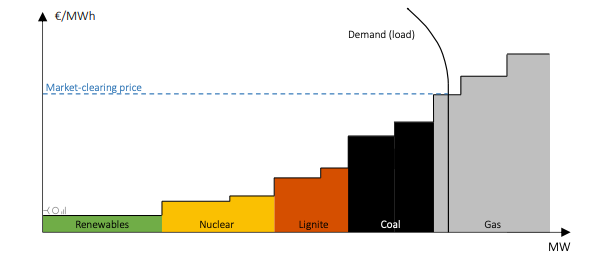
This means that the price of gas sets the price of electricity, whenever gas plants are at the margin.
In the UK, the marginal unit is almost always a gas-fired power plant. As a result, one widely cited academic analysis found that gas set the price of power 97% of the time in the UK in 2021.
In contrast, the analysis found that gas only sets the price of power 7% of the time in France, as shown in the figure below. This is because the French market is dominated by nuclear power.
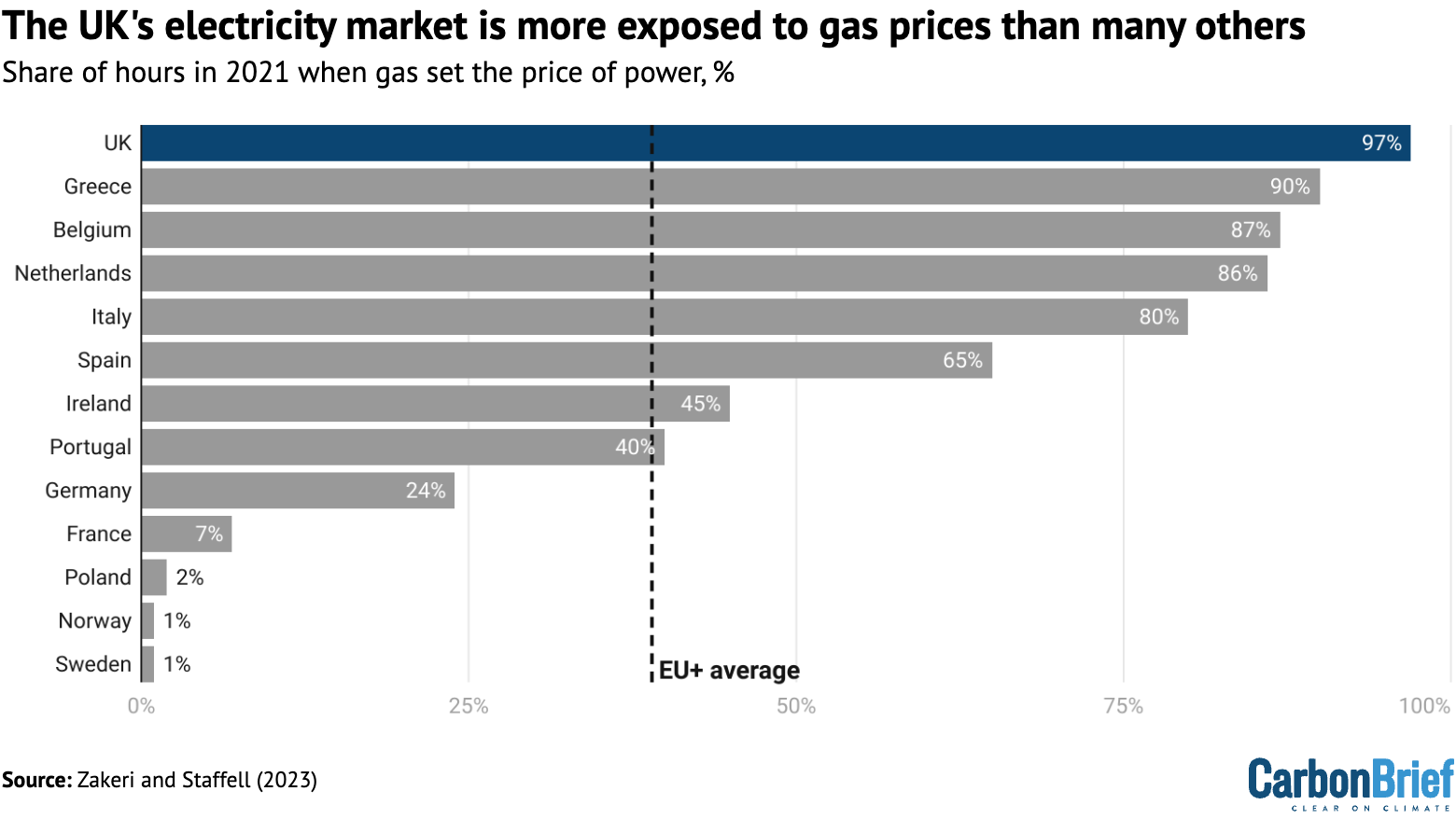
The “pay as clear” marginal-pricing system means that gas sets the price of power more often than might be expected, given its share of electricity generation overall.
For example, gas set the price of power 97% of the time in 2021, even though it only accounted for 37% of electricity generation that year. Equally, even though renewables now make up around half of UK electricity supplies, gas still usually sets the price of power in the UK.
(There are some important subtleties to this, due to the fact that not all gas-fired power plants are equally expensive to run. This is discussed further below.)
Overall, the fact that gas hardly ever sets the price of power in some European markets hints at the potential to decouple electricity prices from gas, by shifting towards alternative sources.
What is the impact of gas setting the electricity price?
The tight coupling of gas and electricity prices in the UK and other markets is the source of significant political debate, particularly during periods when the price of gas soars.
When gas prices hit record highs after Russia’s invasion of Ukraine in 2022, politicians, commentators and the media rushed to understand why this also spiked electricity bills.
The same dynamic is playing out in 2026, following the attacks on Iran by the US and Israel, the closure of the Strait of Hormuz and the resulting surge in international gas prices.
An editorial in the Financial Times published earlier this month is headlined: “The déjà vu of Europe’s energy shock.” It says the crisis is once again raising questions over electricity pricing:
“In Britain, in particular, questions remain on how to reform its electricity pricing, which currently leaves it highly exposed to volatile wholesale gas prices.”
This exposure is illustrated in the figure below, which shows the tight link between prices on the “day-ahead” markets for gas and electricity.

Indeed, recent analysis from the UK Energy Research Centre (UKERC), published before the Iran war, found that high gas prices were still the biggest driver of high UK electricity bills.
The UK is not the only market being hit by high electricity prices after the outbreak of war in the Middle East. Italy is also suffering, at a time when it was already in the midst of a major debate over how to cut electricity prices, which are also high due to its heavy reliance on gas power.
What market reforms have been proposed?
Historically, some governments set the price of electricity themselves. However, this is increasingly rare and most countries now have “liberalised” electricity markets to determine prices.
These markets use the “pay as clear” system of marginal pricing, described above, to balance supply and demand in each hour of the day.
Alternative models include “pay as bid”, where each power plant is only paid the amount that it bid to supply electricity, rather than the higher price of the marginal unit.
However, this “would not provide cheaper prices”, according to the European Commission, because bidders would seek to maximise their profits by guessing the clearing price:
“In the pay-as-bid model, producers (including cheap renewables) would simply bid at the price they expect the market to clear, not at zero or at their generation costs.”
Another option would be to create two separate markets, one “green power pool” for renewables and another for conventional sources of electricity.
One proponent of this idea is Prof Michael Grubb at University College London. In a March 2026 post on LinkedIn he says:
“The impact of surging gas prices on electricity will again highlight the oddities of our current electricity market – which make sense to many economists, but to hardly anyone else.”
Explaining his rationale for creating separate power markets, he continues:
“The crisis again emphasises that gas-generated power and renewables are not really the same commodity and deserve distinct and tailored market structures to also enhance transparency. Unless and until that occurs, no amount of policy tinkering can overcome the volatility imposed by geopolitical events outside our control.”
However, the UK government concluded in 2024 that it “[did] not consider [a green power pool] to be deliverable”, adding that, even if it were possible, it “would not provide additional benefits”.
This was part of the UK government “review of electricity market arrangements” (REMA), which considered – and then rejected – a series of alternative ways to structure the market.
Similarly, it is less than two years since the European Commission also considered – and then rejected – alternatives to the marginal pricing system, notes Jon Ferris, head of flexibility and storage at consultancy LCP Delta, in a LinkedIn post. The commission explains:
“This model provides efficiency, transparency and incentives to keep costs as low as possible. There is general consensus that the marginal model is the most efficient for liberalised electricity markets.”
In the UK, a debate in parliament in early March 2026 saw Labour MP Toby Perkins questioning the marginal pricing system, which he said was now “far less robust”. He said:
“Because renewables are cheaper, should we not look to benefit from that, rather than having a system that allows gas to set the price, even if it accounts for only 1% of our energy?”
Ultimately, however, marginal pricing is the “worst approach to clearing markets apart from all the others”, Ferris tells Carbon Brief.
The Iran crisis has also been used to resurface a more radical option, put forward last year by consultancy Stonehaven and NGO Greenpeace, of taking gas out of the market completely.
The idea would effectively see gas plants being taken into a strategic reserve, where they would receive a regulated return for remaining open. They would be managed centrally and called on to generate power as needed outside of the market, which would continue to use marginal pricing.
Adam Bell, partner at Stonehaven and the government’s former head of energy policy, tells Carbon Brief that it would be possible to implement within 18 months, but only if moving at a pace that the civil service might describe as “brave”.
Why is ‘marginal pricing’ in the news again?
Despite the decisions at UK and EU level to reject the alternatives, interest in moving away from marginal pricing has recently been reignited – even before the shock of the Iran war.
For example, in a speech in February, European Commission president Ursula von der Leyen said a recent meeting of member states had seen “intense discussion” over marginal pricing:
“We did not come to a conclusion. I want to be very clear on this one. But to the next European Council, I will bring different options and findings on whether it is time to move forward on the market design or whether we are still good on this market design.”
A subsequent leak from the commission, seen by Carbon Brief, also implies that marginal pricing is up for debate, as part of ongoing discussions on how to tackle high energy prices.
Subsequently, Philippe Lamberts, climate advisor to von der Leyen, made comments implying that the marginal pricing system was problematic.
In response, ahead of a meeting of EU governments in the week beginning 16 March, a group of seven member states wrote to the commission warning against market reform.
Their letter says that “no satisfactory alternative model has been identified” and that “all other options discussed would introduce inefficiencies”, compared with sticking to marginal pricing.
Industry group Eurelectric makes similar comments in its own letter, as well as warning about the uncertainty that would be created by market reform. It says:
“Delivering massive investments in clean power generation is the structural answer to reduce our dependence on fossil fuels. Reopening the fundamental principles of market design risks increasing uncertainty, delaying investment decisions and, ultimately, raising system costs.”
Another element to the debate has come from Italian government proposals to subsidise gas plants, in an effort to reduce electricity prices in the country.
The proposal has drawn comparisons with the so-called “Iberian mechanism”, under which the governments of Spain and Portugal subsidised gas power during the 2022 energy crisis.
This support did yield “short-term price relief”, says Chris Rosslowe, senior analyst at thinktank Ember in a post on LinkedIn. However, he says it also had “perverse consequences”, including increasing demand for gas “in the middle of a gas supply crisis”.
These sorts of ideas “would cause a lot of collateral damage” in terms of market efficiency, investor confidence and other areas, says Prof Lion Hirth at the Hertie School in Berlin, in a LinkedIn post.
Jean-Paul Harreman, director at consultancy Montel Analytics, writes in an article on LinkedIn:
“[R]eplacing transparent marginal pricing with political price formation is often like replacing a thermometer because you dislike the temperature reading. It may feel satisfying. It does not change the weather.”
Would it help if more gas were extracted domestically?
In the UK, there has also been intense pressure from opposition politicians and some sections of the media to expand gas production in the North Sea.
Nigel Farage, the climate-sceptic head of Reform UK, was recently quoted by Bloomberg as claiming: “Producing our own gas would reduce everybody’s electricity bills significantly.”
There is no evidence to support this claim.
While the opposition Conservatives have also been loudly calling for an expansion of North Sea drilling, they have been more circumspect about any impact on bills.
Writing in the Daily Telegraph, Conservative leader Kemi Badenoch only indirectly links such an expansion in domestic gas production with lower bills. She writes:
“[P]art of the reason we’re being hit so hard by [the Iran war] is because we are not drilling our own oil and gas thanks to [the government’s] net-zero madness.”
Badenoch’s own shadow energy secretary Claire Coutinho contradicted this idea in 2023, when she was in government. She said at the time that awarding new oil and gas licensing “wouldn’t necessarily bring energy bills down”.
This is because, as the UK’s energy minister Michael Shanks said at a recent event: “We will always be a price taker in international fossil-fuel markets, not a price maker.”
What he is saying is that UK gas production is small relative to the size of the European and global market for the fuel. As such, any increases in UK production would not materially affect prices.
Moreover, North Sea gas production has been in decline for decades and this is set to continue, whether or not the government allows new drilling to take place. This is because much of the gas it once contained has already been extracted and burned.
Would burning less gas stop it setting electricity prices?
The final idea for breaking the link between gas and electricity prices is simply to burn less gas.
This is one of the key motivations behind the UK government’s “clean power 2030” plan, which aims to largely decarbonise electricity supplies by 2030.
The government said when launching its plan:
“These investments will protect electricity consumers from volatile gas prices and be the foundation of a UK energy system that can bring down consumer bills for good.”
In 2026, however, UK electricity prices are still largely dictated by gas prices, as described above.
Yet this does not mean that the expansion of renewables has had no impact. Indeed, analysis by thinktank the Energy and Climate Intelligence Unit (ECIU) suggests that renewables have already reduced UK wholesale electricity prices by a third in 2025.
As more renewable generation is added to the system, the most expensive gas plants in the merit order “stack” are knocked out of the market. Even though another gas plant may still be setting power prices, it will be a cheaper and more efficient unit.
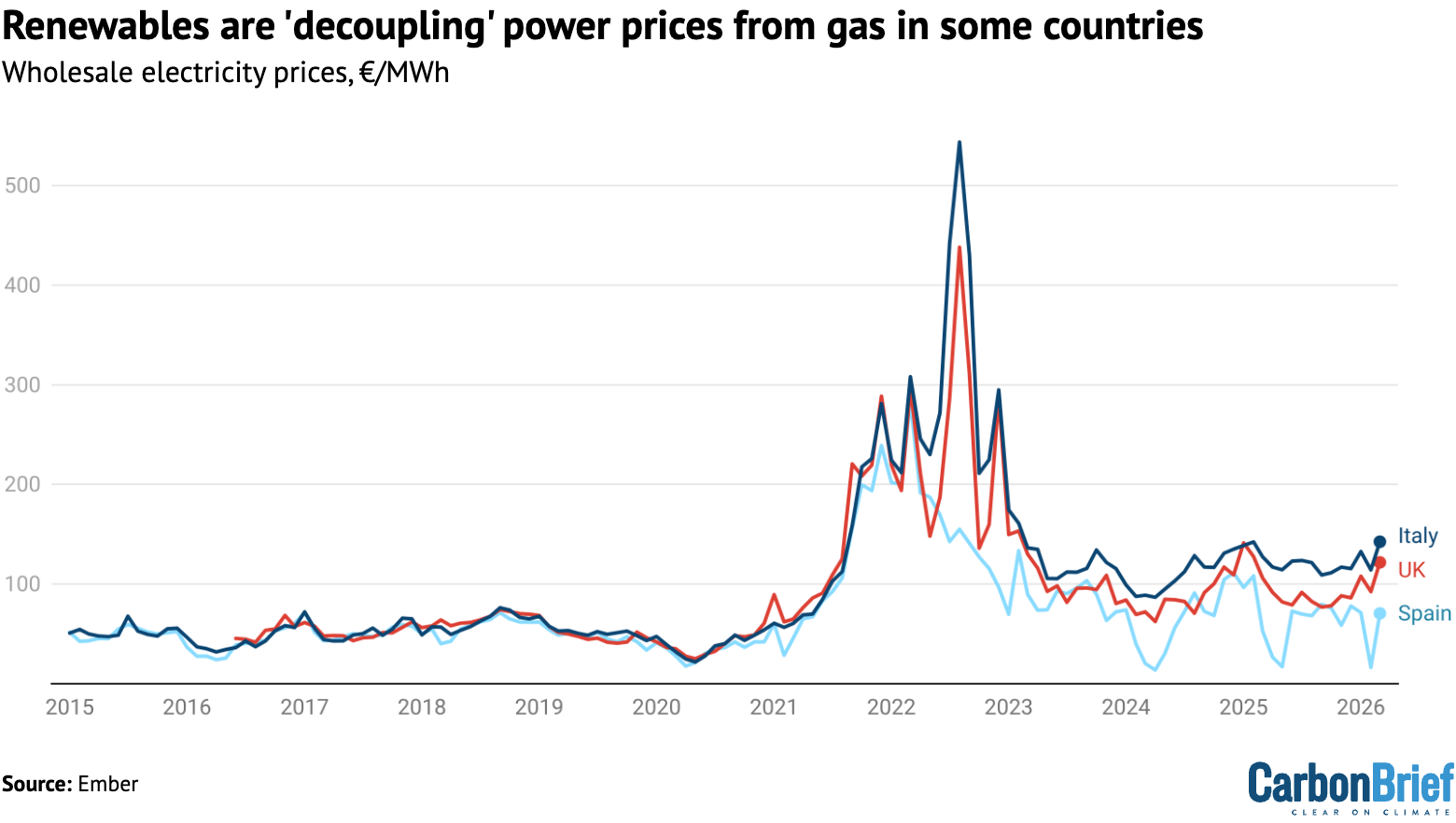
This intermediate impact of renewables is already visible when comparing electricity prices in the UK with those in Italy and Spain, as shown in the figure below.
The figure shows that UK wholesale electricity prices have been lower than those in Italy, as a result of the expansion of renewable sources over the past decade. (Prior to this, wholesale prices were similar in both countries.)
The contrast with prices in Spain is even larger , where Ember says “strong solar and wind growth [has] reduced the influence of expensive coal and gas power on the electricity market”.
The UK is already seeing electricity prices that are “decoupled” from gas prices on windy days. In addition, an increasing amount of electricity is set to be generated by renewable sources that hold “contracts for difference” (CfDs).
CfD projects are paid a fixed price for the electricity they generate, regardless of the price on the “day-ahead” wholesale market. As such, they dilute the impact of gas on consumer bills.
In 2022, when the last energy crisis hit, only 7% of UK generation was covered by CfDs, according to freelance “energy geek” Ben Watts. As of 2026, he says this has climbed to 13%.
By 2030, CfD projects will make up as much as half of total electricity supplies in the UK.
Callum McIver, research fellow at the University of Strathclyde and a member of the UKERC, tells Carbon Brief that CfDs are a “mechanism to decouple bills from the cost of gas”. He adds:
“With significant volumes of new and lower cost renewables on CfDs expected to connect to the system over the next few years, the impact of the scheme on price decoupling should accelerate…This provides an ever increasing hedge against future price shocks.”
Power-purchase agreements (PPAs) can have a similar effect. Here, large users such as industrial sites sign a contract with a power plant to buy the electricity they generate at a fixed price. Again, this takes some electricity out of the wholesale market, diluting the impact of gas prices.
Increases in UK renewable generation are yet to unseat gas from its role in determining electricity prices in most hours of the year, but this shift is starting to have an impact.
Analysis by consultancy Modo Energy suggests that electricity prices in the UK were above the price of gas power in nearly 90% of hours in 2018, a figure that had fallen to below 80% in 2024. Modo’s director Ed Porter said on Twitter: “The link between gas and power prices is weakening.”
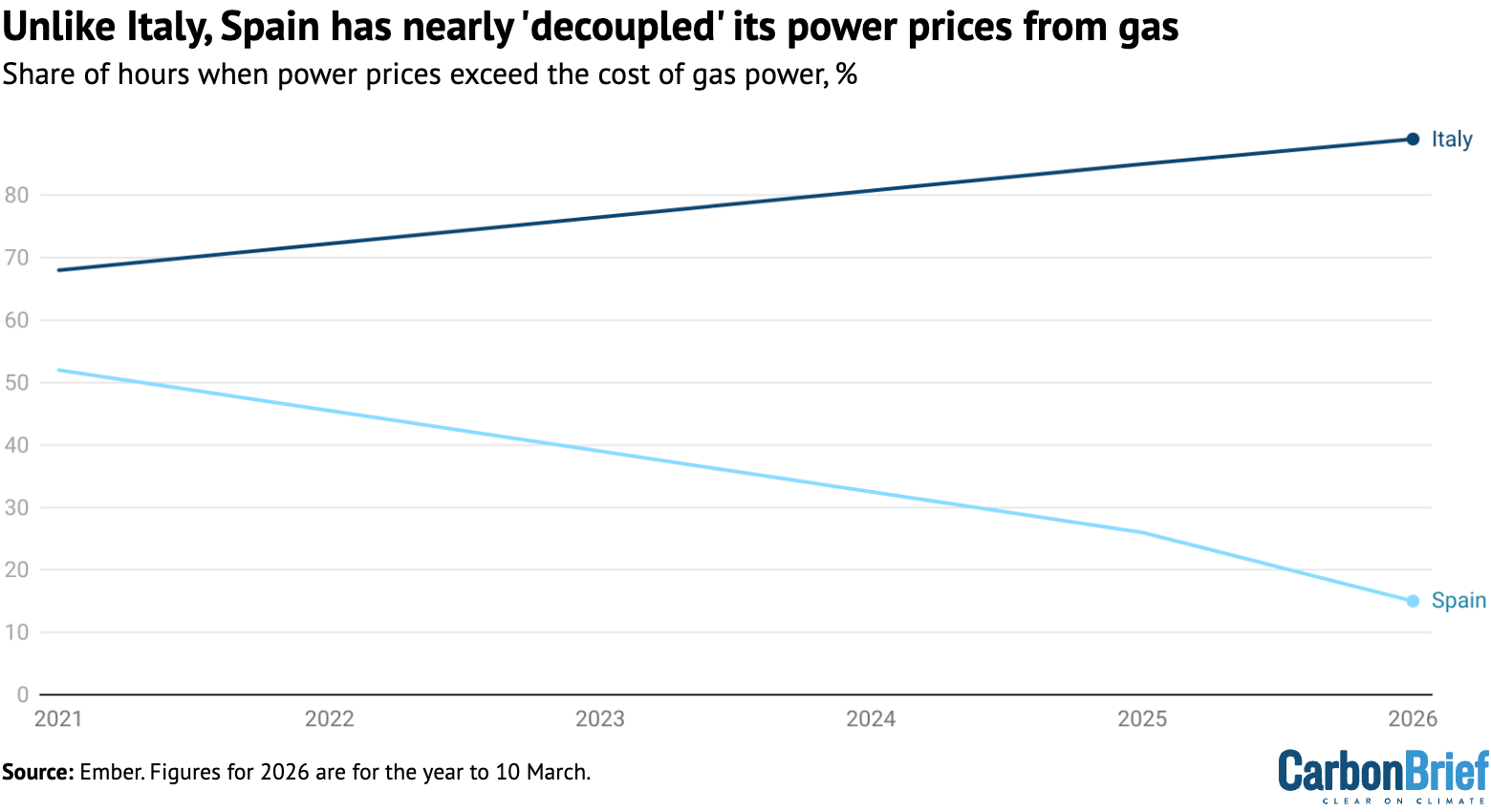
In Spain, analysis by Ember shows that the link is well on the way to being completely broken. Ember data shared with Carbon Brief shows that power prices were above the cost of gas power in 52% of hours in 2021, but this had fallen to 15% of hours in 2026 to date.
This data, shown in the figure below, is in stark contrast with Italy, where the influence of gas on electricity prices has actually increased in recent years.
A similar effect would be possible for the UK. Recent analysis from LCP Delta shows that the UK electricity system would be “almost entirely insulated from gas price shocks”, if it reaches the government’s clean-power 2030 targets.
Posting on LinkedIn, Sam Hollister, principal and head of UK market strategy, writes that a spike in gas prices similar to current levels would only increase household bills by 8%, if the 2030 targets are met. In contrast, bills would rise by 45%, if no CfD-backed renewables were on the system.
In his LinkedIn article, Montel’s Harreman concludes:
“The real structural solution to high power prices is not to mute marginal pricing, but to reduce exposure to fossil fuels and accelerate clean capacity, grids and flexibility. That lowers marginal costs structurally rather than cosmetically.”
“Marginal pricing is uncomfortable in volatile times. But discomfort is not evidence of failure. It is often evidence that the system is telling the truth. And, in energy markets, obscuring the truth is usually more expensive than confronting it.”




The post Q&A: Why does gas set the price of electricity – and is there an alternative? appeared first on Carbon Brief.
Q&A: Why does gas set the price of electricity – and is there an alternative?

The launch of the Africa Energy Bank (AEB) has been put back yet again, raising doubts about the institution’s future ability to finance fossil fuel projects – its main objective – as global lenders retreat from such investments over climate concerns, experts told Climate Home News.
The bank, which had been billed to launch in September after a series of delays, is now scheduled to begin operations in November, according to the head of the African Energy Chamber, an advocacy body for the continent’s oil and gas sector.
Even as the world aims to transition away from fossil fuels, many African leaders have made clear they want to continue exploring and extracting the continent’s large oil and gas deposits – estimated at around 125 billion barrels of crude and over 600 trillion cubic feet of gas – to boost economic development.
As a group, Africa sided with a number of powerful oil-and-gas producing nations in blocking progress on negotiations to craft a global roadmap to transition away from fossil fuels at last year’s UN COP30 climate talks, although some countries did individually support the proposal.
-
Campaigners oppose Dangote’s planned Kenya refinery over climate and ecological risks
Plans to build Africa’s second largest oil refinery in ecologically sensitive region criticised as “environmental recklessness” -
Tanzania pushed African nations to oppose fossil fuel transition at COP30
While chairing the African group at the summit, the gas-dependent nation advised the continent’s ministers to block language on transitioning away from fossil fuels


Meanwhile, major projects under development across the continent – including the 1,443-km East African Crude Oil Pipeline (EACOP) and Dangote’s 700,000-barrel-per-day Kenyan refinery – show that African governments see oil and gas as playing a significant role in meeting their energy and economic needs for many years to come.
In 2022, at a gathering of the African Petroleum Producers’ Organization (APPO) in oil-rich Angola, ministers from its member states adopted a resolution to create the Africa Energy Bank to finance projects for the production, use and trade of oil, gas and broader energy sources.
African control over energy resources
An article on the APPO website explains that the bank was conceived as a way to overcome “disenchantment” with fossil fuels among “the international community” which it said had crystallised around the “energy transition” concept.
“If Western countries, after having long taken advantage of the energy sources they now revile to develop, can afford the luxury of abandoning them, this is not the case in Africa,” it adds, noting that many of the continent’s economies are still largely dependent on oil and gas revenues.
A separate web page about the bank, also hosted on APPO’s website, says its objectives include financing the exploration, production and refining of oil and gas, as well as supporting member states in transitioning from fossil fuels to cleaner energy sources “while ensuring energy security”.
Said Addi, a former executive with Shell and energy commodities trading house Gunvor, said the new bank was judged necessary because financing for hydrocarbons from many traditional international lenders has become constrained.
In trying to fill this financing gap, Africa is not simply setting up another fund to support oil and gas, he added. “It is also an attempt to give African countries greater control over how their energy resources and infrastructure are financed,” he explained.
Nigeria to host the AEB
The energy bank – a joint initiative of APPO and the African Export–Import Bank (Afreximbank) – has so far suffered several delays and is almost two years behind schedule. The initial plan was to start operations in January 2025, with Nigeria as the host country, but the bank’s opening was delayed to June of that year to allow Nigeria time to finalise the construction of the bank’s headquarters in Abuja.
After the government announced the completion of the offices in late November 2025, a new launch date was set for January 2026, which was moved back to April, June and then September. Now it has shifted again to November, raising concerns that the institution may be losing momentum.
Former Shell executive Addi said that if the capital is eventually pai