

Angola has scaled back its targets for reducing emissions in its new national climate plan, saying it chose “realism and implementability” over the Paris Agreement’s calls for governments to set progressively more ambitious goals.
The African oil-exporting country plans to cut greenhouse gas emissions by 11% by 2035 from a “business as usual” scenario. That compares to a 24% cut by 2025 in its previous Nationally Determined Contribution (NDC), which used an earlier baseline year with far lower emissions.
Under the 2015 climate treaty, countries’ NDCs – which should be updated every five years, with the third round since the Paris pact due this year – are meant to represent a progression from the previous one and reflect the “highest possible ambition”.
Citing the country’s struggles to meet previous targets, Angola’s NDC said the level of ambition “must also take into account national circumstances, capabilities and the need for sustainable development, particularly in developing countries such as Angola”.
It said progress on different climate projects to date has been hampered by limited technical capacity, coordination gaps and a lack of financial and technological support, despite strong political will and policies.
-
Turkey’s new climate pledge would control emissions growth, not offer real cuts
The world’s 15th-largest emitter has made progress in boosting clean energy, but it could do much more to decarbonise -
Nigeria gives fossil gas a bigger role as “transition fuel” in climate plan
Officials say the country needs time and money to ramp up renewables, but critics say betting on gas is a risky strategy that could prolong the “oil curse” -
Russia justifies fossil gas use by citing contentious COP28 loophole
In Dubai two years ago, Russia pushed for a clause on “transitional fuels” which its new UN climate plan uses to justify gas consumption


“The targets for the period … have been set to reflect the most realistic and feasible conditions for Angola,” the NDC added. “While the percentage targets are less ambitious than those in the previous NDC, they correspond to a greater absolute reduction” in greenhouse gas emissions, it noted.
At the same time, the country shifted the baseline used to measure future cuts to a far higher level than in its previous NDC, mainly due to upward revision of emissions from changes to land use. That makes the figures difficult to compare, but allows emissions to nearly double from estimated 2015 levels by 2035.
Climate finance gap
Many developing countries, like Angola, split their NDCs into two parts – one that they can achieve with their own domestic resources and an additional effort that depends on them receiving financial support from the international community.
Some NDCs specify the amount of money required to implement the so-called conditional part of their pledges.
Yet, while climate finance mobilised by rich governments and development banks for cutting emissions and adapting to climate change in developing countries rose to nearly $116 billion in 2022, this is far below estimated needs. Experts have also warned that overseas aid cuts could lead to a fall in funding from some donors.
With a 5% unconditional target for reducing emissions and a 6% conditional contribution, Angola estimates it will need about $412 billion to achieve the emissions-cutting goal. It plans to get $48 billion of that from domestic resources and the rest from international support.
The measures it is proposing to reach its 2035 targets include expanding renewable energy and reducing flaring in oil fields, as well as reforestation programmes and more efficient, less carbon-intensive solutions for industry.
“Reflection of realities”
For Angola, there is a further complication, however. Sub-Saharan Africa’s second-biggest crude oil exporter is in the process of graduating from the UN’s Least Developed Countries (LDCs) category, and fears missing out on climate finance targeting the group of the world’s poorest nations as a result.
Despite the Southern African nation’s economic and social development gains, it is saddled with a heavy public debt that was equivalent to almost 70% of its gross domestic product last year.
The new NDC said Angola’s current financial resources were not compatible with the rising ambition set out in the Paris Agreement, adding that the situation could get worse due to the looming loss of certain benefits granted to LDCs such as public development aid.
Panama environment minister backs calls for reform of UN climate process
Giza Gaspar-Martins, a former Angolan climate negotiator who has served as chair of the Least Developed Countries Group in climate talks, said Angola’s updated NDC was simply a “reflection of realities”.
He said the plan includes what the country intends to achieve with domestic resources (unconditionally) and what it can achieve with additional international support (conditionally) and “whether it is a higher number or a lower number, it doesn’t matter, but it is a reflection of realities”.
But other climate experts said that while Angola’s move was understandable, it runs counter to the UN treaty.
Joanna Depledge, a research fellow at the Centre for Environment, Energy and Natural Resource Governance at the University of Cambridge, said Angola’s move was against “the spirit of the Paris Agreement”, but added it should not be judged in the same way as rich countries backing away from their climate targets.
While she noted that – due to the wording used in the treaty – progressively higher targets are not legally binding, “the assumption was that countries must improve their ambition each time”.
In the past decade, countries have not done enough to increase emissions-cutting ambition to the level needed to get the world on a path to limit warming to 1.5C as they agreed to aim for in the Paris Agreement.
To keep the 1.5C goal within reach, countries must reduce emissions by at least 43% from 2019 levels by 2030 – but the last set of NDCs for that target year only represented a 7% reduction, according to a report by the World Resources Institute. It also noted that 23 of those NDCs would not have reduced emissions relative to the initial plan and 42 could not be compared due to insufficient information.
Short on ambition
Angola is not the only country to have submitted an updated NDC in the latest round that fails to raise ambition on climate action, according to researchers.
-
Foreign aid cuts put adaptation finance pledge at risk, NGOs warn
Rich countries’ support for resilience-boosting measures in developing nations may fall far short of their promise to double adaptation finance by this year, says a new report -
Global renewables goal slips off course after Trump, China moves
The IEA downgrades its forecast for renewables growth due to the US cutting renewable tax credits and China’s electricity market reforms


Russia’s new NDC outlines plans to reduce emissions to 33%-35% below 1990 levels by 2035, a goal analysts at the Climate Action Tracker nonprofit said not only fails to reflect “highest ambition”, but marks no real increase at all.
And Turkey, which is bidding to host COP31, recently announced an NDC that would only control emissions rather than reduce them, putting its emissions on track to keep increasing by 2035.
China’s new NDC – while the first time it has set a goal for absolute emissions cuts – is also judged to be easily achievable based on its current performance, with analysts saying it could have offered more.
China unveils underwhelming emissions-cutting target for 2035
Angola’s departure from the LDC category puts it in “a difficult context”, conceded Bill Hare, CEO of global climate science and policy institute Climate Analytics, but said weaker efforts by any country are bad news for the goal to limit global warming to 1.5C.
While the biggest emitters need to do more, “it’s also important that smaller emitters put forward the highest possible ambition,” Hare said, adding that development aid cuts and a fracturing of multilateralism since US President Donald Trump took office are affecting poorer countries in need of climate finance.
Without stronger 2030 and 2035 targets to reduce emissions by all countries, he warned that the chances of limiting warming to 1.5C or even 2C “will start to become very small, leading to massive adverse damages and consequences everywhere”.
The post Angola lowers climate ambition in blow to “spirit” of Paris Agreement appeared first on Climate Home News.
Angola lowers climate ambition in blow to “spirit” of Paris Agreement

For the first time, new-energy vehicles (NEVs) made up 67% of new car sales in China in September, according to the latest data from the China Passenger Car Association (CPCA).
The figures show that NEVs, which include battery electric cars and plug-in hybrids, captured a record share of sales, even though fewer were sold than last year.
This is because sales of combustion-engine cars are falling steeply, a trend that the CPCA has attributed to rising petrol prices following the start of the Hormuz crisis.
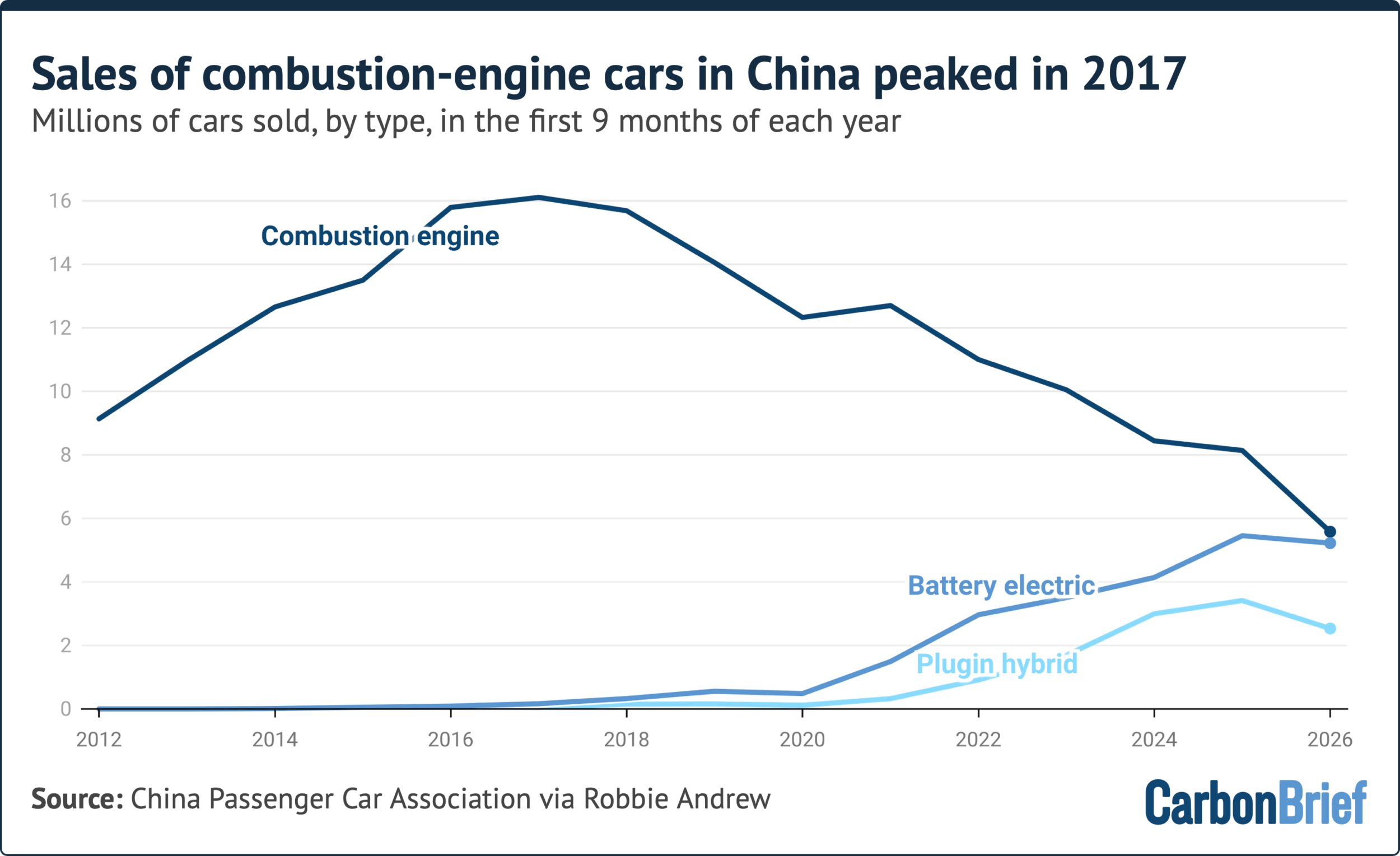
Indeed, sales of fuel-only cars were down 31% year-on-year in the first nine months of 2026, with plug-in hybrid sales down 26% – whereas battery EV sales were only down 4%.
One analyst tells Carbon Brief that China’s rapidly growing EV fleet has offset demand for 143m barrels of oil since the start of the Hormuz crisis.
Another says that the crisis is “reinforcing China’s electrification of road transport”.
Meanwhile, amid slowing domestic sales, Chinese carmakers’ exports of NEVs more than doubled [in 2026 to date / in September] from a year earlier.
NEV record
A record two out of every three cars sold in September in China were NEVs, according to CPCA data, as shown in the figure below.
(NEVs predominantly include battery electric vehicles – BEVs – and plug-in hybrids – PHEVs. BEVs only run on electricity, whereas PHEVs also have a combustion engine.)
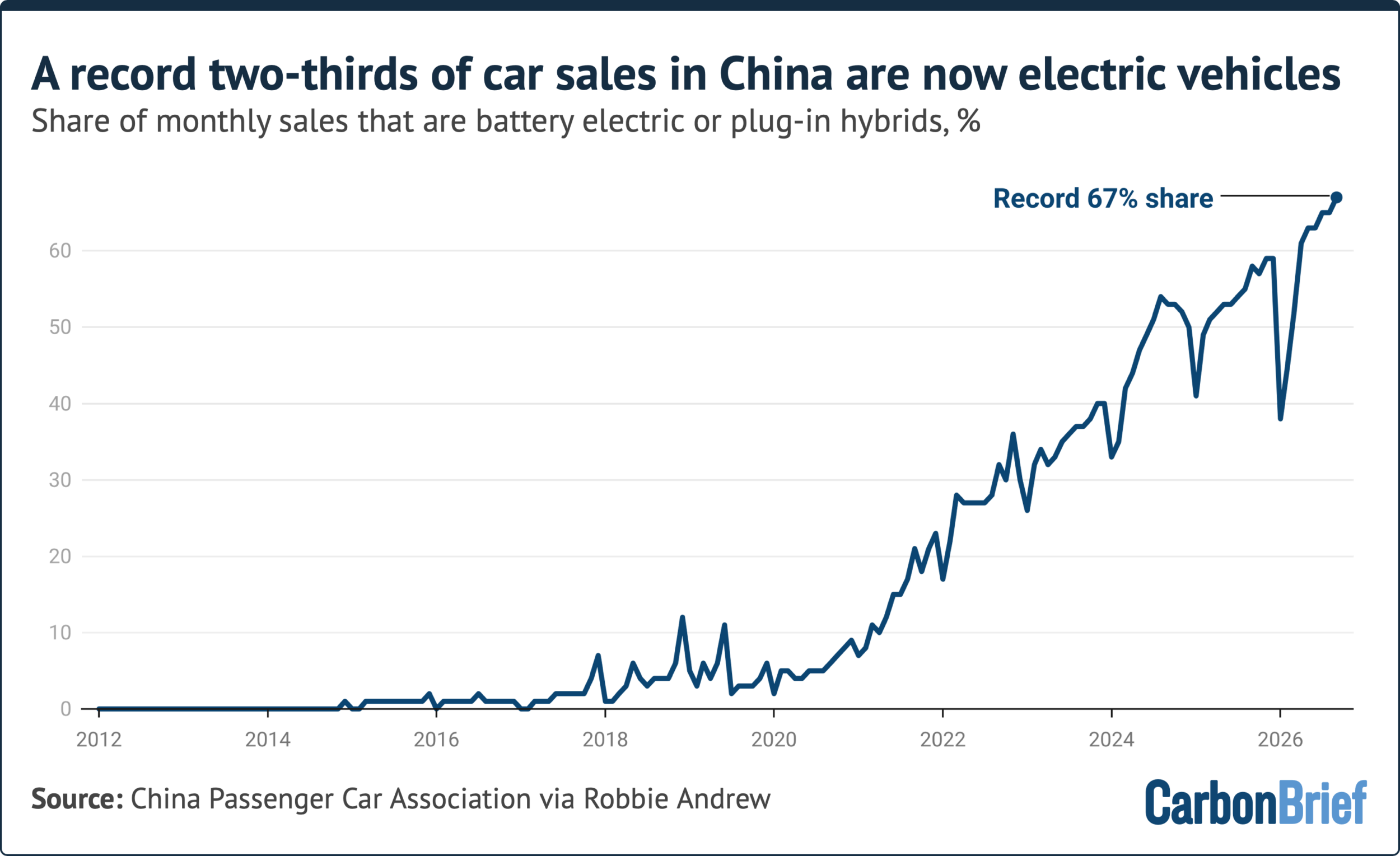
This marks a rapid rise for NEVs from just 6% of new car sales in 2020 up to 58% in 2026 to date – and a record 67% in the month of September.
This year, NEVs’ share of sales has also bounced back from a low of 39% in January, after the full purchase tax exemption that had been in place for more than a decade came to an end in December 2025.
The gain in NEV share in 2026 has come amid a slowdown across the wider domestic passenger-car market, which has hit sales of combustion-engine vehicles particularly hard.
This September, passenger-car retail sales across all categories declined, with overall sales volumes falling 28% year-on-year.
The contraction was led by combustion-engine vehicles, which saw sales fall 43% year-on-year in September and 31% in 2026 to date.
However, sales of PHEVs also fell by 36% year-on-year in September and by 26% in 2026 to date. By comparison, BEVs performed better, although sales still declined 8.5% from a year earlier in September and 4% in 2026 to date.
As a result, NEV sales overall fell by 17% in September and 13% in 2026 to date.
While the market changes in 2026 to date were particularly dramatic, they reflect a broad continuation of trends seen over the past decade.
Indeed, sales of combustion-engine cars in China peaked in 2017 and they have been declining ever since, shown in the figure below.
Impact of Hormuz
Part of the reason for the advance of NEVs in 2026, said Chinese technology news outlet OFweek, was petrol cars “giving up market share” as they were outperformed by electric alternatives.
Cui Dongshu, secretary-general of the CPCA, cited higher petrol prices as an explanation for September’s weak combustion-car sales, in comments to financial news outlet National Business Daily.
Imports of oil into China in January-September have fallen 15% compared to 2025, equivalent to 470m barrels, as ongoing conflict tightened supply and drove up prices.
China’s passenger-car NEV fleet has displaced 143m barrels of oil so far during the strait of Hormuz crisis, Euan Graham, senior energy analyst at thinktank Ember, tells Carbon Brief.
EVs “accounted for 12% of the decrease in China’s oil use post-Hormuz”, according to an estimate provided to thinktank the Brookings Institute by an unnamed analyst.