

Climate change, war and mismanagement are putting Iran’s water supply under major strain, experts have warned.
The Middle Eastern country has faced years of intense drought, which scientists have found was made more intense due to human-caused climate change.
In recent years, Iranian citizens have protested against the government’s management of water supplies, pointing the blame at decades of poor planning and shortsighted policies.
As water supplies run low, authorities warned last year that several of Iran’s major cities – including the capital, Tehran – could soon face “water day zero”, when a city’s water service is turned off and existing supplies rationed.
Meanwhile, recent air strikes on desalination plants in Iran and Bahrain are driving wider questions about how the war might exacerbate water insecurity across the Middle East.
One expert tells Carbon Brief the conflict is “straining an already-fragile [water] system” within Iran.
In this article, Carbon Brief looks at how conflict is combining with climate change and unsustainable use to place pressure on Iran’s water supplies.
- How close are Iran’s major cities to a ‘water day zero’?
- What role is climate change playing?
- What other factors are involved?
- How could attacks on desalination plants impact water supplies in the Middle East?
- What policies could help Iran avoid a ‘water day zero’?
How close are Iran’s major cities to a ‘water day zero’?
Iran is one of the most water-stressed countries in the world and is currently in the grips of an unprecedented, multi-year drought.
The country’s hot and dry climate means that freshwater is scarce. However, many Iranian citizens also blame decades of government mismanagement for the present-day water shortages.
In January, the Guardian explained that over multiple decades, Iranian officials abandoned the country’s “qanat aquifer system”, which consists of tens of thousands of tunnels dug into hillsides across the country that lead to underground water storage. This system has been “supplying [Iran’s] cities and agriculture with freshwater for millennia”, the newspaper said.
To replace the aquifer system, the government built dozens of dams over the second half of the 20th century, which together hold around a quarter of the country’s total water resource, according to the Guardian. However, it added:
“But by putting major dams on rivers too small to sustain them, the authorities brought short-term relief at the cost of longer-term water loss: evaporation from reservoirs increased while upland areas were deprived of water, now trapped behind the dams.”
Yale Environment 360 noted in December that “in the past half century, around half of Iran’s qanats have been rendered waterless through poor maintenance or as pumped wells have lowered water tables within hillsides”.
Agriculture is responsible for 90% of Iran’s water use. Over 2003-19, Iran lost around 211 cubic kilometres of groundwater – around twice the country’s annual water consumption – largely due to unregulated water pumping for farming.
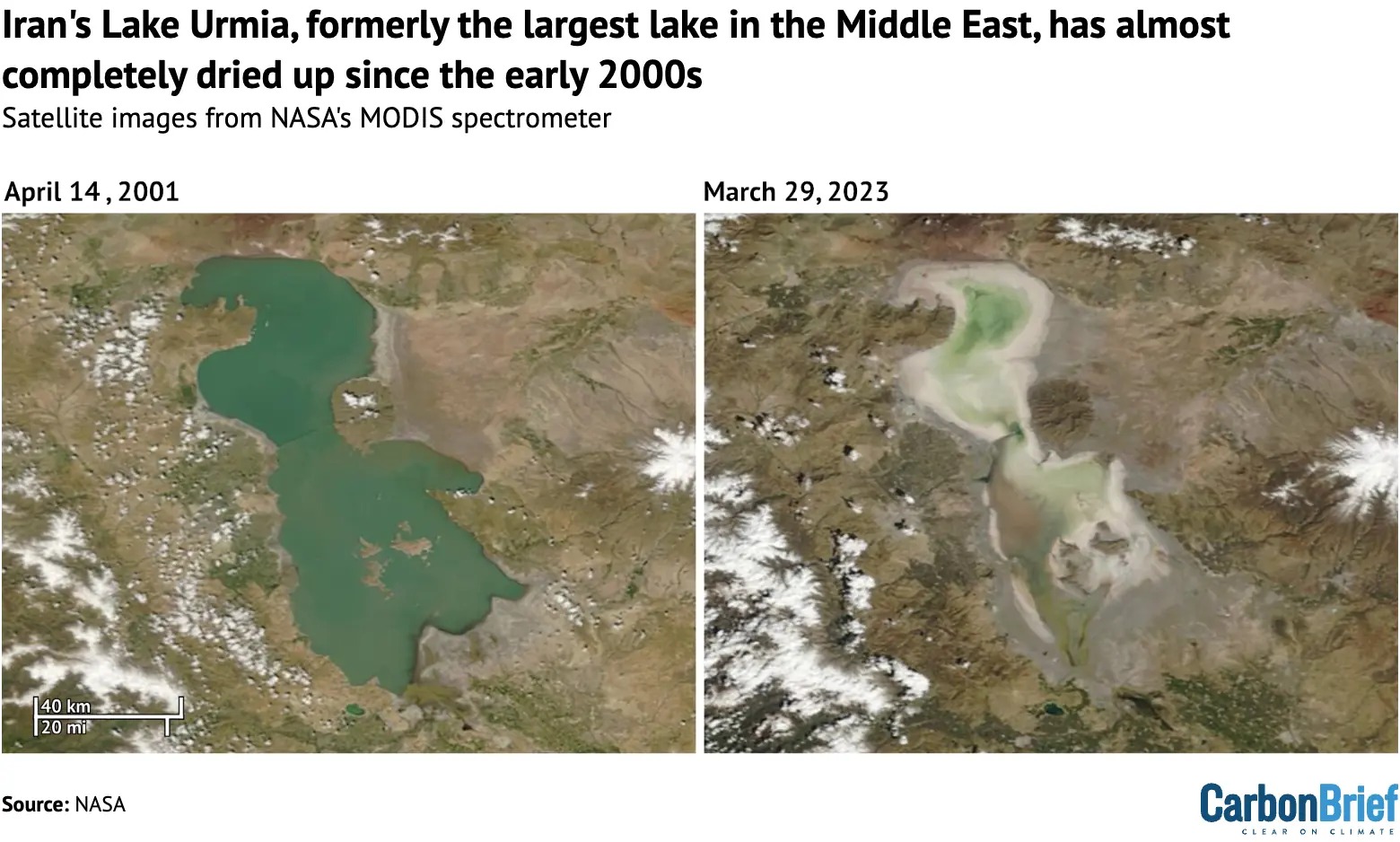
The images below show how Lake Urmia in the north-west of the country – once the largest lake in the Middle East – has almost completely dried up since 2001 as water that feeds that lake has been diverted.
Towards the end of 2025, Iran’s Meteorological Organisation warned that the main dams supplying drinking water to major cities, such as Tehran, Tabriz and Mashhad, were close to “water day zero”.
The term “water day zero” has been used by academics, media and governments to describe the moment when a city or region’s municipal water supply becomes so depleted that authorities have to turn off taps and implement water rationing. It has been used to describe water crises in Cape Town, South Africa and Chennai, India.
In a televised national address in November, Iranian president Masoud Pezeshkian reportedly said the government had “no other choice” but to relocate the capital due to “extreme pressure” on water, land and infrastructure systems.
(This came after the government announced in January it would relocate its capital to the southern coastal region of Makran, citing Tehran’s enduring overpopulation, power shortages and water scarcity.)
Tehran is home to 10 million people and consumes nearly a quarter of Iran’s water supplies.
The water shortages have fuelled nation-wide protests, which have been often-violently suppressed by the government.
Prof Kaveh Madani, former deputy vice-president of Iran and the director of the UN University Institute for Water, Environment and Health, tells Carbon Brief that recent rainfall means the threat of “water day zero” has subsided in Iran in recent months.
However, he stresses that a combination of climate change and “local human factors” mean “many, many places in Iran are in ‘water bankruptcy’ mode”.
“Water bankruptcy” is when water systems have been overused to the point they can no longer meet demand without causing irreversible damage to the environment, according to Madani’s own research.
What role is climate change playing?
Iran is currently facing its sixth year of consecutive drought conditions.
An update posted in November by the National Iranian American Council quoted Mohsen Ardakani – managing director of Tehran Water and Wastewater Company – as saying:
“We are entering our sixth consecutive drought year. Since the start of the 2025-26 water year (about a month ago), not a single drop of rain has fallen anywhere in the country.”
The country’s most recent “water year”, which ran from September 2024 to September 2025, was one of the driest on record. Over the 12-month period, the country recorded 81% less rainfall than the historical average.
Meanwhile, temperatures in Iran can soar above 50C in the hot season, pushing the limits of human survivability and exacerbating water loss through evaporations from reservoirs of water.
Multiple attribution studies have shown that climate change is making the country’s hot and dry conditions more intense and likely.
In 2023, the World Wealth Attribution service (WWA) carried out an analysis on the drought conditions in Iran over 2020-23.
This study investigated agricultural drought, which focuses on the difference between rainfall amounts and levels of evapotranspiration from soils and plants.
The study explored how often a drought of a similar intensity would have occurred in a world without warming and how often it could occur in the climate of 2023. The researchers found that the drought would have been a one-in-80 year event without global warming, but a one-in-five year event in 2023’s climate.
They added that if the planet continues to heat, reaching a warming level of 2C above pre-industrial temperatures, Iran could expect a drought of 2023’s severity, on average, every other year.
The graphic below illustrates these results, where a pink dot indicates the number of years in every 81 with an event like the 2020-23 drought over Iran.
The box on the left shows how often such a drought would be expected in a pre-industrial climate, in which there is no human-driven warming. The box in the centre shows 2023’s climate, which has warmed 1.2C as a result of human-caused climate change. The box on the right shows a world in which the climate is 2C warmer than in the pre-industrial period.

Two years later, WWA carried out another study on drought in Iran, this time focusing on the five-year drought over 2021-25. The authors found an “even stronger impact” of climate change than their previous analysis.
A range of other attribution studies for Iran over the past five years have concluded that climate change made heatwaves and droughts over the region more intense and likely.
Meanwhile, the World Meteorological Organization’s (WMO’s) “state of the climate in the Arab region 2024” report warned about the impact of climate change on water security across the region.
In a statement, WMO secretary general Prof Celeste Saulo warned that “droughts are becoming more frequent and severe in one of the world’s most water-stressed regions”.
What other factors are involved?
Climate change is not the only – or even the primary – driver of water scarcity in Iran.
Madani explains:
“We have both the human factors and the climatic factors…A lot of times, local human factors are much more important and significant than the global factors.”
For example, Madani says, the country has experienced large population growth, but its population is concentrated in “a very few large metropolitan” areas, meaning it can struggle to provide enough water to those places. He also points to inefficient agricultural practices and overreliance on technological solutions, including dams and desalination plants.
The vast majority of the country’s water stress comes from its agricultural sector, which accounts for more than 90% of Iran’s water use.
Dr Assem Mayar, an independent researcher focused on water resources and climate security, tells Carbon Brief that Iran’s arid climate means that it uses more water per unit area for cultivating crops than other countries. This issue is compounded by government policies promoting domestic agriculture, he says:
“[Iran’s] government tries to be self-reliant in [the] food sector, which consumes the most share of water in the country.”
Both of the country’s main water sources – surface water and groundwater – are overexploited, Mayar says.
A 2021 study on the drivers of groundwater depletion in Iran found that between 2002 and 2015, Iran’s aquifers were depleted by around 74 cubic kilometres – 1.6 times larger than the amount of water stored in Iran’s largest lake, Lake Urmia, at its highest recorded levels.
The study also found that some basins had experienced depletion rates of up to 2,600% in that timeframe.
Groundwater aquifers naturally “recharge” as water percolates down from the surface. However, a 2023 study also found that this rate of recharge has been declining since the early 2000s.
When groundwater or other resources are extracted from the ground in high quantities, the land above the aquifer can compact and the aquifers themselves can collapse, leading to “subsidence” as the land surface sinks. Iran is one of the countries with the largest subsidence rates in the world, according to a 2024 study.
In late 2025, BBC News reported that Iran had begun “cloud seeding” – injecting salt particles into clouds to promote condensation, in an effort to “combat the country’s worst drought in decades”.
The country has been employing the technique since 2008 and reports that rainfall increased by 15% in the targeted areas as a result.
However, this does little to address the root of the problem, experts tell Carbon Brief.
Prof Nima Shokri, director of the Institute of Geo-Hydroinformatics at Hamburg University of Technology, tells Carbon Brief:
“Iran’s water crisis stems primarily from decades of policy choices that prioritised ideological and geopolitical objectives over sustainable resource management. A costly foreign policy posture and prolonged international isolation have limited access to foreign investment, modern technology and diversified economic development.
“Domestically, this has translated into policies that encouraged groundwater-dependent agriculture, expanded irrigated land without enforceable extraction limits, maintained heavy energy and water subsidies and underinvested in wastewater reuse, leakage reduction and monitoring systems.”
How could attacks on desalination plants impact water supplies in the Middle East?
A pair of attacks on desalination plants has led to significant media speculation around how the conflict might exacerbate freshwater supplies, both in Iran and across the Middle East.
On Saturday 7 March, Iran accused the US of attacking a desalination plant on Qeshm Island in the Strait of Hormuz.
Describing the attack on the critical water infrastructure as “blatant and desperate crime”, foreign minister Seyed Abbas Araghchi said water supply in 30 villages had been impacted.
The next day, Bahrain government said Iran had caused “material damage” to one of its desalination plants during a drone attack.
David Michel, senior fellow for water security at the Centre for Strategic and International Studies, told the Daily Mail that attacks on water plants in Gulf states by Iran could be designed to “impose costs” that push them to intervene or call for the end of the war.
There has been a boom in desalination across the Middle East in recent decades, as water-scarce countries have turned to the technology – which transforms seawater into freshwater – to boost freshwater supplies.
Collectively, the Middle East accounts for roughly 40% of global desalinated water production, producing 29m cubic metres of water every day, according to a 2026 review. This is shown in the chart below.

Iran has more than 163 desalination plants. However, it is less reliant on these plants than smaller countries in the region with fewer water reserves.
In a 2022 policy paper, the Institut Français des Relations Internationales noted Kuwait, Qatar and Oman sourced 90%, 90% and 86% of drinking water from desalination plants, respectively.
In contrast, an official from Iran’s state-run water company told the Tehran Times in 2022 that just 3% of the country’s drinking water came from desalination plants. (Iran’s water supply is sourced primarily from groundwater and rivers and reservoirs.)
Shrokri says the ongoing conflict is “hitting water security” in Iran through “direct and indirect” attacks on critical infrastructure – including desalination plants, power stations and water networks. He adds:
“The conflict is straining an already fragile system inside Iran. The country entered the war with severe drought, depleted groundwater and shrinking reservoirs, so any disruption to energy systems, industrial facilities or supply chains can quickly cascade into water shortages.”
Shokri also highlights that attacks on desalination plants in the Gulf could have serious consequences for major cities – including Dubai, Doha and Abu Dhabi – “rely heavily” on desalinated seawater for drinking water. He says:
“Without desalination plants, large parts of the region’s modern urban system will struggle to exist. The ripple effects would extend far beyond drinking water. Sanitation systems would begin to fail, public health risks would rise and economic activity could slow dramatically.”
Experts have pointed out that attacks on electricity infrastructure could also impact provision of drinking water, given desalination plants are energy-intensive and often co-located with power plants.
Dr Raha Hakimdavar, a hydrologist at Georgetown University, told Al Jazeera that attacks on desalination plants could also impact domestic food production in the long-term, if groundwater is diverted away from agriculture and towards households.
What policies could help Iran avoid a ‘water day zero’?
Experts tell Carbon Brief that the conflict could make chronic water shortages in Iran more likely – even if hostilities are unlikely to directly force a “water day zero”.
Shokri says:
“The war could accelerate the timeline, but it didn’t create the risk of day zero. Iran’s water system was already under extreme pressure from long-term mismanagement and distorted policy priorities. Conflict simply reduces the margin for error.”
Mayar says the war is “unlikely to force day zero nationwide”, but could bring forward “localised day‑zero conditions in already stressed regions”. These effects could be felt most acutely in Iran’s islands and cities that are already “facing chronic shortages”, he continues.
Since agriculture is such a large contributor to the country’s water usage, potential solutions must focus on that sector, experts say.
Mayar says the government should “phase out subsidy policies that encourage overuse”.
In 2018, researchers at Stanford University released a “national adaptation plan for water scarcity in Iran”, as part of a programme looking at the country’s long-term sustainable development.
That report lays out two sets of adaptation actions: those that work to improve the efficiency of water use and those that end water-intensive activities. Among the specific actions recommended by the report are reusing treated wastewater, reducing irrigated farming and enhancing crop-growing productivity through technological solutions.
The adaptation report concludes:
“The underlying solution to address Iran’s water problem is obvious: consumption should be regulated and reduced, water productivity should be improved and wastewater should be treated and reused in the system.”
Meanwhile, Shokri argues that the “main obstacle” to water reform in Iran is not technical capacity, but “government-set national priorities”. He explains:
“Significant public resources are directed toward non-civil spending and external commitments, leaving limited room for sustained investment in water management and environment…Real progress will require shifting attention and resources toward water security, environmental protection and long-term economic resilience.”



The post Q&A: How climate change and war threaten Iran’s water supplies appeared first on Carbon Brief.
Q&A: How climate change and war threaten Iran’s water supplies

Climate Change
Australia’s climate credibility tested at Pacific Pre-COP talks, as High Court fossil fuel ruling puts government on notice
NADI, FIJI Thursday 8 October 2026 — As the Pacific Pre-COP talks wrap up and Australia prepares to take the reins of COP31 Negotiations in Türkiye next month, Greenpeace Australia Pacific says the government is on notice over fossil fuel expansion and exports, and must accelerate action to align with a 1.5°C pathway.
Following yesterday’s landmark High Court ruling that the climate impacts of coal and gas exports must be considered by New South Wales planning authorities, Greenpeace Australia Pacific is calling on the Albanese government to find the “courage, leadership and grit” to chart a new course away from fossil fuels.
High res images and video from yesterday’s ‘Keep 1.5C Alive’ flotilla in Nadi can be found here
Speaking from Nadi, Shiva Gounden, Head of Pacific at Greenpeace Australia Pacific, said:
“The outcomes of this week’s talks are a drop in the ocean given the scale of need, and urgency of the crisis our communities are facing. It is like taking a glass of water to a burning house if we do not urgently act to address the root cause of the existential threat facing Tuvalu, Fiji and all Pacific countries: fossil fuel expansion.
“The Electrification Pledge must end fossil fuel dependence, not be an end in itself — its ultimate success depends on ensuring electricity comes from renewable sources that displace fossil fuels and align with a 1.5°C pathway. It must be underpinned by justice and backed by finance flowing from polluters to communities.
“Limiting global warming to 1.5°C is a non-negotiable survival line for humanity and Australia must act. The landmark climate advisory ruling from the ICJ is clear — 1.5°C is the moral, the scientific and the legal limit. Continuing down the fossil fuel path, and failing to align efforts with limiting warming to 1.5°C, is a breach of our international legal obligations, and risks making Australia liable for future reparations from climate-vulnerable nations.”
Also in Nadi, Dr Simon Bradshaw, COP31 Lead and climate expert at Greenpeace Australia Pacific, said: “The Pacific was never going to be a mere backdrop for Australia in its role as incoming chair of the COP31 climate talks, but where its credibility and commitment to climate leadership would be tested.
“Here we see communities fighting for their survival and doing everything possible to hold the line on returning warming to 1.5°C. When governments profess to take their concerns seriously, only to then throw more fuel on the fire, the pain and sadness is visceral.
“This week the High Court of Australia recognised what the Federal Government refuses to — that Australia is responsible for the climate damage of our fossil fuel exports and if governments don’t act, the courts will intervene. The message is simple: this is not someone else’s problem, it is ours.
“We must now follow other countries in developing a national roadmap away from fossil fuels that ensures a managed wind-down of fossil fuel production, including exports, in line with our legal obligation to help return warming to 1.5°C.”
ENDS
Media contact: Kate O’Callaghan in Nadi on +61 406 231 892 (Whatsapp/Signal)
A Dutch NGO has filed the first climate complaint under the European Union’s trade rules, arguing that New Zealand violated the environmental provisions of its free trade agreement with the bloc by weakening its climate regulations.
The case will test whether binding climate provisions in the EU’s free trade deals can be enforced to hold governments accountable to their climate obligations, experts told Climate Home News.
The EU-New Zealand free trade agreement, which came into force in 2024, was the first in the world to include legally-binding climate provisions and possible sanctions for violating them, as the EU seeks to use its trade partnerships to advance greater environmental protection.
Under the deal, both parties committed not to weaken their environmental law to promote trade or investment and to “refrain from any action or omission that materially defeats the object and purpose of the Paris Agreement”.
-
International trade linked to 20% of global emissions – but imports ignored
Researchers say governments should discuss how to tackle emissions linked to globally traded goods and services, especially in large importing countries

At the time the agreement was signed, EU Commission President Ursula von der Leyen said the agreement included “unprecedented social and climate commitments”. But experts warned it was unclear how the Paris Agreement provisions would be enforced.
The EU included a similar “trade and sustainable development” clause in 14 other bilateral trade deals in recent years, with several others, including with China, awaiting ratification or being negotiated.
Climate activists at the Dutch NGO Both ENDS argue that the New Zealand government breached these terms by reopening its waters to offshore oil and gas exploration, releasing a climate plan that barely requires any emissions reductions, and passing a law that prevents corporations from getting sued over climate damages.
“Here, we have a so-called gold standard for free trade agreements with sustainability provisions but we have a trading partner that is doing exactly the opposite: regressing, as all the evidence points to, away from the Paris Agreement,” said Marius Troost, a senior policy advisor at Both ENDS.
Can the EU enforce its climate trading rules?
The Dutch environmental group filed the complaint under the EU Commission’s Single Entry Point, a mechanism that allows civil society to request enforcement of the bloc’s trade commitments.
The EU-New Zealand trade deal includes the possibility of suspending beneficial trading arrangements between the two parties in response to serious violations