Welcome to Carbon Brief’s DeBriefed.
An essential guide to the week’s key developments relating to climate change.
This week
Renewables overtake coal
‘HISTORIC FIRST’: Renewables have overtaken coal to become the world’s leading source of electricity for the first six months of this year in a “historic first”, BBC News said. The analysis, from the thinktank Ember, found the world generated “almost a third” more solar power in the first half of the year, compared with the same period in 2024, while wind power grew by “just over 7%,” reported the Guardian.
HEAVY LIFTING: According to the report, China and India were “largely responsible for the surge in renewables”, while the US and Europe “relied more heavily on fossil fuels,” the Guardian wrote. China built more renewables than every other country combined in the first half of this year, the newspaper added.
CONTINENTAL SHIFTS: A second report from the International Energy Agency (IEA) predicted a “surge” in global wind and solar capacity by 2030, but shaved 5% off its previous forecast, the Financial Times said. The IEA revealed that India is set to become the second-largest growth market for renewables after China, “with capacity expected to increase 2.5 times by 2030”, Down to Earth reported. The IEA also upped its forecast for renewables in the Middle East and north Africa by 23%, “helped by Saudi Arabia rolling out wind turbines and solar panels”, but halved the outlook for the US, the FT noted.
Around the world
- EV BOOM: Sales of electric and hybrid cars made up “more than half” of all new car registrations in the UK last month, a new record, according to data from the Society of Motor Manufacturers, reported BBC News.
- BANKING COLLAPSE: A global banking alliance launched by the UN to get banks to slash the carbon footprint of their loans and investments and help drive the transition to a net-zero economy by 2050 has collapsed after four years, Agence France-Press reported.
- CUTS, CUTS, CUTS: The Trump administration plans to cut nearly $24bn in funding for more than 600 climate projects across the US, according to documents reviewed by the Wall Street Journal.
- PEOPLE POWER: A farmer, a prison guard and a teacher were among those from the Dutch-Caribbean island Bonaire who appeared at the Hague on Tuesday to “accuse the Netherlands of not doing enough to protect them from the effects of climate change”, Politico reported.
400,000
The number of annual service days logged by the US National Guard responding to hurricanes, wildfires and other natural disasters over the past decade, according to a Pentagon report to Congress, Inside Climate News reported.
Latest climate research
- Politicians in the UK “overwhelmingly overestimate the time period humanity has left to bend the temperature curve”, according to a survey of 100 MPs | Nature Communications Earth and Environment
- Fire-driven degradation of the Amazon last year released nearly 800m tonnes of CO2 equivalent, surpassing emissions from deforestation and marking the “worst Amazon forest disturbance in over two decades” | Biogeosciences
- Some 43% of the 200 most damaging wildfires recorded over 1980-2023 occurred in the last decade | Science
(For more, see Carbon Brief’s in-depth daily summaries of the top climate news stories on Monday, Tuesday, Wednesday, Thursday and Friday.)
Captured
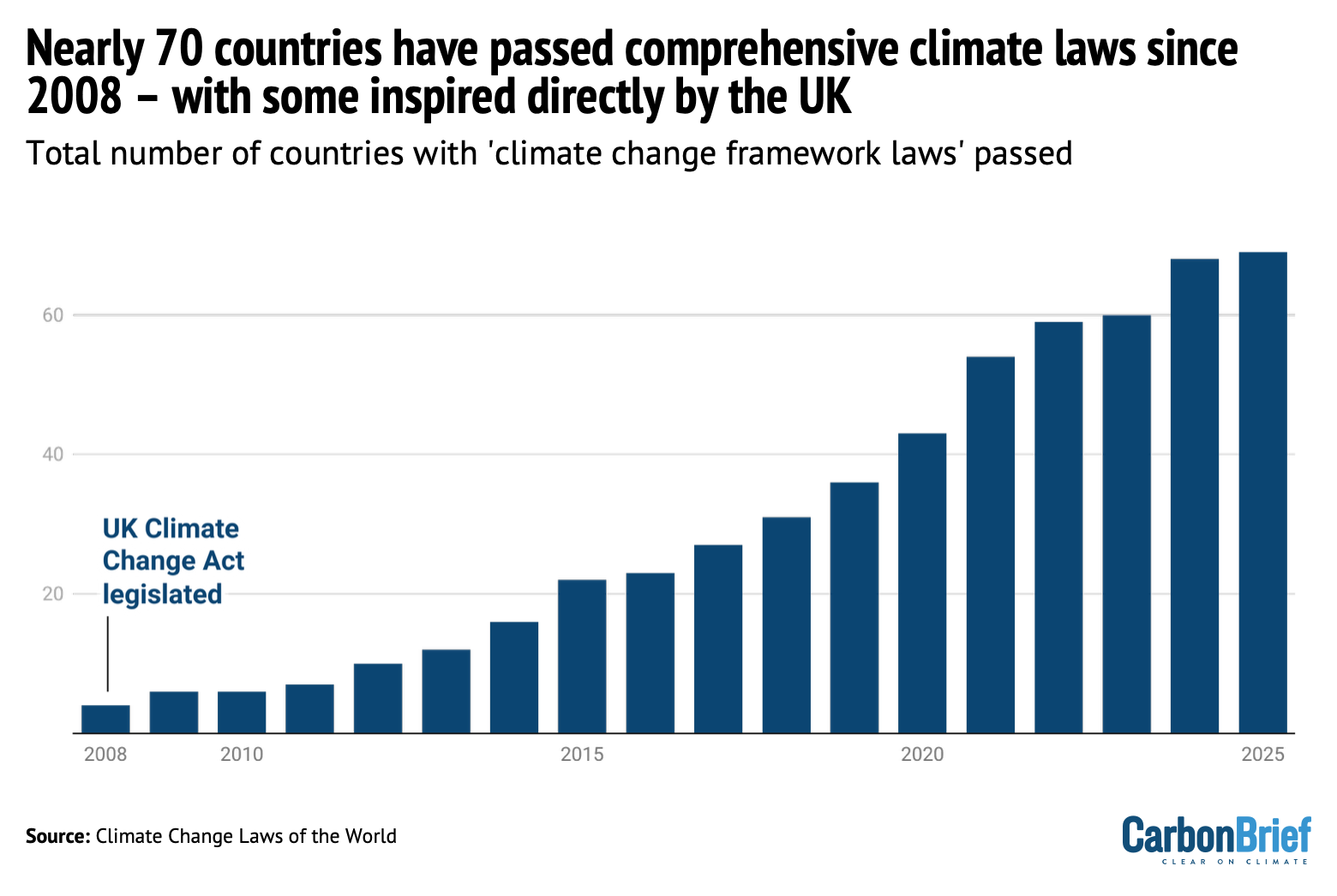
The UK’s Climate Change Act, landmark legislation that guides the nation’s response to climate change, is increasingly coming under attack from anti-net-zero right-leaning politicians. In a factcheck published this week, Carbon Brief explained how the UK’s Climate Change Act was among the first comprehensive national climate laws in the world and the first to include legally binding emissions targets. In total, 69 countries have now passed “framework” climate laws similar to the UK’s Climate Change Act, with laws in New Zealand, Canada and Nigeria among those explicitly based on the UK model. This is up from just four when the act was legislated in 2008. Of these, 14 are explicitly titled the “Climate Change Act”.
Spotlight
Fukushima’s solar future
This week, Carbon Brief examines how Fukushima helped to recover from nuclear disaster by building solar farms on contaminated farmland.
On 11 March 2011, an earthquake off the pacific coast of Japan caused 15m-tall waves to crash into the eastern region of Tōhoku, killing 19,500 people and injuring a further 6,000.
In the aftermath, flooding at the Fukushima Daichi nuclear power plant caused cooling systems to fail, leaching radioactive contaminants into the soil and leading to a major nuclear incident.
Some 1,200km2 around the site was restricted and up to 100,000 people were evacuated – in some cases forever.
In the years following, Japan entered a fraught debate about nuclear energy.
In 2010, nuclear power provided 25% of Japan’s electricity, but, in the years following the disaster, its 54 nuclear reactors were taken offline.
Successive governments have fought over reintroducing nuclear power. Today, some 14 reactors are back online, 27 have been permanently closed and another 19 remain suspended. (Japan’s newly-elected prime minister Sanae Takaichi has promised to make nuclear central to her energy strategy.)
Against this backdrop, Fukushima – a prefecture home to 1.8 million people – has emerged as a surprise leader in the renewables race.
In 2014, the Fukushima Renewable Energy Institute (FREA) opened with the twin goals of promoting research and development into renewable energy, while “making a contribution to industrial clusters and reconstruction”.
That same year, the prefecture declared a target of 100% renewable power by 2040.
Contaminated land
“A lot of these communities, I know, were looking for ways to revitalise their economy,” said Dr Jennifer Sklarew, assistant professor of energy and sustainability at George Mason University and author of “Building Resilient Energy Systems: Lessons from Japan”.
Once evacuation orders were lifted, however, residents in many parts of Fukushima were faced with a dilemma, explained Skarlew:
“Since that area was largely agricultural, and the agriculture was facing challenges due to stigma, and also due to the soil being removed [as part of the decontamination efforts], they had to find something else.”
One solution came in the form of rent, paid to farmers by companies, to use their land as solar farms.
Michiyo Miyamoto, energy finance specialist at the Institute for Energy Economics and Financial Analysis, told Carbon Brief:
“The [Fukushima] prefecture mapped suitable sites early and conducted systematic consultations with residents and agricultural groups before projects were proposed. This upfront process reduced land-use conflicts, shortened permitting timelines and gave developers clarity.”
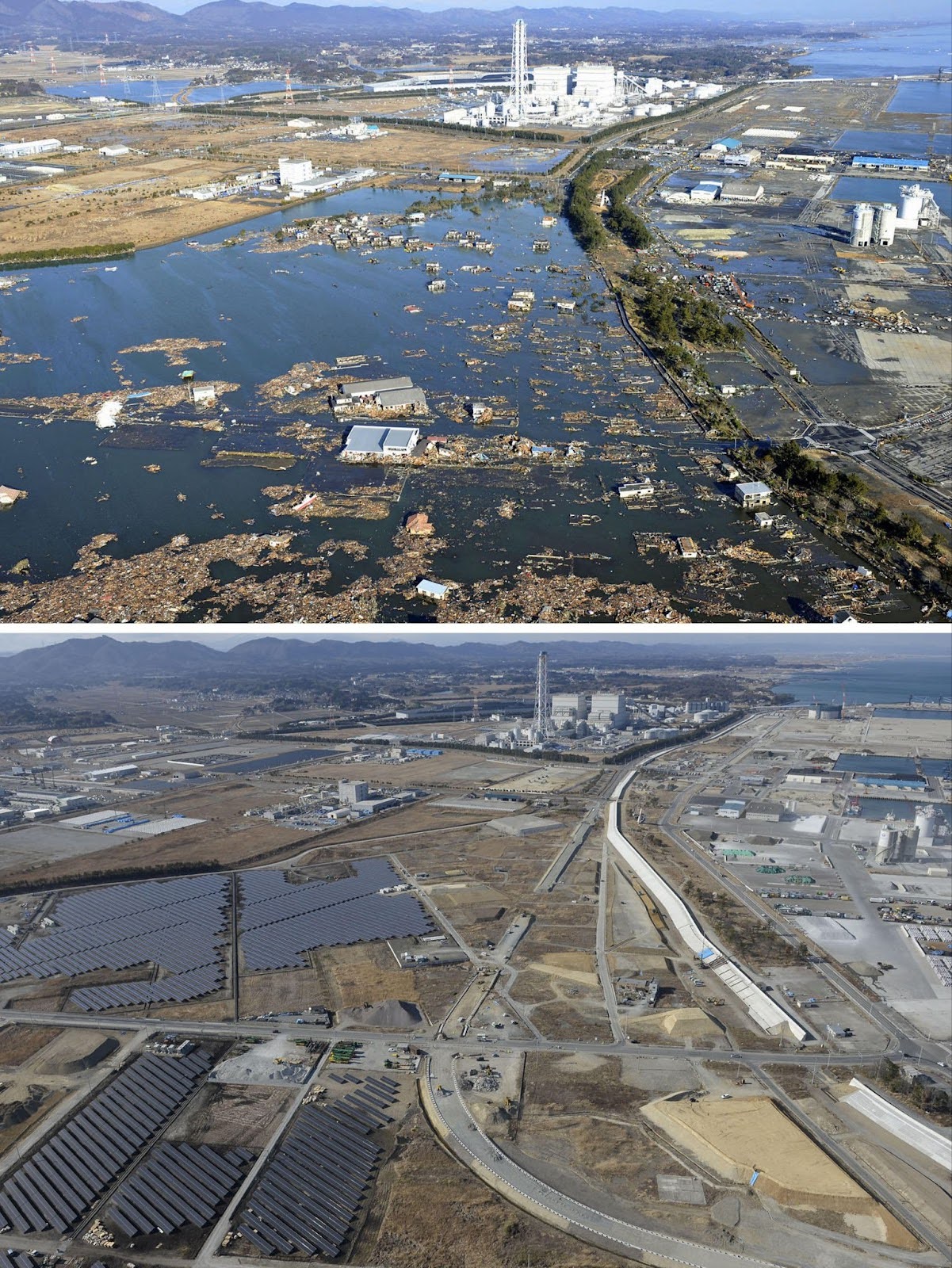
As a result, large-scale solar capacity in Fukushima increased to more than 1,300 megawatts (MW) from 2012 to 2023, according to Miyamoto. Moreover, installed renewable capacity now exceeds local demand, meaning the region can run entirely on clean power when conditions are favourable, Miyamoto said.
Today, aerial pictures of Fukushima reveal how solar panels have proliferated on farmland that was contaminated in the nuclear disaster.
Charging on
Last year, 60% of Fukushima’s electricity was met by renewables, up from 22% in 2011. (The country as a whole still lags behind at 27%.)
And that is set to grow after Japan’s largest onshore windfarm started operations earlier this year in Abukuma, Fukushima, with a capacity of 147MW.
The growth of solar and wind means that Fukushima is already “ahead of schedule” for its 2040 target of 100% renewable power, said Miyamoto:
“The result is a credible pathway from recovery to leadership, with policy, infrastructure and targets working in concert.”
Watch, read, listen
OVERSHOOT: The Strategic Climate Risks Initiative, in partnership with Planet B Productions, has released a four-part podcast series exploring what will happen if global warming exceeds 1.5C.
DRONE WARFARE: On Substack, veteran climate campaigner and author Bill McKibben considered the resilience of solar power amid modern warfare.
CLIMATE AND EMPIRE: For Black history month, the Energy Revolution podcast looked at how “race and the legacies of empire continue to impact the energy transition”.
Coming up
- 12 October: presidential elections, Cameroon
- 13-14 October: Pre-COP, Brasilia, Brazil
- 13-18 October: World Bank Group/IMF annual meetings, Washington DC
- 14-17 October: 2nd extraordinary session of the Marine Environment Protection Committee at the International Maritime Organisation, London
- 15-16 October: Circle of Finance Ministers report
Pick of the jobs
- Buckinghamshire Council, principal climate change officer | Salary: £49,354-£51,759. Location: Aylesbury, Buckinghamshire
- Sustainable NI, sustainable business lead | Salary: £60,000. Location: Belfast, Northern Ireland
- Dialogue Earth, South Asia managing editor | Salary: £1,875 per month. Location: South Asia
DeBriefed is edited by Daisy Dunne. Please send any tips or feedback to debriefed@carbonbrief.org.
This is an online version of Carbon Brief’s weekly DeBriefed email newsletter. Subscribe for free here.

The post DeBriefed 10 October 2025: Renewables power past coal; Legacy of UK’s Climate Change Act; Fukushima’s solar future appeared first on Carbon Brief.
Climate Change
“Sustainable fuels” pose high risks to Lula’s promised roadmap away from fossil fuels
President Lula opened COP30 with his boldest call yet for climate action and a clean-energy future. In his address, the Brazilian President declared that the world must “accelerate the energy transition” and “get rid of fossil fuels.” What drew the loudest applause from climate and energy experts in Belém, however, were his calls for COP30 to deliver tangible roadmaps to “overcome dependence on fossil fuels,” “reverse deforestation,” and secure equitable climate finance in a “fair and planned manner.”
Yet the day after, Lula’s promotion of so-called “sustainable fuels” cast a shadow of concern. A Roadmap away from oil, gas and coal will only succeed if negotiators and the Brazilian presidency resist the dangerous distractions of biofuels and other false solutions and stay focused on the transition from fossil fuels to renewable energy.
The rationale for a roadmap
The case for a global roadmap could not be clearer. The latest round of national climate targets falls dramatically short of the Paris Agreement’s ambition. If the race to decarbonisation at the pace required to limit warming to 1.5°C were a 42-kilometre marathon, by 2035 we should have already covered half the distance. Instead, current pledges take us barely two kilometres forward.
As Nationally Determined Contributions (NDCs) miss the mark, they must become the floor, not the ceiling, of global ambition. A roadmap – if not hijacked as a Trojan horse for false solutions like “sustainable fuels” – could help accelerate the phase out of fossil fuels, the source of nearly three quarters of global emissions. Clearly, a roadmap on its own will not solve these challenges, but it can be a critical step further.
What a roadmap could entail and what’s the process for it?
A full roadmap may not be finalized at COP30, but the mandate to begin accelerating the transition away from fossil fuels could well emerge in Belém – whether through a declaration, the UAE Dialogue, a new agenda item, or an omnibus decision.
To give such an outcome real weight, it should be formally anchored under the CMA and Paris Agreement, not left as an optional declaration. This would transform it into a stronger, coordinated Mutirão, a collective effort embedded within a broader ministerial dialogue on the transition away from fossil fuels.
Such a process should explore transition scenarios and produce global pathways aligned with International Energy Agency (IEA) and Intergovernmental Panel on Climate Change (IPCC) benchmarks, providing structured guidance ahead of the next Global Stocktake, with milestones for 2035 and 2040 and links to long term strategies.
It could also involve developing country-tailored roadmaps that identify enabling conditions, barriers, cooperation mechanisms, and international support needs, consistent with national capacities and equity. Such a process should include a political segment, bringing together ministers and high-level representatives to assess progress and report to COP31 with concrete recommendations for adoption.
Lula’s ‘Sustainable Fuels’ Mirage
On the second day of the Leaders Summit, President Lula, leader of the world’s second-largest biofuels producer, after the United States again spoke of a roadmap to ‘end dependency on fossil fuels’. But this time, he tried to slip in a twist: positioning “sustainable fuels” as a third pillar of the energy transition, alongside renewables and efficiency, and even launching a pledge to quadruple their production. It’s hard not to suspect that Brazil envisions the roadmap as a vehicle to advance its biofuels agenda.
That would be a serious mistake. Ironically, this proposal came alongside Lula’s call for a roadmap to halt deforestation. Yet, biofuels remain a leading driver of forest loss. If both roadmaps emerge from COP30, they must be interlinked to ensure one doesn’t undermine the other. Emission savings from biofuels are wildly overstated; some studies even find they emit more than the fossil fuels they replace. And let’s be honest: it’s impossible to imagine a world that quadruples “sustainable fuels” without devastating consequences for food security.
The pledge to quadruple so-called “sustainable fuels” rests on more shaky ground than one might realize: It conveniently draws from a recent IEA study “prepared in support of Brazil’s COP30 Presidency”. But this study refers to the IEA scenario of an “accelerated case”, which assumes existing policies are implemented, not that these policies align with net-zero pathways or the goals of the Paris Agreement. In fact, this pledge risks slowing down electrification across multiple sectors, contradicting what the IEA itself identifies as essential for a credible net-zero pathway.
Not another COP-out: We must rewrite the rules of the UN climate talks
If COP30 succeeds in establishing a roadmap – and it should – as part of the broader response to the global climate ambition gap, it must not be hijacked by Brazil’s biofuels agenda. Other countries should push back – or at the very least, insist on strong safeguards.
The lack of support speaks for itself: beyond Brazil, only 18 others have backed the pledge, hardly a groundswell compared to the 133 nations that endorsed the tripling renewables target at COP28. What’s more, countries such as Japan and Italy appear to be backing this pledge not to advance decarbonization, but to justify extending the life of combustion-engine vehicles and even coal plants through co-firing under the guise of biofuels.
Brazil’s biofuels push is not a breakthrough. It’s a dangerous distraction. A roadmap for a fast, fair and funded energy transition is urgently needed but it must be science-aligned, electrification-focused, and firmly aimed at phasing out fossil fuels, not replacing one problem with another.
The post “Sustainable fuels” pose high risks to Lula’s promised roadmap away from fossil fuels appeared first on Climate Home News.
“Sustainable fuels” pose high risks to Lula’s promised roadmap away from fossil fuels
Climate Change
Bad COP to good COP: Blocking fossil-fueled disinformation in Belém and beyond
Kate Cell is senior climate campaign manager at the Union of Concerned Scientists (UCS) and a Climate Action Against Disinformation steering committee member and Kathy Mulvey is corporate accountability campaign director at UCS
For years, fossil fuel lobbyists have swarmed the international climate summits outnumbering most national delegations and drowning out the voices of climate-vulnerable nations. Their mission is clear: derail progress, spread disinformation, and dodge accountability for fueling the climate crisis.
This overwhelming influence raises urgent questions – how do we prevent industry obstruction of science-based policy, and what would a climate summit look like if fossil fuel interests were finally shut out?
Climate policy must be guided by science, evidence, and justice – not fossil fuel industry influence. Yet the industry relies on disinformation to undermine science and delay action. This tactic is neither new nor surprising: for decades, fossil fuel companies have funded climate denial, obstructed progress, and profited from confusion.
At the Union of Concerned Scientists, our team’s latest report documents the ongoing role of Big Oil corporations as key drivers and beneficiaries of climate disinformation.
Tools now exist to confront this threat. The Climate Action Against Disinformation coalition seeks to classify climate disinformation as a serious risk under laws regulating search engines and social media. Meanwhile, advocates pursue litigation against fossil fuel companies for “greenwashing,” exposing misleading ads that conceal their role in driving the crisis and holding them accountable.
An international commitment to information integrity (accurate, consistent and reliable information) at COP30 can help remove barriers to strong national climate solutions.
This week, a coalition of civil society groups, local leaders, businesses, and individuals is urging participants to “UNEQUIVOCALLY RECOGNIZE that upholding information integrity on climate change is a prerequisite for effective climate action, democratic principles, public health, and human rights.”
Acknowledging both the importance of information integrity and the dangers of disinformation is vital to advancing robust, verifiable measures that curb greenwashing and manipulative content undermining climate progress.
Limiting the influence of fossil fuel companies
CEOs and lobbyists from BP, Chevron, ExxonMobil, Shell, and others should not shape climate goals or clean energy plans; the fossil fuel industry has an irreconcilable conflict of interest with policies to curb climate change and advance renewable energy.
Yet, year after year, their representatives flood international negotiations, undermining progress and protecting profits while obstructing the urgent transition away from fossil fuels toward a sustainable, science-based future.
2023 marked the first COP where delegates were required to disclose affiliations with fossil fuel companies. These disclosures exposed the thousands of lobbyists granted access to negotiations. New research from the Kick Big Polluters Out coalition found that over the last four years, 5,350 oil, gas, and coal lobbyists were given access to COPs. At last year’s summit in Azerbaijan alone, 1,773 fossil fuel lobbyists registered—70% more than the combined 1,033 delegates from the ten mostclimate vulnerable nations.
This staggering imbalance reveals how polluters dominate climate talks and weaken policy. Amid this lobbying blitz, nations’ fossil fuel production plans are set to double what’s compatible with a 1.5°C pathway by 2030. Major fossil fuel corporations continue to prioritise profits over people and planet. Research shows the 250 largest oil and gas companies invest almost nothing in clean energy compared to their vast fossil fuel extraction, disregarding climate goals; and their role in deepening the crisis.
COP30 PR firm found to be “uniquely reliant” on fossil fuel clients
Requiring delegates to disclose affiliations and funding is a vital step in exposing fossil fuel influence. Yet with the 1.5°C target slipping away, disclosure alone is insufficient. World leaders must advance to disqualification, barring fossil fuel companies from shaping COP negotiations. Future COP hosts must also refuse to retain PR firms tied to fossil fuel companies. This blatant conflict of interest shields industry culpability, distorts public understanding of the demand for climate action, and undermines trust in global climate negotiations.
A summit free from such conflicts of interest would empower nations most affected by extreme heat, rising seas, and other escalating climate impacts, ensuring their voices are not drowned out by lobbyists and spin doctors for the very industry primarily driving destructive, deadly climate change.
Advancing accountability at COP30
The challenge extends beyond the fossil fuel industry. Big Tech’s richest leaders are actively fueling climate denial, deception, and delay when they amplify lies to increase ad revenue—just like fossil fuel corporations and their trade groups. COP30 must confront this corruption head-on: advancing bold policies to hasten a just transition away from fossil fuels, protect a truthful information ecosystem, and hold corporate actors accountable for the lies they spread and the deadly damage they inflict on our planet.
By resisting disinformation and other fossil fuel industry influence at COP30, world leaders can propel a people-centered transition toward a clean energy future grounded in rights, fairness, equity, and solidarity. A summit safeguarded against conflicts of interest would finally prioritize those most affected by the climate crisis, ensuring that science, justice, and integrity—not corporate deception—guide the path forward.
The post Bad COP to good COP: Blocking fossil-fueled disinformation in Belém and beyond appeared first on Climate Home News.
https://www.climatechangenews.com/2025/11/12/bad-cop-to-good-cop-blocking-fossil-fueled-disinformation-in-belem-and-beyond/
Climate Change
IEA: Fossil-fuel use will peak before 2030 – unless ‘stated policies’ are abandoned
The world’s fossil-fuel use is still on track to peak before 2030, despite a surge in political support for coal, oil and gas, according to data from the International Energy Agency (IEA).
The IEA’s latest World Energy Outlook 2025, published during the opening days of the COP30 climate summit in Brazil, shows coal at or close to a peak, with oil set to follow around 2030 and gas by 2035, based on the stated policy intentions of the world’s governments.
Under the same assumptions, the IEA says that clean-energy use will surge, as nuclear power rises 39% by 2035, solar by 344% and wind by 178%.
Still, the outlook has some notable shifts since last year, with coal use revised up by around 6% in the near term, oil seeing a shallower post-peak decline and gas plateauing at higher levels.
This means that the IEA expects global warming to reach 2.5C this century if “stated policies” are implemented as planned, up marginally from 2.4C in last year’s outlook.
In addition, after pressure from the Trump administration in the US, the IEA has resurrected its “current policies scenario”, which – effectively – assumes that governments around the world abandon their stated intentions and only policies already set in legislation are continued.
If this were to happen, the IEA warns, global warming would reach 2.9C by 2100, as oil and gas demand would continue to rise and the decline in coal use would proceed at a slower rate.
This year’s outlook also includes a pathway that limits warming to 1.5C in 2100, but says that this would only be possible after a period of “overshoot”, where temperature rise peaks at 1.65C.
The IEA will publish its “announced pledges scenario” at a later date, to illustrate the impact of new national climate pledges being implemented on time and in full.
(See Carbon Brief’s coverage of previous IEA world energy outlooks from 2024, 2023, 2022, 2021, 2020, 2019, 2018, 2017, 2016 and 2015.)
World energy outlook
The IEA’s annual World Energy Outlook (WEO) is published every autumn. It is regarded as one of the most influential annual contributions to the understanding of energy and emissions trends.
The outlook explores a range of scenarios, representing different possible futures for the global energy system. These are developed using the IEA’s “global energy and climate model”.
The latest report stresses that “none of [these scenarios] should be regarded as a forecast”.
However, this year’s outlook marks a major shift in emphasis between the scenarios – and it reintroduces a pathway where oil and gas demand continues to rise for many decades.
This pathway is named the “current policies scenario” (CPS), which assumes that governments abandon their planned policies, leaving only those that are already set in legislation.
If the world followed this path, then global temperatures would reach 2.9C above pre-industrial levels by 2100 and would be “set to keep rising from there”, the IEA says.
The CPS was part of the annual outlook until 2020, when the IEA said that it was “difficult to imagine” such a pathway “prevailing in today’s circumstances”.
It has been resurrected following heavy pressure from the US, which is a major funder of the IEA that accounts for 14% of the agency’s budget.
For example, in July Politico reported “a ratcheted-up US pressure campaign” and “months of public frustrations with the IEA from top Trump administration officials”. It noted:
“Some Republicans say the IEA has discouraged investment in fossil fuels by publishing analyses that show near-term peaks in global demand for oil and gas.”
The CPS is the first scenario to be discussed in detail in the report, appearing in chapter three. The CPS similarly appears first in Annex A, the data tables for the report.
The second scenario is the “stated policies scenario” (STEPS), featured in chapter four of this year’s outlook. Here, the outlook also includes policies that governments say they intend to bring forward and that the IEA judges as likely to be implemented in practice.
In this world, global warming would reach 2.5C by 2100 – up marginally from the 2.4C expected in the 2024 edition of the outlook.
Beyond the STEPS and the CPS, the outlook includes two further scenarios.
One is the “net-zero emissions by 2050” (NZE) scenario, which illustrates how the world’s energy system would need to change in order to limit warming in 2100 to 1.5C.
The NZE was first floated in the 2020 edition of the report and was then formally featured in 2021.
The report notes that, unlike in previous editions, this scenario would see warming peak at more than 1.6C above pre-industrial temperatures, before returning to 1.5C by the end of the century.
This means it would include a high level of temporary “overshoot” of the 1.5C target. The IEA explains that this results from the “reality of persistently high emissions in recent years”. It adds:
“In addition to very rapid progress with the transformation of the energy sector, bringing the temperature rise back down below 1.5C by 2100 also requires widespread deployment of CO2 removal technologies that are currently unproven at large scale.”
Finally, the outlook includes a new scenario where everyone in the world is able to gain access to electricity by 2035 and to clean cooking by 2040, named “ACCESS”.
While the STEPS appears second in the running order of the report, it is mentioned slightly more frequently than the CPS, as shown in the figure below. The CPS is a close second, however, whereas the IEA’s 1.5C pathway (NZE) receives a declining level of attention.

US critics of the IEA have presented its stated policies scenario as “disconnected from reality”, in contrast to what they describe as the “likely scenario” of “business as usual”.
Yet the current policies scenario is far from a “business-as-usual” pathway. The IEA says this explicitly in an article published ahead of the outlook:
“The CPS might seem like a ‘business-as-usual’ scenario, but this terminology can be misleading in an energy system where new technologies are already being deployed at scale, underpinned by robust economics and mature, existing policy frameworks. In these areas, ‘business as usual’ would imply continuing the current process of change and, in some cases, accelerating it.”
In order to create the current policies scenario, where oil and gas use continues to surge into the future, the IEA therefore has to make more pessimistic assumptions about barriers to the uptake of new technologies and about the willingness of governments to row back on their plans. It says:
“The CPS…builds on a narrow reading of today’s policy settings…assuming no change, even where governments have indicated their intention to do so.”
This is not a scenario of “business as usual”. Instead, it is a scenario where countries around the world follow US president Donald Trump in dismantling their plans to shift away from fossil fuels.
More specifically, the current policies scenario assumes that countries around the world renege on their policy commitments and fail to honour their climate pledges.
For example, it assumes that Japan and South Korea fail to implement their latest national electricity plans, that China fails to continue its power-market reforms and abandons its provincial targets for clean power, that EU countries fail to meet their coal phase-out pledges and that US states such as California fail to extend their clean-energy targets.
Similarly, it assumes that Brazil, Turkey and India fail to implement their greenhouse gas emissions trading schemes (ETS) as planned and that China fails to expand its ETS to other industries.
The scenario also assumes that the EU, China, India, Australia, Japan and many others fail to extend or continue strengthening regulations on the energy efficiency of buildings and appliances, as well as those relating to the fuel-economy standards for new vehicles.
In contrast to the portrayal of the stated policies scenario as blindly assuming that all pledges will be met, the IEA notes that it does not give a free pass to aspirational targets. It says:
“[T]argets are not automatically assumed to be met; the prospects and timing for their realisation are subject to an assessment of relevant market, infrastructure and financial constraints…[L]ike the CPS, the STEPS does not assume that aspirational goals, such as those included in the Paris Agreement, are achieved.”
Only in the “announced pledges scenario” (APS) does the IEA assume that countries meet all of their climate pledges on time and full – regardless of how credible they are.
The APS does not appear in this year’s report, presumably because many countries missed the deadlines to publish new climate pledges ahead of COP30.
The IEA says it will publish its APS, assessing the impact of the new pledges, “once there is a more complete picture of these commitments”.
Fossil-fuel peak
In recent years, there has been a significant shift in the IEA’s outlook for fossil fuels under the stated policies scenario, which it has described as “a mirror to the plans of today’s policymakers”.
In 2020, the agency said that prevailing policy conditions pointed towards a “structural” decline in global coal demand, but that it was too soon to declare a peak in oil or gas demand.
By 2021, it said global fossil-fuel use could peak as soon as 2025, but only if all countries got on track to meet their climate goals. Under stated policies, it expected fossil-fuel use to hit a plateau from the late 2020s onwards, declining only marginally by 2050.
There was a dramatic change in 2022, when it said that Russia’s invasion of Ukraine and the resulting global energy crisis had “turbo-charged” the shift away from fossil fuels.
As a result, it said at the time that it expected a peak in demand for each of the fossil fuels. Coal “within a few years”, oil “in the mid-2030s” and gas ”by the end of the decade”.
This outlook sharpened further in 2023 and, by 2024, it was saying that each of the fossil fuels would see a peak in global demand before 2030.
This year’s report notes that “some formal country-level [climate] commitments have waned”, pointing to the withdrawal of the US from the Paris Agreement.
The report says the “new direction” in the US is among “major new policies” in 48 countries. The other changes it lists include Brazil’s “energy transition acceleration programme”, Japan’s new plan for 2040 and the EU’s recently adopted 2040 climate target.
Overall, the IEA data still points to peaks in demand for coal, oil and gas under the stated policies scenario, as shown in the figure below.
Alongside this there is a surge in clean technologies, with renewables overtaking oil to become the world’s largest source of energy – not just electricity – by the early 2040s.

In this year’s outlook under stated policies, the IEA sees global coal demand as already being at – or very close to – a definitive peak, as the chart above shows.
Coal then enters a structural decline, where demand for the fuel is displaced by cheaper alternatives, particularly renewable sources of electricity.
The IEA reiterates that the cost of solar, wind and batteries has respectively fallen by 90%, 70% and 90% since 2010, with further declines of 10-40% expected by 2035.
(The report notes that household energy spending would be lower under the more ambitious NZE scenario than under stated policies, despite the need for greater investment.)
However, this year’s outlook has coal use in 2030 coming in some 6% higher than expected last year, although it ultimately declines to similar levels by 2050.
For oil, the agency’s data still points to a peak in demand this decade, as electric vehicles (EVs) and more efficient combustion engines erode the need for the fuel in road transport.
While this sees oil demand in 2030 reaching similar levels to what the IEA expected last year, the post-peak decline is slightly less marked in the latest outlook, ending some 5% higher in 2050.
The biggest shift compared with last year is for gas, where the IEA suggests that global demand will keep rising until 2035, rather than peaking by 2030.
Still, the outlook has gas demand in 2030 being only 7% higher than expected last year. It notes:
“Long-term natural gas demand growth is kept lower than in recent decades by the expanding deployment of renewables, efficiency gains and electrification of end-uses.”
In terms of clean energy, the outlook sees nuclear power output growing to 39% above 2024 levels by 2035 and doubling by 2050. Solar grows nearly four-fold by 2035 and nearly nine-fold by 2050, while wind power nearly triples and quadruples over the same periods.
Notably, the IEA sees strong growth of clean-energy technologies, even in the current policies scenario. Here, renewables would still become the world’s largest energy source before 2050.
This is despite the severe headwinds assumed in this scenario, including EVs never increasing from their current low share of sales in India or the US.
The CPS would see oil and gas use continuing to rise, with demand for oil reaching 11% above current levels by 2050 and gas climbing 31%, even as renewables nearly triple.
This means that coal use would still decline, falling to a fifth below current levels by 2050.
Finally, while the IEA considers the prospect of global coal demand continuing to rise rather than falling as expected, it gives this idea short shrift. It explains:
“A growth story for coal over the coming decades cannot entirely be ruled out but it would fly in the face of two crucial structural trends witnessed in recent years: the rise of renewable sources of power generation, and the shift in China away from an especially coal-intensive model of growth and infrastructure development. As such, sustained growth for coal demand appears highly unlikely.”
The post IEA: Fossil-fuel use will peak before 2030 – unless ‘stated policies’ are abandoned appeared first on Carbon Brief.
IEA: Fossil-fuel use will peak before 2030 – unless ‘stated policies’ are abandoned
-
Climate Change3 months ago
Guest post: Why China is still building new coal – and when it might stop
-
Climate Change2 years ago
Spanish-language misinformation on renewable energy spreads online, report shows
-
Greenhouse Gases3 months ago
Guest post: Why China is still building new coal – and when it might stop
-
Climate Change Videos2 years ago
The toxic gas flares fuelling Nigeria’s climate change – BBC News
-
Greenhouse Gases1 year ago嘉宾来稿:满足中国增长的用电需求 光伏加储能“比新建煤电更实惠”
-
Climate Change1 year ago嘉宾来稿:满足中国增长的用电需求 光伏加储能“比新建煤电更实惠”
-
Carbon Footprint2 years agoUS SEC’s Climate Disclosure Rules Spur Renewed Interest in Carbon Credits
-
Renewable Energy4 months ago
US Grid Strain, Possible Allete Sale