

Google, Kairos Power, and the Tennessee Valley Authority (TVA) have joined forces to bring the next generation of nuclear energy to the U.S. electricity grid. On August 18, the partners announced a landmark power purchase agreement (PPA) for Kairos Power’s Hermes 2 Plant in Oak Ridge, Tennessee.
- The project is the first step under a broader agreement between Kairos Power and Google to bring 500 MW of advanced nuclear capacity online by 2035. It will directly support the tech giant’s growth and clean energy goals.
Kairos Scales Up Hermes 2 to Power Google Data Centers
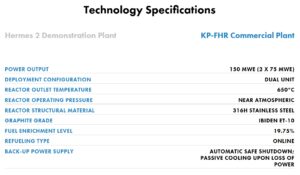
This agreement marks the first time a U.S. utility will buy electricity from an advanced Generation IV (GEN IV) nuclear reactor. Under the deal, the Hermes 2 reactor will supply up to 50 megawatts (MW) of round-the-clock, carbon-free energy to TVA’s grid starting in 2030.
Originally designed to generate 28 MW. By boosting output, Kairos Power ensures that the plant delivers enough energy for data centers that run 24/7 with near-zero downtime. Precisely, that electricity will power Google’s massive data centers in Montgomery County, Tennessee, and Jackson County, Alabama.
Amanda Peterson Corio, Google’s Global Head of Data Center Energy
“To power the future, we need to grow the availability of smart, firm energy sources. This collaboration with TVA, Kairos Power, and the Oak Ridge community will accelerate the deployment of innovative nuclear technologies and help support the needs of our growing digital economy while also bringing firm carbon-free energy to the electricity system. Lessons from the development and operation of the Hermes 2 plant will help drive down the cost of future reactors, improving the economics of clean firm power generation in the TVA region and beyond.”
Mike Laufer, Kairos Power CEO and co-founder, also noted,
“This collaboration is an important enabler to making advanced nuclear energy commercially competitive. The re-envisioned Hermes 2 gets us closer to the commercial fleet sooner and could only be made possible by close collaboration with TVA and Google, and a supportive local community. We are excited to grow Kairos Power’s operations in Oak Ridge while writing a new chapter in the region’s distinguished nuclear history.”
TVA Bridges Utilities, Tech, and Innovation in Nuclear Power
TVA will buy the electricity from Kairos Power and deliver it to Google through its grid. In return, Google will receive the clean energy attributes tied to Hermes 2, ensuring its local operations are powered with verified carbon-free energy every hour of every day.
This three-way model, i.e, bringing together energy customers, utilities, and technology developers, highlights a new path for delivering advanced energy projects. Instead of utilities or developers shouldering all the risk, partnerships distribute costs and accelerate innovation.
Don Moul, TVA President and CEO, said,
“Energy security is national security, and electricity is the strategic commodity that is the building block for AI and our nation’s economic prosperity. The world is looking for American leadership, and this first-of-a-kind agreement is the start of an innovative way of doing business. By developing a technology, a supply chain, and a delivery model that can build an industry to unleash American energy, we can attract and support companies like Google and help America win the AI race.”
Why Oak Ridge Matters
The decision to build Hermes 2 in Oak Ridge, Tennessee, carries deep symbolic weight. Oak Ridge played a central role in nuclear innovation during the 20th century and was the site of some of the biggest breakthroughs in U.S. nuclear history. Now, it’s becoming a hub for the next era of nuclear innovation.
Beyond clean energy, the project will drive local growth. Kairos Power is working with the University of Tennessee and other regional institutions to train operators, engineers, and technicians. These programs aim to create a pipeline of high-paying, skilled jobs in advanced nuclear technology, ensuring that the benefits of Hermes 2 extend far beyond the plant itself.
- ALSO READ: Google Backs Fusion Energy: Signs 200MW Offtake Agreement with Commonwealth Fusion Systems
Rising Electricity Demand in the AI Era
The timing of Hermes 2 couldn’t be more critical. America’s power grid faces surging demand, fueled by data centers and transportation electrification.
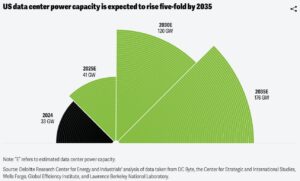
Deloitte estimates that data center power use could increase fivefold by 2035, climbing to 176 gigawatts (GW).
- The National Electrical Manufacturers Association (NEMA) projects that U.S. electricity demand will rise 2% annually, surging nearly 50% by 2050.
This growth is driven not just by cloud services but by artificial intelligence (AI), which requires immense computing power. AI-focused data centers may consume thousands of megawatts each, far beyond the capacity of traditional renewable energy solutions alone.
Why Nuclear Energy is a Strong Fit for Data Centers?
Nuclear power is emerging as one of the few reliable options to meet skyrocketing electricity needs while cutting emissions. IEA says, in 2024, nuclear supplied 18.5% of U.S. electricity, despite accounting for less than 8% of total operating capacity.
-
Massive power output: A single nuclear reactor can generate 800 MW or more, enough to support multiple hyperscale data centers.
-
Around-the-clock reliability: Unlike wind and solar, nuclear plants provide steady power, day and night.
-
Low emissions: Nuclear energy produces almost no greenhouse gases during operation, making it a climate-friendly option.
-
Efficient land use: Nuclear facilities need far less land compared to solar or wind farms, which makes them ideal for regions where space is limited.
The Rise of Small Modular Reactors (SMRs)
While traditional nuclear plants are ideal for massive grids, small modular reactors (SMRs) are changing the game. SMRs typically generate up to 300 MW, making them flexible, scalable, and perfectly sized for powering individual data centers or clusters.
SMRs also carry advantages in cost and deployment:
-
They can be built in factories and assembled on-site, speeding up timelines.
-
Their modular design lowers upfront capital risks.
-
They can be paired with renewables to provide grid stability.
Experts predict that by 2035, SMRs could cover 10% of the forecasted increase in U.S. data center electricity demand if regulatory and financial hurdles are overcome.
Kairos Power–TVA–Google Model Cracks the Cost Barrier
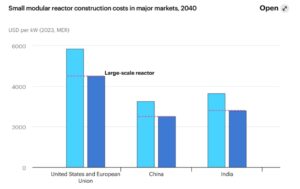
Based on the above analysis, the Kairos Power–TVA–Google model is also designed to spread out costs and bring down expenses for utilities and households over time. This is possible because of leveraging early partnerships with major energy buyers like Google.
Moving on, the Hermes 2 project is a blueprint for how advanced nuclear can scale across the U.S. energy system.
-
For utilities, it provides reliable, carbon-free power without overburdening ratepayers.
-
For tech companies, it delivers guaranteed clean energy to match massive AI and data needs.
-
For communities, it creates jobs, training programs, and long-term economic benefits.
Boosting Google’s 2030 Carbon-free Energy Goal
The U.S. is entering a new era where electricity demand is rising fast, mainly due to data centers and AI. And renewable energy can’t do it alone. The grid needs a reliable, scalable, and carbon-free solution.
For Google, Hermes 2 builds on nearly a decade of clean energy work with TVA. Since 2015, Google has invested a lot in renewable energy for the Tennessee Valley. This effort helps modernize the grid and supports data center growth.
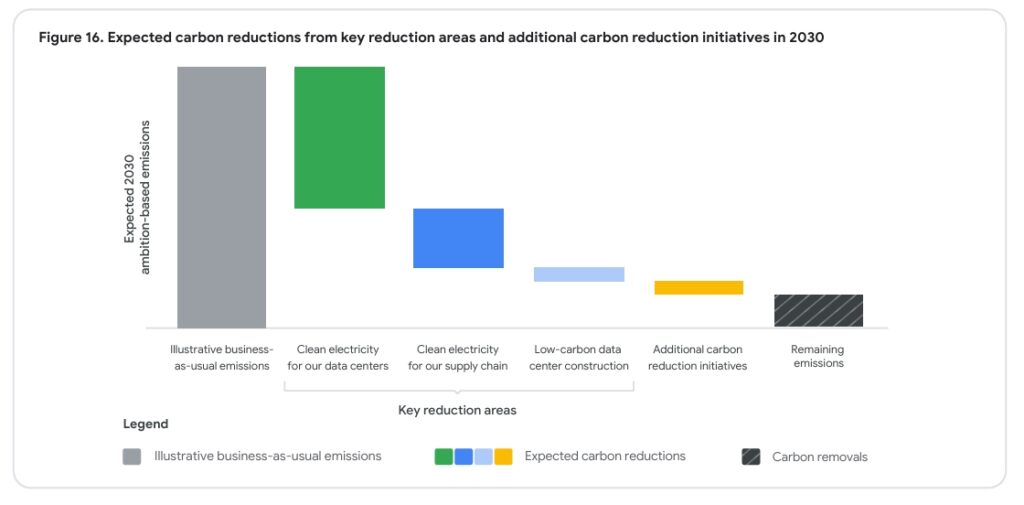
Now, with Hermes 2, Google is taking the next leap — adding 24/7 nuclear power to complement wind and solar. This move helps meet Google’s 2030 carbon-free energy goal. It also ensures that its expanding AI operations are powered reliably.
Google, Kairos Power, and TVA are proving that nuclear and data centers can grow together. If Hermes 2 works, it may speed up SMR use across the U.S. This would help meet climate goals and manage rising energy demands.
The post Google, Kairos, and TVA Unlock Advanced Nuclear Energy for America’s AI Data Centers appeared first on Carbon Credits.

The accounting differences that decide whether your nature investment shows up in inventory, in BVCM, or nowhere at all.
The question reaches a procurement team about three weeks before the next sustainability committee meeting. Someone has read about insetting. Someone else has just signed off on an offset purchase. The CSO wants to know if the two are interchangeable. The answer is no, and the GHG Protocol Land Sector and Removals Standard is the reason why.
This article walks through what each term means at audit-grade specificity, what the standards actually say about how each gets counted, and how to decide which tool fits which target. The insetting vs offsetting question is one of the most-searched in corporate climate strategy, and one of the most poorly answered. By the end of this piece, you should be able to brief a committee on the difference without notes.
The two definitions, in plain English
Offsetting means buying carbon credits generated outside your value chain and retiring them against your residual emissions. The reduction happens somewhere else, financed by you, and the credit is the receipt.
Insetting means investing in emission reductions or removals inside your own value chain, typically with suppliers, where the reduction is directly linked to the products and services you buy. The reduction happens inside the boundary of your Scope 3 inventory, and the accounting treatment is fundamentally different.
The shorthand from the University of Oxford’s Nature-based Insetting Initiative is useful: insetting is what you do with the supply chain you have; offsetting is what you do with the supply chain you do not have.
What the GHG Protocol Land Sector Standard actually says
The GHG Protocol Land Sector and Removals Standard, finalised in 2024 after a multi-year pilot, sets the rules for how land-based emission reductions and removals enter corporate inventories. The Standard distinguishes between inventory accounting (Scope 1, 2, and 3) and project or intervention accounting (a separate methodology for crediting).
For insetting, the practical implication is that supplier-level interventions, when properly measured and attributed, can reduce your Scope 3 category 1 (purchased goods and services) emissions in your inventory. The reduction is not a credit retired against the inventory; it is a lower inventory number, period.
For offsetting, the credit is retired separately. It can be reported as a contribution toward a net-zero claim under the SBTi Beyond Value Chain Mitigation framework or as part of a VCMI Carbon Integrity claim, but it does not lower the inventory number.
A practical consequence: if your Science Based Target requires a 50% absolute reduction in Scope 3 emissions by 2030, insetting moves you toward the target. Offsetting does not. This single point of difference reshapes the procurement decision.
When insetting counts toward Scope 3 (and when it does not)
Insetting counts toward Scope 3 only when several conditions are met:
- The intervention must occur with an entity in your value chain.
- The emissions reduction or removal must be measured against a defensible baseline.
- The reduction must be attributed to your share of that supplier’s output, not double-counted with other buyers.
- It must follow the inventory accounting rules in the GHG Protocol Land Sector Standard, not the project accounting rules used to generate credits.
The most common failure mode is double counting. If your supplier sells the same reduction as a credit on the voluntary market and also reports it to you as a Scope 3 reduction, the math breaks. The Standard requires you to address this risk, typically by purchasing and retiring the supplier-issued credit as part of your inventory or by contractual provisions that prevent the supplier from selling the reduction twice.
When insetting does not count toward Scope 3: when the intervention sits with a supplier you do not buy from, when the baseline is not defensible, when the attribution is unclear, or when the documentation does not survive audit. Those cases default to Beyond Value Chain Mitigation, which is still useful but operates on a different ledger.
The procurement and supplier engagement question
Insetting is harder than offsetting. That is the unfashionable truth most buyers eventually confront. Offsetting is a transaction; insetting is a relationship.
To run an insetting program, you need supplier mapping precise enough to know which farms or facilities sit at which Scope 3 boundary. You need an engagement model that gets suppliers to participate, which usually requires multi-year commitments and shared economics. You need an MRV architecture that measures the right things and produces audit-ready documentation. And you need a contractual structure that prevents double counting and protects both sides.
The trade-off you receive in return is significant. Reductions count against your inventory rather than your residual. Supplier relationships deepen, which protects sourcing continuity. Yield and quality improvements often follow regenerative interventions, which reduces your input cost over time. And the regulatory file, under CSRD, CSDDD, EUDR, and the SBTi FLAG Guidance, is materially stronger.
Choosing the right tool for the right target
A practical decision rule. If your target is a science-based Scope 3 reduction and you operate in a FLAG sector or source FLAG commodities, insetting is the structurally correct tool. If your target is a net-zero claim that includes neutralising hard-to-abate residual emissions outside your value chain, BVCM via high-integrity offsets is the structurally correct tool. Most companies with material Scope 3 exposure need both, in different proportions, sequenced over time.
The sequencing matters. Insetting takes longer to stand up but produces a permanent reduction in the inventory. Offsetting can be transacted faster but does not change the inventory and now sits under tighter claim restrictions. Treat them as complementary tools with different jobs, not as substitutes. The Accountability Framework Initiative and the IUCN Global Standard for Nature-based Solutions both provide useful guardrails for the insetting side, with biodiversity, human rights, and benefit-sharing requirements that go beyond carbon math.
If you are mapping a Scope 3 reduction roadmap and need to scope which interventions count toward your inventory versus which sit in Beyond Value Chain Mitigation, the carbon and sustainability experts at Carbon Credit Capital can help you structure a nature-based supply chain investment program that fits your FLAG exposure, your target architecture, and your audit horizon. Schedule a consultation.
Net zero is often described as a balancing act: cut what you can, account for the rest, and reach zero on the ledger. That framing is useful, but it leaves something out. It treats every tonne of carbon as interchangeable and every route to zero as equally sound, while the science tells a more specific story.

Malawi has lost a striking share of its forests over the past three decades. Woodlands that once covered well over a third of the country now cover less than a quarter, and the pressure on what remains is increasing. Behind those figures sit two practical questions: what is driving the loss, and what reverses it?




-
Climate Change1 year ago
Guest post: Why China is still building new coal – and when it might stop
-
Greenhouse Gases1 year ago
Guest post: Why China is still building new coal – and when it might stop
-

 Greenhouse Gases2 years ago
嘉宾来稿:满足中国增长的用电需求 光伏加储能“比新建煤电更实惠”
-

 Climate Change2 years ago
嘉宾来稿:满足中国增长的用电需求 光伏加储能“比新建煤电更实惠”
-
Climate Change2 years ago
Bill Discounting Climate Change in Florida’s Energy Policy Awaits DeSantis’ Approval
-

 Renewable Energy10 months ago
Sending Progressive Philanthropist George Soros to Prison?
-
Greenhouse Gases1 year ago
嘉宾来稿:探究火山喷发如何影响气候预测
-

 Carbon Footprint2 years ago
US SEC’s Climate Disclosure Rules Spur Renewed Interest in Carbon Credits