


Google has partnered with Energy Dome, an Italian startup, to test and deploy a new kind of long-duration energy storage system. The innovation centers on a CO₂-based battery designed to store renewable energy for up to 24 hours. This move helps Google reach its clean energy goals. It also provides a scalable way to tackle a major issue in decarbonizing power grids: storing solar and wind energy when the sun is down or the wind is calm.
The project will begin in Sardinia, Italy, where Energy Dome is based. Google will help fund and validate a commercial-scale CO₂ battery installation there. If successful, the system could support Google’s plans to run all its data centers and campuses on 24/7 carbon-free energy (CFE) by 2030.
The technology offers a cheap and efficient way to fill energy supply gaps. This is important as more grids use renewable power sources.
Maud Texier, Director of EMEA Energy at Google, remarked:
“Google is committed to powering our operations with clean energy, and Energy Dome’s technologically proven and scalable long-duration energy storage solution can help us unlock rapid progress.”
What Is a CO₂ Battery and How Does It Work?
Unlike lithium-ion batteries or pumped hydro storage, the CO₂ battery uses carbon dioxide in a closed loop to store and release energy. When there is excess electricity from solar or wind, the system compresses CO₂ gas and stores it in liquid form.
Later, when energy is needed, the liquid CO₂ is heated and expanded back into a gas, spinning a turbine to generate electricity.
The entire process is carbon-neutral since the CO₂ is never released into the atmosphere. It simply moves between gas and liquid states in a sealed system.
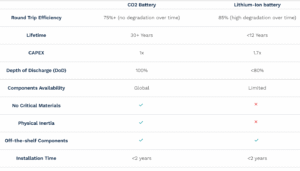
Energy Dome’s design allows users to store energy for 10 to 24 hours. That’s much longer than regular lithium-ion batteries, which last only four to six hours.
The CO₂ battery can be made with current industrial tools like steel tanks and compressors. This makes it quicker and cheaper to set up than other long-duration technologies. Energy Dome says its systems can be built for under half the cost of lithium-ion storage. They also offer similar or better efficiency, around 75%.
Why Google’s Future Runs on 24-Hour Clean Energy
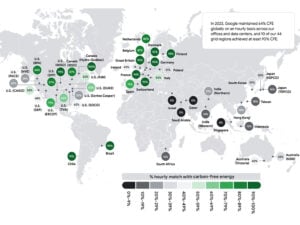
Google is one of the world’s largest corporate buyers of renewable energy. However, as it advances toward its ambitious 24/7 carbon-free goal, it requires more than just solar and wind power—it needs the ability to store clean energy for extended periods and deliver it when needed. This is where long-duration energy storage becomes essential.
Traditional battery systems help balance short-term fluctuations in energy supply and demand. But they struggle with overnight or multi-day needs. Long-duration solutions like the CO₂ battery help smooth out these gaps, especially as fossil fuels are phased out and weather-dependent renewables take their place.
By supporting Energy Dome, Google is investing in a technology that could allow it to run data centers on clean energy around the clock. The tech giant’s data centers consume massive amounts of electricity—roughly 1.3 terawatt-hours annually in the U.S. alone. Without reliable clean energy storage, these facilities risk falling back on fossil power during grid shortages or renewables downtime.
The partnership aligns with Google’s wider climate strategy, which includes investing in emerging technologies, optimizing data center efficiency, and using advanced AI to predict and manage energy loads.
- RELATED: Google Rides the Wind: First Offshore Wind Deal in Asia Pacific For 24/7 Carbon-Free Energy
From Sardinia to the World: Climate Tech with Global Reach
If proven successful, the CO₂ battery could offer a scalable tool for decarbonizing power grids worldwide. According to the International Energy Agency (IEA), the world will need over 1500 gigawatts (GW) of energy storage by 2050 to meet climate goals.
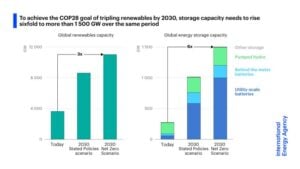
Today, only a fraction of that exists. Long-duration technologies could fill much of that gap.
Energy Dome’s battery could be especially useful in places with abundant solar and wind energy but limited storage options. Regions like Texas, California, and parts of Europe often curtail clean energy production due to a lack of storage. Deploying low-cost systems like this one could unlock more renewable use and reduce reliance on backup fossil fuels.
The technology also supports grid stability. As renewables grow, so do fluctuations in power supply. Long-duration storage can buffer these swings, keeping the grid balanced and reliable. That’s especially important as heatwaves and extreme weather strain power systems.
Beyond technical benefits, the partnership marks a milestone in clean tech investment. Google’s support brings credibility and funding to a new player in the energy storage space. It also signals growing interest from major tech firms in scaling novel climate solutions.
What’s Next for Google and Energy Dome?
The Sardinia project will be one of the first commercial deployments of a CO₂ battery anywhere in the world. Energy Dome has already completed a 2.5 MW demonstration unit and is now building its first utility-scale project.
- The system will have 20 MW of power and 200 MWh of storage—enough to power tens of thousands of homes for 10 hours.
Once operational, Google and Energy Dome will study performance data, costs, and scalability. If successful, the technology could be used across other Google data centers globally.
Energy Dome also plans to expand into the U.S., where tax incentives could make new projects more attractive.
The companies have not disclosed the exact financial terms of the deal. But both parties say the goal is to make the technology bankable and ready for global markets. Other energy companies and utilities are watching closely, as many are also seeking cost-effective long-duration storage options.
Google’s collaboration with Energy Dome represents more than just a single project. It reflects a broader shift toward deeper integration of renewable energy, long-duration storage, and corporate climate responsibility.
As tech companies race to reduce emissions and support climate goals, scalable solutions like CO₂ batteries could play a major role. This partnership highlights a path forward: combining innovation with investment to solve tough problems like clean energy reliability.
If the Sardinia pilot works as expected, it could pave the way for rapid global deployment of carbon-neutral energy storage. It will help Google, and perhaps many others, stay online and emissions-free at the same time.
The post Google Backs Energy Dome’s CO₂ Battery Breakthrough for Clean Energy Storage appeared first on Carbon Credits.

EU carbon credit claims changed on 27 September 2026, the day the Directive (EU) 2024/825 began to apply across the European Union. The change is narrow. It changes how a company can talk about the credits it buys. A product can no longer be called neutral on the strength of compensation alone; however, every specific, evidenced statement about what a company measured, reduced, and funded stays fully available.

The post Promoting Improved Cooking Practices in Nigeria appeared first on Terrapass.



-
Climate Change1 year ago
Guest post: Why China is still building new coal – and when it might stop
-

 Greenhouse Gases2 years ago
嘉宾来稿:满足中国增长的用电需求 光伏加储能“比新建煤电更实惠”
-
Greenhouse Gases1 year ago
Guest post: Why China is still building new coal – and when it might stop
-

 Climate Change2 years ago
嘉宾来稿:满足中国增长的用电需求 光伏加储能“比新建煤电更实惠”
-

 Renewable Energy12 months ago
Sending Progressive Philanthropist George Soros to Prison?
-
Climate Change2 years ago
Bill Discounting Climate Change in Florida’s Energy Policy Awaits DeSantis’ Approval
-
Greenhouse Gases1 year ago
嘉宾来稿:探究火山喷发如何影响气候预测
-

 Climate Change2 years ago
Analysis: China’s CO2 falls 1% in Q2 2024 in first quarterly drop since Covid-19