

Humans are deeply responsible for the current climate crisis, and a significant root cause is the nationstate fiction that land and morethanhuman relations can be reduced to “property” to be owned, controlled, and exhausted for profit. This ownership paradigm is inseparable from the Doctrine of Discovery and Terra Nullius, by Church and Crown, which gave moral and legal cover to seize Indigenous lands and suppress Indigenous laws of responsibility and reciprocity with the web of life.
The modern idea that a Crown or state holds “underlying title” to Indigenous lands in Canada flows directly from these doctrines, which treated alreadyinhabited territories as “empty” and available to Christian European empires. In practice, this has allowed Canada to assert ultimate authority over unceded territories, reduce Indigenous Nations to “claimants” on their own lands, and legitimize largescale extraction and dispossession.
This way of thinking has fractured the integrity of land and the broader web of life. When land is seen as property rather than as a living relation, decisions are framed around shortterm economic gain instead of the continuity of waters, soils, plants, animals, and communities. From clearcut logging and fossil fuel expansion to exclusionary conservation, the same logic of unilateral control has fragmented habitats, undermined biodiversity, and disrupted longstanding Indigenous stewardship practices.
For Indigenous Nations, climate change intensifies these harms. Shifting seasons, altered animal migrations, and degraded waters are eroding the conditions for hunting, fishing, trapping, and gathering, and with them, language, ceremony, and landbased teachings. This is not just environmental damage; it is an attack on living Indigenous legal orders that were designed to keep human behaviour accountable to the land.
Politically, the ownership myth entrenches a hierarchy in which the state imagines itself as the final decisionmaker over territories it claims. Indigenous Nations are pushed into endless “consultation,” while absolute authority and benefitsharing rarely shift. Economically, this worldview feeds a growthdriven model in which “wealth” is measured by what can be extracted, privatized, and traded, rather than by the health of ecosystems and communities. Socially and spiritually, it normalizes disconnection from place, where many people experience land as a commodity rather than as a living network to which they belong and are accountable.
Human arrogance thrives in this disconnection. The belief that humans stand above other beings, entitled to engineer, commodify, or sacrifice them for convenience and profit, has opened a climate change Pandora’s box: land turned into property, relations turned into resources, and the garden of life left to rot around us while humanity chooses profits over peace. Our current geopolitical and geoeconomic crises are symptoms of the same disorder, power and control elevated above responsibility and reciprocity.
There is no doubt that human activities, shaped by colonialism, fossil capitalism, and the property mindset, are driving the climate crisis. Yet Indigenous knowledge holders and communities across Turtle Island insist that genuine solutions must be rooted in decolonization, land back, and the restoration of landbased responsibilities and Indigenous selfdetermination. Indigenousled renewable energy projects, landback agreements, and the revitalization of traditional land use practices show it is possible to align livelihoods with the wellbeing of ecosystems instead of their destruction.
This moment demands more than new policies; it calls for a profound shift in worldview. Humans are not owners, but relatives, not masters, but participants in a living treaty with the rest of creation. Moving from ownership to relationship feeling as well as thinking our way back into reciprocity offers one path out of the current crisis.
Householdlevel conversations are an essential place to begin reconciling with Mother Earth. These conversations can ask different questions: Who rather than What is this land to us? What are our responsibilities here? How do our everyday choices, food, energy, transport, investments, and political action support or undermine Indigenousled visions of climate justice? When families and communities begin to live as if land is a relative rather than a possession, the foundations of a different future begin to take root.
Blog by Rye Karonhiowanen Barberstock
Image Credit: Davey Gravy, Unsplash
The post From Ownership to Relationship: Reclaiming Our Responsibilities to Land appeared first on Indigenous Climate Hub.
From Ownership to Relationship: Reclaiming Our Responsibilities to Land

After witnessing and hearing stories of Pacific islands’ vulnerability to climate change, senior climate officials have promised to strengthen efforts to limit global warming to 1.5C, despite an expected overshoot, and to help the region adapt to rising seas and other impacts.
More than 30 world leaders, ministers, climate negotiators and international development bankers travelled to the sinking atoll nation of Tuvalu on Tuesday before attending the pre-COP31 talks in Fiji, where schoolchildren told them about the effects warming-driven droughts, heatwaves and storms are having on their education.
Australia and the Pacific nations hoped to use the pre-COP to reinforce the urgency of tackling climate change to the officials from around 50 countries who travelled to the region. Fiji’s climate minister, Lynda Tabuya, told a closing press conference on Thursday they had wanted to “bring decision-makers to the climate frontlines”.
Many of those decision-makers said they had been moved by what they had seen and heard this week, and their speeches emphasised the importance of limiting global warming to 1.5C above pre-industrial levels, a key goal of the 2015 Paris climate agreement.
-
Pacific leaders rail at climate finance failures after pre-COP trip to Tuvalu
Island nations seek invest in their own Pacific Resilience Facility, as they struggle with the red-tape of international climate funds -
New Zealand accused of breaching EU trade deal over climate rollbacks
The EU’s climate trade rules face their first major test after a green group alleged New Zealand violated binding environmental provisions under its trade deal with the bloc

In September, a UN report acknowledged that the 1.5C threshold will be breached but said temperatures could still be brought back down to that level by the end of the century with stepped-up climate action.
A month ago, Türkiye‘s COP31 President Murat Kurum told a press conference in the northern Turkish city of Trabzon that limiting global warming to 1.5C “does not really look possible”, adding that “around 1.5C, that will be a success”.
But after seeing the “anxiety” of children and mothers in Tuvalu caused by rising sea levels, Kurum told reporters in Fiji that 1.5C is a “matter of survival – the survival of cultures, history, memories, your homeland, your homes – it’s that important.”
“The 1.5C target is in jeopardy and we do not have a single minute, a single day to lose,” he added through an interpreter.
Jacobo Ocharan, head of political strategies at Climate Action Network International, warned that “words of concern will not protect anyone”. “The Pacific has shown the world what is at stake. Now governments must show they are ready to act,” he said. “[COP31 in] Antalya must deliver decisions that change people’s lives for the better.”
$1.5 billion for 1.5C
In Fiji, Kurum echoed the call of Australia and Pacific nations for contributions to the fledgling Pacific Resilience Facility (PRF), which aims to use the returns on its investments to fund community climate adaptation projects like water storage, building sea walls and protecting homes from storms. “$1.5 billion for 1.5 degrees will save the Pacific,” he said. “It’s that easy. Life will continue in Tuvalu. Children will be smiling again.”
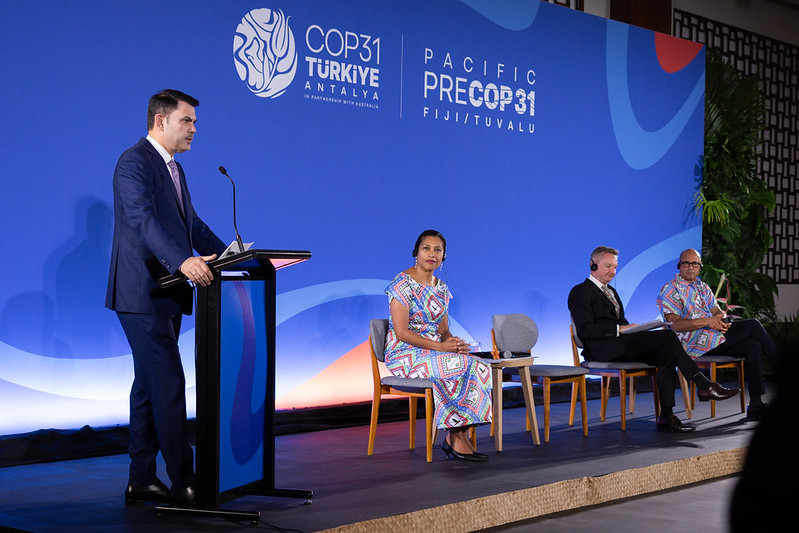
Sitting next to him, Fiji’s Tabuya said she was “encouraged” by his words. “$1.5 billion for 1.5. We will hold COP 31 to that,” she said. The PRF has been promised just under $200 million so far – including about $15 million pledged by European and Pacific governments at pre-COP – and is aiming for $500 million by COP31. It has a longer-term target of mobilising $1.5 billion in capital.
After Pacific leaders on Tuesday aired a litany of concerns about the barriers to accessing the global climate finance system, Kurum joined in at Thursday’s press conference. “Justice in climate finance is essential,” he said. “Resources must reach those in need in a timely and accessible manner, not through a lot of red-tape, and we cannot accept that the same countries should always bear the burden.”
Plan for easier access to climate finance
Australian climate and energy minister Chris Bowen, who is COP31’s president of negotiations, also lamented that “the countries that need the finance the most get it the least”. He said he would ask governments and multilateral development banks to support an access to finance plan for small island states and the world’s poorest nations, launched by Australia on Thursday.
The plan says that while there has been progress in making it easier and quicker to obtain international climate funding, “multiple persistent challenges have continued to limit access to climate finance for developing countries”.
It adds that the amounts available are insufficient to meet climate goals and stresses the need for “grant-based and highly concessional financing”, especially for adaptation and responding to loss and damage. The plan proposes an annual high-level forum on climate finance access to track implementation.
The pre-COP summit closed with an emotional plea from Fiji’s host minister Tabuya. Fighting back tears before finally succumbing, she asked delegates to “carry something of the Pacific with you”.
“Remember the people you met, the stories you heard and why we gathered. This pre-COP draws to a close tonight. Our responsibility does not,” she said to applause.
The post Pre-COP draws attention to Pacific’s climate plight and 1.5C goal appeared first on Climate Home News.
Pre-COP draws attention to Pacific’s climate plight and 1.5C goal
Climate Change
Australia’s climate credibility tested at Pacific Pre-COP talks, as High Court fossil fuel ruling puts government on notice
NADI, FIJI Thursday 8 October 2026 — As the Pacific Pre-COP talks wrap up and Australia prepares to take the reins of COP31 Negotiations in Türkiye next month, Greenpeace Australia Pacific says the government is on notice over fossil fuel expansion and exports, and must accelerate action to align with a 1.5°C pathway.
Following yesterday’s landmark High Court ruling that the climate impacts of coal and gas exports must be considered by New South Wales planning authorities, Greenpeace Australia Pacific is calling on the Albanese government to find the “courage, leadership and grit” to chart a new course away from fossil fuels.
High res images and video from yesterday’s ‘Keep 1.5C Alive’ flotilla in Nadi can be found here
Speaking from Nadi, Shiva Gounden, Head of Pacific at Greenpeace Australia Pacific, said:
“The outcomes of this week’s talks are a drop in the ocean given the scale of need, and urgency of the crisis our communities are facing. It is like taking a glass of water to a burning house if we do not urgently act to address the root cause of the existential threat facing Tuvalu, Fiji and all Pacific countries: fossil fuel expansion.
“The Electrification Pledge must end fossil fuel dependence, not be an end in itself — its ultimate success depends on ensuring electricity comes from renewable sources that displace fossil fuels and align with a 1.5°C pathway. It must be underpinned by justice and backed by finance flowing from polluters to communities.
“Limiting global warming to 1.5°C is a non-negotiable survival line for humanity and Australia must act. The landmark climate advisory ruling from the ICJ is clear — 1.5°C is the moral, the scientific and the legal limit. Continuing down the fossil fuel path, and failing to align efforts with limiting warming to 1.5°C, is a breach of our international legal obligations, and risks making Australia liable for future reparations from climate-vulnerable nations.”
Also in Nadi, Dr Simon Bradshaw, COP31 Lead and climate expert at Greenpeace Australia Pacific, said: “The Pacific was never going to be a mere backdrop for Australia in its role as incoming chair of the COP31 climate talks, but where its credibility and commitment to climate leadership would be tested.
“Here we see communities fighting for their survival and doing everything possible to hold the line on returning warming to 1.5°C. When governments profess to take their concerns seriously, only to then throw more fuel on the fire, the pain and sadness is visceral.
“This week the High Court of Australia recognised what the Federal Government refuses to — that Australia is responsible for the climate damage of our fossil fuel exports and if governments don’t act, the courts will intervene. The message is simple: this is not someone else’s problem, it is ours.
“We must now follow other countries in developing a national roadmap away from fossil fuels that ensures a managed wind-down of fossil fuel production, including exports, in line with our legal obligation to help return warming to 1.5°C.”
ENDS
Media contact: Kate O’Callaghan in Nadi on +61 406 231 892 (Whatsapp/Signal)
A Dutch NGO has filed the first climate complaint under the European Union’s trade rules, arguing that New Zealand violated the environmental provisions of its free trade agreement with the bloc by weakening its climate regulations.
The case will test whether binding climate provisions in the EU’s free trade deals can be enforced to hold governments accountable to their climate obligations, experts told Climate Home News.
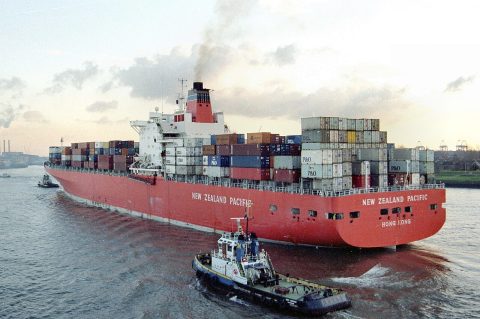
The EU-New Zealand free trade agreement, which came into force in 2024, was the first in the world to include legally-binding climate provisions and possible sanctions for violating them, as the EU seeks to use its trade partnerships to advance greater environmental protection.
Under the deal, both parties committed not to weaken their environmental law to promote trade or investment and to “refrain from any action or omission that materially defeats the object and purpose of the Paris Agreement”.
-
International trade linked to 20% of global emissions – but imports ignored
Researchers say governments should discuss how to tackle emissions linked to globally traded goods and services, especially in large importing countries

At the time the agreement was signed, EU Commission President Ursula von der Leyen said the agreement included “unprecedented social and climate commitments”. But experts warned it was unclear how the Paris Agreement provisions would be enforced.
The EU included a similar “trade and sustainable development” clause in 14 other bilateral trade deals in recent years, with several others, including with China, awaiting ratification or being negotiated.
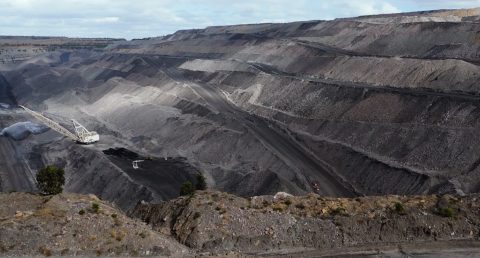
Climate activists at the Dutch NGO Both ENDS argue that the New Zealand government breached these terms by reopening its waters to offshore oil and gas exploration, releasing a climate plan that barely requires any emissions reductions, and passing a law that prevents corporations from getting sued over climate damages.
“Here, we have a so-called gold standard for free trade agreements with sustainability provisions but we have a trading partner that is doing exactly the opposite: regressing, as all the evidence points to, away from the Paris Agreement,” said Marius Troost, a senior policy advisor at Both ENDS.
Can the EU enforce its climate trading rules?
The Dutch environmental group filed the complaint under the EU Commission’s Single Entry Point, a mechanism that allows civil society to request enforcement of the bloc’s trade commitments.
The EU-New Zealand trade deal includes the possibility of suspending beneficial trading arrangements between the two parties in response to serious violations of its climate provisions. This, Troost said, is a “unique” tool to enforce both parties’ obligations under the deal.
“This is an opportunity for the EU and New Zealand to show that they are actually serious about these commitments,” he told Climate Home News.

A spokesperson for New Zealand’s Ministry of Foreign Affairs and Trade denied any violations of the agreement and said the government hadn’t received formal notice of the complaint. The country, they said, “takes its commitments under the NZ-EU Free Trade Agreement seriously, including the agreement’s environment and climate-related provisions”.
An EU Commission spokesperson said it will start a preliminary assessment of the complaint and engage with NGO Both ENDS. “Sustainability is a central pillar of the EU-New Zealand relationship,” they added.
The EU is New Zealand’s second-largest trading partner after China, with about 14% of the country’s exports going to the European market. Agricultural products like meat, diary, fruit and vegetables are the country’s biggest exports to Europe.
New Zealand is ‘having its cake and eating it’
Eliza Prestidge-Oldfield, a senior legal researcher at the New Zealand-based Environmental Law Initiative, which is supporting Both ENDS’s claim, told Climate Home News that if the EU upholds the complaint, both parties would begin a negotiation process.
“The idea is to try and resolve this positively with the New Zealand government acknowledging areas where it needs to change its actions in order to comply with the agreement, and get that change in place as soon as possible,” she said.
But New Zealand’s right-wing coalition government said it won’t take any directives from foreign actors regarding its policies. Trade minister Todd McClay told local media that it was “not for overseas countries, organisations or lobby groups to tell New Zealand how to meet its obligations”.
-
Coal mines and hypocrisy must not be Australia’s COP31 legacy
Still without a coal phase-out plan, Australia must course-correct to earn the mantle it has been given and do right by the Pacific nations that backed its bid for COP’s co-presidency -
Pacific leaders rail at climate finance failures after pre-COP trip to Tuvalu
Island nations seek invest in their own Pacific Resilience Facility, as they struggle with the red-tape of international climate funds -
As COP31 co-host, Australia should make its polluters pay for climate damage
With UN climate funds running short on cash, now is the time to start taxing the companies whose emissions are driving harm in the Pacific and other vulnerable parts of the world


Prestidge-Oldfield argued the complaint isn’t about “Europe telling anyone what to do at all”, but rather stressing the conditions under which they are willing to import goods from New Zealand. “The New Zealand government is trying to have its cake and eat it too,” she said.
If New Zealand refuses to adjust its policies in line with the agreement, the complaint will be assessed by an independent panel, which can require the country to make changes. If those changes are not implemented, the panel could decide that New Zealand should lose its preferential EU market access.
A negotiated resolution is more likely, however, with no prior labour-related complaints to the EU having ever reached the p