

When I’m out in the ocean, I’m obsessed by everything I see. I’m the woman in the boat who’s got her fish guide out to look up the names of any unknown fish while throwing out fun facts about the creatures I’ve already identified. Yet so much ocean life is so small, I might miss them entirely. I’m talking about plankton—the tiny plants and animals that make up 90% of the mass of all marine life in the ocean and play an extremely important role in the health of our planet.
Love ocean content?
Enter your email and never miss an update
Plankton are the start of the ocean’s food chain. Phytoplankton (a.k.a. plant-type plankton) turn sunlight into energy via photosynthesis and are eaten by zooplankton (a.k.a. animal-type plankton), small fish and invertebrates. Zooplankton, in turn, become food for larger species like fish, whales or crustaceans. Phytoplankton also pump out oxygen and sequester carbon. Five hundred million years ago, a bloom of plankton created the breathable oxygen-rich atmosphere humans depend on today.
Despite being so crucial to life on this planet, plankton are best defined by their go-with-the-flow nature. An organism is considered plankton if it can’t swim or move against the forces of the ocean like currents and tides. That’s why the name comes from a Greek word meaning “drifter.” A vast diversity of life falls under the heading of plankton from krill to single-celled algae to the offspring of crabs to jellyfish. Each plankter (that’s actually the word for individual plankton) is unique, and today I’m going to introduce you to a couple of the wandering creatures.
Dinoflagellates
Dinoflagellates are among the most common type of plankton with more than 1,500 species living in our ocean. They are single-celled phytoplankton with flagella, thread like appendages that allow these microscopic organisms to move. These tiny organisms can be responsible for wonder and destruction in the ocean. If you’ve ever swum in a bioluminescent bay, the light you see is caused by dinoflagellates. The light may help distract or startle would-be predators. In addition, some species have symbiotic relationships, helping corals, jellyfish and other animals thrive.
On the flip side, dinoflagellates are largely responsible for deadly red tides. The term “red tide” comes from the pigment found in these tiny creatures and the color of the water when these blooms happen. When dinoflagellates grow uncontrollably, they can produce toxins and reduce the oxygen in the water leading to die-offs in the ocean. Red tides can cause health hazards for people on land and lead to the deaths of manatees, fish and other creatures in the ocean.
Baby Sea Creatures

My favorite activity growing up was tide pooling, but I never really thought about how many of the creatures I encountered ended up there in the first place. That’s because the offspring star fish, sea urchins, sea anemones, barnacles, crabs, even octopuses start their lives as plankton that look almost nothing like the creatures they will one day become. If you want to play the wildest game of “Where are they now?” try to match ocean creatures with their baby forms in this quiz from The American Museum of Natural History.
Siphonophores

There are about 175 different species of siphonophores, the most famous being the Portuguese Man-O’-War. Another notable siphonophore is the Apolemia, which may be the longest creature on Earth at 150 feet long. That’s about the length of 1.5 blue whales! Proof that not all plankton are the tiny creatures we commonly think of them to be.
While they may appear to be a single organism, they are actually a colony of individuals called zooids. Each zooid has a unique function in the colony. For instance, there are zooids that are responsible for swimming and moving around, while others specialize in digestion and providing food for the whole colony. There are even battle zooids that are always on the ready to inject toxins into prey.
Comb Jellies

When you think of plankton, you often think of tiny animals, not beautiful otherworldly creatures like comb jellies. They are mesmerizing to watch because they produce a dazzling array of colors. This effect is caused by their cilia, which are like little hairs and are what give the comb jellies their name. These combs diffract light, breaking it up like a rain droplet or prism, to create rainbows.
Despite the similar name, comb jellies are not types of jellyfish. In fact, they could be descended from the Earth’s oldest animals. Recent research suggests that they could be the closest relatives of the first group to split off from our common ancestor around 500 million years ago. Comb jellies are pretty simple creatures without intestines, lungs or stomachs but they do have a nervous system that has puzzled scientists. Comb jellies have a nerve net that doesn’t have the usual synapses that humans and most other animals need for their neurons to communicate. Comb jellies could hold the answers to so many questions we have about how life evolved on Earth.
Diatoms

Diatoms are single-celled algae and among the largest groups of life on Earth. You can find diatoms anywhere it’s wet: freshwater, the ocean, even in moist soil. There are more than 100,000 species of diatoms and counting, as scientists find new types every year. What each diatom has in common is a cell wall made of silica, the same component we use to make glass, meaning they literally live in glass houses. Silica is also the main component of opals, and diatoms share some of that beauty, earning the name “jewels of the sea.” Diatoms are not only beautiful but are also powerful. They produce a significant amount of the air we breathe and are critical to marine ecosystems all over the world.
Some of the most amazing creatures on Earth are the ones we can’t easily see on the surface. Plankton play a critical role in sustaining life on this planet. Climate change is causing disruptions that we can see like intensifying storms, but it is also causing issues that we can’t see. That’s why it is so important that we all do what we can now to reduce polluting carbon emissions that are changing the ocean’s temperature, chemistry and function. Ocean Conservancy views climate change as the greatest challenge facing our planet today and is committed to finding ocean-based solutions to address it. Join us in taking action to combat climate change now.
The post Five Types of Plankton appeared first on Ocean Conservancy.

By Nathalie Rodríguez Lara (GEOMAR), Federico Scarscelli (GEOMAR), Ajit Subramanian (LDEO), Qi-fan Wu (University of Copenhagen), Eduardo Lima (UFPE), Herbert Barbosa (UFPE), Joelle Habib (LOV) and Zengchao Xu (GEOMAR)
So, you have been invited to participate in an oceanographic research vessel? Congrats! Oh, it’s German… well. Here are some tips that will be especially useful in the following days.
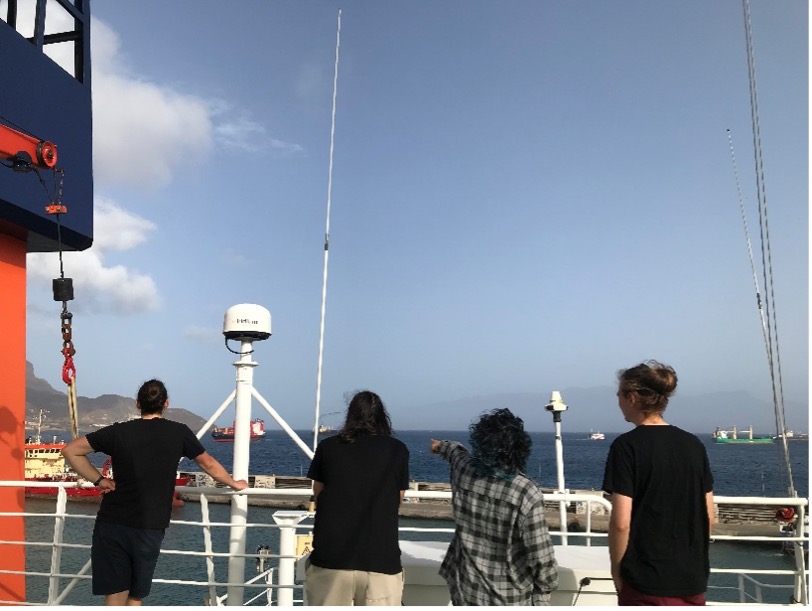
We shall start with food. Everyone needs it after all.
As with all ships, the Meteor has some hard rules on mealtimes, so be aware of the hour and get ready to enjoy some German delicacies. Keeping the mealtimes is important because the staff must clean up and prepare for the next meal. However, if you are working, you can ask for your food to be put aside for you to eat later.
First of all, breakfast. For the first bite after getting up (or before going to bed, in case you had the night shift), you can always expect a large variety of eggs, cheese, ham, and bread. Moreover, in the Meteor breakfast menu, you even get a little surprise dish each day, featuring a specialty Hausmannskost, or traditional homemade recipe, usually chosen among north Germany’s delicacies. These recipes are made for people that work hard all day, so of course the hearty meals are there to sustain hours on hours of manual labour, with strong flavour as well. Some of our favourites are the Schlemmerschnitte, Bremen Knipp, Wurstschnitzel and, of course, one of Germany’s greatest, the Zwiebelmettbrötchen. Yes, they are quite heavy compared to a nice yogurt, but they will provide you with enough energy for any scientific endeavour or challenge you will face.
As you walk towards the Messe be ready to say Moin, hello, Morgen, morning or any variety of greeting for the day to anyone who passes you by. Even when this is not customary on German land, it is most imperative that you do it on a German ship. Otherwise, be prepared to be greeted by a very loud “Morgen” at 7 am and a disapproving look.
“Mahlzeit” you say as you enter lunch time, a greeting for mealtimes meaning quite literally “mealtime”. A selection of food is served buffet style, so you may choose your desired quantity and meal type. Vegetarian options are included at every meal for those who prefer it, and you can never forget bit of potato on the side. On Sunday, the cooks usually prepare some traditional “family lunch” menu, as a way to enjoy a small moment of home feeling, even when it is far away on land. Even in the hottest day in the Tropical Atlantic, you will immediately feel like celebrating Christmas at your German friend’s home.
For dinner, a similar situation can be expected: a selection of food awaits you at the Messe including everything you need for a good Abendbrot, or evening bread, to those initiating on the German lifestyle.
A lot of attention shall be put on shoes and clothes for all mealtimes. The Messe is to be enjoyed by everyone, so no dirty safety shoes or dirty work clothes shall cross the door (leave the shoes outside, if you must). Sit down with your fellow scientist, eat with people, talk to them, ponder about all the life choices that led you to this point in time and the contributions your days at sea will do to science. Let yourself enjoy the company of other humans and DO NOT use your phone!
Oh, look at the clock, its 15:00! Well, dear reader, I shall introduce you to the great German culture of “Kaffee und Kuchen” or coffee and cake. Every afternoon, the kitchen lays out a variety of sweet little treats for you to enjoy, only a piece though, as everyone should enjoy this lovely tradition. Those in not so friendly terms with caffeine, may also find various selections of teas or even a glass of milk. Perhaps some chocolate or snacks (at your own cost), if you prefer. What’s more, as you see your fellow men work tirelessly under the sun, bring some cake to them, offer a little break from science, and enjoy the long-lived tradition of pastries.
Regarding the work on board, although there is a predefined shift schedule, some activities require most people to be available to help, such as mooring recovery and deployment. Offer a hand with those who need it, using the ancient spells “Do you need some help?” and “Do you want to switch?”. It is very much appreciated by those on deck, who have been bearing the load of the sun and hours of manual labour, and who probably haven’t had a nice meal yet.
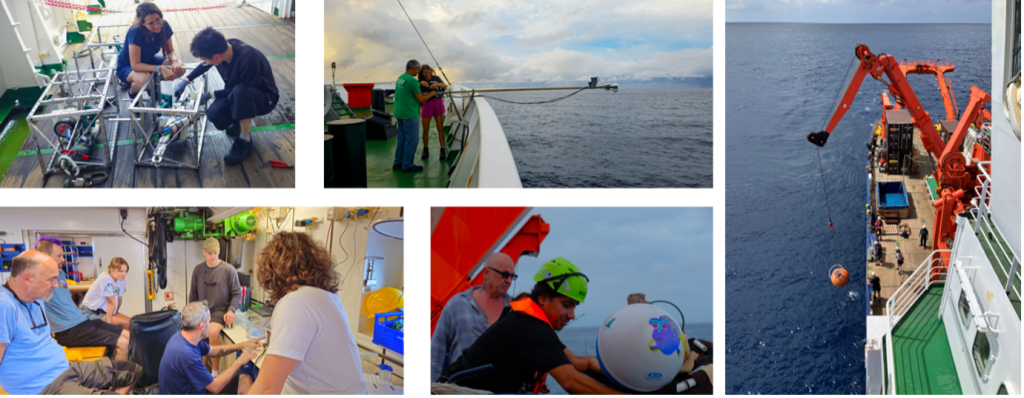
For the ones not so familiar with the German language, we offer two very useful work-related words: “stop” and “weiter”, meaning stop and continue. If you want to become a real professional and show off some advanced German skills, you can also add “schneller” and “langsamer”: faster and slower. Keep them in your heart and in your mind, and when the moment comes, you will find them more useful than not.
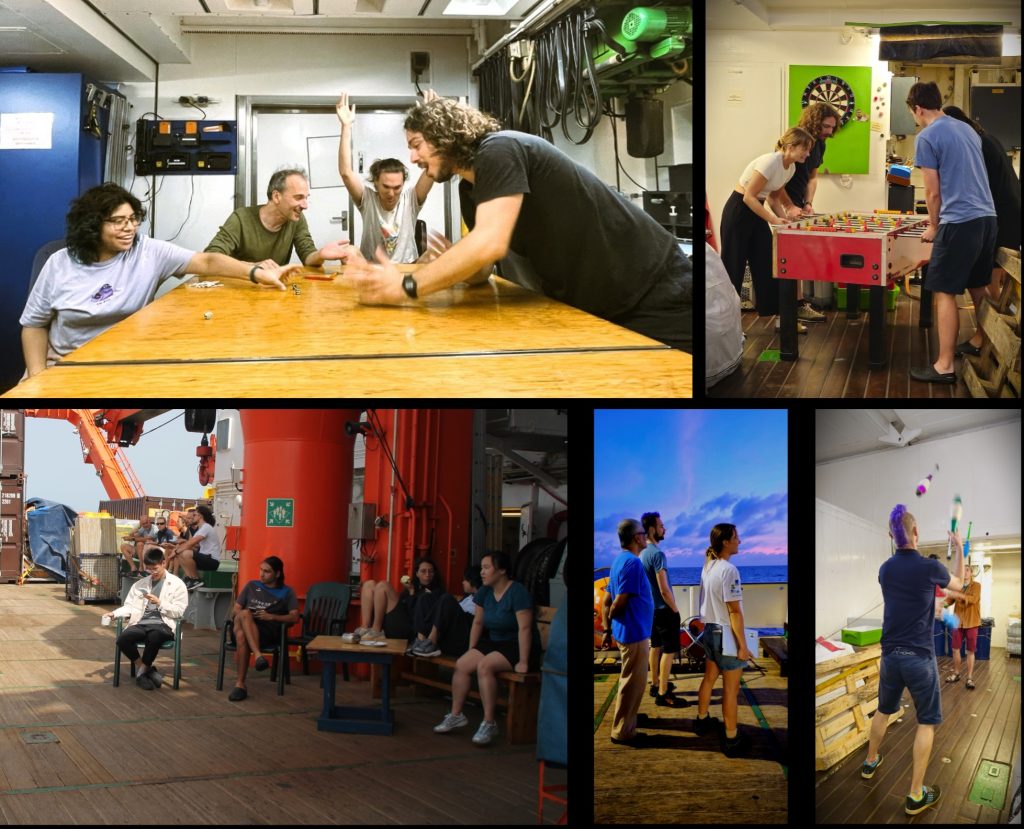
And, of course, after a tiring day of work, there are smiles, conversations, and music, along with the good feeling that comes from a job well done. Walk into the common areas for the evening: talk with people, maybe play a good round (or two) of Kniffel; perhaps join the kicker or pingpong tournament, a movie night sounds good, or just looking at the stars and the vastness of the night sky would suffice for today.
Another thing to keep in mind is house-keeping rules.
Follow your steward rules. Your cabin is your personal space, keeping it tidy and clean helps you and the housekeeping crew. Remember to leave your door open if you are not sleeping and take care of your shower curtain so it dries properly, we do not want mold on a ship!
Since we are already here, some general advice for life at sea.
An important aspect of life at sea is, sadly, sea sickness. It’s as common as it’s normal, everyone has tips and tricks. Here is ours: bring your pills, also known as Reisetabletten, take them every day and see how it works for you, maybe you are lucky and don’t need them after a few days. But never be too careless, the sea is as vast as it is treacherous, and big waves can change your internal balance easily. So, keep your pills close and keep them safe.
Be aware of the time changes, crossing the Atlantic may feel like a timeless void but time zones still exist to the rest of the world. The captain will announce the changes in time zone, moving an hour forward or backwards as needed, so be aware of this, keep an eye on the clocks and be prepared for a bit of a longer, or shorter, day ahead.
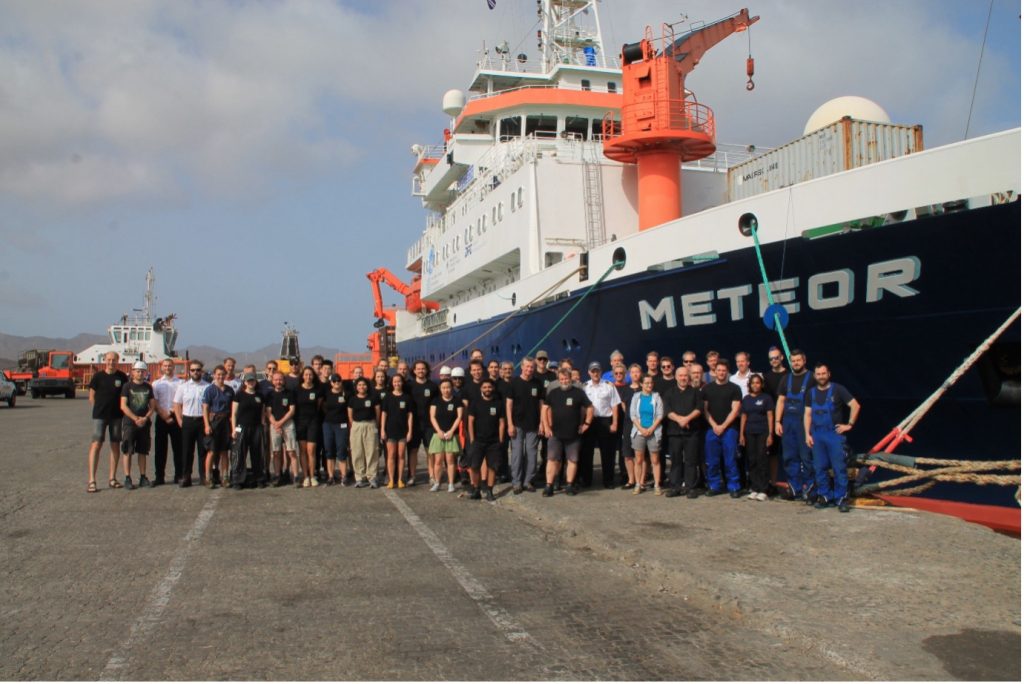
We thought of giving advice on science, but that’s what you are here for. Do not fret. Do your work and do it well. Trust that the knowledge that has brought you to this vessel can contribute, and be contributed, by those around you. Both the scientists and the crew are welcoming (but you have to follow the rules both for safety reasons and to work well in a limited shared space) and make a good effort to communicate in English, even if it is not so comfortable for all of them to so. So, dear reader, may your equipment be efficient, your samples uncontaminated and your results significant. Have a good trip, enjoy the camaraderie of new friends, and remember to enjoy these crazy days ahead.
Gute Reise und viel Spaß!
By Tina Hans (GEOMAR)
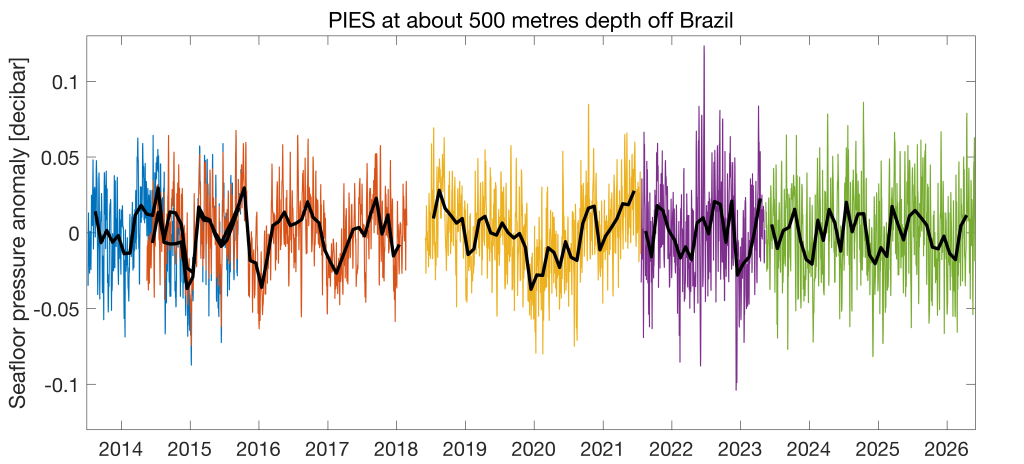
One main objective of the cruise is to investigate the large-scale ocean currents in the tropical Atlantic. For that purpose, we are maintaining several long-term observatories at the seafloor and in the water column. Additional to the moorings which have been described in the previous blog “Keeping the record alive”, we deployed and recovered close to the Brazilian coast so-called PIES. They have – as some might say unfortunately – nothing to do with pastries but are oceanographic instruments that measure the pressure at the seafloor as well as the time an acoustic signal takes to travel from the instrument to surface, where the signal is reflected, and back. We deployed six of those instruments across the continental shelf off Brazil at depth ranging from 150 metres to 3000 metres. These deployments are the result of a collaboration with the University of Bremen. We also successfully recovered one PIES that spent just over three years at the seafloor at a depth of 500 metres. With the data of the recovered PIES, we could extend our time series of seafloor pressure measurements at 500 metres depth. This time series, which goes back until 2013, spans now 13 years.
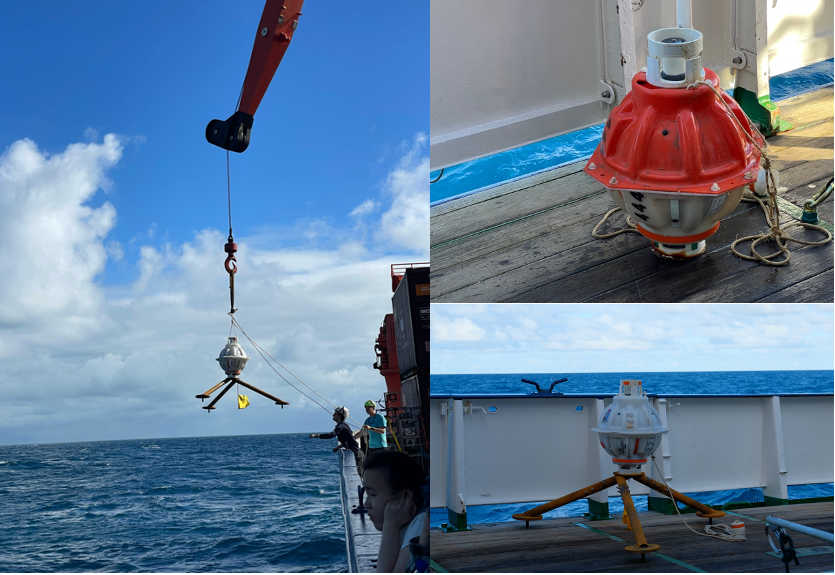
This still leaves the question of what the pressure at the seafloor can tell us about ocean currents. To answer this, one needs to know that the ocean dynamics are largely governed by a balance of two physical forces: the pressure gradient force and the Coriolis force. Essentially, when water ‘piles up’ somewhere, a current is created which attempts to even out the differences, and the direction of this current is deflected due to the Earth’s rotation. This force balance can also be used to directly relate the difference in pressure between two locations to the mean velocity in between these locations. We make use of this relation by measuring the seafloor pressure not just off Brazil but also off Angola at a similar latitude. With the combination of these measurements, we can calculate the mean north-/southward velocities across the Atlantic between Brazil and Angola. From this velocity we can then derive the strength of the Atlantic Meridional Overturning Circulation (AMOC).
However, there is one caveat: the pressure sensors are drifting over time. This makes it impossible to make statements about long-term trends, but we can still make statements about the seasonal to interannual variability of the AMOC. Therefore, the measurements of the PIES can be used to better understand the large-scale currents in the tropical Atlantic. In a next step, we are now using these measurements to better understand the linkage of the AMOC to climate variability in the tropics.
By Qi-Fan Wu (Niels Bohr Institutet, University of Copenhagen)
During our journey, we saw many beautiful cloud patterns while looking outside the METEOR! Even though people do not always pay attention to them, clouds are among the most visible elements of the sky and naturally form part of our everyday background. And when we sailed away from the coastal region of Recife to the open ocean, the sky seemed to open up, allowing clouds to reveal their full variety and structure.
In climate modelling, clouds are one of the biggest sources of uncertainty. There is a famous saying in mathematics: “Mathematics is the queen of the sciences, number theory is the crown of mathematics, and the Goldbach Conjecture is the pearl on the crown.” The same idea can be applied to the study of clouds in Earth science. There is still no general macroscopic theory of clouds. Cloud physics is an absolutely fascinating topic, as it combines turbulence, stochastic processes, chemicals in the air, multiscale interactions within the Earth–atmosphere system, and a close connection to our daily weather.
In this blog entry, we would like to share some lovely photos of cloud patterns that we took on METEOR. Instead of serious systematic investigations, we focus on the basic cloud physics behind some typical cloud phenomena shown in these photos. These examples might provide something interesting to think about during our leisure time, even after returning to land. If nature is an artist, clouds are among its finest masterpieces, shaped by physical laws and stochastic processes.
What are clouds, and what is inside them? Clouds are made of many liquid water droplets and ice crystals inside the boundaries of the cloud. They are mostly air, with the many particles dispersed widely and more or less randomly throughout the cloud interiors [a]. The individual particles that make up a cloud are very, very small and not generally visible to the human eye.
When we look up from our research vessel METEOR and observe clouds, we first see their macroscopic structure: their overall shape, height, thickness, and organization across the sky. Broad, layered clouds often form through slow, large-scale ascent, while towering clouds with visible turrets reflect rapid rising motion in smaller air parcels. These visible forms are continuously shaped by moisture supply, cooling, turbulence, mixing with drier air, and precipitation, linking the large-scale atmospheric flow to the clouds we observe [a,b].
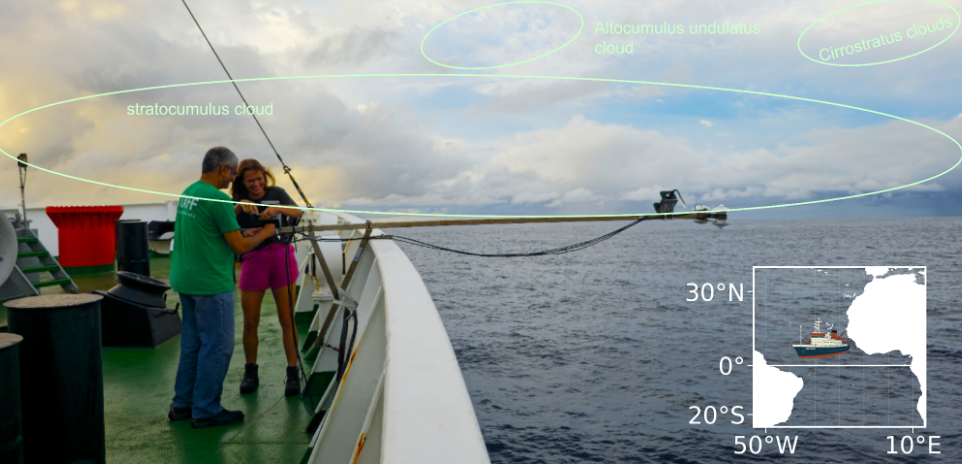
After leaving Recife, we entered a region typically influenced by the southeast trade winds of the tropical South Atlantic, where a vertically layered atmosphere, warm ocean conditions, and wind-driven mixing often promote a turbulent marine boundary layer. In Figure 1, the sky shows a layered cloudscape ranging from thin, high cirrostratus and altocumulus clouds to low cumulus and towering cumulonimbus clouds. These different forms reflect how the atmosphere organizes moisture, cooling, and vertical motion: broad layers are associated with gradual ascent, while the rising turrets of cumulus and cumulonimbus reveal stronger localized updrafts. Together, they illustrate the visible macroscopic structure of clouds, shaped by atmospheric motion and the microphysical processes occurring within them.
It should be noted that, in general, atmospheric temperature in the troposphere decreases with increasing altitude. Over the subtropical oceans, however, this is not the case. A relatively thin temperature-inversion layer lies above the subtropical marine boundary layer, within which temperature increases with height and the atmosphere is highly stable (Figure 2). Cloud occurrence above the marine boundary layer is relatively low in this region. The base of the trade-wind inversion is typically located at an altitude of approximately 1–2 km, separating the moist lower layer from the dry free troposphere [c].
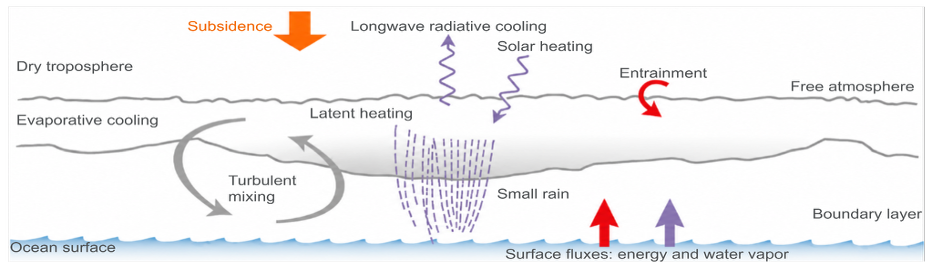
This large-scale thermodynamic structure provides the environmental conditions under which clouds form and evolve. At the microscopic scale, however, clouds consist of particles: liquid water droplets, ice crystals, or a mixture of both. Clouds composed entirely of liquid droplets are commonly referred to as “warm clouds”, whereas clouds containing ice particles are classified as “cold clouds”. When liquid droplets and ice crystals coexist, the cloud is described as a mixed-phase cloud. However, the distinction between “warm” and “cold” clouds hinge on the phase of the particles, not on the temperature. The warm/cold distinction depends on the microphysical phase of the particles inside the cloud, which a normal naked eye observation cannot resolve.
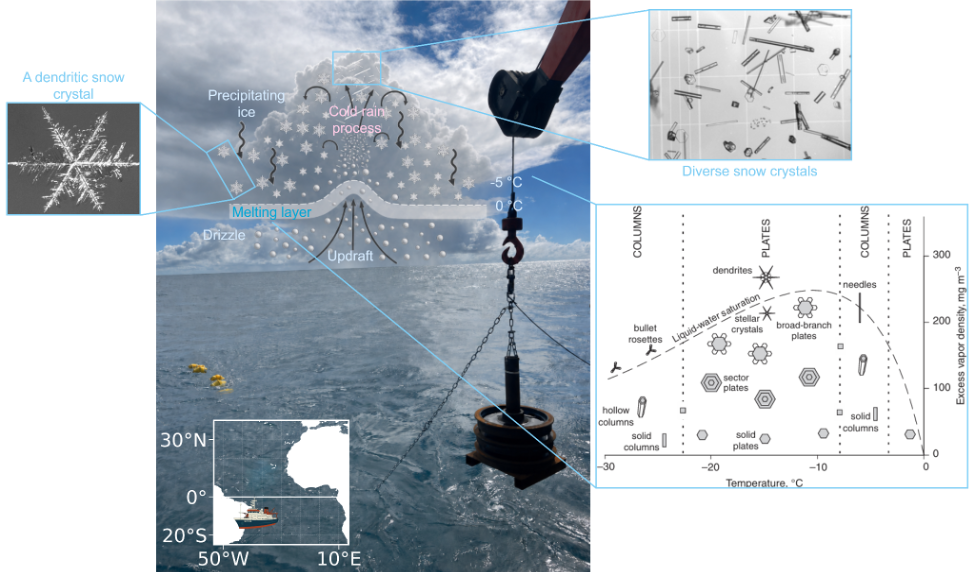
Warm clouds consist of liquid water droplets spanning a range of sizes, from small haze droplets and cloud condensation nuclei to cloud droplets, drizzle drops, and raindrops (Figure 3). Cloud droplets typically form when water vapour condenses onto cloud condensation nuclei. Rainfall develops when some droplets grow much larger: larger droplets fall faster, collide with smaller droplets, and collect them. As a result, many small cloud droplets can combine to form fewer, larger drizzle drops and eventually raindrops [a]. This process approximately conserves the total liquid-water mass within the cloud, while transferring water from numerous small droplets to a much smaller number of large drops that are heavy enough to fall as rain.
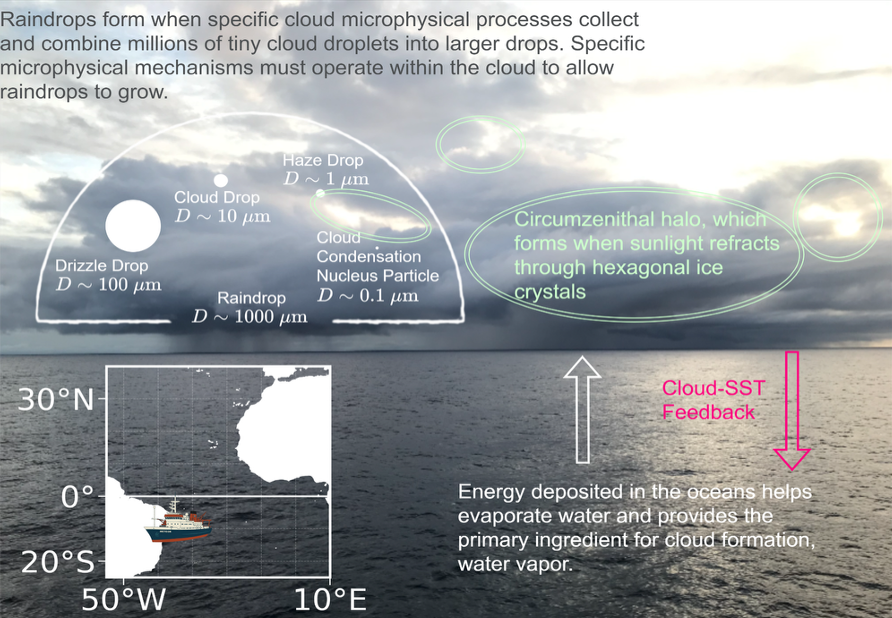
Cold clouds contain ice particles, either alone or together with supercooled liquid water droplets [a]. Unlike liquid droplets, which are nearly spherical because of surface tension, ice particles can develop a wide range of crystalline shapes, including plates, columns, needles, dendrites, and aggregates (Figure 4). Their shape depends mainly on temperature and ice supersaturation during growth by water-vapour deposition. As ice crystals become large enough to fall, they may collide and stick together to form snow aggregates, or collect supercooled droplets that freeze on contact, a process known as riming. The regular hexagonal structure of ice crystals can also produce optical phenomena such as halos, which form when sunlight is refracted or reflected by suitably oriented ice crystals in high-level clouds as shown in Figure 3. In mixed-phase clouds, uplift supports the growth of ice crystals at the expense of supercooled droplets. Once sufficiently large, the ice precipitates and may melt into rain or drizzle while falling through the melting layer (Figure 3).
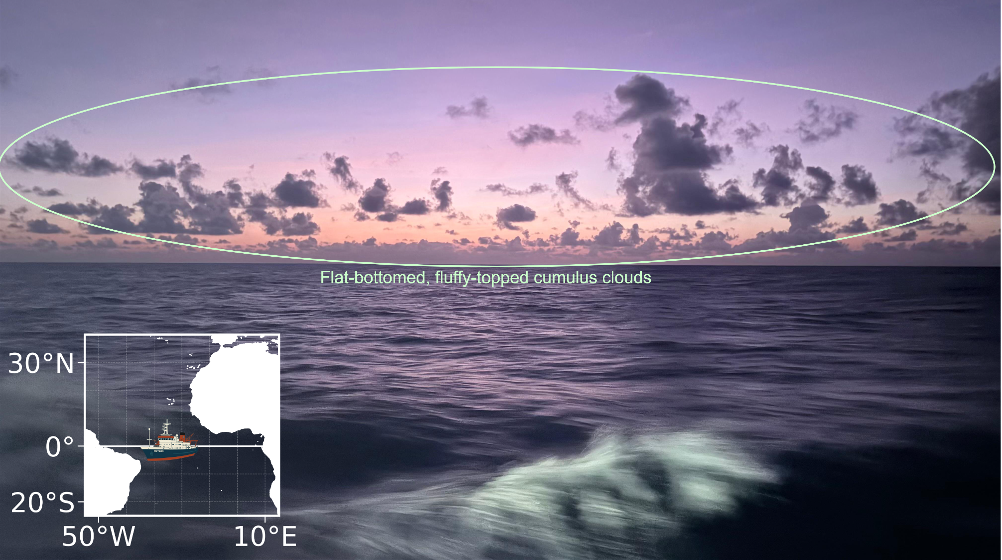
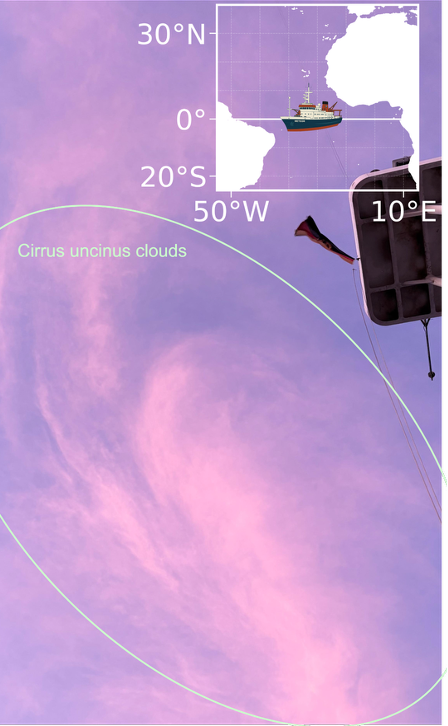
When we approached the equator, we saw many cumulus clouds with remarkably flat bases, marking the lifting condensation level where warm, moist air rising from the ocean cooled to its dew point and condensed into droplets. Similar temperature/humidity across an area leads to clouds sharing flat bases. Their uneven, towering tops reflected continued turbulence and convection above this level, revealing the active vertical mixing of the tropical atmosphere (Figure 5). As moist tropical air rises toward the cold-point tropopause, it encounters extremely low temperatures. When an air mass reaches a local temperature minimum, water vapour can freeze into very thin cirrus clouds (Figure 6).
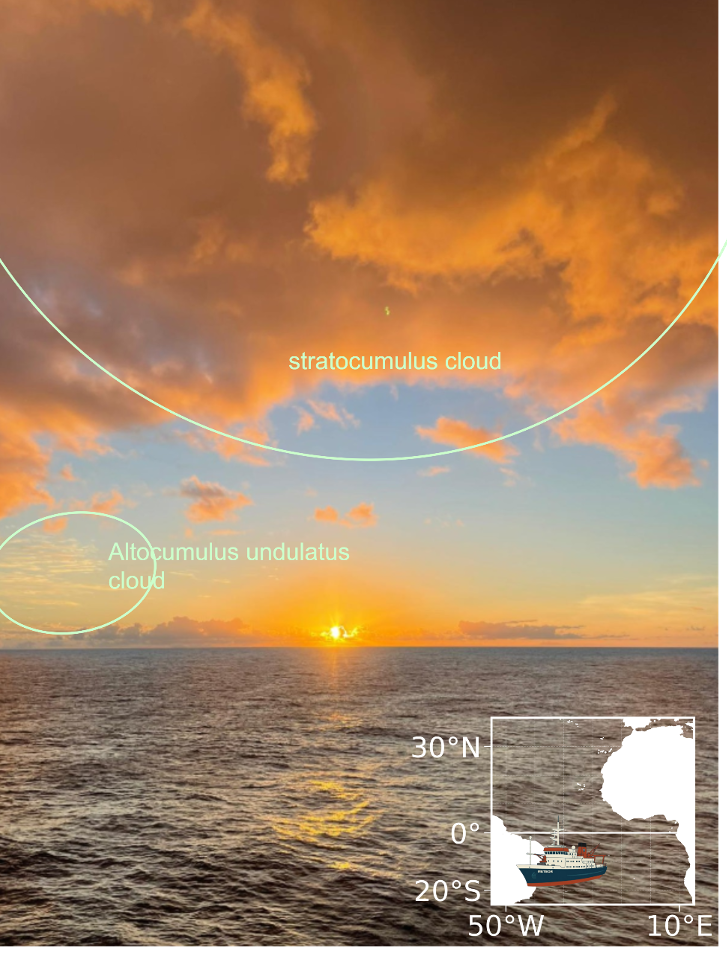
After crossing the equator, we entered the Intertropical Convergence Zone (ITCZ), a band of heavy rainfall extending across the tropical Atlantic. Cloud organization within and around the ITCZ varies markedly from day to day. Extensive low-level stratocumulus clouds can also occur in the surrounding region, acting like a blanket that reduces the amount of incoming solar radiation reaching the ocean surface (Figure 7).
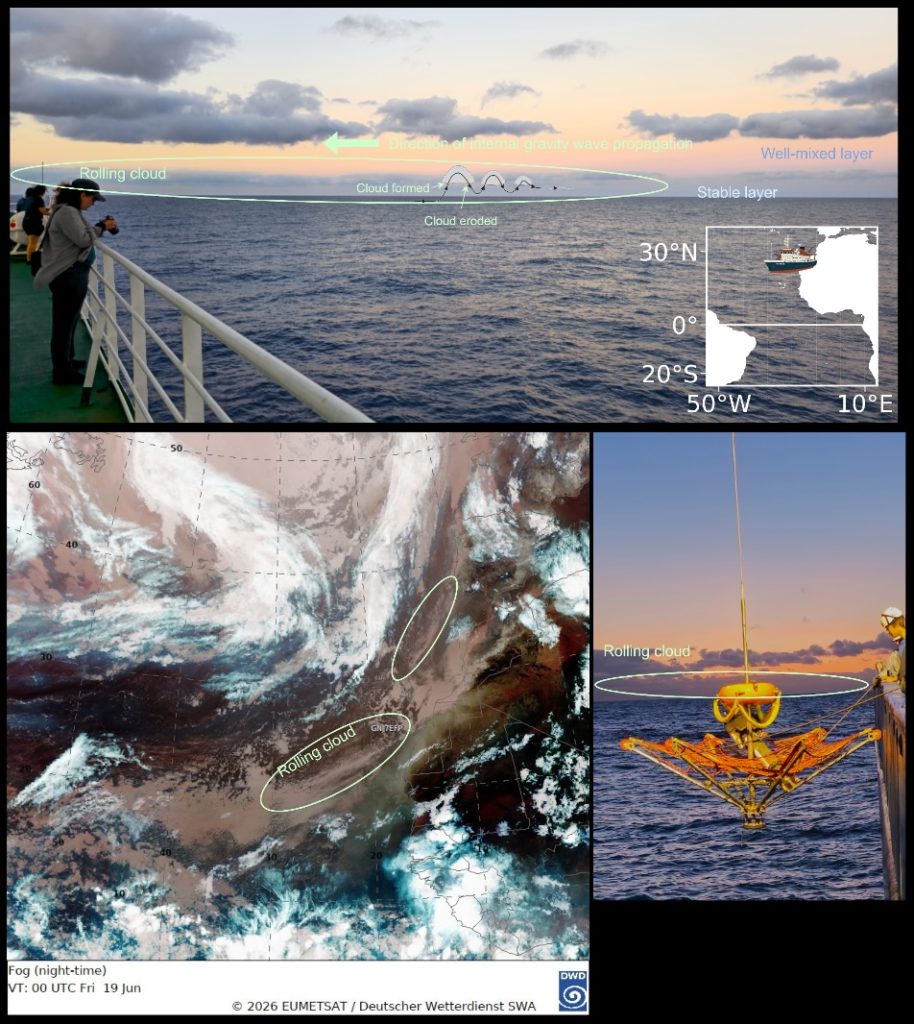
As we continued northward on our way home, we moved closer to the continent and witnessed some spectacular roll clouds, a very rare meteorological phenomenon. This type of cloud is known as “Morning Glory,” although evening land breezes can also produce roll clouds. The roll cloud is not attached to other clouds. associated with a solitary wave, a wave that has a single crest and moves without changing speed or shape.
As we were relatively close to the shoreline of West Africa, these roll clouds may have been produced by internal gravity waves propagating along a stable marine boundary layer [d]. The collision or sudden advance of a sea breeze or cold front can disturb the stable air layer near the surface, generating an atmospheric bore (a train of internal gravity waves). Such waves consist of alternating regions of upward and downward motion. Along the crest of the wave, moist air is lifted and cools to saturation, forming clouds, while behind the crest the air descends and warms, causing the cloud to evaporate. Because this cycle of ascent and descent extends along a long line of low-level convergence, cloud is continuously generated at the leading edge and dissipated at the trailing edge, maintaining a long, coherent band (Figure 8).
I think observing and thinking about clouds can be a nice hobby for enjoying the beauty of nature. Cloud processes are stochastic because nucleation and droplet collection do not occur at exactly the same time for every particle, even under the same environmental conditions [a]. Instead, freezing, condensation, and coalescence depend on chance microscopic events, so only some droplets become “lucky” and grow or freeze earlier than others. Perhaps cloud viewing could also give us good food for thought. After all, many cloud-related problems in climate modeling remain among the most beautiful mysteries in climate science.
Enjoy ~
References:
[a] Lamb D, Verlinde J. Physics and Chemistry of Clouds. Cambridge University Press; 2011.
[b] Levizzani, V., Kidd, C. (2025). Cloud Physics. In: Precipitation. Geophysics and Environmental Physics. Springer, Cham. https://doi.org/10.1007/978-3-031-97096-2_3
[c] Shang-Ping Xie. Subtropical climate: Trade winds and low clouds. In: Coupled Atmosphere-Ocean Dynamics. Elsevier; 2024. p. 139–163. doi:10.1016/B978-0-323-95490-7.00006-0.
[d] The Morning Glory and related phenomena. https://www.meteo.physik.uni-muenchen.de/~roger/AustralianProjects/TheMorningGlory/TheMorningGlory.html



-
Greenhouse Gases11 months ago
Guest post: Why China is still building new coal – and when it might stop
-
Climate Change11 months ago
Guest post: Why China is still building new coal – and when it might stop
-

 Greenhouse Gases2 years ago
嘉宾来稿:满足中国增长的用电需求 光伏加储能“比新建煤电更实惠”
-

 Climate Change2 years ago
嘉宾来稿:满足中国增长的用电需求 光伏加储能“比新建煤电更实惠”
-
Climate Change2 years ago
Bill Discounting Climate Change in Florida’s Energy Policy Awaits DeSantis’ Approval
-

 Renewable Energy8 months ago
Sending Progressive Philanthropist George Soros to Prison?
-

 Carbon Footprint2 years ago
US SEC’s Climate Disclosure Rules Spur Renewed Interest in Carbon Credits
-
Greenhouse Gases11 months ago
嘉宾来稿:探究火山喷发如何影响气候预测