

By John Kerry, Visiting Statesman at Carnegie Endowment for International Peace, former US Secretary of State, and former Special Presidential Envoy for Climate
Many eyes in the climate community are focused on COP30 in Belem this November, but there’s another critical climate moment happening now in September: London International Shipping Week.
This can be a moment to put industry’s muscle behind the decisions that need to be made to reap the benefits and accelerate the opportunity presented by the International Maritime Organization’s (IMO) April embrace of the Net-Zero Framework, which is to be formally adopted by governments next month.
The maritime community understands the significance of this agreement, the very first to align action with the IMO’s 2023 climate strategy words: combining a mandatory greenhouse gas fuel standard with a pricing mechanism that can reward first movers, and stimulate a rapid, worldwide transition that’s just and equitable.
First, though, that Framework must be adopted, and I encourage all Member States to support its passage at October’s extraordinary session of the Marine Environment Protection Committee. This deal agreed in April is the result of long and complex negotiations and a victory for multilateral cooperation.
A cornerstone to this approach is ensuring that all greenhouse gas emissions – not just CO2 – are addressed as soon as the protections enter into force in 2027. Similarly, emissions will be regulated on a well-to-wake basis.
While some details remain open for further negotiation, the shipping sector must now plan for a clean energy market – with opportunities for asset managers and fleet owners to reap the advantages of being first movers.
-
Governments agree green shipping targets and fees for missing them
Ship owners who fail to reduce emissions intensity 30% by 2035 will have to pay into a “net zero fund” to clean up shipping through green fuels -
Oil states accused of using scare tactics in bid to sink green shipping deal
Saudi Arabia, Iran and other oil-reliant countries are campaigning to stop the adoption of the IMO’s Net-zero Framework in October -
Shipping’s climate deal sets up battle over pollution calculations for gas and biofuels
The IMO will set emissions intensity levels for different fuels that decide how ship owners will be rewarded or penalised for using them in new green push


The details of the Framework shouldn’t cut corners or dodge emissions commitments with teeth; fuel production should be backed by a robust sustainability criterion that accounts for elements of production such as indirect land uses changes.
These standards will help ensure the market accelerates and rewards solutions which are truly sustainable, scalable, and capable of delivering deep greenhouse gas emissions reductions. Current evidence suggests the e-fuels, or fuels made from renewable energy and green hydrogen, meet these criteria best. Use of these fuels must also be properly rewarded within the IMO’s Framework and supported by further national and private actions.
Some shipowners are already accelerating their turn towards this growing market and should continue to do so. In 2024 supply of alternative fuels such as ammonia or e-methanol was projected to be 50% higher than it was just in 2023. Their example is an important one for others who may believe that short-term fixes are a path of least resistance. Economic opportunity awaits those who act now to race to the other side of the shipping transition.
Customers are clearly ready and waiting for additional shipowners to make the jump. In February the second tender from the Zero Emission Buyer’s Alliance was launched, with 40 member companies looking to ship 1.5 million containers’ worth of goods on e-fuels. These commitments are commendable. More companies must join, and more investment is needed for this effort to succeed.
-
COP observers invited to reveal who is bank-rolling their participation at climate talks
As UN climate change body introduces new voluntary transparency measures, campaigners welcome “much needed step” to keep fossil fuel influence out of the talks -
Banned from the US: The voices missing at New York Climate Week
How can there be climate justice when people from some of the world’s most vulnerable countries are shut out of the conversation by Trump’s travel ban? -
Industry says carbon capture still an expensive last resort to cut emissions
Carbon capture players told a recent global conference that the technology remains a costly way to reduce CO2 and needs more government support


Beyond opportunity, it’s important to also consider risk. Reinvesting in the old way of doing things or patchwork short term solutions such as liquified natural gas could translate into stranded assets for these companies in short order.
Beyond fuels, to meet the full goals of the Revised Strategy energy efficiency solutions or technological innovations such as wind-assisted propulsion power should be deployed at greater scale. Many remain relatively underutilized.
Shippers can reverse this trend, not just for the immediate fuel savings, but for the degree of resilience these technical measures offer in the face of strengthening climate regulations. More tools exist today to help shipowners navigate these decisions, and the financial sector can offer more creative products to accelerate the transition.
At COP 26, as Special Presidential Envoy for Climate, I stood with CEOs from the world’s largest companies and we launched the First Mover’s Coalition to demonstrate a simple proposition: a gigantic industry-led demand signal for the climate solutions hard-to-abate sectors were longing to create.
In a short time, global shipping has risen to the challenge and developed many of the tools envisioned in that initiative. We now have enabling frameworks backing up the growing market for solutions that everyone at London International Shipping Week can embrace.
We are on the cusp of something exciting – proof that “if you build it, better solutions will come.” It’s an historic moment to stop waiting for perfection, get to work, and decide that we’re all first movers now – for our economy, and our future.
The post Diplomacy accelerated shipping climate action; it’s time to seal the deal appeared first on Climate Home News.
Diplomacy accelerated shipping climate action; it’s time to seal the deal

Three countries have been named by the Paris Agreement’s compliance committee for failing to submit a nationally determined contribution (NDC) and repeatedly snubbing offers of help with their climate plans.
After months of internal debate over whether to identify serial non-responders, the Paris Agreement’s Implementation and Compliance Committee (PAICC) named the three countries which have failed to engage with it over their NDCs on Friday.
It named Democratic Republic of Congo, Senegal and North Korea in a footnote of its annual report, adding that it decided to name them “with a view to facilitating engagement”, adding that representatives of the three nations had been invited to its meeting in early 2027 “with the purpose of identifying any challenges and constraints”.
“The Committee noted the importance of Parties engaging with the Committee in a timely manner, while noting that some delays may be due to the national capabilities and circumstances of the Parties”, the report said.
-
Under US pressure, World Bank says it will back gas “where appropriate”
The US wants the World Bank to expand its gas support while climate campaigners are pushing for it to end – its head spoke this week of limited backing for the fossil fuel -
IPCC scientists vow to press on with climate reports despite political deadlock
After governments again failed to agree a timeline, nearly 120 IPCC authors pledged to complete their assessment on time and with full scientific rigour -
Paris Agreement committee snubbed over missing NDC climate plans
Many governments have still not submitted a nationally determined contribution to the UN, breaching a key requirement of the Paris Agreement

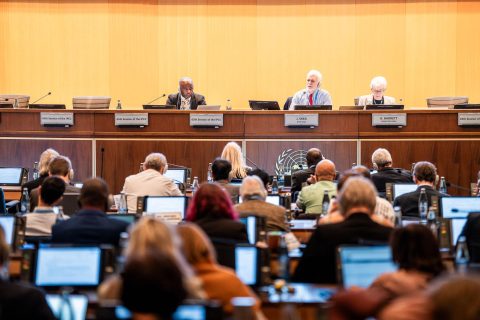

In July, PAICC said 12 countries had ignored its repeated attempts to discuss why they had not published an NDC as required every five years under the 2015 Paris accord.
Members of the committee had been divided over whether to name them, but at a September meeting decided to do so in their annual report to the annual climate COP summit.
By the time the report was published on Friday, only Congo, Senegal and North Korea “had not communicated an NDC or submitted a [Biennial Transparency Report] and had not yet responded to any of the Committee’s notifications, despite several reminders issued by the Committee in this regard”.
Rainforest and renewable energy ambitions
The silence from Congo and Senegal is notable because the former is home to much of the Congo Basin rainforest while the latter has sought billions of dollars in climate finance to support its renewable energy ambitions.
After Brazil, Congo has more rainforest than any country in the world. This forest, and the country’s peatlands, absorb huge amounts of greenhouse gas but are fast being lost to expanding farmland, charcoal production, logging and mining.
Senegal signed a Just Energy Transition Partnership with Canada and wealthy European nations in 2023, to help it meet its renewable energy targets under the-then government of Macky Sall. It was chair of the Least Developed Countries group between January 2022 and December 2023.

Tejas Rao, who is researching the PAICC as part of a doctoral thesis at Cambridge University, said the governments of the three countries should engage with the committee.
“Engagement costs these governments very little and the committee has shown it will listen,” he said.
“Silence leaves the committee with no basis to help, and it leaves the [governments] exposed to the narrative that they are simply disengaged,” he told Climate Home News.
Paris Agreement requirement
The 2015 Paris Agreement requires all parties to publish an NDC every five years outlining their emissions reduction targets, with each plan meant to be more ambitious than the country’s last NDC.
The latest set – the third round of plans, with new targets for 2035 – was due in February 2025. While most countries missed this deadline, all but around 30 – mostly small emitters but including Egypt, Vietnam and Argentina – have now submitted them.
Over the year, the PAICC – which is made up of government climate officials from developed and developing countries – has been communicating with governments that have not submitted NDCs and trying to overcome barriers to them doing so.
Some nations have cited exceptional circumstances as the reason for not submitting an NDC, a process that requires a significant amount of work in tracking emissions and consulting on how to curb them across the economy. For example, a letter from a Sudanese official to the PAICC, seen by Climate Home News, said that the country’s civil war had led to the suspension of its NDC preparation.
-
IPCC scientists vow to press on with climate reports despite political deadlock
After governments again failed to agree a timeline, nearly 120 IPCC authors pledged to complete their assessment on time and with full scientific rigour -
Under US pressure, World Bank says it will back gas “where appropriate”
The US wants the World Bank to expand its gas support while climate campaigners are pushing for it to end – its head spoke this week of limited backing for the fossil fuel -
Who shapes climate science? The equity question facing the IPCC
Early completion of the next global climate science assessment reports risks excluding research from the Global South, which is key to ensuring the findings are fair

The US and Iran are not signed up to the Paris Agreement and so do not have active NDCs, nor does Taiwan, which is not a UN member state.
Rao said that because the PAICC is “facilitative and non-punitive”, naming the countries “is meant to open a door, not close one – the invited consultation is the point”.
“In recent months, governments that explained their constraints, whether capacity, finance or domestic process, have been met with follow-up and support rather than sanction, and the number of silent governments has fallen sharply,” Rao said.
The post Paris Agreement committee names three countries snubbing it over NDCs appeared first on Climate Home News.
Paris Agreement committee names three countries snubbing it over NDCs