



- What timeline options were delegates debating?
- How did the timeline discussions unfold?
- What were the main points of disagreement?
- Why is the IPCC in a ‘serious funding crisis’?
- How have scientists reacted?
- What other issues remain unresolved?
- How are the IPCC AR7 reports progressing?
- How might the IPCC use AI and enhance gender inclusivity?

As an Indigenous geography scholar and researcher, I increasingly focus on the realities of climate change and its profound impact on ecology. In a recent class I co-instructed at the Queen’s University School of Urban and Regional Planning, I introduced students to ancestral Indigenous planning, centring on a 12th-century Iroquoian community model. The discussion illuminated how human interactions with the land and natural resources were determinants of community planning and fundamental to sustaining the delicate balance of human and non-human relations.
Exploring the interrelationship of people and place through the cultural geography of the Haudenosaunee, we delved into how identity itself is shaped by land and its natural actors. For a class filled with aspiring urban and regional planners—along with three practicing city planners—the experience was transformative. It quickly became apparent that planning must move beyond rigid zoning practices and embrace place-based autonomy, where decision-making aligns with the rhythms and needs of the land itself.
Haudenosaunee Knowledge and Climate Adaptation
The prevailing mindset in modern urban and regional planning has long been dictated by frameworks rooted in industrialization, urban sprawl, and resource extraction. Much of the profession adheres to highly regulated, standardized practices that prioritize short-term economic gain over long-term environmental sustainability. Yet Indigenous planning offers a profound alternative that considers the interconnectedness of people, land, and ecological cycles.
This perspective challenges the conventional notion that humans design space for habitation; instead, it asserts that we must enhance and harmonize with the natural rhythms of place. When we examined Haudenosaunee planning principles, students responded with genuine curiosity and awe. Concepts such as ensuring the autonomy of water sources were central to settlement adaptation, using topography for protection, and identifying prime lands for cultivation were revelatory for many.
The more students engaged with this knowledge, the more they recognized that contemporary urban and regional planning must evolve to address the growing need for sustainable living. Climate change is no longer a future concern—it is here and reshaping our landscapes. If planners and policymakers fail to integrate climate adaptation and Indigenous value systems into their frameworks, they risk perpetuating unsustainable models that continue to degrade the environment.
The Iroquoian Longhouse: A Model for Sustainable Design
A compelling example of Indigenous planning is the Iroquoian longhouse, a structure that served as both shelter and a communal space. Built from natural materials such as elm bark, the longhouse was constructed with deep respect for the land—only taking what was necessary, ensuring sustainability, and allowing trees to replenish. The longhouse’s design reflected a life-cycle systems approach; structures were built for 30 to 40 years before being returned to the earth, where they naturally decomposed and reintegrated into the landscape.

Image Source: Wikimedia Commons (‘Exterior View of Traditional Iroquois Longhouse’).
The students were fascinated by the idea that communal spaces were designed with a finite yet renewable existence. In contrast, modern urban development often prioritizes permanence and expansion, creating structures that outlive their usefulness, contributing to urban decay and environmental strain. What if, instead, our urban centers were designed with adaptability in mind? What if materials used in construction aligned with ecological cycles rather than being treated as disposable waste?
The Power of Education in Transforming Urban Planning
Education systems are critical in fostering openness to new ideas and methodologies. However, much of the current urban planning curriculum is rooted in post-war suburban development models emphasizing efficiency, uniformity, and mass production. Integrating Indigenous value systems, environmental determinants, and climate change considerations into planning education is essential in fostering a holistic, future-focused approach to community development.
The challenge, of course, lies in decolonizing the profession itself. Innovation in urban and regional planning is often stifled in favour of “tried and true” practices prioritizing economic stability over ecological well-being. Yet, if planners are to truly serve the needs of future generations, they must expand their thinking beyond conventional models. Indigenous planning philosophies, such as those practiced by the Haudenosaunee, represent just one of the hundreds of cultural contributions that can help reshape human-centred design into more inclusive and regenerative.
A Call to Action: Expanding Thought, Embracing Change
If climate change is to be effectively addressed in community development, it must be at the forefront of planning discussions, not an afterthought. Recognizing the significance of place-based planning, environmental stewardship, and Indigenous knowledge systems is not an elective enhancement but a necessary revolution.
Urban and regional planning must evolve beyond rigid regulations and embrace the knowledge that has sustained Indigenous communities for millennia. The interconnectedness of land, water, climate, and human habitation must become central to planning efforts. This requires an intentional shift in education that welcomes new perspectives, cultural inclusivity, and Indigenous methodologies as fundamental learning components. It is not merely about integrating Indigenous knowledge for inclusion but about recognizing its profound value in creating sustainable, resilient, and thriving communities.
In the face of climate change, the question is no longer whether we need change but whether we are willing to embrace it. The wisdom of Indigenous planning offers a pathway forward, one rooted in reciprocity, sustainability, and deep respect for the land. Now is the time to expand our thinking, decolonize our approaches, and integrate climate consciousness into planning.
For the future of our communities, ecosystems, and generations, we must choose transformation over stagnation, reciprocity over exploitation, and sustainability over short-term convenience.
– By Rye Karonhiwanen Barberstock
(Header Image Credit: A.C., Licenced, Unsplash+)
The post Decolonizing Urban and Regional Planning: Haudenosaunee Knowledge, Stewardship, and Climate Adaptation appeared first on Indigenous Climate Hub.
Continue Reading
Three countries have been named by the Paris Agreement’s compliance committee for failing to submit a nationally determined contribution (NDC) and repeatedly snubbing offers of help with their climate plans.
After months of internal debate over whether to identify serial non-responders, the Paris Agreement’s Implementation and Compliance Committee (PAICC) named the three countries which have failed to engage with it over their NDCs on Friday.
It named Democratic Republic of Congo, Senegal and North Korea in a footnote of its annual report, adding that it decided to name them “with a view to facilitating engagement”, adding that representatives of the three nations had been invited to its meeting in early 2027 “with the purpose of identifying any challenges and constraints”.
“The Committee noted the importance of Parties engaging with the Committee in a timely manner, while noting that some delays may be due to the national capabilities and circumstances of the Parties”, the report said.
-
Under US pressure, World Bank says it will back gas “where appropriate”
The US wants the World Bank to expand its gas support while climate campaigners are pushing for it to end – its head spoke this week of limited backing for the fossil fuel -
IPCC scientists vow to press on with climate reports despite political deadlock
After governments again failed to agree a timeline, nearly 120 IPCC authors pledged to complete their assessment on time and with full scientific rigour -
Paris Agreement committee snubbed over missing NDC climate plans
Many governments have still not submitted a nationally determined contribution to the UN, breaching a key requirement of the Paris Agreement
In July, PAICC said 12 countries had ignored its repeated attempts to discuss why they had not published an NDC as required every five years under the 2015 Paris accord.
Members of the committee had been divided over whether to name them, but at a September meeting decided to do so in their annual report to the annual climate COP summit.
By the time the report was published on Friday, only Congo, Senegal and North Korea “had not communicated an NDC or submitted a [Biennial Transparency Report] and had not yet responded to any of the Committee’s notifications, despite several reminders issued by the Committee in this regard”.
Rainforest and renewable energy ambitions
The silence from Congo and Senegal is notable because the former is home to much of the Congo Basin rainforest while the latter has sought billions of dollars in climate finance to support its renewable energy ambitions.
After Brazil, Congo has more rainforest than any country in the world. This forest, and the country’s peatlands, absorb huge amounts of greenhouse gas but are fast being lost to expanding farmland, charcoal production, logging and mining.
Senegal signed a Just Energy Transition Partnership with Canada and wealthy European nations in 2023, to help it meet its renewable energy targets under the-then government of Macky Sall. It was chair of the Least Developed Countries group between January 2022 and December 2023.

Tejas Rao, who is researching the PAICC as part of a doctoral thesis at Cambridge University, said the governments of the three countries should engage with the committee.
“Engagement costs these governments very little and the committee has shown it will listen,” he said.
“Silence leaves the committee with no basis to help, and it leaves the [governments] exposed to the narrative that they are simply disengaged,” he told Climate Home News.
Paris Agreement requirement
The 2015 Paris Agreement requires all parties to publish an NDC every five years outlining their emissions reduction targets, with each plan meant to be more ambitious than the country’s last NDC.
The latest set – the third round of plans, with new targets for 2035 – was due in February 2025. While most countries missed this deadline, all but around 30 – mostly small emitters but including Egypt, Vietnam and Argentina – have now submitted them.
Over the year, the PAICC – which is made up of government climate officials from developed and developing countries – has been communicating with governments that have not submitted NDCs and trying to overcome barriers to them doing so.
Some nations have cited exceptional circumstances as the reason for not submitting an NDC, a process that requires a significant amount of work in tracking emissions and consulting on how to curb them across the economy. For example, a letter from a Sudanese official to the PAICC, seen by Climate Home News, said that the country’s civil war had led to the suspension of its NDC preparation.
-
IPCC scientists vow to press on with climate reports despite political deadlock
After governments again failed to agree a timeline, nearly 120 IPCC authors pledged to complete their assessment on time and with full scientific rigour -
Under US pressure, World Bank says it will back gas “where appropriate”
The US wants the World Bank to expand its gas support while climate campaigners are pushing for it to end – its head spoke this week of limited backing for the fossil fuel -
Who shapes climate science? The equity question facing the IPCC
Early completion of the next global climate science assessment reports risks excluding research from the Global South, which is key to ensuring the findings are fair
The US and Iran are not signed up to the Paris Agreement and so do not have active NDCs, nor does Taiwan, which is not a UN member state.
Rao said that because the PAICC is “facilitative and non-punitive”, naming the countries “is meant to open a door, not close one – the invited consultation is the point”.
“In recent months, governments that explained their constraints, whether capacity, finance or domestic process, have been met with follow-up and support rather than sanction, and the number of silent governments has fallen sharply,” Rao said.
The post Paris Agreement committee names three countries snubbing it over NDCs appeared first on Climate Home News.
Paris Agreement committee names three countries snubbing it over NDCs
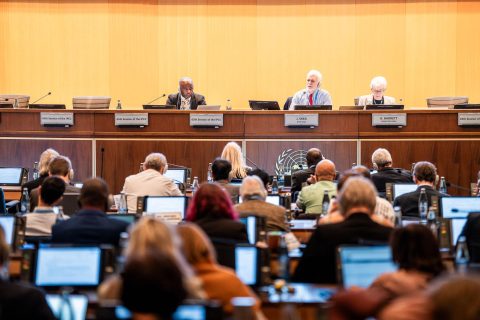
Countries have failed – for the sixth time running – to agree on the timeline for publishing the Intergovernmental Panel on Climate Change’s (IPCC) next set of influential reports.
The IPCC’s 65th session (IPCC-65) was seen by many to be the final opportunity for countries to agree on a schedule where its seventh assessment report (AR7) would be published in time for the UN’s second “global stocktake” of climate action.
Before last week’s meeting in Addis Ababa, Ethiopia, IPCC chair Prof Sir Jim Skea had warned that releasing the reports in time for the stocktake in 2028 would depend on a timelines being agreed by the end of 2026.