

Welcome to Carbon Brief’s DeBriefed.
An essential guide to the week’s key developments relating to climate change.
This week
Drought in southern Africa
NATIONAL DISASTERS: An ongoing extreme drought in southern Africa is threatening millions of people with hunger, Sky News reported. According to Reuters, Zimbabwe has declared the drought a national disaster. The drought has also reached crisis levels in neighbouring Zambia and Malawi, with both countries declaring national disasters, the Associated Press said. Botswana, Angola, Mozambique and Madagascar are also affected, it added.
EL-NIÑO: Dry weather conditions linked to the El Niño weather pattern have worsened the drought, which emerged in its latest phase in mid-2023, Deutsche Welle reported. El Niño reached a peak in December, according to the World Meteorological Organization, but is still expected to result in above-normal temperatures until May, the outlet added. Scientists told Sky News that El Niño could be “amplifying the existing impacts of climate change”.
CALL FOR AID: Zimbabwe president Emmerson Mnangagwa said the country needs more than $2bn in aid to feed the millions of people facing hunger, the Associated Press reported. It added that the United Nations’ World Food Programme has already rolled out a food assistance programme targeting 2.7 million people.
Electric car sales slump
POOR QUARTER: The world’s top sellers of electric vehicles (EV), Elon Musk’s Tesla and Chinese rival BYD, reported sharp falls in sales in the first financial quarter of this year, adding to “concerns over the slowing shifts towards EVs”, the Financial Times reported. It added that both carmakers have repeatedly cut prices since the start of the year in a bid to stimulate demand.
DIRE FUTURE?: Tesla’s shares fell following the news, extending their 2024 slide to 33%, the second-worst showing in the S&P 500 stock market index, Bloomberg reported. The dip in sales comes amid a “sharp deterioration in growth” for US EVs, the New York Times said. However, Musk is mulling over the possibility of building a £3bn Tesla EV factory in India, the Daily Telegraph reported.
ELECTRIC SUBSIDIES: Only seven out of 500,000 EV charging stations have been built under a $7.5bn US government subsidy programme launched in 2021 and scheduled for completion by 2030, the Independent reported. The Federal Highway Administration told the Independent that “the slow pace has been deliberate, to avoid costly mistakes while navigating a brand-new law and building a network from scratch”.
Around the world
- SEARING HEAT: India’s national weather service has forecast “hotter-than-usual” temperatures for April to June, raising the risk of water shortages and crop damages, Bloomberg reported.
- UNUSUAL FIRES: Venezuela is battling a record number of wildfires – with satellites detecting more than 30,200 fires between January and March – as a climate change-driven drought consumes the Amazon rainforest region, according to Reuters.
- CLIMATE JUSTICE: Shell began its appeal against a ruling at The Hague that compelled it to slash its emissions by 45% by 2030, relative to 2019, the Financial Times reported. A judgement is expected in the second half of this year, the paper added.
- AID BY FOSSIL: White House officials have suggested that they are open to ending president Joe Biden’s pause on approvals of new liquefied natural gas (LNG) export terminals in order to get a Ukraine aid package through Congress, Reuters reported. A White House spokesperson denied the story.
- WARNING BELLS: According to a new study reported by the Guardian, a boom in mining projects for minerals needed in renewable energy technologies is now threatening up to a third of apes in Africa.
- STANDING TALL: A new analysis found that the number of trees lost in Brazil and Colombia was down “dramatically” in 2023 – falling by 39% – largely due to changes in political leadership in these nations, according to BBC News.
57
The number of fossil fuel and cement producers responsible for 80% of the world’s CO2 emissions from 2016-2022, according to the Carbon Majors project by non-profit thinktank InfluenceMap.
Latest climate research
- A study in npj Climate Action evaluated the perceptions of climate change among a selection of academics at a local university in Cameroon and suggested a framework to support educators as they help to foster critical thinking.
- The optimal location for North American birds has shifted northward by an average rate of 1.5km each year in response to climate change, a new study in Proceedings of the National Academy of Sciences found, representing a total distance moved of 82.5km over the past 55 years.
- A new study in Climate and Development investigated the “policy blind spots” around the contribution of women to rangeland cultivation in Tunisia and the effects of climate change on their livelihoods.
(For more, see Carbon Brief’s in-depth daily summaries of the top climate news stories on Tuesday, Wednesday, Thursday and Friday.)
Captured
The UN climate change body, the UNFCCC, is largely funded by industrialised nations, such as the US, China, Japan, UK and France. However, these nations have not yet paid anything towards the UNFCCC’s core budget for this year, according to Carbon Brief analysis of UN data. This shortfall could be impacting the body’s functioning. For example, the UNFCCC recently cancelled this year’s Regional Climate Weeks, which are a “vital platform to express the concerns of people and communities most affected by climate change,” according to a comment piece by WaterAid’s Dulce Marrumbe published on Climate Home News. “The suspension of the Regional Climate Weeks is hugely disappointing news,” Marrumbe said.
Spotlight
How is Nigeria coping with extreme heat fuelled by climate change?
This week, Carbon Brief zooms in on how Nigerians are responding to the extreme heat affecting west Africa.
Since the start of this year, Africa’s most populous nation Nigeria has faced prolonged stretches of severe heat.
A recent quick-fire analysis found that the conditions in February, when temperatures exceeded 40C, were made 10 times more likely by human-caused climate change.
But the heat is still ongoing, with temperatures reaching a record 44.8C in Sokoto, a city in north-western Nigeria, on 1 April.
With comprehensive record-keeping of heat and its impacts lacking in Nigeria, Carbon Brief spoke to doctors, farmers and meteorologists about how this episode of extreme weather is affecting the country.
Health impacts
The impact of the heat is “catastrophic”, Dr Ugo Uguwanyi, a doctor in Abuja, Nigeria’s capital city, told Carbon Brief:
“Don’t even bother to step out from 10am to 6pm. And make sure you burn the diesel to power the air conditioning to be able to sleep at night.”
Information about the heatwave’s impact is limited, but this does not mean the weather conditions are not dangerous, according to the authors of the recent analysis into the role of climate change in Nigeria’s extreme heat. Rather, a lack of systematic reporting may obscure what they described as a “silent killer”.
In mid-February, the Nigerian Meteorological Agency (NiMet) issued a public forecast warning on the prolonged heatwave.
The agency advised citizens to stay hydrated, wear light clothing and avoid direct exposure to high temperatures during peak periods. A group of Nigerian doctors also issued safety tips.
NiMet’s director of Weather Forecast Services, Vincent Weli, had advised that a state of emergency be declared in states most affected by the heatwave and workers be allowed to take breaks between noon and 3pm. Speaking to Nigeria’s Channels Television, Weli said:
“Of course, you know, with high temperature, cognitive development will be affected and productivity will be affected. There will be a loss of concentration.”
However, no such directive has yet been issued by state governments.
Agricultural and workforce impacts
Meanwhile, in Lagos, Nigeria’s most populated city, ride-hailing drivers are operating under melting conditions, stuck between preserving their health or livelihood, according to a Rest of World report.
The heatwave is also expected to reduce agricultural productivity, a sector that contributes about 22% to Nigeria’s gross domestic product (GDP) and accounts for more than a third of total employment.
Wasiu Adeniyi Ibrahim, a meteorologist from NiMet, told Carbon Brief:
“Heatwaves can reduce agricultural productivity by causing heat stress to crops and livestock.”
There is not a lot of data on how the current heat is affecting agriculture in Nigeria.
However, the national secretary of the All Farmers Association of Nigeria, Yunusa Halidu, told Carbon Brief that its members expect the heatwave to affect productivity yield this year. He said:
“The heat is extreme this year, although we have been expecting it, as we work with the Nigerian Meteorological Agency. We know it is global warming and we are working to see how we can mitigate the effects.”
Watch, read, listen
STRATEGIC DOMINANCE: Eric Olander and Cobus van Staden of the China-Global South Podcast interviewed automotive analyst Lei Xing on Chinese EV brands’ plans to dominate global-south car markets.
CLIMATE FUTURES: The New York Times investigated whether Guyana’s oil is a “blessing or a curse”.
CARBON POLITICS: In a new episode of Political Heat, environmental campaigner Amy Mount spoke to Prof Rebecca Willis about democracy and the challenge of responding to climate change.
Coming up
- 10 April: South Korea parliamentary elections
- 12 April: Launch of the International Energy Agency (IEA) oil market report
- 12-13 April: Second G20 environment and climate sustainability working group, Brasilia
Pick of the jobs
- Politico, sustainability editor | Salary: Unknown. Location: Brussels
- Climate Action Network International, finance and grants officer | Salary: €36,000-48,000. Location: Flexible
- International Centre for Integrated Mountain Development (ICIMOD), senior cryosphere specialist | Salary: Unknown. Location: Kathmandu, Nepal
- Business and Human Rights Resource Centre, senior researcher, just energy transition and natural resources | Salary: £37,500-40,000. Location: UK, Germany or remote
DeBriefed is edited by Daisy Dunne. Please send any tips or feedback to debriefed@carbonbrief.org.
This is an online version of Carbon Brief’s weekly DeBriefed email newsletter. Subscribe for free here.


The post DeBriefed 5 April 2024: Southern Africa’s drought ‘disaster’; Top electric car sales slump; Is Nigeria coping with extreme heat? appeared first on Carbon Brief.

After witnessing and hearing stories of Pacific islands’ vulnerability to climate change, senior climate officials have promised to strengthen efforts to limit global warming to 1.5C, despite an expected overshoot, and to help the region adapt to rising seas and other impacts.
More than 30 world leaders, ministers, climate negotiators and international development bankers travelled to the sinking atoll nation of Tuvalu on Tuesday before attending the pre-COP31 talks in Fiji, where schoolchildren told them about the effects warming-driven droughts, heatwaves and storms are having on their education.
Australia and the Pacific nations hoped to use the pre-COP to reinforce the urgency of tackling climate change to the officials from around 50 countries who travelled to the region. Fiji’s climate minister, Lynda Tabuya, told a closing press conference on Thursday they had wanted to “bring decision-makers to the climate frontlines”.
Many of those decision-makers said they had been moved by what they had seen and heard this week, and their speeches emphasised the importance of limiting global warming to 1.5C above pre-industrial levels, a key goal of the 2015 Paris climate agreement.
-
Pacific leaders rail at climate finance failures after pre-COP trip to Tuvalu
Island nations seek invest in their own Pacific Resilience Facility, as they struggle with the red-tape of international climate funds -
New Zealand accused of breaching EU trade deal over climate rollbacks
The EU’s climate trade rules face their first major test after a green group alleged New Zealand violated binding environmental provisions under its trade deal with the bloc

In September, a UN report acknowledged that the 1.5C threshold will be breached but said temperatures could still be brought back down to that level by the end of the century with stepped-up climate action.
A month ago, Türkiye‘s COP31 President Murat Kurum told a press conference in the northern Turkish city of Trabzon that limiting global warming to 1.5C “does not really look possible”, adding that “around 1.5C, that will be a success”.
But after seeing the “anxiety” of children and mothers in Tuvalu caused by rising sea levels, Kurum told reporters in Fiji that 1.5C is a “matter of survival – the survival of cultures, history, memories, your homeland, your homes – it’s that important.”
“The 1.5C target is in jeopardy and we do not have a single minute, a single day to lose,” he added through an interpreter.
Jacobo Ocharan, head of political strategies at Climate Action Network International, warned that “words of concern will not protect anyone”. “The Pacific has shown the world what is at stake. Now governments must show they are ready to act,” he said. “[COP31 in] Antalya must deliver decisions that change people’s lives for the better.”
$1.5 billion for 1.5C
In Fiji, Kurum echoed the call of Australia and Pacific nations for contributions to the fledgling Pacific Resilience Facility (PRF), which aims to use the returns on its investments to fund community climate adaptation projects like water storage, building sea walls and protecting homes from storms. “$1.5 billion for 1.5 degrees will save the Pacific,” he said. “It’s that easy. Life will continue in Tuvalu. Children will be smiling again.”
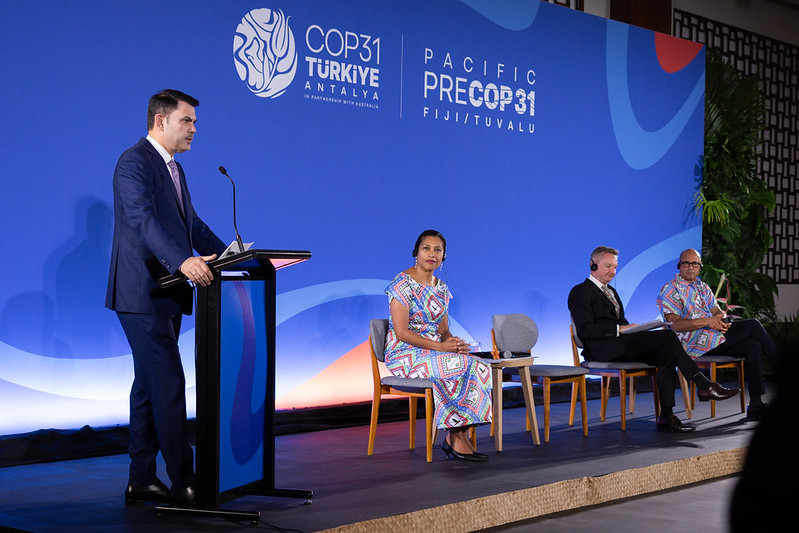
Sitting next to him, Fiji’s Tabuya said she was “encouraged” by his words. “$1.5 billion for 1.5. We will hold COP 31 to that,” she said. The PRF has been promised just under $200 million so far – including about $15 million pledged by European and Pacific governments at pre-COP – and is aiming for $500 million by COP31. It has a longer-term target of mobilising $1.5 billion in capital.
After Pacific leaders on Tuesday aired a litany of concerns about the barriers to accessing the global climate finance system, Kurum joined in at Thursday’s press conference. “Justice in climate finance is essential,” he said. “Resources must reach those in need in a timely and accessible manner, not through a lot of red-tape, and we cannot accept that the same countries should always bear the burden.”
Plan for easier access to climate finance
Australian climate and energy minister Chris Bowen, who is COP31’s president of negotiations, also lamented that “the countries that need the finance the most get it the least”. He said he would ask governments and multilateral development banks to support an access to finance plan for small island states and the world’s poorest nations, launched by Australia on Thursday.
The plan says that while there has been progress in making it easier and quicker to obtain international climate funding, “multiple persistent challenges have continued to limit access to climate finance for developing countries”.
It adds that the amounts available are insufficient to meet climate goals and stresses the need for “grant-based and highly concessional financing”, especially for adaptation and responding to loss and damage. The plan proposes an annual high-level forum on climate finance access to track implementation.
The pre-COP summit closed with an emotional plea from Fiji’s host minister Tabuya. Fighting back tears before finally succumbing, she asked delegates to “carry something of the Pacific with you”.
“Remember the people you met, the stories you heard and why we gathered. This pre-COP draws to a close tonight. Our responsibility does not,” she said to applause.
The post Pre-COP draws attention to Pacific’s climate plight and 1.5C goal appeared first on Climate Home News.
Pre-COP draws attention to Pacific’s climate plight and 1.5C goal
Climate Change
Australia’s climate credibility tested at Pacific Pre-COP talks, as High Court fossil fuel ruling puts government on notice
NADI, FIJI Thursday 8 October 2026 — As the Pacific Pre-COP talks wrap up and Australia prepares to take the reins of COP31 Negotiations in Türkiye next month, Greenpeace Australia Pacific says the government is on notice over fossil fuel expansion and exports, and must accelerate action to align with a 1.5°C pathway.
Following yesterday’s landmark High Court ruling that the climate impacts of coal and gas exports must be considered by New South Wales planning authorities, Greenpeace Australia Pacific is calling on the Albanese government to find the “courage, leadership and grit” to chart a new course away from fossil fuels.
High res images and video from yesterday’s ‘Keep 1.5C Alive’ flotilla in Nadi can be found here
Speaking from Nadi, Shiva Gounden, Head of Pacific at Greenpeace Australia Pacific, said:
“The outcomes of this week’s talks are a drop in the ocean given the scale of need, and urgency of the crisis our communities are facing. It is like taking a glass of water to a burning house if we do not urgently act to address the root cause of the existential threat facing Tuvalu, Fiji and all Pacific countries: fossil fuel expansion.
“The Electrification Pledge must end fossil fuel dependence, not be an end in itself — its ultimate success depends on ensuring electricity comes from renewable sources that displace fossil fuels and align with a 1.5°C pathway. It must be underpinned by justice and backed by finance flowing from polluters to communities.
“Limiting global warming to 1.5°C is a non-negotiable survival line for humanity and Australia must act. The landmark climate advisory ruling from the ICJ is clear — 1.5°C is the moral, the scientific and the legal limit. Continuing down the fossil fuel path, and failing to align efforts with limiting warming to 1.5°C, is a breach of our international legal obligations, and risks making Australia liable for future reparations from climate-vulnerable nations.”
Also in Nadi, Dr Simon Bradshaw, COP31 Lead and climate expert at Greenpeace Australia Pacific, said: “The Pacific was never going to be a mere backdrop for Australia in its role as incoming chair of the COP31 climate talks, but where its credibility and commitment to climate leadership would be tested.
“Here we see communities fighting for their survival and doing everything possible to hold the line on returning warming to 1.5°C. When governments profess to take their concerns seriously, only to then throw more fuel on the fire, the pain and sadness is visceral.
“This week the High Court of Australia recognised what the Federal Government refuses to — that Australia is responsible for the climate damage of our fossil fuel exports and if governments don’t act, the courts will intervene. The message is simple: this is not someone else’s problem, it is ours.
“We must now follow other countries in developing a national roadmap away from fossil fuels that ensures a managed wind-down of fossil fuel production, including exports, in line with our legal obligation to help return warming to 1.5°C.”
ENDS
Media contact: Kate O’Callaghan in Nadi on +61 406 231 892 (Whatsapp/Signal)
A Dutch NGO has filed the first climate complaint under the European Union’s trade rules, arguing that New Zealand violated the environmental provisions of its free trade agreement with the bloc by weakening its climate regulations.
The case will test whether binding climate provisions in the EU’s free trade deals can be enforced to hold governments accountable to their climate obligations, experts told Climate Home News.
The EU-New Zealand free trade agreement, which came into force in 2024, was the first in the world to include legally-binding climate provisions and possible sanctions for violating them, as the EU seeks to use its trade partnerships to advance greater environmental protection.
Under the deal, both parties committed not to weaken their environmental law to promote trade or investment and to “refrain from any action or omission that materially defeats the object and purpose of the Paris Agreement”.