

Welcome to Carbon Brief’s DeBriefed.
An essential guide to the week’s key developments relating to climate change.
This week
Earth eyes 2C
TEMPERATURE WARMING: Global temperatures could hit nearly 2C above pre-industrial levels for the first time in the next five years, according to new data from the UN World Meteorological Organization (WMO) covered by the Financial Times. The outlet noted that this would not represent a breach of the Paris Agreement target of keeping warming below 2C, as this threshold is typically measured over at least two decades. However, it added that 2C of warming would result in a “fall in crop yields” and more than a third of the world’s population being exposed to extreme heat.
WILDFIRE EMERGENCY: Wildfires in Canada have forced thousands of people to flee their homes, CBC News reported. The government of Manitoba declared a state of emergency after evacuating 17,000 people and neighbouring province Saskatchewan followed suit a day later, CBC News said. Manitoba premier Wab Kinew said the prevalence of fire in “every region” was a “sign of a changing climate that we are going to have to adapt to”, according to Le Monde. BBC News noted that “scientists have linked worsening wildfire seasons to climate change”.
MONSOON IN MAY: Monsoon rains hit the coast of India’s southernmost state of Kerala eight days early, marking the earliest arrival of the rainy season in 16 years, Reuters reported. Just two days later, the rains reached Mumbai – the city’s earliest monsoon in 75 years, according to Business Standard. India Today said human-caused climate change and “natural climatic systems” played a role.
ALPINE DISASTER: A landslide of ice, mud and rocks triggered by the collapse of a glacier has buried a large part of the Swiss village of Blatten, Swissinfo reported. Climate scientist Christian Huggel told Reuters that climate change had “likely played a part in the deluge”, given that the loss of permafrost can “negatively affect the stability of mountain rock”. The Swiss army has been deployed to find a missing person, Reuters said.
Around the world
- INDONESIA UN-QUITS COAL: Indonesia set out plans to build new coal plants in its power supply plan for 2025-2034, “backtrack[ing]” on its previous pledge to gradually phase out coal assets, the Straits Times said.
- NIXED: Inside Climate News covered analysis which found that $14bn of clean energy investment has been cancelled so far this year in the US. The non-profit group behind the figures – Environmental Entrepreneurs – said this was an “ominous sign” as the Senate gears up to vote on a bill that would, if passed in its current form, gut Biden-era clean energy tax credits.
- ‘CLIMATE SETBACK’: Bloomberg reported that Australia has given preliminary approval to extend the life of its biggest and oldest liquefied natural gas (LNG) plant from 2030 to 2070.
- THE NEW SCEPTICS: COP30 president-designate André Corrêa do Lago told the Guardian that attempts to discredit climate policies are the “new kind of opposition to climate action”. He said: “It’s not a scientific denial, it’s an economic denial.”
- FARAGE’S ‘FANTASY’: Meanwhile, the UK’s hard-right Reform party led by Nigel Farage has been accused of espousing “fantasy economics” after falsely claiming £225bn could be saved by scrapping net-zero projects, according to the Evening Standard.
- GREEN TOURIST LEVY: Hawaii has introduced a tax on hotel rooms and holiday rentals which will raise money for environmental protection and defences against natural disasters, the Guardian reported.
18 football pitches
The equivalent amount of primary tropical forest that was lost every minute in 2024, according to data from the World Resources Institute.
Latest climate research
- Researchers in Nature Climate Change looked at how floods drove migration between counties in the US from 2006-19, finding young, educated people were more likely to leave following a disaster, while older, unemployed people were more likely to move into an affected area.
- Sea ice strength and “pressure” along two major Arctic shipping routes will decline “substantially” over the next two decades under strong warming, according to findings in Geophysical Research Letters.
- A study in Nature revealed that changes to concentrations of air pollutants have contributed in recent decades to an increase in the global “methane sink”, the amount of methane that is removed from the atmosphere and thus unable to drive up temperatures.
(For more, see Carbon Brief’s in-depth daily summaries of the top climate news stories on Tuesday, Wednesday, Thursday and Friday.)
Captured
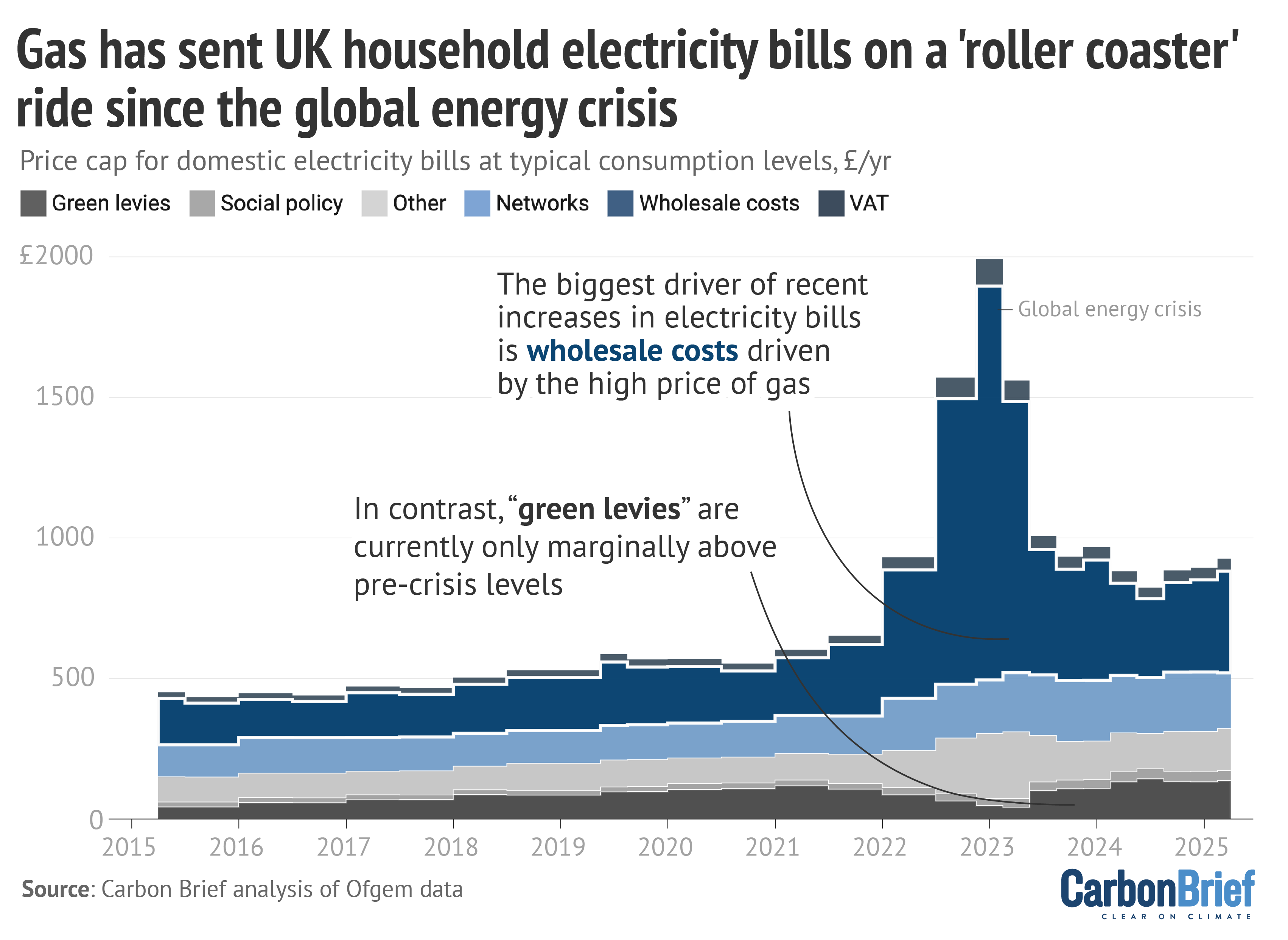
A new analysis by Carbon Brief of data from UK energy regulator Ofgem showed how the biggest driver of recent increases in electricity bills in the UK has been wholesale electricity prices – which in the UK are set almost exclusively by wholesale gas prices. In contrast, “green levies” – costs added to bills in order to pay for government climate policies – actually fell during the height of the gas price spike, as the dark grey area of the chart shows. This runs counter to opposition politicians’ claims that the UK’s high electricity prices are caused by its target for net-zero emissions by 2050 and green levies.
Spotlight
Livestreaming for climate science
This week, Carbon Brief speaks to US climate scientists taking part in a 100-hour livestream aimed at raising awareness of their work and the risks they face.
Marathon livestreams are typically the preserve of video gamers, sex workers and chess stars – not climate scientists. But unusual times call for unusual measures.
Hundreds of climate scientists and meteorologists from across the US are this week participating in a 100-hour livestream, which aims to raise awareness of their work as the government gears up for a major programme of cuts to federal science agencies.
The broadcast runs day and night until Sunday afternoon on YouTube, with each speaker advised to dedicate their 30-45 minute session to presenting their research in layperson’s terms – with a mention of how it is or could be impacted by federal cuts to science.
The online event comes after the Trump administration set out plans to halve NASA’s science budget and shrink the National Oceanic and Atmospheric Administration (NOAA’s) funding by more than a quarter.
The livestream will be rolling while NASA’s climate and space monitoring lab, the Goddard Institute for Space Studies, is moving out of its New York building on 31 May, after the federal government abruptly terminated the space agency’s lease.
(The White House has also cancelled funding to the body that produces the country’s National Climate Assessment, blocked US scientists from attending Intergovernmental Panel for Climate Change meetings and laid off hundreds of workers at the agency responsible for hurricane preparations.)
Speaking to Carbon Brief in a personal capacity, climate scientist and keynote speaker Dr Kate Marvel described the livestream event as a “fire hose of public engagement”. She added:
“It is scientists making the case to the people we work for. We work for the American people because we receive taxpayer dollars. It is really important for us to share our results, to explain to people why what we do is important and to help them see themselves in what we do.”
‘Climate science affects us all’
At 1:30am California time – 4:30am New York time – on Thursday morning, more than 750 people were tuned in to the livestream, and the comment section was lively.
Some viewers shared words of encouragement – “not from the continent of America but still here to support!!! climate science affects us all!!!!” and “beautiful visualisations!”
Others focused on the science: “Look up the relationship between the Salton Sea and earthquakes – fascinating findings”, “does this mean misaligned storms have two different impacts on each level?” and “albedo effect [fire emoji]”.
Livestream organiser Dr Margaret Duffy, who studies cloud dynamics at the Massachusetts Institute of Technology, said the event’s “long format” is designed to underscore the “widespread” nature of the cuts. She told Carbon Brief:
“[It will] make clear that it’s not one or two programmes that are being cut, [nor] one or two researchers that are losing their funding. Researcher after researcher after researcher will explain what they do, and then make the connection to the cuts and what is happening to them.”
The audience is being pointed to materials to help them contact their political representatives about cuts to climate and weather research – but this is not an obligation, Duffy said, explaining that “at a very basic level, we just want to share with the public what it is that we do”.
Climate scientist Marvel commended the livestream organisers for “stepping up” amid much-justified “flailing” and “panic”, adding:
“We are not in normal times. There is a lot of fear and there’s a lot of reasons to be afraid. I think trouble may be coming for us – but we just need to make sure that we get in good trouble. [In other words] you shake things up, you maybe attract negative attention. Maybe it’s scary and maybe there are consequences. But ultimately, you are always going to be happy to have done the right thing.”
Watch, read, listen
WATER CRISIS: Atmos Earth looked at how changing rainfall patterns are impacting the lives of Palestinians already denied access to water.
FRAGILE TEXTS: In a photo essay, Al Jazeera looked at how encroaching desert sands are threatening centuries-old manuscripts stored in Oualata, Mauritania.
LURCHING RIGHT: For Drilled, Amy Westervelt unpacked the structural issues in the US media hurting climate coverage.
Coming up
- 1 June: Round two of Poland’s presidential election
- 2-4 June: 8th Copernicus Climate Change Service general assembly, Valencia, Spain
- 4-7 June:Right here, right now global climate summit, Oxford, UK
Pick of the jobs
- Carbon Brief, summer internship | Salary: London living wage (£13.85 an hour). Location: London (hybrid)
- British Antarctic Survey, space weather scientist | Salary: £41,344-£45,479. Location: Cambridge, UK
- UN Development Programme,energy finance specialist | Salary: Unknown. Location: Abidjan, Cote d’Ivoire
DeBriefed is edited by Daisy Dunne. Please send any tips or feedback to debriefed@carbonbrief.org.
This is an online version of Carbon Brief’s weekly DeBriefed email newsletter. Subscribe for free here.


The post DeBriefed 30 May 2025: Earth eyes 2C; Why net-zero is not behind UK bill hikes; US academics stage climate science ‘fire hose’ appeared first on Carbon Brief.

Climate Change
“Sink or swim”: WA Gov hugely underestimating decline in regional gas demand while sleeping on green exports, new report finds
PERTH, Tuesday 13 October 2026 — A new report from Greenpeace Australia Pacific and Springmount Advisory reveals green commodity exports are an untapped economic opportunity for Western Australia in a declining Asian gas market, while offering a genuine solution for decarbonising Asia.
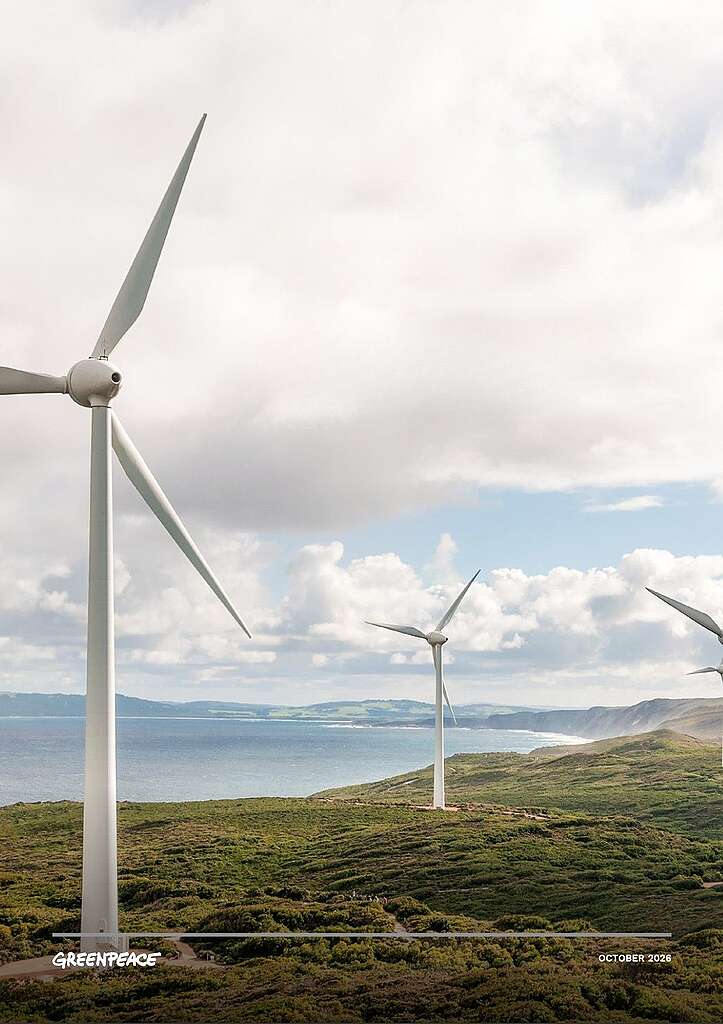
From Gas to Green: Building Western Australia’s Future State is a comprehensive analysis of the declining gas market in Asia, and the untapped economic opportunity for WA to become a global leader in green commodity exports while driving the regional shift away from fossil fuels.
The report offers key recommendations for the WA Government to support regional decarbonisation through an orderly phase out of gas exports in favour of green iron and other green exports. It comes as global climate leaders from across business, politics and advocacy prepare to meet for the Global Citizen Now: Perth event focused on decarbonising WA.
Key findings:
- Gas demand is falling across WA’s core markets in Asia: Gas demand fell in 2025 and is projected to continue to decline, driven by a combination of global geopolitical factors and domestic concerns.
- Policy shifts in key markets since the war on Iran now prioritise renewables and nuclear over gas: Japan, South Korea and China have legislated energy plans that prioritise renewables and nuclear over gas.
- New WA gas would arrive in a saturated, uncertain Asian market filled with cheaper gas: The US is now the world’s largest liquefied gas producer and plans to double its capacity as it also targets Asian markets.
- Green commodities offer a real solution to sustain WA’s economy: WA can lead Australia’s green commodity exports, which by 2060 could be worth almost a trillion dollars.
- Exporting more WA gas is likely to delay or impede Asia decarbonisation: Despite claims by the gas industry, there is no evidence that WA gas is displacing coal in Asia, and in fact diverts resources from genuine decarbonisation options.
Geoff Bice, WA Campaign Lead at Greenpeace Australia Pacific said: “As our export partners in Asia shift away from expensive and polluting gas, the WA Government has a golden opportunity to pivot our economy to green exports, like green iron, which is the most effective way to help our region to decarbonise.
“The writing is on the wall: gas is in decline, renewables are our future. In this context, it makes zero sense for the government to encourage high risk projects like Woodside’s reckless Browse gas proposal at Scott Reef.
“This report clearly shows that the WA Government faces a choice: sink or swim. They can either allow the gas industry to keep ripping off West Australians and continue propping up its decline, or choose the path that will deliver enormous benefits to the state and the world by becoming a leader in the rapidly expanding green economy.”
Tom Quinn, Managing Director of Springmount Advisory: “Western Australia prospers when it looks to the future and builds for future demand. Twenty years from now, what the world needs is green commodities made using WAs abundant renewable resources. Just like it did with iron ore in the 1950s and gas in the 1970s, WA should look to the future and build what the world will need, not sunsetting industries like gas that are already past their peak.”
-ENDS-
Media contact
Kate O’Callaghan on 0406 231 892 or kate.ocallaghan@greenpeace.org
Lucy Keller on 0491 135 308 or lucy.keller@greenpeace.org
A report from Greenpeace Australia Pacific and Springmount Advisory reveals the untapped green economic opportunity for Western Australia in a declining Asian gas market, which also offers a genuine solution for decarbonisation in Asia.
Is Western Australia clinging to a fading gas industry while a thriving green future passes it by? As major Asian trading partners rapidly pivot away from volatile gas imports toward cheap solar and battery storage, this report exposes a high-stakes choice: risk becoming stranded in an oversupplied fossil fuel market, or harness WA’s unmatched sun and wind to lead the global clean energy transition.
Summary
From Gas to Green: Building Western Australia’s Future State reveals that Western Australia (WA) faces a critical juncture as falling Asian gas demand, geopolitical gas supply volatility and accelerating renewable energy deployment undermine the long-term economic viability of gas exports. By harnessing its world-class wind and solar resources, the report demonstrates that WA can execute an orderly phase-out of gas and pioneer a green commodity export economy that could generate $987 billion in economic value by 2060, create 24,000 ongoing jobs, and drive a 9.6% reduction in global greenhouse gas emissions.
Key Findings
- Gas demand is falling in Asia – WA can no longer rely on gas exports: Gas demand in core Asian markets fell in 2025 and is projected to continue to decline in 2026. Legislated energy plans in Japan, South Korea, and China now prioritise renewables and nuclear over gas.
- Asia is increasing renewables, importing gas just gets in the way: Evidence from markets like Thailand suggests that gas imports are increasingly crowding out cheaper renewable energy investments and battery storage rather than displacing coal, locking in more emissions over time.
- Green commodities offer a real solution to decarbonise Asia – this is a major win for WA: With world-class renewables, WA can lead Australia’s green commodity exports, which by 2060 could be worth almost a trillion dollars ($987 billion) and support a genuine 9.6% reduction in global emissions.
Recommendations to WA government
Recommendation 1: Plan an orderly gas phase-out aligned with a trading partner pivot plan
Implement a managed, orderly phase-out of gas exports aligned with trading partners’ decarbonisation pathways, rather than waiting for demand to collapse, by:
- Developing and implementing a staged phase-out of gas facilities aligned with feedstock supply expiry or typical end of facility lifespans.
- Committing to no new gas development for gas expansion, including Browse and Kimberley fields.
- Developing new, reciprocal trade relationships with existing gas trade partners, structured to progressively replace gas exports with green commodities – integrated with recommendation 2.
Recommendation 2: Develop an integrated green commodity export strategy, positioning WA as a global green iron manufacturing hub
Establish an integrated green commodity export strategy that immediately prioritises green iron development, positioning WA as a global green iron manufacturing hub, by:
- Committing to green commodity export targets to give industry and investors a clear demand signal.
- Prioritising green iron as the lead sector within the broader green commodity strategy, given WA’s iron ore endowment and first-mover potential.
Recommendation 3: Reject false solutions such as carbon dumping (CCS) and blue hydrogen
Reject carbon dumping (also described as carbon capture and storage, or CCS) and blue hydrogen as viable decarbonisation technologies, and prioritise green hydrogen and proven renewables for clean energy and fuel production by:
- Excluding blue hydrogen projects (and CCS-dependent projects) from all government support programs.
- Requiring existing hydrogen-based production (including ammonia, methanol, synthetic fuels) to have clear, near-term transition timelines to switch to green hydrogen production.

What you can do
Together, we can push for a prosperous green future.
You can help by:
- Sending an email to Environment Minister Murray Watt and Prime Minister Anthony Albanese, calling on them to reject Browse.
- Sharing this story to help more Australians understand what’s at stake.
- Encouraging your friends and family to take action.
REPORT: “From Gas to Green” Building Western Australia’s Future State