

Welcome to Carbon Brief’s DeBriefed.
An essential guide to the week’s key developments relating to climate change.
This week
Shattered climate consensus
FRACKING BAN: UK energy secretary Ed Miliband has announced that the government will bring forward its plans to permanently ban fracking, in a move designed to counter a promise from the hard-right Reform party to restart efforts to introduce the practice, the Guardian said. In the same speech, Miliband said Reform’s plans to scrap clean-energy projects would “betray” young people and future generations, the Press Association reported.
ACT AXE?: Meanwhile, Kemi Badenoch, leader of the Conservatives, pledged to scrap the 2008 Climate Change Act if elected, Bloomberg reported. It noted that the legislation was passed with cross-party support and strengthened by the Conservatives.
‘INSANE’: Badenoch faced a backlash from senior Tory figures, including ex-prime minister Theresa May, who called her pledge a “catastrophic mistake”, said the Financial Times. The newspaper added that the Conservatives were “trailing third in opinion polls”. A wide range of climate scientists also condemned the idea, describing it as “insane”, an “insult” and a “serious regression”.
Around the world
- CLIMATE CRACKDOWN: The US Department of Energy has told employees in the Office of Energy Efficiency and Renewable Energy to avoid using the term “climate change”, according to the Guardian.
- FOREST DELAY: Plans for Brazil’s COP30 flagship initiative, the tropical forests forever fund, are “suffer[ing] delays” as officials remain split on key details, Bloomberg said.
- COP MAY BE ‘SPLIT’: Australia could “split” the hosting of the COP31 climate summit in 2026 under a potential compromise with Turkey, reported the Guardian.
- DIVINE INTERVENTION: Pope Leo XIV has criticised those who minimise the “increasingly evident” impact of global warming in his first major climate speech, BBC News reported.
€44.5 billion
The cost of extreme weather and climate change in the EU in the last four years – two-and-a-half times higher than in the decade to 2019, according to a European Environment Agency report covered by the Financial Times.
Latest climate research
- Fossil-fuelled climate change caused around 36% of Typhoon Ragasa’s direct damage to homes and properties in southern China, according to a rapid impact attribution study | Imperial Grantham Institute – Climate Change and the Environment
- Some 86% of the global population are concerned about climate change, according to a survey of 280,000 people in 142 countries and regions | Climate Policy
- A global shift towards a “planetary health diet” could slash emissions and save tens of thousands of lives each day | EAT-Lancet Commission 2025 report
(For more, see Carbon Brief’s in-depth daily summaries of the top climate news stories on Monday, Tuesday, Wednesday, Thursday and Friday.)
Captured

Clean energy has met 100% of Great Britain’s electricity demand for a record 87 hours this year so far, according to new Carbon Brief analysis. This is up from just 2.5 hours in 2021 and 64.5 hours in all of 2024. The longest stretch of time where 100% of electricity demand was met by clean energy stands at 15 hours, from midnight on 25 May 2025 through to 3pm on 26 May, according to the analysis.
Spotlight
‘Overshoot’ unknowns
As the chances of limiting global warming to 1.5C dwindle, there is increasing focus on the prospects for “overshooting” the Paris Agreement target and then bringing temperatures back down by removing CO2 from the atmosphere.
At the first-ever Overshoot Conference in Laxenburg, Austria, Carbon Brief asks experts about the key unknowns around warming “overshoot”.
Sir Prof Jim Skea
Chair of the Intergovernmental Panel on Climate Change (IPCC) and emeritus professor at Imperial College London’s Centre for Environmental Policy
So there are huge knowledge gaps around overshoot and carbon dioxide removal (CDR). As it’s very clear from the themes of this conference, we don’t altogether understand how the Earth would react in taking CO2 out of the atmosphere.
We don’t understand the nature of the irreversibilities and we don’t understand the effectiveness of CDR techniques, which might themselves be influenced by the level of global warming, plus all the equity and sustainability issues surrounding using CDR techniques.
Prof Kristie Ebi
Professor at the University of Washington’s Center for Health and the Global Environment
There are all kinds of questions about adaptation and how to approach effective adaptation. At the moment, adaptation is primarily assuming a continual increase in global mean surface temperature. If there is going to be a peak – and of course, we don’t know what that peak is – then how do you start planning? Do you change your planning?
There are places, for instance when thinking about hard infrastructure, [where overshoot] may result in a change in your plan – because as you come down the backside, maybe the need would be less. For example, when building a bridge taller. And when implementing early warning systems, how do you take into account that there will be a peak and ultimately a decline? There is almost no work in that. I would say that’s one of the critical unknowns.
Dr James Fletcher
Former minister for public service, sustainable development, energy, science and technology for Saint Lucia and negotiator at COP21 in Paris.
The key unknown is where we’re going to land. At what point will we peak [temperatures] before we start going down and how long will we stay in that overshoot period? That is a scary thing. Yes, there will be overshoot, but at what point will that overshoot peak? Are we peaking at 1.6C, 1.7C, 2.1C?
All of these are scary scenarios for small island developing states – anything above 1.5C is scary. Every fraction of a degree matters to us. Where we peak is very important and how long we stay in this overshoot period is equally important. That’s when you start getting into very serious, irreversible impacts and tipping points.
Prof Oliver Geden
Senior fellow and head of the climate policy and politics research cluster at the German Institute for International and Security Affairs and vice-chair of IPCC Working Group III
[A key unknown] is whether countries are really willing to commit to net-negative trajectories. We are assuming, in science, global pathways going net-negative, with hardly any country saying they want to go there. So maybe it is just an academic thought experiment. So we don’t know yet if [overshoot] is even relevant. It is relevant in the sense that if we do, [the] 1.5C [target] stays on the table. But I think the next phase needs to be that countries – or the UNFCCC as a whole – needs to decide what they want to do.
Prof Lavanya Rajamani
Professor of international environmental law at the University of Oxford
I think there are several scientific unknowns, but I would like to focus on the governance unknowns with respect to overshoot. To me, a key governance unknown is the extent to which our current legal and regulatory architecture – across levels of governance, so domestic, regional and international – will actually be responsive to the needs of an overshoot world and the consequences of actually not having regulatory and governance architectures in place to address overshoot.
Watch, read, listen
FUTURE GAZING: The Financial Times examined a “future where China wins the green race”.
‘JUNK CREDITS’: Climate Home News reported on a “forest carbon megaproject” in Zimbabwe that has allegedly “generated millions of junk credits”.
‘SINK OR SWIM’: An extract from a new book on how the world needs to adapt to climate change, by Dr Susannah Fisher, featured in Backchannel.
Coming up
- 7 October: International Energy Agency (IEA) renewables 2025 report launch
- 8-10 October: World summit of Indigenous peoples and nature, Abu Dhabi, UAE
- 9-15 October: International Union for the Conservation of Nature (IUCN) 2025 congress, Abu Dhabi, UAE
Pick of the jobs
- UK government foreign, commonwealth and development office, senior climate policy adviser | Salary: CA$93,207. Location: Calgary, Canada
- Wellcome Trust, senior research manager, climate and health | Salary: £64,800. Location: London
- Bloomberg, product manager – climate, nature and sustainability regulations | Salary: Unknown. Location: London
DeBriefed is edited by Daisy Dunne. Please send any tips or feedback to debriefed@carbonbrief.org.
This is an online version of Carbon Brief’s weekly DeBriefed email newsletter. Subscribe for free here.


The post DeBriefed 3 October 2025: UK political gap on climate widens; Fossil-fuelled Typhoon Ragasa; ‘Overshoot’ unknowns appeared first on Carbon Brief.

For the first time, new-energy vehicles (NEVs) made up 67% of new car sales in China in September, according to the latest data from the China Passenger Car Association (CPCA).
The figures show that NEVs, which include battery electric cars and plug-in hybrids, captured a record share of sales, even though fewer were sold than last year.
This is because sales of combustion-engine cars are falling steeply, a trend that the CPCA has attributed to rising petrol prices following the start of the Hormuz crisis.
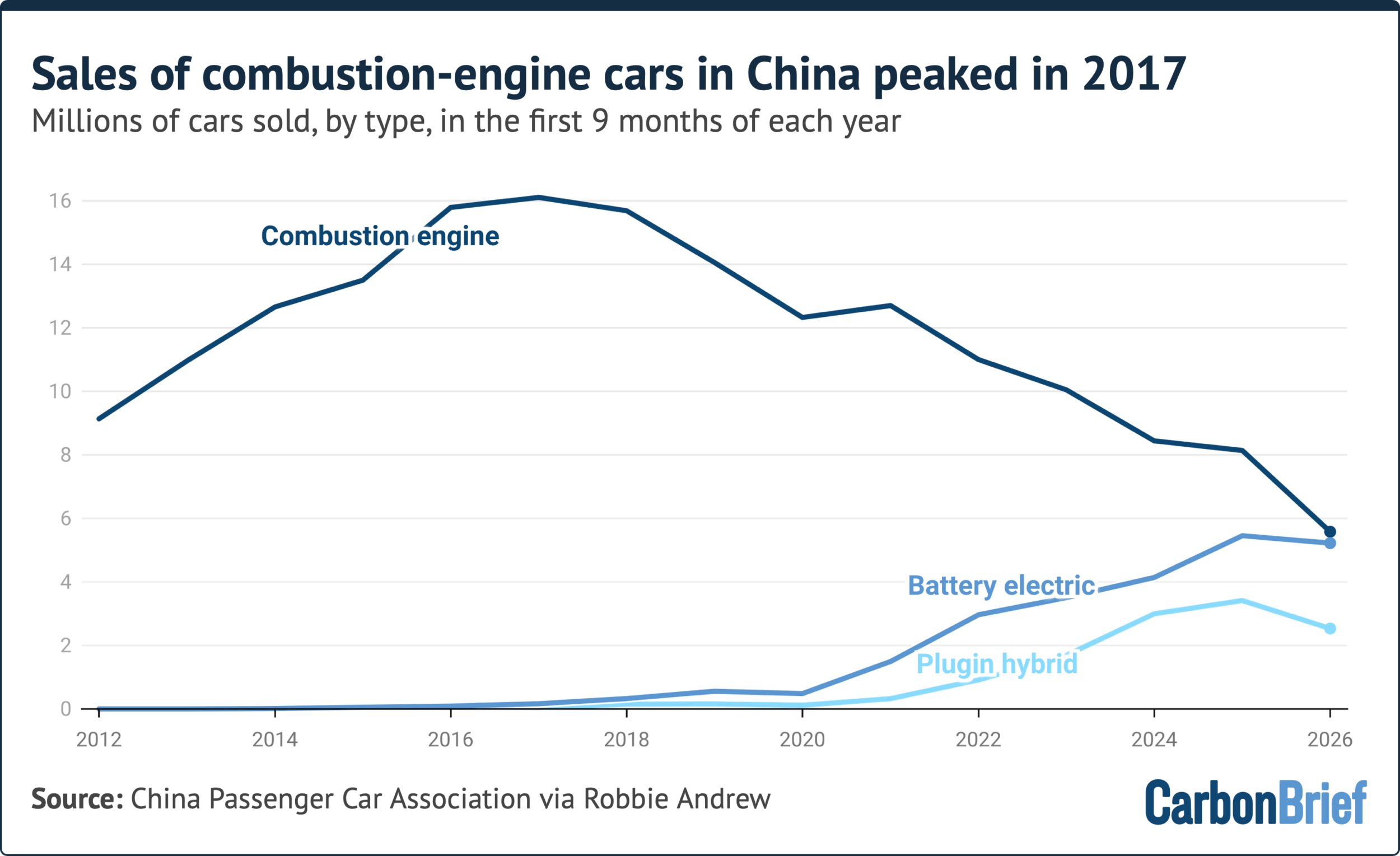
Indeed, sales of fuel-only cars were down 31% year-on-year in the first nine months of 2026, with plug-in hybrid sales down 26% – whereas battery EV sales were only down 4%.
One analyst tells Carbon Brief that China’s rapidly growing EV fleet has offset demand for 143m barrels of oil since the start of the Hormuz crisis.
Another says that the crisis is “reinforcing China’s electrification of road transport”.
Meanwhile, amid slowing domestic sales, Chinese carmakers’ exports of NEVs more than doubled [in 2026 to date / in September] from a year earlier.
NEV record
A record two out of every three cars sold in September in China were NEVs, according to CPCA data, as shown in the figure below.
(NEVs predominantly include battery electric vehicles – BEVs – and plug-in hybrids – PHEVs. BEVs only run on electricity, whereas PHEVs also have a combustion engine.)
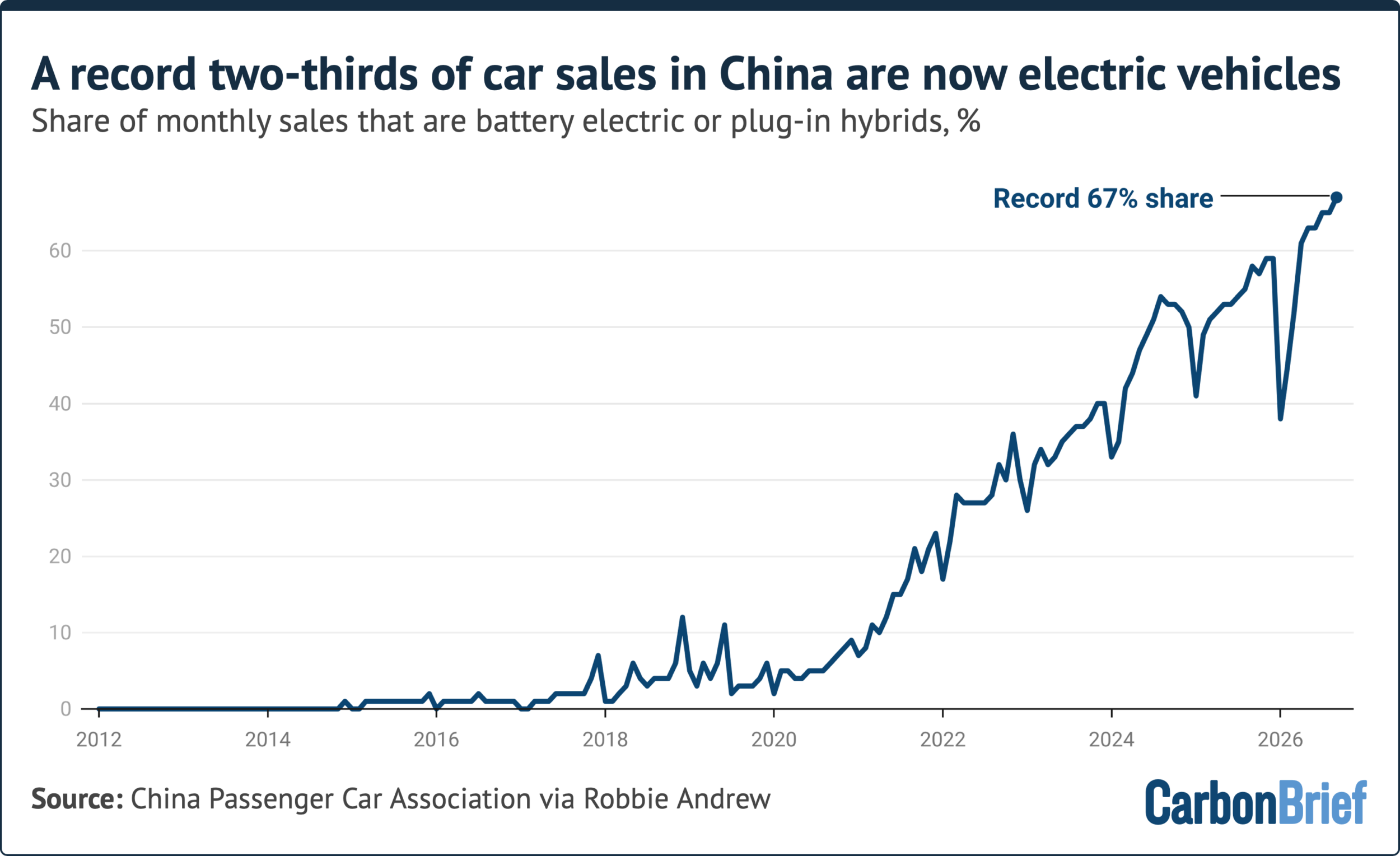
This marks a rapid rise for NEVs from just 6% of new car sales in 2020 up to 58% in 2026 to date – and a record 67% in the month of September.
This year, NEVs’ share of sales has also bounced back from a low of 39% in January, after the full purchase tax exemption that had been in place for more than a decade came to an end in December 2025.
The gain in NEV share in 2026 has come amid a slowdown across the wider domestic passenger-car market, which has hit sales of combustion-engine vehicles particularly hard.
This September, passenger-car retail sales across all categories declined, with overall sales volumes falling 28% year-on-year.
The contraction was led by combustion-engine vehicles, which saw sales fall 43% year-on-year in September and 31% in 2026 to date.
However, sales of PHEVs also fell by 36% year-on-year in September and by 26% in 2026 to date. By comparison, BEVs performed better, although sales still declined 8.5% from a year earlier in September and 4% in 2026 to date.
As a result, NEV sales overall fell by 17% in September and 13% in 2026 to date.
While the market changes in 2026 to date were particularly dramatic, they reflect a broad continuation of trends seen over the past decade.
Indeed, sales of combustion-engine cars in China peaked in 2017 and they have been declining ever since, shown in the figure below.
Impact of Hormuz
Part of the reason for the advance of NEVs in 2026, said Chinese technology news outlet OFweek, was petrol cars “giving up market share” as they were outperformed by electric alternatives.
Cui Dongshu, secretary-general of the CPCA, cited higher petrol prices as an explanation for September’s weak combustion-car sales, in comments to financial news outlet National Business Daily.
Imports of oil into China in January-September have fallen 15% compared to 2025, equivalent to 470m barrels, as ongoing conflict tightened supply and drove up prices.
China’s passenger-car NEV fleet has displaced 143m barrels of oil so far during the strait of Hormuz crisis, Euan Graham, senior energy analyst at thinktank Ember, tells Carbon Brief.
EVs “accounted for 12% of the decrease in China’s oil use post-Hormuz”, according to an estimate provided to thinktank the Brookings Institute by an unnamed analyst.