

Welcome to Carbon Brief’s DeBriefed.
An essential guide to the week’s key developments relating to climate change.
This is an online version of Carbon Brief’s weekly DeBriefed email newsletter. Subscribe for free here.
This week
West Antarctic melt ‘unavoidable’
LOCKED IN: New research by the British Antarctic Survey (BAS), covered by Reuters, found that melting of the West Antarctic ice sheet will continue, irrespective of any reductions in emissions. The decline of the ice sheet is “one of nine global climate ‘tipping points’…identified in 2009”, Reuters said. The study added that governments must “prepare for several metres of sea level rise over the coming centuries”, New Scientist said.
‘RECORD EXTREMES’: A separate study found that “20 of the 35 planetary vital signs [the authors] use to track the climate crisis are at record extremes”, the Guardian reported. Previous records for global air temperature, ocean temperature and Antarctic sea ice extent were all “broken by enormous margins in 2023”, the researchers said, adding that “by 2100…3-6 billion people may find themselves outside Earth’s livable regions”.
CAUSE FOR HOPE: The BAS report authors wrote in the Conversation that “we are now committed to rapid ocean warming in the Amundsen Sea until at least 2100”. Nevertheless, they said: “The future will not end in 2100…Our simulations of the 1.5C scenario show ice-shelf melting starting to plateau by the end of the century, suggesting that further changes in the 22nd century and beyond may still be preventable.”
Global CO2 could peak in 2023
CO2 PIVOT: Global CO2 emissions from energy use and industry could peak as soon as this year, according to Carbon Brief analysis of figures from the International Energy Agency (IEA). The IEA’s latest World Energy Outlook 2023 shows coal, oil and gas each peaking before 2030, the first time this has been expected under current policies – with fossil fuel use peaking in China next year and globally in 2025. The report once again boosted the outlook for solar (by 69% in 2050) and electric vehicles (by 20% in 2030) compared with last year’s edition, Carbon Brief’s in-depth coverage found.
RISING RENEWABLES: In its coverage of the World Energy Outlook, BBC News reported that the findings show that the global uptake of renewable energy is now “unstoppable”. The IEA expects that more than half of the world’s electricity in 2030 will come from renewable sources, it added. This may be “the beginning of the end of the fossil fuel era”, the Times quoted the report saying, with demand peaking before 2030.
Around the world
- FUNDING FRACAS: Talks in Egypt on how to develop a loss and damage fund for climate-vulnerable nations collapsed due to “discord over who should fund it, where it should be based and who would be eligible for support”, the Financial Times reported.
- HURRICANE OTIS: The “rapid” transformation of Hurricane Otis into a Category 5 storm before making landfall in Mexico “highlighted what climate change, combined with weather and climate variability, can do to a storm”, Axios reported.
- POLISH POLITICS: A coalition of “climate friendly” political parties won the general election in Poland beating the right-wing ruling party, but may “struggle to agree on policies”, the Guardian said.
- HUMAN IMPACT: TheCable in Nigeria reported on a Carbon Brief investigation that found up to 15,700 people in Africa have died in extreme weather events so far this year.
- FOREST LOSS: The 2023 Forest Declaration Assessment report found that the world is “moving too slowly” to meet deforestation targets, according to Reuters. Some 66,000 square kilometres (km2) of forest were destroyed in 2022.
- EV LAG: Bloomberg reported that there is only one electric vehicle charging connector per every 4,000 users in Japan, compared to one for every 500 people in Europe, 600 in the US and 1,800 in China.
21
The number of myths debunked in Dr Simon Evans’s epic factcheck for Carbon Brief of common misperceptions about electric vehicles.
Latest climate research
- New research in Science Advances identified how the impact of an ocean phenomenon known as the “Atlantic Niño” on the tropics remains high, despite having decreased in strength since the 1970s.
- A decline in groundwater recharge of around 3.8mm per year in Iran is primarily driven by “unsustainable water and environmental resources management” and is “exacerbated by decadal changes in climatic conditions”, according to a new analysis in Nature Communications.
- A new study in Nature Water found that the temperatures of surface waters in lakes across the world are generally increasing more slowly than global air temperatures, mainly due to an acceleration in evaporation rates.
(For more, see Carbon Brief’s in-depth daily summaries of the top climate news stories on Monday, Tuesday, Wednesday, Thursday and Friday.)
Captured

China’s exports of solar panel cells grew five-fold between 2017 and 2022, and stood at 147 gigawatts between January and August 2023, according to data compiled by climate thinktank Ember. Earlier analysis noted that, between January and June 2023, China’s solar exports were “going through the roof” and had already exceeded the equivalent of total US installed solar panel capacity. Meanwhile, Cao Yue, a researcher at the thinktank Overseas Development Institute, told Caixin that the low cost of Chinese solar panels made it “no surprise that…exports have shot up”, adding that he expected growth to continue.
Spotlight
What does China’s uptick in Russian fossil-fuel use mean for its climate goals?
This week, Carbon Brief explores the implications of a recent uptick in China-Russia energy cooperation for China’s transition to carbon neutrality by 2060.
The International Energy Agency’s (IEA) World Energy Outlook 2023 has lowered projections for gas consumption, particularly of Russian gas, and forecast declines in oil and gas consumption in China after 2030 and 2040, respectively.
This stands at odds with the fact that China imported record amounts of Russian oil in the first half of 2023 and that China’s president Xi Jinping recently called for “substantial progress” on the Power of Siberia 2 gas pipeline linking the two countries.
By increasing its imports of cheap Russian fossil fuels, the FT stated, China receives “a double benefit of cheap [fuel] for itself and the opportunity to boost exports”.
Concerns in Beijing around energy security make Russian fossil fuels attractive, as diversifying its energy suppliers mitigates “other vulnerabilities to its imports”, according to the Interpreter, a media outlet managed by the Lowy Institute. Trade with Russia also shores up the “stability” of a key political ally, wrote Sergey Vakulenko, a nonresident scholar at the Carnegie Russia Eurasia Center.
However, China has concerns about the pipeline. This has slowed progress, Dr Michal Meidan, head of China energy research at the Oxford Institute for Energy Studies (OIES) told Carbon Brief. It could “bind the two countries” and create an outsized dependency on Russia, she explained.
Nevertheless, increased imports of Russian gas may support China’s decarbonisation efforts, Meidan wrote. This is because gas is “very much part of the country’s energy transition away from coal”.
Vakulenko added that “the high capacity of gas import pipelines would allow China to increase the share of wind and solar in its power system without investing too much in costly energy storage, using gas generation for balancing”.
Gas currently makes a “relatively small” direct contribution to China’s emissions, the IEA said, and using gas over coal has drastically improved air quality, which is a key metric for evaluation of local official’s efforts around environmental protection.
However, the IEA added, these benefits could be offset by methane released from burning gas. Russian production of gas is “highly methane-intensive”, which could exacerbate negative environmental impacts.
And how China then weans itself off gas to meet its 2060 target for carbon neutrality remains an open question, Meidan told Carbon Brief.
While oil is likely to peak soon, Meidan said, “we do not have solutions yet” for operating several key Chinese industries without fossil fuels. Developments of carbon capture, utilisation and storage technologies could open pathways for continued use of fossil fuels after 2060, she said. “Certainly for the next 20-30 years China will need oil and gas”, she added.
Forecasts are also dependent on China’s economic performance, according to Vakulenko:
“If [it] beats expectations, that will accelerate the transition to renewable energy sources and gas consumption will decrease. If it performs worse than expected, cheaper coal will continue to account for a significant proportion of the energy balance.”
Nevertheless, in his view, “the gas trade between Russia and China is likely to end by about 2060 or even earlier as a result of the global energy transition…Within a few decades, Power of Siberia 2 will become obsolete.”
Watch, read, listen
BROKEN PROMISES: Project Syndicate featured a commentary from the Organization of Indigenous Peoples of the Colombian Amazon calling for better regulation of carbon offsets to avoid “exaggerated emissions-reduction claims” and exploitation of Indigenous communities.
‘DINNER DIPLOMACY’: Politico recounted how US climate envoy John Kerry held an “exclusive dinner” in March for COP28 president-designate and oil boss Sultan Al Jaber.
NOT TOO LATE: Dr Jane Goodall spoke on CBC about habitat destruction, saying that she believes we “still have a window of time” to slow down climate change and loss of biodiversity.
Coming up
- 29 October: Oman parliamentary elections
- 30-31 October: Pre-COP28, Abu Dhabi, United Arab Emirates
- 30 October-8 November: 28th annual session of the International Seabed Authority (3rd part), Kingston, Jamaica
Pick of the jobs
- Local Storytelling Exchange, storytellers – climate communication | Salary: £64,000. Location: Kent, Sussex and East Anglia, Scotland
- Greater London Authority, principal policy and programme officer | Salary: £60,394-£65,371. Location: London, UK
- The Lifescape Project, senior lawyer – climate and nature litigation | Salary: £40,000-£43,000. Location: Remote
- Coral Future, climate change associate | Salary: Unknown. Location: Malaysia
DeBriefed is edited by Daisy Dunne. Please send any tips or feedback to debriefed@carbonbrief.org

The post DeBriefed 27 October 2023: Antarctic ice melt ‘unavoidable’; EV factcheck; China-Russia fossil fuel trade appeared first on Carbon Brief.

A temporary breach of the 1.5C global-warming limit is now “inevitable” following “decades of insufficient climate action”, says the UN Environment Programme (UNEP).
In its “sobering” annual assessment of the global “emissions gap”, UNEP says that exceeding the Paris Agreement’s 1.5C limit is “imminent and unavoidable”.
This year’s report, titled “The point of return”, says the “task now” is to minimise the size and scale of a temperature “overshoot” and to “establish a credible return path to 1.5C by the end of the century”.
Even the “lowest possible” overshoot scenario for 1.5C would first see global warming peak at around 1.7-1.8C in the middle of the century before declining, says the report.
This scenario – which is “still aligned with the long-term temperature goal of the Paris Agreement” – would require global emissions cuts of 18% by 2030 and 45% by 2035, while ramping up “removals” of carbon dioxide (CO2) from the atmosphere, says UNEP.
In contrast, it notes that the current climate pledges by countries around the world – even if fully implemented – would only reduce emissions by 5-8% by 2030 and 11-15 % by 2035, relative to 2025 levels.
Nonetheless, the report identifies “ample opportunity to accelerate action”, concluding that “countries can still limit peak warming, shorten the duration of overshoot and keep the goals of the Paris Agreement within reach”.
(See Carbon Brief’s detailed coverage of previous reports in 2014, 2015, 2016, 2017, 2018, 2019, 2020, 2021, 2022, 2023, 2024 and 2025.)
Emissions ‘comparable’ between 2024 and 2025
The report says that emissions in 2025 were “comparable” to those of 2024.
Global greenhouse gas emissions in 2025 totalled 58.4bn tonnes of CO2 equivalent (GtCO2e), according to the report. This is around 0.16GtCO2e lower than 2024 levels – albeit, with high levels of uncertainty around the numbers.
In addition, because the figures presented in the 2025 report are “provisional”, the report says, it is “not possible to conclude on the overall direction of emissions in 2025”.
The emissions growth rate has been slowing down in recent decades: the growth rate over 1990-2015 was, on average, 1.7% per year, while emissions have increased by an average of 0.8% per year since 2016.
The chart below shows the total human-driven emissions between 1990 and 2025, separated by greenhouse gas: CO2 from fossil-fuel combustion (dark grey), methane (light grey), nitrous oxide (blue), fluorinated gases (orange) and CO2 from land-use change (green).
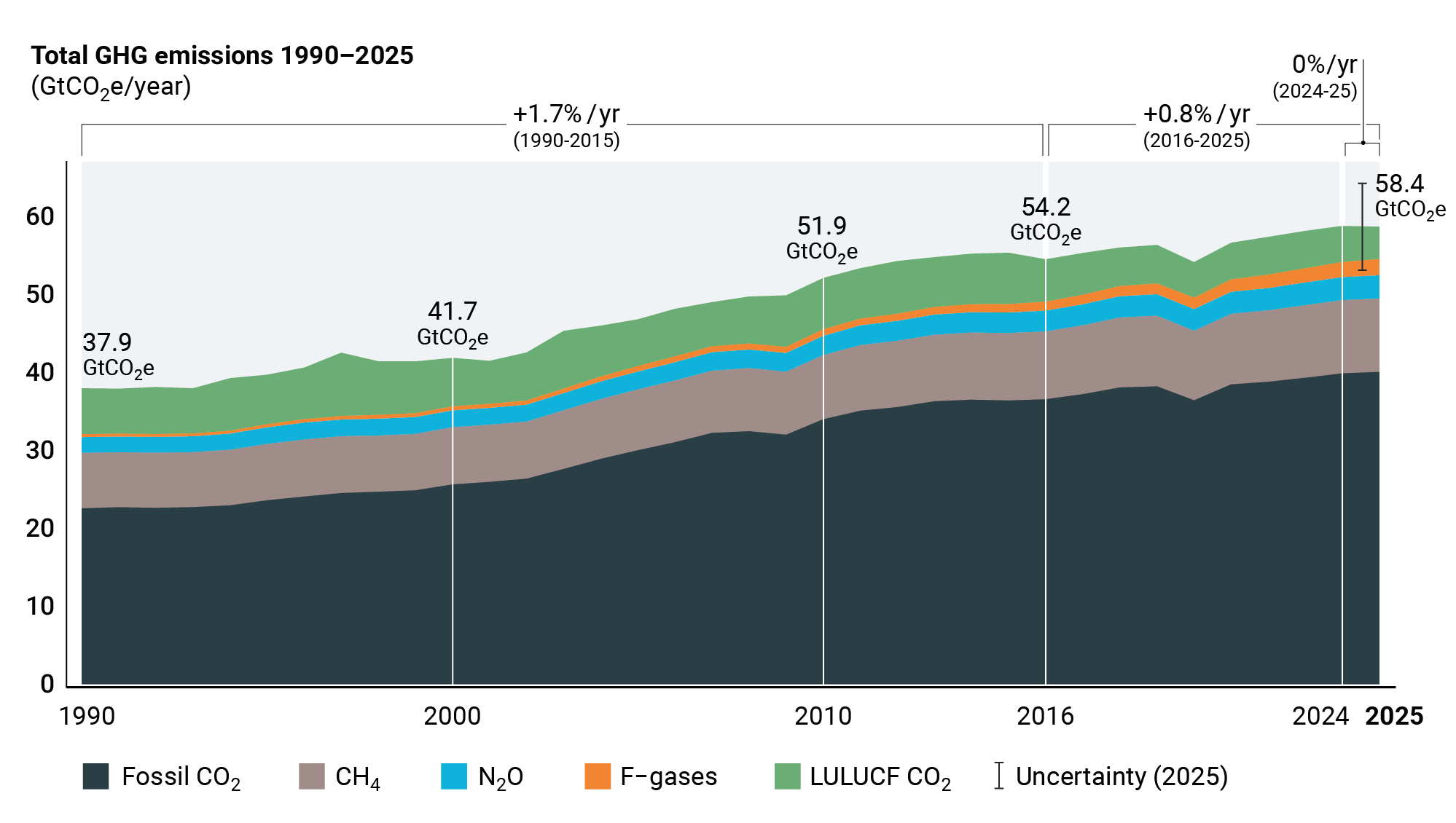
Compared to 2024, emissions from fossil fuels increased slightly, by between 0.4-1.1%, says the report. Emissions of both nitrous oxide and fluorinated gases increased by even higher rates, but since these comprise such a small part of total greenhouse gas emissions, “their contribution to the overall trend is relatively less significant”, it adds. Methane emissions remained steady over that time.
A reduction in the CO2 emissions from land use, land-use change and forestry (LULUCF) “slightly overcompensates” for the rise in emissions of fossil-fuel CO2 and other gases, according to the report. (For more on falling land-use emissions, see Carbon Brief’s explainer.)
The decrease in LULUCF emissions was “partially driven” by a decline in global wildfire emissions, particularly in Africa, South America and parts of south-east Asia. The report notes that these decreases were “likely connected to the ceasing of El Niño conditions”. The ongoing “super” El Niño is likely to cause LULUCF emissions to increase in 2026.
The report also examines countries’ contributions to the increase in greenhouse gas emissions – although here, it excludes LULUCF due to a lag in national-level emissions inventories for the sector.
Among the top six emitters, only the US saw a notable increase in 2025, says the report, whereas emissions in China, the EU, India, Russia and Indonesia were relatively flat. Emissions in the US grew by 133m tonnes of CO2e (MtCO2e) in 2025, due to increased electricity demand and a “rebound” of coal power. This growth in US emissions is likely due to a combination of market factors, including increased heating demand due to a colder winter, higher gas prices and overall increased electricity demand.
The changes for the six largest emitters, the rest of the G20 countries, international transport and the rest of the world can be seen in the chart below.
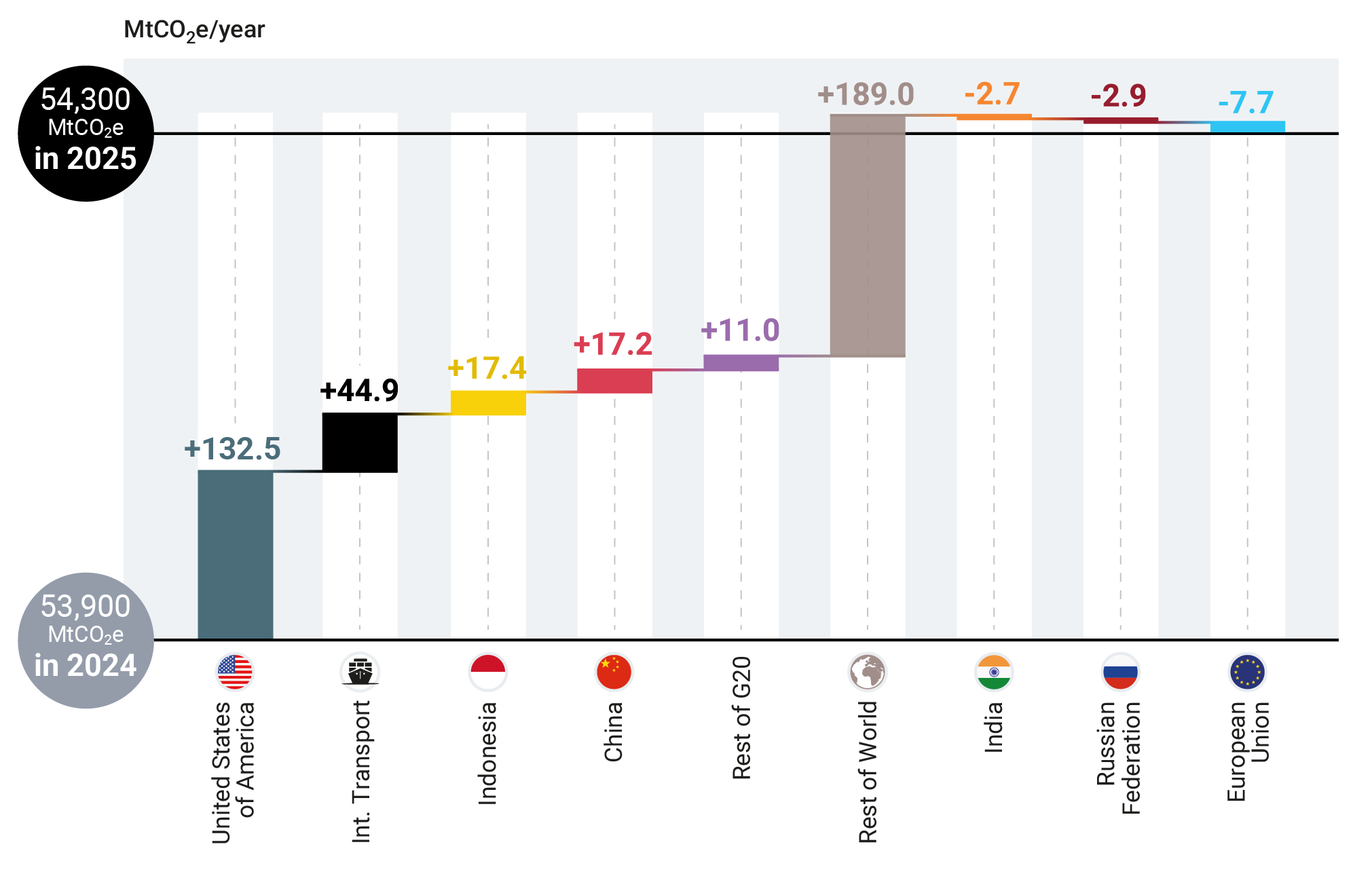
Across most sectors, progress towards decarbonisation has been “modest”, says the report. The most notable decreases have occurred in the power sector and the transport sector, due to the growth of solar power and electric vehicles. The report notes:
“There are emerging signs of transport sector electrification and decarbonisation, but at rates and levels that are not yet sufficient to drive emissions reductions at the global level.”
However, emissions from the transport sector have continued to grow, due to increased demand for international aviation and shipping.
The report notes that while electricity demand from data centres is “projected to double” by 2030, data centres at present account for less than 1% of total emissions.
New NDCs would reduce emissions ‘far from what is needed’
All countries were meant to submit new UN climate pledges for 2035, known as the third nationally determined contributions (NDCs) to the Paris Agreement, by February 2025. However, 95% of nations missed this deadline.
Many countries came forward with their third NDCs at a UN climate summit in New York in September 2025 and at the COP30 climate summit in Brazil in November 2025.
By the end of COP30, 122 – or 63% – of countries had produced their third NDCs.
The report says that figure had risen to 124 by 1 September 2026, with pledges now covering 75% of global emissions.
This is more than double the number of third NDCs available at the time of the 2025 emissions gap report – allowing a “more robust basis for assessing collective progress and ambition toward 2035”, says the report.
Although the first global stocktake of action towards the goals of the Paris Agreement called for countries to submit targets “covering all greenhouse gases”, there has only been a “modest” increase in the number of nations to do so, according to the report.
It says that eight countries included greenhouse gas targets for the first time in their third NDCs, bringing the total number parties with such targets up to 155.
The third NDCs “increasingly use more robust and verifiable target formulations”, such as standardised baselines, says the report.
However, they have not “meaningfully broadened the scope of sectors and gases covered by the targets”, it adds.
If the third NDCs were implemented in full, it would lower global emissions in 2035 by 3.5GtCO2e, compared to 2030 targets, says the report.
It says this is “far from the global reductions needed to get on track to achieving the long-term temperature goal of the Paris Agreement”.
Compared to the 2025 report, the projections for global emissions in 2035 as a result the third NDCs are about 3GtCO2e higher.
This is down to the formal withdrawal of the US from the Paris Agreement, as well as from “harmonising” the projections with the latest historical emissions data, says the report.
The global “implementation gap” for 2030 – defined as the difference between countries’ projected emissions under current policies and the emissions expected if they implemented their NDCs in full – has narrowed compared to last year, says the report.
However, this is mainly due to the withdrawal of the US from the Paris Agreement. In other words, the narrowing of the gap is due to “policy changes, not policy progress”.
The implementation gap for both 2030 and 2035 are of a similar size – suggesting “enhanced collective ambition of 2035 NDCs is weak”, continues the report.
Some 14 of the 17 G20 nations, counting the EU as one, have submitted new NDCs with emissions targets for 2035, says the report.
However, the emissions trajectories of the majority of G20 nations remain “misaligned” with their net-zero targets, says the report.
The chart below shows the gap between nations’ current emission trajectories and their NDC tar