

Welcome to Carbon Brief’s DeBriefed.
An essential guide to the week’s key developments relating to climate change.
This is an online version of Carbon Brief’s weekly DeBriefed email newsletter. Subscribe for free here.
This week
Behind on 1.5C
UN REPORT: A new UN report examining the progress countries have made to slash their emissions under the Paris Agreement, published last Tuesday, said that global pollution is set to fall just 2% below 2019 levels by 2030, Reuters reported. Under countries’ current “nationally determined contributions” (NDCs), “emissions can be expected to rise 9% above 2010 levels by the end of this decade”, Reuters noted. This falls short of what is needed to stay below 1.5C, it added.
‘BIG IF’: The Financial Times wrote that the expected emissions reduction is “slightly better” than the 11% by 2030 rise above 2010 levels laid out in last year’s assessment. Nevertheless, it quoted UN secretary-general António Guterres saying NDCs were “strikingly misaligned with the science”. The New York Times emphasised that even the relatively modest reductions in emissions outlined in the report will only happen “if every country does what it has promised to rein in global warming, and that’s a big if”.
WRI REPORT: The World Resources Institute’s “state of climate action 2023” report found that “countries are falling behind on almost every policy required to cut greenhouse gas emissions”. The Guardian reported that, of the 42 indicators assessed, electric vehicle sales is the only one that is progressing on track. To limit global warming to 1.5C coal must be phased out seven times faster than the current rate, it added.
US and China cooperate
JOINT STATEMENT: Many publications this week covered a new joint statement from China and the US, which saw the world’s two biggest emitters promise “to jointly tackle global warming by ramping up wind, solar and other renewable energy with the goal of displacing fossil fuels”, according to the New York Times. BBC News reported that, according to the statement, the two nations have agreed to “step up co-operation on methane”, but added “the document is silent on the use of coal and the future of fossil energy”. See Carbon Brief’s China Briefing for more details.
‘CAUTIOUS’ OPTIMISM: Politico said that “while much of the early reaction to the deal is cautiously positive, experts noted there were some notable goals and targets that were not in the agreement”. Carbon Brief’s Dr Simon Evans broke down the key points from the US-China joint climate statement on Twitter.
COP28 nears
POWER PLEDGES: More than 60 countries have backed a pledge to triple renewable energy sources by 2030 led by the US and the EU ahead of the COP28 climate summit in Dubai later this month, Bloomberg reported. The US is also spearheading a commitment to triple the amount of installed nuclear power capacity globally by 2050 at the summit, according to a second Bloomberg story.
LOSS AND DAMAGE: On Monday, the EU said it would make a “substantial” financial contribution to a new fund for “loss and damage” from climate change, Reuters said. The decision to establish the fund was made at COP27 and the details of how it will operate are due to be decided at COP28. Politico noted there is a growing gap between the EU and US on their approach to providing loss-and-damage funding.
EYES ON THE HOST: Time magazine this week published a sit down interview with the oil-and-gas chief who is president-designate of COP28, Sultan Al Jaber. He told the publication that the “phasedown” of fossil fuels was “inevitable”, but added that he believes the world is not ready to ditch oil and gas entirely, saying: “We need to get real. We cannot unplug the world from the current energy system before we build a new energy system.” It comes as Politico reported on how the United Arab Emirates has backtracked on planned restrictions on journalists at the summit after an investigation by the publication.
Around the world
- SOMALIA FLOODS: Somalia is currently experiencing its worst floods in a century as flash waters have killed at least 32 people, BBC News reported. A quarter of Somalia’s population is facing “crisis-level” hunger as a result of floods and drought, Reuters said.
- EU TARGETS METHANE: The EU has agreed a deal to curb methane emissions from the fossil fuel industry, reported the Guardian. The “first-of-its-kind law” applies to imports as well as domestic production.
- GRAVE DISRESPECT: In Climate Home News, two religious leaders claimed that the energy company Total is unearthing graves in order to build its East African Crude Oil Pipeline.
- CLIMATE REFUGEES: Libya’s deadly floods in September have created a new generation of climate refugees, Al Jazeera reported. Refugees sheltering in government schools describe their situation as “humiliating”.
- UK AID CUTS: The UK’s decision to cut foreign aid in 2020 could have left communities in Malawi more vulnerable to the impacts of Cyclone Freddy earlier this year, reported Climate Home News.
€60bn
The financial hole in Germany’s climate funds now that the nation’s plan to divert unused debt, unlocked during the Covid-19 pandemic, has been ruled unconstitutional by the country’s top court, according to Politico.
Latest climate research
- Restoring forests globally could capture an additional 226bn tonnes of carbon – an amount equivalent to one-third of all human-caused emissions since the beginning of the industrial era – according to new Nature research, which added this restoration “cannot be a substitute for emissions reductions”.
- Courts are playing “an increasingly influential” role in the global response to climate change and should be recognised as “Anthropocene institutions” within an “Earth system law paradigm”, a Global Policy paper suggested.
- Five species of small lowland herbivore declined by an average of 28% in the 20 months after Cyclone Idai in Mozambique in 2019, according to new research in Nature.
(For more, see Carbon Brief’s in-depth daily summaries of the top climate news stories on Monday, Tuesday, Wednesday, Thursday and Friday.)
Captured

Loss of labour due to heat stress wiped out the equivalent of 4% of Africa’s GDP in 2022, according to a new report from the Lancet Countdown on Health and Climate Change covered by Carbon Brief. Meanwhile, Europe and North America only saw labour losses equivalent to 0.1% and 0.2% of their GDP, respectively, according to the findings. The chart shows effective income losses in 2022 due to heat stress in agriculture (blue) and other sectors (red), as a percentage of GDP, by continent.
Spotlight
Why do runners care about climate change?
This week, Carbon Brief speaks to Damian Hall, an ultramarathon runner who has broken records and represented GB, while also campaigning for action on climate change.
This interview has been edited for clarity.

Carbon Brief: What came first for you: running or climate activism?
Damian Hall: The best answer is that running came first. But looking back, you can see some of the values that family passed on. My parents voted for the Green Party for many decades. All my sister wanted for her birthday was to protect a bit of the Amazon rainforest. I was in Tasmania a long time ago and felt politicised seeing the rainforests unprotected. So there were seeds of it before running.
But you always think someone else is going to sort it out. It was only after the Extinction Rebellion protests in London that I really woke up. So I’ve only been a productive activist since 2019.
CB: Do you think more runners compared to other athletes care about climate change and if so why?
DH: It’s hard to analyse how many runners care, although there are studies. I hadn’t thought running was part of the problem. I thought: “Running’s quite an innocent activity, isn’t it? You need a pair of shoes and off you go, how much harm can that be doing?” Then in 2018, fellow ultra runners Dan and Charlotte Lawson launched ReRun clothing to sound the alarm about waste in the industry, including all those free race t-shirts. Another friend, Jim Mann, started Trees Not Tees. Dan and I formed a WhatsApp group of runners vocal about the climate emergency and found that the runners who are out on the hills, out in nature – the trail, fell and ultra-distance runners – seemed more galvanised.
Ultimately, I was encouraged to write a book about it, which came out about a year ago – ‘We Can’t Run Away From This’. I looked into the sportswear industry which has lots of greenwashing. A topical example is Adidas – their new super shoe was meant to be single use, for one marathon and a little bit of warmup time. So wasteful. An event I covered in my book was the Paris Marathon – that had an equivalent footprint of [the lifetime CO2 emissions of] 34 people.
CB: Do you think running, particularly trail, is inherently linked to caring about the environment?
DH: Ultimately, some runners care more than others. I feel like trail, fell and ultra runners are maybe ahead of others.
A great example is Ultra-Trail du Mont-Blanc (UTMB), the biggest trail race there is. Chamonix Valley has the biggest glacier in France, Mur de Place, which is shrinking before our eyes. In the late 80s, you would get a cable car up, then after five steps, you’d be at the bottom of the glacier. Now when you get off that cable car, you have to go up 50 steps to get to the bottom of the same glacier. In that same valley you have UTMB, who now have a high carbon car manufacturing sponsor. You couldn’t encapsulate the dilemma of running any better than what’s happening in that valley. You’ve got both problems: what’s actually happening and the cause of it.
Watch, read, listen
FRONTLINE PALESTINE: In a Drilled podcast, Abeer Butmeh, coordinator of the Palestinian NGOs Network, spoke about battling for short- and long-term survival in the middle of a war and climate crisis.
SPOTIFY OFFSETS: An investigation by Follow the Money and the Guardian alleged that a Swiss climate consultancy generated carbon credits in a region “where the risk of state-enforced labour is probably the highest in the world” and sold them to Spotify and fossil fuel giant BP.
SCIENCE HATERS: The Climate Question podcast asked why climate scientists are facing a growing barrage of abuse.
Coming up
- 19 November: Argentina presidential election, final round
- 22 November: G20 leaders’ summit ministers meeting
- 23 November: International Energy Agency (IEA) launch for the “oil and gas industry in net-zero transitions” report
Pick of the jobs
- Carbon Brief, multimedia producer | Salary: £30,000 a year, dependent on experience. Location: UK/Europe time zone
- Knepp Wildland Foundation, Weald to waves project lead | Salary: £38,000-£40,000. Location: Horsham, UK
- EGU, press assistants (science writer and videographer/photographer) | Salary: €19.25 per hour. Location: Vienna, Austria
- The Lifescape Project, senior lawyer – climate and nature litigation | Salary: £40,000-£43,000. Location: Remote
- Compass and Clive Lewis MP, creative campaigner | Salary: £30,000-£32,000. Location: London, UK
DeBriefed is edited by Daisy Dunne. Please send any tips or feedback to debriefed@carbonbrief.org


The post DeBriefed 17 November 2023: Countries fail 1.5C test; US and China agree on renewables; Why runners care about climate change appeared first on Carbon Brief.

A temporary breach of the 1.5C global-warming limit is now “inevitable” following “decades of insufficient climate action”, says the UN Environment Programme (UNEP).
In its “sobering” annual assessment of the global “emissions gap”, UNEP says that exceeding the Paris Agreement’s 1.5C limit is “imminent and unavoidable”.
This year’s report, titled “The point of return”, says the “task now” is to minimise the size and scale of a temperature “overshoot” and to “establish a credible return path to 1.5C by the end of the century”.
Even the “lowest possible” overshoot scenario for 1.5C would first see global warming peak at around 1.7-1.8C in the middle of the century before declining, says the report.
This scenario – which is “still aligned with the long-term temperature goal of the Paris Agreement” – would require global emissions cuts of 18% by 2030 and 45% by 2035, while ramping up “removals” of carbon dioxide (CO2) from the atmosphere, says UNEP.
In contrast, it notes that the current climate pledges by countries around the world – even if fully implemented – would only reduce emissions by 5-8% by 2030 and 11-15 % by 2035, relative to 2025 levels.
Nonetheless, the report identifies “ample opportunity to accelerate action”, concluding that “countries can still limit peak warming, shorten the duration of overshoot and keep the goals of the Paris Agreement within reach”.
(See Carbon Brief’s detailed coverage of previous reports in 2014, 2015, 2016, 2017, 2018, 2019, 2020, 2021, 2022, 2023, 2024 and 2025.)
Emissions ‘comparable’ between 2024 and 2025
The report says that emissions in 2025 were “comparable” to those of 2024.
Global greenhouse gas emissions in 2025 totalled 58.4bn tonnes of CO2 equivalent (GtCO2e), according to the report. This is around 0.16GtCO2e lower than 2024 levels – albeit, with high levels of uncertainty around the numbers.
In addition, because the figures presented in the 2025 report are “provisional”, the report says, it is “not possible to conclude on the overall direction of emissions in 2025”.
The emissions growth rate has been slowing down in recent decades: the growth rate over 1990-2015 was, on average, 1.7% per year, while emissions have increased by an average of 0.8% per year since 2016.
The chart below shows the total human-driven emissions between 1990 and 2025, separated by greenhouse gas: CO2 from fossil-fuel combustion (dark grey), methane (light grey), nitrous oxide (blue), fluorinated gases (orange) and CO2 from land-use change (green).
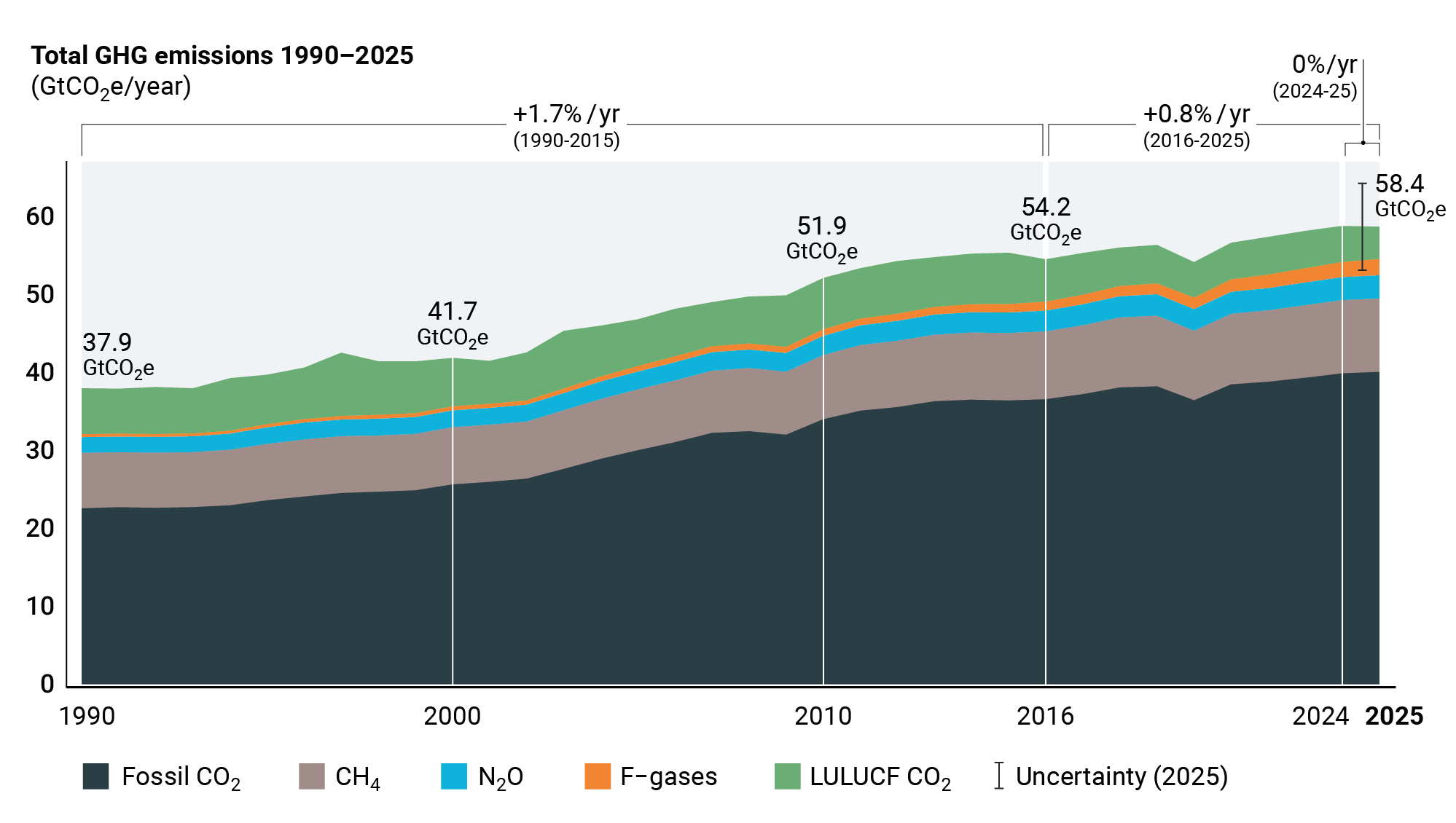
Compared to 2024, emissions from fossil fuels increased slightly, by between 0.4-1.1%, says the report. Emissions of both nitrous oxide and fluorinated gases increased by even higher rates, but since these comprise such a small part of total greenhouse gas emissions, “their contribution to the overall trend is relatively less significant”, it adds. Methane emissions remained steady over that time.
A reduction in the CO2 emissions from land use, land-use change and forestry (LULUCF) “slightly overcompensates” for the rise in emissions of fossil-fuel CO2 and other gases, according to the report. (For more on falling land-use emissions, see Carbon Brief’s explainer.)
The decrease in LULUCF emissions was “partially driven” by a decline in global wildfire emissions, particularly in Africa, South America and parts of south-east Asia. The report notes that these decreases were “likely connected to the ceasing of El Niño conditions”. The ongoing “super” El Niño is likely to cause LULUCF emissions to increase in 2026.
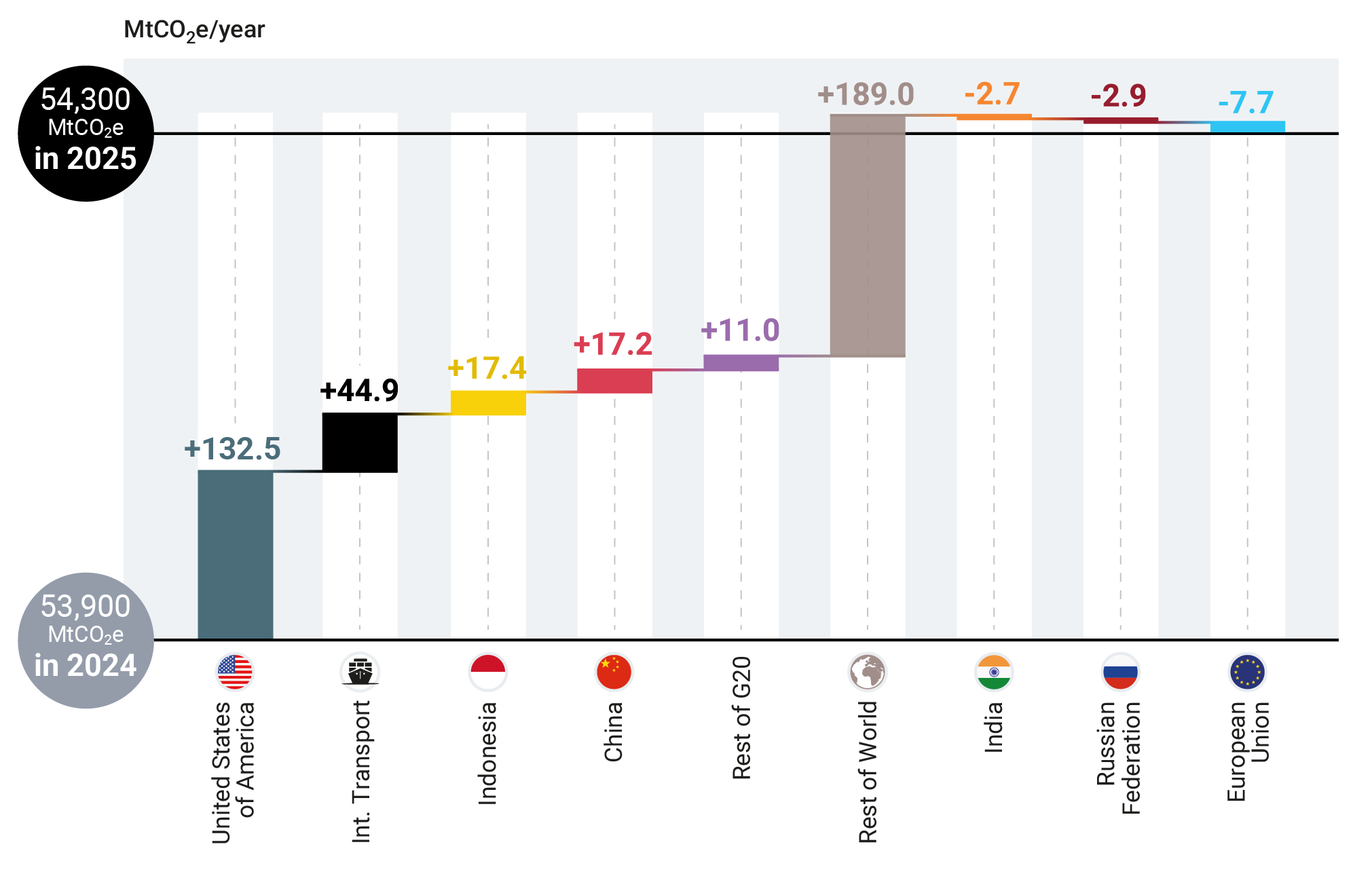
The report also examines countries’ contributions to the increase in greenhouse gas emissions – although here, it excludes LULUCF due to a lag in national-level emissions inventories for the sector.
Among the top six emitters, only the US saw a notable increase in 2025, says the report, whereas emissions in China, the EU, India, Russia and Indonesia were relatively flat. Emissions in the US grew by 133m tonnes of CO2e (MtCO2e) in 2025, due to increased electricity demand and a “rebound” of coal power. This growth in US emissions is likely due to a combination of market factors, including increased heating demand due to a colder winter, higher gas prices and overall increased electricity demand.
The changes for the six largest emitters, the rest of the G20 countries, international transport and the rest of the world can be seen in the chart below.
Across most sectors, progress towards decarbonisation has been “modest”, says the report. The most notable decreases have occurred in the power sector and the transport sector, due to the growth of solar power and electric vehicles. The report notes:
“There are emerging signs of transport sector electrification and decarbonisation, but at rates and levels that are not yet sufficient to drive emissions reductions at the global level.”
However, emissions from the transport sector have continued to grow, due to increased demand for international aviation and shipping.
The report notes that while electricity demand from data centres is “projected to double” by 2030, data centres at present account for less than 1% of total emissions.
New NDCs would reduce emissions ‘far from what is needed’
All countries were meant to submit new UN climate pledges for 2035, known as the third nationally determined contributions (NDCs) to the Paris Agreement, by February 2025. However, 95% of nations missed this deadline.
Many countries came forward with their third NDCs at a UN climate summit in New York in September 2025 and at the COP30 climate summit in Brazil in November 2025.
By the end of COP30, 122 – or 63% – of countries had produced their third NDCs.
The report says that figure had risen to 124 by 1 September 2026, with pledge