

Welcome to Carbon Brief’s DeBriefed.
An essential guide to the week’s key developments relating to climate change.
This week
Biden’s ‘climate legacy’
BIDEN OUT: US energy policy expert Jason Bordoff was among commentators reacting to the news that Joe Biden has withdrawn from the 2024 presidential race, telling Axios that he will “leave office with the strongest record on climate change of any president in US history”. The Associated Press reported that the Environmental Protection Agency announced $4.3bn in funding this week for decarbonisation efforts across 30 states. The timing of the grants will “ensure Biden’s environmental legacy will remain intact”, Inside Climate News said.
STILL OFF TRACK: Despite Biden’s efforts, the US remains off track for its Paris Agreement pledge of halving emissions from 2005 levels by 2030, according to a new report from US thinktank Rhodium Group, covered by the Financial Times. Rhodium’s analysis suggests the US would only reach 32-43% reductions by 2030, despite a record $71bn of clean energy investment in the first quarter of 2024. The Guardian covered how the US became the world’s biggest oil and gas producer, noting that no other country has ever produced as much of the fossil fuels.
KAMALA IN?: The New York Times is among publications examining the climate record of Kamala Harris, current vice-president and Biden’s most likely successor in the presidential race. “Harris has for years made the environment a top concern,” the newspaper said. The Guardian noted that, when Harris ran for the Democratic presidential primary in 2019, she promoted a “green agenda that was more ambitious than Biden’s, including calling for a carbon tax, a ban on fracking on public lands and a $10tn investment” to help combat climate change.
Global burning
NORTH AMERICA ON FIRE: Biden’s departure from the presidential race comes as US firefighters continue to battle wildfires in Utah and California amid blistering heat, the Guardian reported. NBC News noted that wildfires are also raging across Oregon and Washington, as well as across the border in Alberta, Canada. Fires forced 25,000 people to evacuate the tourist town of Jasper in Alberta, where flames have reached as high as 100 metres, the New York Times reported.
EUROPE ON FIRE: Parts of Europe are also battling blazes, with Greece facing its “most difficult wildfire season in two decades”, according to Bloomberg. There were 30 wildfires reported within a 24-hour period through last Sunday, it added. At least 20 wildfires were also reported in North Macedonia, with firefighters from neighbouring countries called in to help, according to Euronews.
Around the world
- FOSSIL CLIMATE FUNDS: Azerbaijan, host of the COP29 climate summit in November, is setting up a “Climate Finance Action Fund”, which will take money from fossil-fuel producing countries and companies in order to finance climate action in the global south, Reuters reported.
- ALTÉRRA-IA MOTIVE: Climate Home News reported on how money from a $30bn climate fund set up by COP28 host UAE, known as ALTÉRRA, has been used to help finance a gas pipeline project in the US.
- CLIMATE HYPOCRISY: A Guardian exclusive revealed how five wealthy countries are responsible for the majority of the new oil and gas licences handed out in 2024, with these projects due to emit 12bn tonnes of CO2 over their lifetimes. UN chief Antonio Guterres responded to the news by saying rich nations “are signing away our future”, reported Inside Climate News.
- WORST OIL SPILL: An oil tanker carrying 1.4m litres of oil capsized off the coast of the Philippines, with the country’s coast guard saying it “would be the worst oil spill in Philippine history if it were to leak”, reported the Inquirer.
- SA CLIMATE BILL: South Africa’s president Cyril Ramaphosa signed a new climate change bill into law this week, reported the Citizen. The bill introduces a regulatory framework for climate mitigation and adaptation, something that had been lacking up to now.
- ETHIOPIA MUDSLIDES: At least 229 people have been killed in mudslides triggered by heavy rains in Ethiopia, Al Jazeera reported.
17.15C
The global temperature on Monday 22 July, which was likely the hottest day in human history, according to Carbon Brief’s latest “state of the climate” update.
Latest climate research
- A study in Nature Climate Change showed that only 8% and 53% of African nations’ nationally determined contributions (NDCs) and national adaptation plans (NAPs), respectively, provide sufficient baselines for tracking progress on climate adaptation.
- The current “science-based” climate targets that have been adopted by companies across the world suffer from three issues: “basic misrepresentation”; “narrow and arbitrary benchmarks”; and “unequal effort sharing in an unequal world”. This makes them in need of reform, argued a comment piece published in Nature Communications Nature and Environment.
- A Nature study found that as well as absorbing carbon dioxide, trees also absorb methane from the atmosphere through their bark, making them more effective in absorbing greenhouse gases than previously thought.
(For more, see Carbon Brief’s in-depth daily summaries of the top climate news stories on Monday, Tuesday, Wednesday, Thursday and Friday.)
Captured
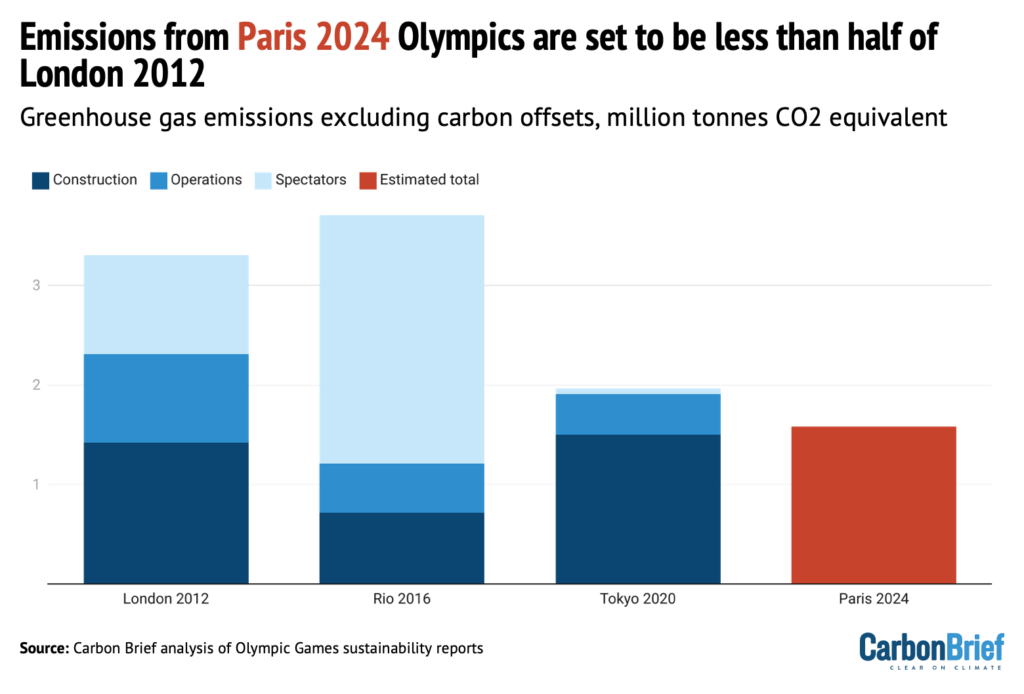
The Paris 2024 Olympics officially start today and these Games are likely to be the hottest ever, with the organisers attempting to mitigate impacts from the likely heatwaves. Carbon Brief analysis shows that the greenhouse gas emissions from these Games are expected to be less than half of those from London 2012. The Paris organisers have explicitly set a carbon budget of 1.75m tonnes of CO2 equivalent (which is half of the average of London 2012 and Rio 2016) and, according to their latest estimates, they are set to meet this target with total emissions coming in at 1.58m tonnes. Organisers said they had aimed to reduce emissions through use of temporary and low-carbon construction materials, as well as by encouraging sustainable travel. The Paris total is set to be even lower than the emissions from the Tokyo 2020 games held in 2021, when emissions were significantly reduced due to a ban on spectators amid the Covid-19 pandemic. The emissions figures exclude any carbon offsets and, for Rio 2016, do not include emissions from legacy construction.
Spotlight
Life in Louisiana’s ‘Cancer Alley’

This week, Carbon Brief interviews Dr Joy Banner, co-founder and co-director of the Descendants Project, about her work trying to uplift Black communities in the face of industrial pollution and increasing climate impacts.
Banner is based in a region along the Mississippi River in Louisiana known as “Cancer Alley”. It is so named due to the high prominence of cancer, which has been linked to local industrial air pollution from the area’s 150 industrial plants. These plants contributed 66% of Louisiana’s greenhouse gas emissions in 2020.
Levels of the carcinogen ethylene oxide, used in plastics production, were found to be 1,000 times higher than safe levels in the region. The health impacts disproportionately affect Black communities. This has been labelled by the UN as a form of “environmental racism”.
Banner’s organisation, the Descendants Project, aims to raise awareness of how Black communities in the region are “descended from the enslaved men, women and children who were forced to labour at plantations”, many of which were purchased by “large industrial petrochemical plants” fromin the 1970s onwards.
Carbon Brief: How would you say that your work relates to petrochemicals and climate change?
Joy Banner: To be honest, when we first started the Descendents Project…we didn’t see it as intersecting our work. But, pretty early on, Jo [co-founder and Joy’s sister] was invited to a conference in Texas, which is another location where there is a proliferation of petrochemical development. That work brought to mind the environmental issues that we are having in Louisiana. So, we are known as “Cancer Alley”, because of the health consequences of having so much industry right on top of us. Our cancer risk is 95% higher than the rest of the country. And the reason why we have so much production is plastics – and plastics is petrochemical[s] and so I guess I didn’t put two and two together [until then].
CB: The carbon emissions released in the production of plastics is having a global impact, but what are the kind of local impacts that you’re seeing in your community?
JB: I don’t know the statistics of how much [petrochemical production in] the Gulf Coast region is impacting climate overall, but it’s not insignificant at all. But, it’s just, for us, we are inundated with the smells. You can taste it, you can feel it, you can see it, you can hear it. It takes over your senses. And the other side of it is the impact that is happening to our climate and the way it’s impacting the strength of the hurricanes and the storm systems that are coming through…Our storms are getting worse. Those hurricanes are getting worse. And the impact of those storms are having more dire consequences.
CB: What are things that you’re trying to do [through the Descendants Project]?
JB: One of the strategies…[is] this dependence that we feel that we have on industries is false. It’s an illusion, it’s not actually a dependence because the plants are not doing s**t for us. Excuse my language, they really are not. Like they’re making billions of dollars. And why, if they’re so rich, then why are we in an impoverished community? Why do we have food deserts? Why are our school systems not better? And so, so our work is breaking that illusion, educating people and getting them to the point where they’re asking questions…We’re just strategising and highlighting the ways in which our communities are doing things for ourselves.
Watch, read, listen
BATTERY DEMANDS: A new report from the US thinktank RMI explored future demand for batteries and the critical raw minerals required to make them.
NOT SO RARE: The podcast BBC Rare Earth explored whether the rise in wildfires around the world is unstoppable and whether the solutions might be found through applying Indigenous fire management practices.
JAILED PROTEST: George Monbiot appeared on Guardian’s Science Weekly podcast to discuss the record-long jail terms for non-violent protest given to five Just Stop Oil activists for planning the blocking of a motorway in the UK.
Coming up
- 27 July-2 August: 61st session of the Intergovernmental Panel on Climate Change, Sofia, Bulgaria
- 28 July: Venezuelan presidential elections
- 29 July-2 August: International Seabed Authority Assembly, second part of the 29th session, Kingston, Jamaica
- 30 July-1 August: UN Environment Programme Dialogue on Actionable Steps for Inclusive Climate Resilience Monitoring and Reporting, online
Pick of the jobs
- International Energy Agency, China programme officer | Salary: €5,741 per month. Location: Paris
- Internews, environmental media consultant – Middle East North Africa | Salary: Unknown. Location: Remote (based in UK or Tunisia)
- Earth Journalism Network, virtual reporting fellowships to the UNCBD (COP16) and UNFCCC (COP29) | Salary: $100 communications stipend
- Reuters Institute, Oxford Climate Journalism Network Engagement Manager | Salary: £32,332-£38,205. Location: Oxford, UK
DeBriefed is edited by Daisy Dunne. Please send any tips or feedback to debriefed@carbonbrief.org.
This is an online version of Carbon Brief’s weekly DeBriefed email newsletter. Subscribe for free here.


The post DeBriefed 26 July 2024: Biden’s ‘climate legacy’; Global wildfires; Life in Louisiana’s ‘Cancer Alley’ appeared first on Carbon Brief.

The US is expected to resume its attempt to sink measures for a greener global shipping sector at closed-door talks between governments at the International Maritime Organization (IMO) in early September.
The US and oil-producing allies like Saudi Arabia want to weaken a proposed plan for cleaner fuels that aims to reduce planet-heating emissions from the industry, which relies heavily on dirty bunker fuels. Shipping currently represents 3% of global emissions.
Those that want a softer system are likely to back a Liberian proposal which expert analysis suggests would see emissions fall by only half at most by 2050, far short of the sector’s agreed climate goals.
After several years of debate, governments provisionally agreed in April 2025 on the “Net Zero Framework” (NZF), a series of emissions reduction targets for shipowners, backed up with financial rewards for meeting the targets and fees for missing them.
But in October 2025, after a high-profile intervention from US President Donald Trump and threats of sanctions and visa restrictions, the US convinced a majority of voting nations to postpone the adoption of the NZF for a year.
Ralph Regenvanu, climate minister for the Pacific nation of Vanuatu, called the delay “unacceptable” given the urgency of accelerating climate change.
After a round of low-profile talks in May, the first of three further sets of talks on how to clean up shipping will begin at the IMO’s riverside headquarters in London on Tuesday, culminating in a final public session in November.
Em Fenton, who follows the talks as senior director of climate diplomacy at Opportunity Green, an NGO focused on aviation and shipping, said governments should not be sidetracked by alternative proposals to the NZF, calling them “a distraction from a hard-fought multilateral compromise”.
“If countries want to deliver a just and fair maritime transition, there is really only one choice: back the NZF and stand together in solidarity against those who would tear it apart,” Fenton added.
Five proposals on the table
Governments will discuss five different proposals submitted in advance of next week’s meeting. The most ambitious of these is from the Pacific island nation of Tuvalu, which has proposed a levy on the entirety of a ship’s emissions rather than just those above a certain level, as the NZF envisions.
That had been the original demand of Pacific nations before the NZF was provisionally adopted in April 2025. At the time, Tuvalu’s transport minister Simon Kofe described the NZF as disappointing and not ambitious enough.
For this reason, six Pacific countries abstained in the vote on the NZF. While they supported the original plan for its adoption in October 2025, they have used the delay to push again for more ambition.
John Kautoke, advisor to a group of Pacific nations called 6PAC+, told Climate Home News that the NZF “cannot diminish its already inadequate ambition. If anything, the NZF must increase in ambition if we are going to renegotiate its parameters.”
-
New Zealand moves to protect business with law curtailing climate litigation
A new bill prevents corporations being sued for the climate damage their emissions cause, as the government says climate action should be handled at the national level not in court -
Indonesia’s nickel production cuts are not enough to create a sustainable industry
The government is restricting nickel production to push up prices but producing more sustainable nickel for a premium requires addressing the industry’s coal issue -
As marine heat breaks records, countries seek ocean roadmap at COP31
Africa and the EU are leading a push for COP31 to deliver a roadmap that lays out measures to protect fast-warming oceans


Analysis by the Institute of Marine Engineering, Science and Technology (IMarEST) suggests that, of the five proposals, only Tuvalu’s would meet the 2030 and 2040 emissions reduction targets for global shipping that were agreed by governments in 2023. Those were for cuts of 20% between 2008 and 2030, 70% by 2040 and then reaching net zero “by or around, i.e. close to 2050”.
Despite this, the UK, Australia, Canada and South Africa have formally proposed that governments adopt the NZF, which won support in a 63-13 vote among governments at the April 2025 talks. Trump’s US walked out halfway through.
According to IMarEst’s analysis, while the NZF proposal will not be enough to meet the industry’s targets, it will reduce emissions more cheaply than the Pacific proposal.
A proposal by Brazil – which fought hard for the NZF last October – suggests tweaking the framework to make meeting targets easier in the short term and harder in the long term.
While this compromise will make it more appealing to the owners of polluting ships and countries that support them, IMarEst estimates it would lead to higher cumulative emissions than either the NZF or Pacific proposals.
The NZF stipulates that fees for high-polluting shipowners should be be put into a Net Zero Fund and used to promote clean shipping fuels and a fairer transition. The Brazilian proposal would delay raising and spending these funds by two years, from 2029 to 2031.
Liberia’s proposal weakens emissions cuts
The US and Saudi Arabia are likely to swing behind a new proposal from Liberia, whose government makes millions of dollars a year selling the right for shipowners to register their vessels in the small West African nation via a US-based company.
This proposal would weaken the emissions reduction targets. IMarEst says it would cut the industry’s emissions at most by a half by 2050, falling far short of the target agreed in 2023 for international shipping to reach net zero “close to 2050”.
It would also replace the NZF’s fees for missing targets with a carbon trading system. As a result, there would be no Net Zero Fund and therefore less money available to incentivise green fuels and make the transition more equitable for poorer nations.
Pacific advisor Kautoke said that, as well as preventing shipping from reaching zero emissions by 2050, Liberia’s proposal would mean the Pacific “will not receive any support to deal with the disproportionately negative impacts created by the cost of the transition”.
“We get a double blow if we adopt the Liberian proposal,” he warned. “We get all the cost of a transition without any support, and we have an industry that continues to burn fossil fuels to an unforeseen point.”
Japanese proposal favours shipowners
Japan has submitted a late proposal to amend the NZF so that shipowners have more control over how the fees they would pay for emitting above a set threshold are spent.
University College London professor Tristan Smith has argued that this change means there will be no central mechanism to incentivise investments in clean fuels. He wrote on LinkedIn that under the system put forward by Japan, shipowners would be able to select which green projects their fees would go to. They could choose their own or those of a sister company or other shipowners, rather than funding broader just transition projects that would benefit marine workers or developing countries hit by rising shipping costs.
Despite its flaws, Smith added that Japan’s proposal “could still get taken seriously by some, given how appealing it may seem to shipowners who have consistently demanded control of revenues, and given how the US and other member states have pushed back against the IMO Net Zero Fund and [greenhouse gas] pricing.”
Tacit or explicit approval?
Next week, governments are expected to make statements saying which proposals – or which aspects of proposals – they prefer. Another set of talks will be held from November 23-27 before a potentially final round from November 30-December 4.
A new framework to tackle shipping emissions could be adopted at those talks if two-thirds of countries that are present and signed up to a regulation called Marpol Annex VI – endorsed by just over 100 states – vote in favour of it, as they did in April 2025.
The US and its allies are also trying to change the rules to make the next stage more difficult. Decisions that have been adopted at IMO meetings usually take effect automatically unless a certain number of countries object within a certain time period decided by governments, a system known as tacit approval.
But the US wants that to require explicit approval instead, so that any new emissions standard would not come into force unless enough governments – representing a certain percentage of the world’s shipping fleet – actively indicate support for it.
Critics say this change would give a small number of countries with large shipping registries the power to block implementation. Liberia has the world’s biggest shipping registry, run by an American company, followed by Panama and the Republic of the Marshall Islands.
Liberia and Panama have supported the US at the talks on the Net Zero Framework. The Marshall Islands has long been one of the most vocal supporters of climate action in shipping but, with its officials and shipping registry income vulnerable to US retaliation, did not sign on to the recent Pacific proposal vowing to strengthen the NZF if it is re-opened.
Brazilian negotiator Adriana de Medeiros Gabinio warned in April that the NZF’s opponents are trying to change the rules by which it comes into force as a “safety net to block” it.
The post Battle over cleaning up shipping set to resume at London talks appeared first on Climate Home News.
Battle over cleaning up shipping set to resume at London talks
SYDNEY, Wednesday 26 August 2026 — New 2026 Sustainability Reports released by supermarket giants Coles and Woolworths this week demonstrate the retailers are failing on their commitments to end deforestation in their supply chains.
Adele Chasson, Nature Policy Lead at Greenpeace Australia Pacific said:
“These so-called sustainability reports are revealing. Despite their public commitments in 2024 and 2025, neither Coles nor Woolworths have taken deforestation-linked beef off their shelves. Meanwhile, bulldozers continue to tear up forests and bushland, pushing wildlife closer to extinction and causing mass toxic runoff to flow into the Great Barrier Reef. Millions of native animals like koalas are losing their homes to beef pastures each year, while the big supermarkets put off action.
“Australians would be shocked to know that beef on the shelves of our biggest supermarkets could be pushing threatened species to the brink of extinction. Collectively Coles and Woolworths have made more than $2 billion in profits in the last year, profiting from the destruction of wildlife and precious Australian nature. Coles and Woolworths owe it to shoppers to deliver on their promises and end deforestation in their supply chains now.
“As big beef buyers, Coles and Woolworths have an essential role to play in keeping Australia’s unique forests standing. They can help stop the Great Barrier Reef from being poisoned by runoff and protect iconic forest wildlife by taking deforestation off their shelves. It’s time these big companies put their money where their mouths are and follow through on their promise of sourcing and supplying deforestation-free beef.”
New Zealand’s parliament has adopted a controversial new law blocking a whole avenue of climate litigation and shutting down its most advanced corporate lawsuit, which has been blamed by the government for shaking business confidence and investment.
The Climate Change Response (Tort Liability) Amendment Bill, expected to take effect in the coming days after it is formally signed by the Governor-General, prevents all current and future civil claims for climate loss or harm under tort law.
Justice minister Paul Goldsmith said last week that the aim was to give businesses “certainty around their climate change obligations”, noting it would not alter the government’s responsibilities under the Climate Change Response Act 2002 nor business obligations under the Emissions Trading Scheme.
“Our response to climate change is best managed by the Government at a national level and not through piece-meal litigation in the courts,” he added in a statement.
Such litigation, he said, “risks developing a new regime that contradicts the framework Parliament has already enacted” to tackle climate change.
South Africa’s top court blocks Shell’s offshore oil exploration right
Constitutional Court rules that Shell and its partners failed to consult affected communities and did not properly consider environmental risksPeruvian farmer loses climate case against RWE – but paves way for future action
Experts say that despite dismissing the lawsuit, the ruling sets a precedent by confirming that climate science can establish legal liability for the damage caused by emissions

Goldsmith singled out a key domestic climate lawsuit brought by Northland iwi leader and activist Mike Smith against six big companies: dairy firms Fonterra and Dairy Holdings, energy firms Genesis Energy and Z Energy, New Zealand Steel and coal mining firm BT Mining. A seventh original defendant, Channel Infrastructure, was dropped after it permanently decommissioned its Marsden Point oil refinery.
Smith argued that these companies had caused him harm under public nuisance and negligence law, as well as a third breach of a duty to cease contributing to climate change that has yet to be tested domestically. He did not seek financial compensation, instead asking for the companies to immediately stop emitting or contributing to net greenhouse gas emissions.
In one of the most advanced corporate climate accountability lawsuits in the world, a trial had been scheduled for April 2027 after the Supreme Court unanimously allowed the case to continue.
Corporate lobbying in the shadows
Smith described the passing of the bill as “deeply concerning”, particularly as it coincided with the Supreme Court hearing another of his climate lawsuits. In that case, Smith v Attorney-General, he argues that the government’s response to climate change and its impacts on Māori communities in particular breaches rights to life and culture.
“That timing raises profound questions about the separation of powers and the rule of law,” said Smith. “Whatever one’s view of the merits of these cases, it is deeply troubling when parliament intervenes to remove a legal pathway while the courts are actively considering fundamental questions about climate responsibility, rights and the crown’s obligations.”
The bill – which says that no person (including the government) can be found liable in tort for emissions-related climate change effects – followed major lobbying efforts by the companies defending themselves in Smith’s lawsuit. They outlined a proposed legal amendment in a briefing note to the government in 2024.
The centre-right government has been fiercely criticised over its lack of transparency in relation to this lobbying activity. The national ombudsman recently found that the Prime Minister’s Office effectively withheld information requested by the Environmental Law Initiative about meetings, discussions and conversations regarding Smith’s case.
Green groups fail to stop bill
The bill sparked huge concern among environmental campaigners in New Zealand and elsewhere. Greenpeace Aotearoa called it a “shocking abuse of executive power” and the vast majority of submissions to a parliamentary inquiry said it should be rejected.
But in the end, it was adopted with little resistance, moving relatively smoothly through parliament, passing its third reading by 67 votes to 53. Sam Bookman, climate law lecturer at Melbourne Law School, told Climate Home News he was not surprised by this, given that the coalition government has a secure majority.
A complaint has been made to the UN special rapporteur on climate change and human rights by Smith, the National Iwi Chairs Forum Pou Tikanga and youth coalition Climate Clinic Aotearoa over what they see as the government’s heavy-handed approach. Smith is also challenging the new law in yet another lawsuit.
“Pathetic”: New Zealand plans to barely cut emissions between 2030 and 2035
Bookman thinks it “very unlikely” that such a challenge will succeed, noting that New Zealand’s constitution is firmly anchored in parliamentary sovereignty.
But the expert in climate law does not see the bill as the end of legal action in the country, noting that New Zealand has a “sophisticated climate litigation landscape with a growing number of specialist and experienced lawyers and NGOs”.
The country is also approaching its next general election in November, and some opposition parties have pledged to restore access to the courts if elected.
Amanda Larsson, global project lead on agriculture for Greenpeace International, said: “This law deserves to be tested, and I strongly encourage the international climate litigation community to unite and help defend New Zealanders’ fundamental right to hold polluters accountable before this becomes a global blueprint.”
Copycat legislation on the rise
New Zealand’s move is part of a small but growing legislative effort to shut down climate litigation around the world.
In the US, Republican politicians introduced legislation in the House and Senate in April that would shield fossil fuel firms from climate liability lawsuits. Similar laws have already been passed at state level in Tennessee, Utah, Iowa and Louisiana.
The German state of Bavaria has put forward a similar proposal to the Federal Council, aiming to block private climate claims as well as the recognition and enforcement of foreign judgments imposing such liability. There are also proposals to limit available remedies and actions in the Netherlands and Belgium.
UN General Assembly backs “climate obligations” set by world’s top court
Bookman said he expects more efforts to counter climate damages litigation and advised plaintiffs to think about how to respond, including drawing on broader support in opposing them.
“Even though it’s very hard for plaintiffs to win these types of cases, companies are very eager to avoid the expense, embarrassment and political accountability that come even with unsuccessful lawsuits,” he said.
The post New Zealand moves to protect business with law curtailing climate litigation appeared first on Climate Home News.
New Zealand moves to protect business with law curtailing climate litigation


-
Climate Change1 year ago
Guest post: Why China is still building new coal – and when it might stop
-
Greenhouse Gases1 year ago
Guest post: Why China is still building new coal – and when it might stop
-

 Greenhouse Gases2 years ago
嘉宾来稿:满足中国增长的用电需求 光伏加储能“比新建煤电更实惠”
-

 Climate Change2 years ago
嘉宾来稿:满足中国增长的用电需求 光伏加储能“比新建煤电更实惠”
-
Climate Change2 years ago
Bill Discounting Climate Change in Florida’s Energy Policy Awaits DeSantis’ Approval
-

 Renewable Energy10 months ago
Sending Progressive Philanthropist George Soros to Prison?
-
Greenhouse Gases1 year ago
嘉宾来稿:探究火山喷发如何影响气候预测
-

 Carbon Footprint2 years ago
US SEC’s Climate Disclosure Rules Spur Renewed Interest in Carbon Credits