

Welcome to Carbon Brief’s DeBriefed.
An essential guide to the week’s key developments relating to climate change.
This is an online version of Carbon Brief’s weekly DeBriefed email newsletter. Subscribe for free here.
This week
Atlantic and Amazon ‘tipping points’
CURRENT COLLAPSE?: New research found the Atlantic Meridional Overturning Circulation (AMOC), a large system of ocean currents that helps keep western Europe milder, “may already be on course to a tipping point”, the Press Association reported. The Associated Press said: “An abrupt shutdown of Atlantic Ocean currents that could put large parts of Europe in a deep freeze is looking a bit more likely and closer than before.”
QUESTION MARKS: The Daily Telegraph quoted Prof Jonathan Bamber, director of the Bristol Glaciology Centre, saying the new research was “entirely unrealistic for even the most extreme warming scenario over the next century”. But on the scientific blog RealClimate, ocean scientist Prof Stefan Rahmstorf noted that it was “observational data from the South Atlantic which suggest the AMOC is on tipping course” and that the model simulation was “just there to get a better understanding of which early warning signals work and why”.
AMAZON STRESS: Another study found that up to half of the Amazon is facing combined stress from rising heat, drought, deforestation and other factors that could push the rainforest towards a tipping point by 2050, Reuters reported. The research is the first to assess the cumulative impact of multiple threats, the New York Times reported. Carbon Brief also covered the findings.
‘Troika’ tout 1.5C target
COP30 COUNTDOWN: The United Arab Emirates, Azerbaijan and Brazil – hosts of the COP28, COP29 and COP30 climate summits – are teaming up to push for higher ambition towards the 1.5C limit, Al Jazeera reported. The “troika” wants countries to submit more ambitious pledges ahead of COP30 in Belem, Brazil next year, the outlet said.
MISSION 1.5C: Their efforts were mandated by the COP28 outcome, which launched an undefined “set of activities” known as “road map to mission 1.5C”. Meanwhile, Azerbaijan is on track to raise its gas output by 35% in a decade, Agence France-Presse reported.
MINISTERIAL MEETING: The International Energy Agency (IEA) held its 50th ministerial meeting this week, where leaders pledged in a communique to strengthen energy security and speed efforts towards 1.5C, Bloomberg reported. The IEA, which currently has 31 full members, also opened talks with India over joining the club, Press Trust of India reported.
Around the world
- INDONESIA ELECTS: Defence minister Prabowo Subianto, a “veteran…with a hardline military past”, will be the country’s next president, the Jakarta Post reported. He owns a coal business and “could increase deforestation and coal use”, said NPR.
- DRY JANUARY: A lack of rain in January caused Mexico’s “worst drought” for 12 years, Excélsior reported. Chile is clearing up after devastating forest fires, said El Mercurio, while Peru has issued warnings over heat stroke, El Comercio reported.
- MIGRATORY THREAT: One in five migratory species are under threat from human impacts including climate change, according to a UN report covered by BBC News.
- SAUDI TRANSITION ADMISSION: Oil giant Aramco dropped its expansion plans because of the energy transition, CNBC reported, quoting Saudi Arabia’s energy minister. The surprise move late last month had “spark[ed] questions” over the kingdom’s “concerns over the future of oil demand”, the outlet added.
- AFRICAN MYSTERY: New research casts doubt on earlier findings that Africa’s tropical ecosystems are releasing 6bn tonnes of carbon dioxide a year, Carbon Brief reported. Both sides agree on-the-ground data is needed to unravel the mystery.
- SHELL GAME: Demand for liquified natural gas (LNG) will “surge 50% by 2040” according to Shell, the Financial Times reported. The forecast, from the “world’s largest private LNG trader”, was “slightly lower” than last year, the paper said.
€881 billion
The record value of global carbon markets in 2023, according to a report from London Stock Exchange Group covered by BusinessGreen.
Latest climate research
- A new report from Climate Analytics translated the global goal of tripling renewable capacity by 2030 into regional targets and said only Asia was broadly on track.
- Research in Nature Energy explained how different types of lower-income coal, oil and gas producers can transition away from fossil fuels.
- Global warming “will lead to widespread increases in locust outbreaks”, found a study in Science Advances.
(For more, see Carbon Brief’s in-depth daily summaries of the top climate news stories on Monday, Tuesday, Wednesday, Thursday and Friday.)
Captured

Only a fifth of the population of the Democratic Republic of the Congo (DRC) has access to electricity, with per-capita consumption below that of an average UK fridge, reported Carbon Brief in its latest country profile. Despite using hardly any fossil fuels, the country is one of the world’s biggest greenhouse gas emitters, the profile explained, as a result of human-caused land use changes in its major forests and peatlands.
Spotlight
‘Underestimated’ global public support for climate action
This week, Carbon Brief interviews the authors of new research finding that “almost universal” global support for climate action is “systematically underestimated”.
Carbon Brief: Your survey of nearly 130,000 people in 125 countries found “almost universal” support (86%) for climate action. Were you surprised?
Prof Peter Andre, Prof Teodora Boneva, Prof Felix Chopra and Prof Armin Falk: We were indeed surprised to find that the percentage of the population approving of pro-climate social norms and demanding more political action from their national government is very high in almost all countries in our sample. We were probably misled by the same pessimism that we found to be so widespread across the globe. A broad majority of people across the globe is willing to pay a personal cost [to fight global warming]. However, in 110 out of 125 countries, the majority thinks that they are in the minority.
CB: Do you think this would hold for specific policies, such as a carbon tax?
PA, TB, FC and AF: One cannot simply equate support in the survey with support for specific policy proposals. [However], in a representative US sample, we do find that the general demand for more political action is strongly correlated with demand for specific climate policies, such as a carbon tax.
CB: There has been a resurgence of anti-climate rhetoric from politicians and the media in many countries. Do you think public opinion has shifted since your survey in 2021-22?
PA, TB, FC and AF: We do not detect any clear time trend within our samples from 2021 and 2022, but do not have data for the most recent months. If we were to speculate, we would not want to fall victim to the same pessimism one more time. Our best guess is that the support for climate action has increased rather than decreased in the last two years.
CB: You found stronger willingness to contribute among respondents in poorer, hotter and more vulnerable countries. Why do you think richer people are less willing to pay their way?
PA, TB, FC and AF: Two potential explanations come to mind. First, richer countries are still strongly dependent on fossil fuels. The mitigation costs could therefore be perceived as relatively high and the required lifestyle changes as too drastic. At the same time, richer countries may be more resilient: A country’s GDP per capita reflects its economic capacity to cope with climate change. The most direct and immediate consequences are likely to be concentrated in more vulnerable countries, which have fewer resources to mitigate the negative consequences of the climate crisis.
CB: You found people systematically underestimated the willingness of their peers to contribute to climate action. Why do you think that is – and how could it be changed?
PA, TB, FC and AF: The reasons for this perception gap are likely to be manifold. In the past, media and public discussions have given a lot of focus to the small number of climate change sceptics and have fallen prey to the efforts of special interest groups. Moreover, climate change is difficult to tackle. People might mistakenly infer that the slow progress in combating climate change is due to a widespread lack of personal commitment.
In our view, correcting this perception gap is more important than understanding its origin. Humans are (what behavioural scientists call) “conditional cooperators”. They contribute more to the public good if they believe that others contribute as well. For this reason, pessimism about others’ contributions is harmful. It can constitute a critical obstacle for climate action. We thus conclude in the paper that, “[r]ather than echoing the concerns of a vocal minority that opposes any form of climate action, we need to effectively communicate that the vast majority of people around the world are willing to act against climate change and expect their national government to act”. We hope that our study sparks a debate on this topic, and increases awareness about the large global support for climate action.
This interview was edited for length. A full transcript will be published on Carbon Brief’s website later today.
Watch, read, listen
‘UNINSURABLE WORLD’: A Financial Times “big read” looked at rising insurance premiums as extreme weather events become more frequent.
TRUMP WARNING: An election win for former US president Donald Trump would “spell disaster for climate action in Africa”, wrote Nathaniel Mong’are, adviser to the Kenyan cabinet secretary, in an article for SciDevNet.
WTF?: Popular Indian podcast WTF is? tackled climate change, interviewing researcher Prof Navroz Dubash, activist Sunita Narain and others.
Coming up
- 11-17 February: COP14 for migratory species, Samarkand, Uzbekistan
- 17-18 February: African Union summit, Addis Ababa, Ethiopia
- 19 February to 1 March: Sixth UN Environment Assembly, Nairobi, Kenya
- 20 February: International Energy Agency (IEA) beyond COP28 event, Paris, France
- 21-23 February: Climate and Clean Air Conference, Nairobi, Kenya
Pick of the jobs
- Global Witness, investigator and senior investigator of climate disinformation | Salary: £44,837 and £52,494, respectively. Location: London (hybrid)
- California-China Climate Institute, University of California, Berkeley, climate policy fellow | Salary: $70,500-$86,900. Location: Berkeley, California
- Small World Consulting, sustainability consultants for carbon management and land use | Salary: £29,000-£40,000. Location: Lancaster, UK
- Common Wealth, principal or senior analyst for transatlantic energy | Salary: £43,500 for senior analyst or £50,500 for principal analyst. Location: London or US east coast
DeBriefed is edited by Daisy Dunne. Please send any tips or feedback to debriefed@carbonbrief.org

The post DeBriefed 16 February 2024: Atlantic and Amazon ‘tipping points’; New ‘troika’ for 1.5C; Global support for climate action ‘underestimated’ appeared first on Carbon Brief.

When the Turkish COP31 presidency presented its priorities to international business leaders for the first time in New York in September, among those invited to give the private sector’s first response was Ali Koç, scion of one of Türkiye’s wealthiest families.
On stage, the vice chair of the board of Koç Holding said the family company, which weeks earlier had been announced as one of the top sponsors for the UN climate summit, can be seen as “quite exemplary” for its climate record.
What Koç did not mention was that the group’s biggest money-making arm – Türkiye’s largest oil refiner Tüpraş – plans to keep running its refineries “at maximum potential”. Nor did he say that, in 2025, both parent company and subsidiary cut their 2030 climate targets to a level they had already nearly achieved, as Climate Home News’ analysis of company records reveals.
The decision to hand Koç Holding a prominent role at COP31 – the company is also the summit’s “Global Business Partner” – has reignited a long-running controversy over the platforming of fossil fuel interests at the annual UN climate conference.
It has also thrown into question how COP sponsors are chosen and screened. The hosting agreement between the Turkish government and the UN climate secretariat (UNFCCC) says that a partner company’s “climate integrity” should be taken into account.
COP31 electrification pledge leaves out clean power commitment
But how that test is applied is unclear and the process for picking sponsors remains largely opaque. The Turkish COP31 presidency has not published its selection criteria, nor the financial terms of any of its partnership agreements, including Koç’s. The UNFCCC declined to clarify how it advises on such deals.
Campaigners have long argued that accepting sponsorship from polluting companies is wrong because it gives them a global stage, visibility and access to policymakers at talks that are meant to move the world away from fossil fuels, and tarnishes the reputation of the COPs.
Koç’s energy division, which is dominated by oil refiner Tüpraş, accounted for three-quarters of the parent firm’s income in the first half of 2026.
“How was Koç Holding ever chosen as a COP31 sponsor? Any corporation that makes most of its money from oil refining should not qualify as sustainable,” said Pascoe Sabido, a campaigner at Corporate Europe Observatory, which exposes company lobbying. “This is hugely embarrassing for the UNFCCC and its climate integrity check, which doesn’t appear to be worth the paper it’s written on.”
Koç Holding “is not just standing still but walking backwards”, he told Climate Home News.
Koç Holding and Tüpraş did not reply to multiple requests for comment. The UNFCCC secretariat and the Turkish COP31 presidency declined to respond to questions from Climate Home News on the sponsorship agreement.
Oil refining windfall
Türkiye’s biggest industrial group, Koç Holding has stakes in several key sectors of the economy, spanning vehicle manufacturing in a joint venture with Ford to electronics, home appliances and banking.
But the conglomerate’s crown jewel is oil refiner Tüpraş, which Koç controls. Last year its four refineries turned crude oil into 26.8 million tonnes of petrol, diesel, jet fuel and other products, enough to fill about 36 Olympic swimming pools every day.
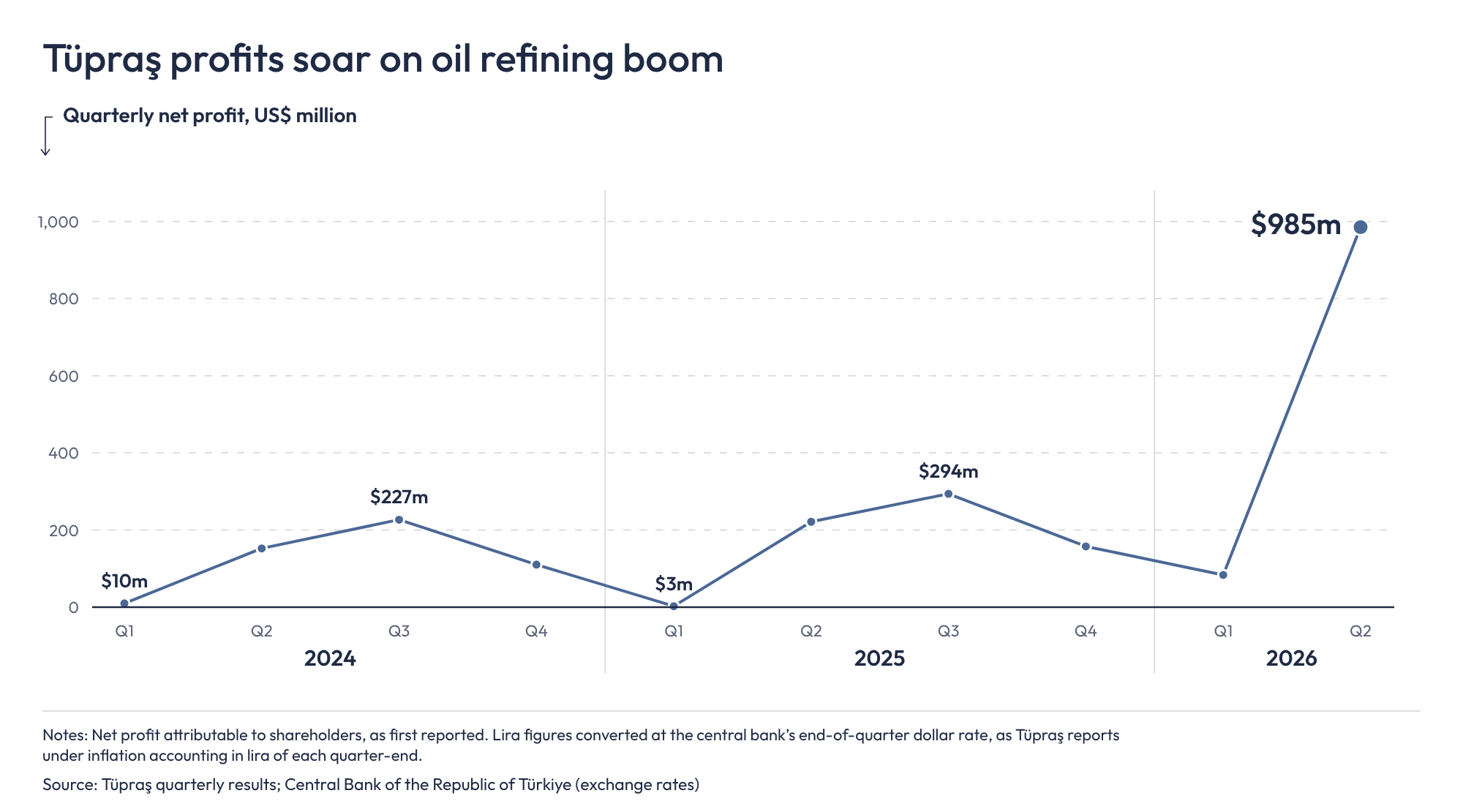
The company plans to raise its production to 29 million tonnes in 2026 – already a bumper year so far with soaring profits, thanks to sky-rocketing refining margins driven by a crunch in global oil processing capacity caused by the Middle East crisis.
The oil business boom sits awkwardly with the climate and energy transition plans Koç and Tüpraş unveiled in 2021, when both pledged to become carbon neutral by 2050. Then, Tüpraş set out its aim to become “a leading carbon-neutral energy company”.
Despite these promises, in 2025, both companies lowered their targets for cutting emissions from their own operations by 2030, from 27% to 20% below 2017 levels. Tüpraş also cut its 2035 goal from 35% to 25%. The company still technically retains its long-term target of carbon neutrality by 2050, but the new plan will require much more drastic cuts after 2035.
Lowering the climate bar
Tüpraş blamed its weakening of climate ambition on “changing market dynamics, economic conditions and technological developments”. In a presentation announcing the revision to investors, the refiner said the energy outlook had changed since 2021.
The reasons it listed included elevated geopolitical tensions, increased investment in oil and gas extraction, which it said showed refined fuels remain vital for energy security – and even the depletion of the carbon budget to keep global warming to 1.5C.
Its parent company Koç pointed the finger at the slow pace of green hydrogen development, which the group said now had a “low feasibility” of transforming the energy sector after it had previously pinned much of its transition plan on the sustainable fuel.
The Turkish company’s new 2030 targets are certainly within reach. Tüpraş had already cut its operational emissions by 17% from 2017 levels by 2025, with nearly all of that progress achieved before the transition plan was unveiled, while Koç had reduced them by 16%.
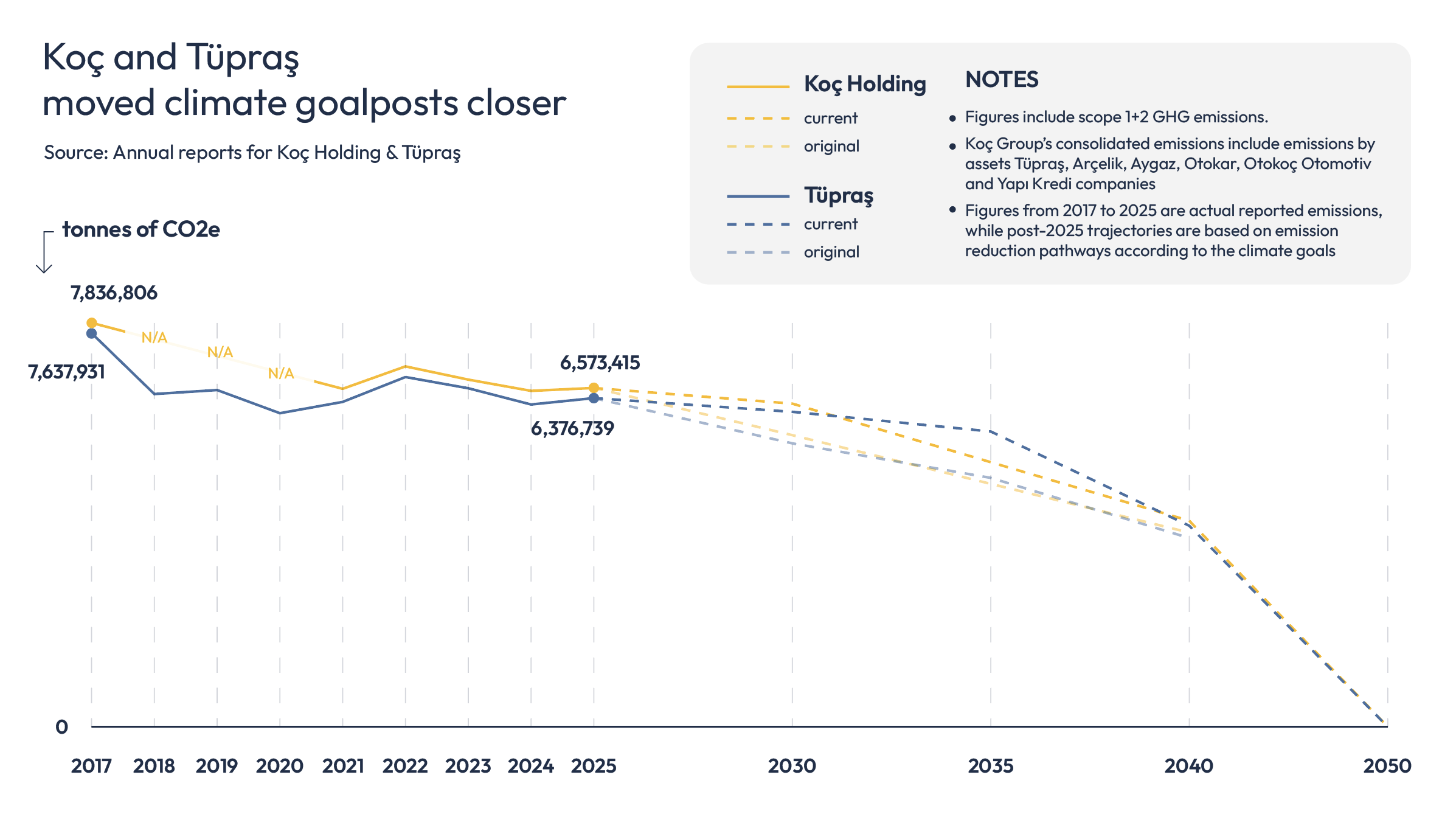
The softer targets also exclude the bulk of the group’s climate impact. Most of its emissions come not from its own refineries and factories but from the products it sells: petrol, diesel and jet fuel burned in the engines of cars or planes.
These so-called Scope 3 emissions make up about 97% of Koç’s carbon footprint. They rose by around a sixth between 2019 and 2024, and neither Koç nor Tüpraş has set a target to cut them.
Efe Baysal, Türkiye team lead at campaign group 350.org, said there is a “clear contradiction” between talking about climate action while weakening emission targets and seeing emissions from the use of petroleum products keep rising.
“If the company is serious about the transition, it needs a clear plan to wind down fossil fuel operations, rather than relying on efficiency measures and technologies that let business as usual continue,” she told Climate Home News.
‘Sustainable refining’ push
Tüpraş’s updated transition plan rules out expanding its oil refineries, but commits to “maintaining the existing capacity” and running it “at maximum potential”. Oil refining is expected to remain its main source of earnings for years to come. Koç listed “growing oil demand and diesel deficit” in Türkiye as a competitive advantage for its energy business in a pitch to investors last month.
The biggest component of the Tüpraş transition plan is what the company calls “sustainable refining”. It plans to invest $3.9 billion between 2025 and 2035 in programmes to modernise its refineries, improve their energy efficiency and bring down the direct emissions they generate. The company is also shifting some of its production to petrochemicals, which it expects to reduce its Scope 3 emissions.
Australia says COP31 co-presidency will work on a cover decision
Alongside these “sustainable refining” efforts, Tüpraş is also investing in renewable power.
Four years ago, it bought Entek, which produces electricity primarily from six hydropower plants and one gas plant. Since the acquisition, Tüpraş has started building a utility-scale solar farm in Romania and a wind power plant with storage in Türkiye, alongside smaller solar energy installations at some of its refineries. A dozen more renewable energy projects are currently in the pipeline, according to its latest annual report.
In a self-declared bid to become “Türkiye’s leading producer of zero-carbon electricity”, Tüpraş wants to reach installed capacity of 1.6 gigawatts (GW) by 2030 – a target it raised in its updated plan – and 2.5GW by 2035. The Turkish government has committed to rolling out 120GW of wind and solar capacity nationwide by then.
Setback for green fuels
Tüpraş plans to supply most of its low-carbon electricity to run its future production plants for green hydrogen, an alternative fuel that can replace fossil fuels in some heavy industries and long-distance transport.
A few years ago, green hydrogen looked set to become a key pillar of the global energy transition, with companies pitching visionary projects and governments rolling out strategies for the fuel to decarbonise economies. But inflated forecasts, high costs and weak demand have led to a reality check for prospective producers like Tüpraş.
The Turkish refiner significantly scaled back its green hydrogen plans last year. While it originally hoped to start producing the clean fuel in 2025, it now targets a first pilot project by 2030 with commercial large-scale production not expected before 2035. That’s primarily because the cost of electrolysers, the machines that split water into hydrogen and oxygen, has risen fourfold since its original projections, the company said.
Is the world’s big idea for greener air travel a flight of fancy?
Tüpraş’s ambition to become Türkiye’s leading producer of sustainable aviation fuel (SAF) has also seen a partial rethink. The firm originally said it would convert by 2026 a unit in its sprawling oil refinery in the port city of Izmir into a plant that would produce SAF from waste cooking oil into “green” jet fuel.
But it is now planning to build a dedicated plant which is expected to be commissioned towards the end of 2028. That means its SAF output will be added to its existing fossil fuel refining capacity rather than replacing any of it.
Dividends dwarf green spending
Under its updated blueprint, Tüpraş plans to invest $4.35 billion in zero-carbon power, SAF and green hydrogen by 2035. Last year, it spent $137 million on activities that qualify as green under EU rules, leaving much ground to make up in the next 10 years. Most of its green investment in 2025 went on solar and wind farms, and a quarter on a unit making propylene, a refinery by-product used to produce plastic packaging and bottle caps.
Over the same year, it paid out about five times as much – roughly $740 million – to shareholders, under a policy of distributing around 80% of its profits. About half went to Koç Holding, which in turn paid its own shareholders some $460 million. The Koç family and companies it controls hold the majority of the group.
Kelly Trout, research director at energy think-tank Oil Change International, said a company like Koç should not be the face of the COP31 climate summit as it doesn’t pass the test of “climate integrity” the UN requires of a sponsor.
The hosting agreement struck between Türkiye and the UNFCCC says that the government has to consult the secretariat of the UN body to obtain advice on which “entities of concern” it should not conclude sponsorship or partnership agreements with. The document adds that the advice should give appropriate consideration to the partner’s climate integrity, but it does not specify how that should be judged.
‘Climate integrity’ mystery
Climate Home News asked the UNFCCC and the Turkish COP31 presidency if this process was followed for the Koç Holding sponsorship, but had not received a response at the time of publication.
The same provision featured in the host country agreement for COP29 in Azerbaijan, according to a leaked copy published by Human Rights Watch.