

Welcome to Carbon Brief’s DeBriefed.
An essential guide to the week’s key developments relating to climate change.
This week
‘Historic’ court victory
FIRST-EVER RULING: The European Court of Human Rights this week ruled that insufficient action to tackle climate change is a violation of human rights, DeSmog reported. In a “historic” judgement, the court ruled that Switzerland’s inadequate action on cutting emissions breached the rights to respect for family and private life of some of its most vulnerable citizens, DeSmog said. The case was brought by a group of 2,000 older Swiss women, BBC News reported.
PORTUGUESE CASE: The same court also dismissed a climate case brought by six Portuguese young people, finding the group had not exhausted legal action through the national courts, the Financial Times reported. Gerry Liston, the lawyer for the Portuguese youths, said that, despite the judges dismissing the case, the court’s ruling on the Swiss women’s action was “a massive win for all generations”, added the outlet.
INDIAN COURT: Also this week, India’s Supreme Court expanded the “right to life” to include “protection against adverse effects of climate change”, adding that “climate change threatens ‘constitutional guarantees of equality and health’, impacting factors such as air pollution, disease, and food security”, the Independent reported. An editorial in the Indian Express described the decision as a “call to action”, adding that the significance of the ruling “cannot be overstated”.
Heat goes on
ROASTING MARCH: March 2024 was the “tenth straight month to be the hottest on record”, reported the Associated Press. March temperatures averaged at 14.14C – 1.68C warmer than in the late 1800s, when the fossil fuel era began, according to AP. It added that “climate scientists attribute most of the record heat to human-caused climate change from carbon dioxide (CO2) and methane emissions produced by the burning of coal, oil and natural gas”.
HEAT-TRAPPING GASES: Atmospheric levels of the three most important heat-trapping gases – CO2, methane and nitrous oxide – reached record highs again last year, the Guardian reported. The global concentration of CO2 rose to an average of 419 parts per million (ppm) in 2023, while methane rose to an average of 1,922 parts per billion (ppb) and nitrous oxide climbed slightly to 336ppb, the outlet said.
‘RAISE VOICES’: Amid the records, UN climate chief Simon Stiell urged “ordinary people everywhere” to “raise their voices” over climate change in a speech in London, the Financial Times reported. Stiell warned that humanity has just two years left to “save the world”, adding “we still have a chance… but we need these stronger [national climate] plans, now”, reported the Associated Press.
Around the world
- EU INVESTIGATION: The EU launched an investigation to examine “whether Chinese companies participating in wind parks across Europe may have benefited from state support from Beijing”, said the Financial Times.
- BIGGEST ICEBERG: BBC News tracked the world’s biggest iceberg – more than twice the size of Greater London – which has “begun to drift at pace once more” after a “few weeks loitering on the fringes of Antarctica”.
- BIGGEST ECONOMIES: G20 countries and “the multilateral development banks they fund” put £112bn into overseas fossil fuel development over 2020-2022, the Guardian reported. Despite pledging in 2022 to halt such financing, oil and gas funding “has continued at a strong pace”, the outlet added.
- UK POLITICS: Politico reported that the UK’s rightwing populist party Reform, the brainchild of Brexiteer Nigel Farage, has plans to make scrapping climate policies a central part of its campaigning in the next general election.
- SEVERE FLOODING: Russia and Kazakhstan have ordered more than 100,000 people to evacuate after melting snow swelled rivers beyond bursting point, leading to the worst flooding in the area for at least 70 years, reported Reuters.
- CHINA COAL: China accounted for 95% of the world’s new coal power construction activity in 2023, according to the latest annual report from Global Energy Monitor covered by Carbon Brief.
1.37m km
The total length of “ghost roads” uncovered by researchers studying deforestation in the Asian Pacific, according to Carbon Brief.
Latest climate research
- A new study in Nature Climate Change warned that meteorites holding potential clues to life’s origins or the prospect of alien existence are fast disappearing from Antarctica because of climate change.
- Geoengineering methods that change the planet’s radiative forcing – aiming to reduce the amount of energy that reaches the surface of the Earth – could increase the incidence of fires in the Arctic, when combined with very high greenhouse gas emissions, new research in Communications Earth & Environment suggested.
- A new study in npj Climate Action found that “Roman Catholics are less likely to believe in man-made climate change as compared to evangelical Christians”. However, the more positive a respondent’s view of Pope Francis, the more likely they are “to acknowledge the effect of human activity on global warming”, it said.
(For more, see Carbon Brief’s in-depth daily summaries of the top climate news stories on Monday, Tuesday, Wednesday, Thursday and Friday.)
Captured

Carbon Brief has just published a two-part miniseries on the complex topic of climate migration. Carbon Brief’s explainer looked into the main drivers of why people move. Using data from the Internal Displacement Monitoring Centre (IDMC), Carbon Brief analysis showed that most climate-linked internal displacement is due to floods and storms (see above). The series also includes a special report on climate-driven migration in rural Thailand. Carbon Brief’s science journalist Ayesha Tandon also produced a video on her investigation into climate-driven migration in Thailand.
Spotlight
K-pop fans campaign for climate change

This week, Carbon Brief speaks to K-pop fans about their efforts to tackle climate change.
Dayeon Lee is a Tokyo-based South Korean student, and before discovering and joining climate campaigns, she was a “guilty” K-pop fan.
“K-pop” is a term for popular music from South Korea. K-pop has witnessed an explosion in popularity since the term first appeared internationally in the 2000s.
“I think people have the stereotype of K-pop fans, thinking we are just a group of crazy girls being obsessed with boys, but we are more than that, we are also a group of young people who care about the planet,” Lee told Carbon Brief.
“Korean entertainment companies produce a lot of album covers and we as fans buy hundreds of albums to support our idols. The companies don’t care about the environmental cost and waste, but we bear the guilt.”
Looking to make a change, Lee joined the campaign group Kpop4planet in 2021. The group, which is managed by K-pop fans, launched the campaign “No K-pop on a Dead Planet”, urging the industry to “make K-pop sustainable” and produce more eco-friendly albums.
“We had K-pop fans returning hundreds of albums to the major entertainment companies in South Korea to make sure they are aware of the issue. Although they didn’t officially respond to us, they started to introduce digital albums with purchasing code fans can scan,” said Lee.
The online campaign has in total attracted more than 100,000 people to join and they hope to inspire more.
There are an estimated 178m active K-pop fans worldwide. Kpop4planet’s campaigns cover a wide range of environmental issues, from reducing the high cost of fashion worn by K-pop singers, to protecting a beach featuring in K-pop songs and zero-emissions concerts.
“Since K-pop stars are involved with so many industries…that need to become more sustainable, we want to motivate and gather the power and influence of K-pop fans and the youth… to change the companies that are heavily polluting the environment by using fossil fuels,” said Lee.
Lee told Carbon Brief that K-pop entertainment agencies have already listened to their concerns, with some of them, such as South Korean record label JYP, committing to use 100% renewable electricity to power its operation.
‘Drop coal’
Recently, Kpop4planet decided to target the Korean motor company, Hyundai, which had signed a deal with an Indonesian company to source aluminium from a coal-powered smelter in North Kalimantan, Indonesia.
“Hyundai has a good image in Indonesia because they use the image of Korean band BTS as ‘their face’,” said Lee, adding that Kpop4planet hopes to leverage their K-pop fan stance to convince the company to “drop coal”.
Another campaigner Nural Sarifah, based in Indonesia, told Carbon Brief that the group has undertaken a “series of activities” to campaign against Hyundai’s decision, including delivering a signed petition “with a touch of K-pop dance” outside the Hyundai Motor Studio in Jakarta.
On 2 April, Reuters reported that Hyundai and its Indonesian supplier had “ended an aluminium supply agreement after calls by a climate campaigner backed by K-pop fans not to procure supplies of the metal produced using coal power”.
Hyundai announced in a statement that it had “decided to explore other opportunities independently” in Indonesia, according to the news agency. Lee told Carbon Brief:
“This move is a victory for thousands of K-pop fans who took action. We are glad that Hyundai is now exploring options to acquire transparent and sustainable sourcing materials in Indonesia.”
Lee added that their campaign will not stop there:
“Ultimately, we would like to use our collective power to [make] change. We want to secure the future that K-pop fans and the youth will inherit.”
Watch, read, listen
CHINESE SOLAR: The Financial Times published a Lex opinion piece saying “Chinese solar companies are paying a high price for victory” in a battle with European solar firms.
HAWAII’S CRISIS: CBS News released a documentary on YouTube about the water-related crisis on the Hawaiian islands.
GREEN FUNERAL: The Anti-dread Climate Podcast explored the carbon costs of traditional burial and looked for more climate-friendly alternatives.
Coming up
- 16-19 April: Scoping meeting for the Intergovernmental Panel on Climate Change (IPCC) special report on cities, Riga, Latvia
- 17 April: Solomon Islands parliamentary elections
- 19 April: Start of India’s general election
Pick of the jobs
- The United States Department of Agriculture Forest Service Office of Sustainability and Climate, climate communications resource assistant | Salary: $750 per week and $1,000 per month housing stipend. Location: Remote (US)
- European Space Agency, climate and long-term action knowledge exchange officer | Salary: Unknown. Location: Harwell, UK
- Chatham House, Mo Ibrahim Foundation Academy fellowship 2024-25 | Salary: Monthly stipend of £2,365. Location: London
- Institutional Investors Group on Climate Change , programme manager, nature | Salary: Unknown. Location: London
DeBriefed is edited by Daisy Dunne. Please send any tips or feedback to debriefed@carbonbrief.org.
This is an online version of Carbon Brief’s weekly DeBriefed email newsletter. Subscribe for free here.


The post DeBriefed 12 April 2024: ‘Historic’ European court victory; Climate migration explained; K-pop and climate change appeared first on Carbon Brief.

Scientists have vowed to keep working on the next flagship set of reports for the Intergovernmental Panel on Climate Change (IPCC), after a political row over the timeline for their release saw its latest session suspended on Friday evening without agreement.
During the weekend, government officials and scientists alike expressed disappointment over the inability to reach a compromise before some delegates from developing countries and small island states had to leave the week-long meeting in Ethiopia to catch flights home.
The disagreement – which has persisted since early 2024 – turns on whether the three key parts of the AR7 assessment should all be published before the conclusion of the UN’s next Global Stocktake of global climate action, which is due to be completed in late 2028.
The IPCC issued a statement after the close of the session, saying that “key agenda items” – the timelines for the three AR7 reports, as well as the IPCC budget – remain open and under discussion. It said the IPCC’s plenary session and its deliberations on the pending agenda “will resume at the earliest opportunity”, giving no further details of when.
IPCC Chair Jim Skea told delegates in closing remarks that recent months had been some of the most turbulent for the climate science panel and that, if there were stronger words than “profound disappointment” he would use them, according to a summary published by the Earth Negotiators Bulletin (ENB). IPCC discussions happen behind closed doors.
IPCC scientists remained committed
In an open letter, issued on Monday, a group of nearly 120 scientists – from a total of 664 AR7 authors – said they “stand committed to continue working to deliver the AR7 reports in a manner that is rigorous, timely and inclusive, in line with our mandate to be policy-relevant”.
“An assessment that arrives after the decisions it is meant to inform cannot serve its purpose,” they emphasised. “The second Global Stocktake in 2028 is such a decision point, and the world should not have to face it without the IPCCʼs latest assessment.”
Europe, small islands and the least developed countries, plus many Latin American and developed nations, want the IPCC to meet this deadline, arguing that the findings from the UN climate science body are irreplaceable in the UN climate policy-making process.
However, around a dozen developing countries plus Russia have argued that the reports should come later in order to allow for greater research input from the Global South – something that, in their view, would make the findings fairer. They also claim that a shorter timeline would put excessive pressure on experts.
-
Who shapes climate science? The equity question facing the IPCC
Early completion of the next global climate science assessment reports risks excluding research from the Global South, which is key to ensuring the findings are fair -
Governments that support climate science must stand firm against naysayers
The IPCC is meeting to decide the timing of its next major report, as some countries try to delay it and weaken the case for faster emissions cuts


The most vocal of this group at last week’s meeting were India and Saudi Arabia, according to the ENB summary and a developed country diplomat. Critics see this push for a longer timeline as an excuse to deprive government decision-makers of the latest science and ease pressure on emerging economies to raise their ambition, particularly on cutting emissions.
Commenting on last week’s meeting, France’s ambassador for climate negotiations Benoît Faraco said a broad coalition of developed and developing countries from all five continents, “united in their support for science and the timeline proposed by scientists”, had withstood pressure “from a few countries” seeking to slow down the process of adopting the IPCC reports.
He added that France would not back down and would “continue to fight tirelessly for science, protect the integrity of information, and convince our partners that without the best available scientific data, we will be less effective in tackling climate change and protecting our populations”.
Inclusivity proposal stalled
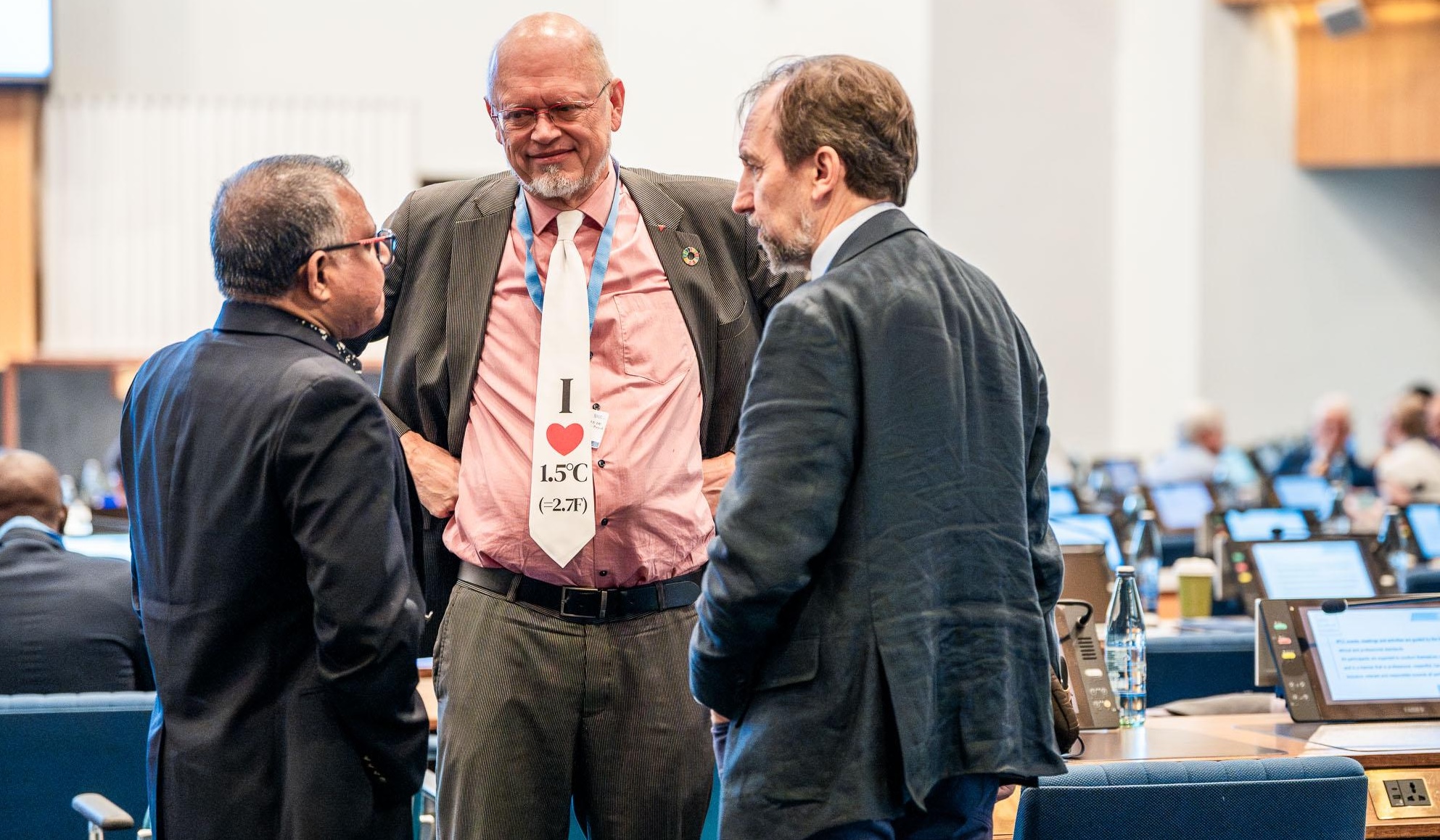
In a bid to unlock a solution for the AR7 timeline, countries discussed ways to improve the inclusivity of the IPCC’s work. One option put on the table was for the IPCC to expand its funding for delegates from developing countries to attend some or all of its sessions from one to two participants, according to the ENB summary and a delegate speaking to Climate Home News.
That would increase the costs for the IPCC to complete AR7 by up to a quarter, according to an assessment shared by the secretariat. The panel’s budget is under severe strain and its officials have warned that, without additional voluntary contributions, it risks running out of money before it can deliver on this assessment cycle.
Climate Home News understands that some of the IPCC’s traditional donors – which mainly include European countries, Japan and Australia – indicated a willingness to support funding for an additional developing country participant. But without an agreement over the budget or the timeline for the reports, that option was ultimately not adopted.
‘Disappointed and worried’
The three reports are managed by working groups that collate and draw overall findings from the latest scientific studies and data on the physical effects of global warming around the world, how to adapt to it, and pathways for cutting planet-heating emissions in order to meet the temperature goals of the Paris Agreement.
Winston Chow, an urban climate professor at Singapore Management University who co-chairs Working Group II on adaptation, wrote in a LinkedIn post that he was “disappointed and worried” for the IPCC authors who have worked “extraordinarily hard” to assess the relevant climate science over the past two years.
He said he shared their concern that “the rigour, time and goodwill they’ve invested are now being put at risk by the Panel’s stalemate”.
As science comes under attack at UN talks, climate movement splits over how to respond
For Working Group II, a meeting for 250 experts writing that report is scheduled for January 2027, followed by the approval of a special report on cities and climate change in Singapore next March.
But because the IPCC’s budget has not been confirmed due to uncertainty about the AR7 schedule, travel support for those researchers is at risk, wrote Chow. “If they cannot participate, our assessments will lose vital expertise, perspectives and scientific breadth, and the collective effort of our authors will be undermined,” he warned.
Scientific work continues
Despite the political holdups, he – together with French climate scientist Robert Vautard, co-chair of Working Group 1 – agreed with IPCC head Skea who told the IPCC’s closing session on Friday: “The engine room of the IPCC is working, and it’s healthy.”
Vautard commented in a separate post on LinkedIn after it ended: “The boat is at full steam.” Working groups I and II are due to start revising the first drafts of their reports, while Working Group III on reducing emissions is finalising its first draft which will be out soon, he wrote.
“The most exciting two years of the cycle are ahead, for the authors. The momentum in the engine room is here and now. Trust the engine room!” he added.
The IPCC and some scientists report that progress has been made towards achieving an equitable balance of authors from the Global North and the Global South.
The group of researchers who signed the open letter on Monday noted that “inclusivity is at the heart of how we work”, with author teams bringing together experts from developed and developing countries with diverse backgrounds and at different stages of their careers.
Plea to overcome political differences
The signatories include several scientists from some of the countries opposed to the alignment of all IPCC reports with the Global Stocktake.
“We are committed to an assessment in which the knowledge, experience and priorities of every region are fully reflected, a commitment we share with the leadership of the IPCC.
Equity is built into how our assessment is being drafted,” they added.
They appealed to governments that make up the IPCC “to overcome their political differences and work together as we do as a global scientific community, so that we can deliver the IPCC reports the world needs to hear”.
In a statement published on Monday, IPCC chair Skea said reaching consensus on the schedule for the reports is “vital”. He added that the assessments provide authoritative scientific evidence to inform national climate policies, strengthen adaptation and resilience and support access to climate finance, as well as helping communicate the scale of the climate crisis and the urgency of efforts to tackle it.
The post IPCC scientists vow to press on with climate reports despite political deadlock appeared first on Climate Home News.
IPCC scientists vow to press on with climate reports despite political deadlock