

Welcome to Carbon Brief’s Cropped.
We handpick and explain the most important stories at the intersection of climate, land, food and nature over the past fortnight.
This is an online version of Carbon Brief’s fortnightly Cropped email newsletter. Subscribe for free here.
Key developments
Agri-disasters costing trillions
CATASTROPHE COSTS: Disasters have caused about $3.8tn worth of lost crops and livestock production over the past three decades, according to a new report by the UN’s Food and Agriculture Organization (FAO). The report, the first of its kind, looked at the impact of disasters such as floods, droughts and wildfires on agriculture and food security. It highlighted proactive ways to address agrifood system risks and ways to “mainstream disaster risk management”, FAO director general Qu Dongyu said in the foreword of the report. Overall, disaster-related losses have “moderately” increased since the 1990s, the report said, but “they have become more widespread in terms of the countries and products that they affect”.
IMPACTS: Extreme temperatures and droughts “inflict the largest impact per event” according to the report. It is “essential” to look at the interconnected nature of risks, the report noted, adding: “Climate change, pandemics, epidemics and armed conflict are all affecting agricultural production, value chains and food security.” Losses of cereal, such as wheat and maize, caused by disasters amounted to an average of 69m tonnes per year over the past 30 years – around the same as all of France’s cereal production in 2021, the report said. Meat, dairy and eggs accrued around 16m tonnes in losses each year.
FAO FALLOUT: Meanwhile, the Guardian reported that former FAO officials said they were “censored, sabotaged, undermined and victimised” for more than a decade after writing about and investigating the extent livestock contributes to methane emissions between 2006 and 2019. The allegations date back to the years after 2006 when a landmark UN report, “livestock’s long shadow”, was published. This report “pushed farm emissions on to the climate agenda for the first time”, the newspaper said, adding: “The officials described a culture in which attempts to probe the connection between livestock and climate change were discouraged and, in some cases, suppressed, and where management attempted to sabotage research and research networks.”
RECENT CHANGES: The 2006 FAO livestock report estimated that 18% of total greenhouse gas emissions come from livestock, mostly cattle. This figure was “revised downwards to 14.5% in a follow-up paper” in 2013, the Guardian said. Dr Anne Mottet, the FAO’s livestock development officer, “stressed that the changing figures reflected best practices and evolving methodologies”, the newspaper said. She told the Guardian: “Livestock is part of the FAO’s strategy on climate change and we work with governments and farmers and industry on this programme as well. We can’t ignore the main actors of the sector but there has been no particular pressure from them.” The newspaper said that the wider FAO declined to comment, along with several meat and dairy industry lobbyists.
Bankrolling Amazon destruction
‘GREEN BONDS’ INVESTIGATION: European banks Santander and UBS have allegedly raised hundreds of millions of pounds by selling “green” bonds, but some of these funds have gone to groups linked to Amazon deforestation and human-rights abuses, according to a new investigation from Greenpeace UK’s Unearthed and O Joio e O Trigo. Unearthed reported: “Among those linked to the bonds are a farmer who allegedly held five labourers in ‘slave-like’ conditions, a soy company identified as the biggest deforester in Brazil’s Cerrado savannah, a cattle rancher fined for preventing the regeneration of 17km2 of Amazon rainforest and an ethanol producer that poisoned a river relied on by an Indigenous community.”
BANKS’ RESPONSE: According to Unearthed, the financing was made possible by tools called “CRAs”, which are bonds specifically linked to Brazilian agribusiness. A spokesperson for Santander told Unearthed that CRAs are independently regulated and that it “has strong governance processes in place to ensure that required market standards are adhered to”. A UBS spokesperson told Unearthed that the bank “does not provide finance or advisory services to companies whose primary business activity is associated with illegal logging or high conservation value forest”.
AMAZON DROUGHT: Elsewhere, unprecedented drought in the Amazon continued to intensify. Earlier this month, the Negro River – the Amazon’s second-largest tributary – reached its lowest level since official measurements began 121 years ago, the Associated Press said. Reuters reported that human faces sculpted into stone up to 2,000 years ago have appeared at the edge of the Amazon River amid extremely low water levels. Bloomberg spoke to Brazilian atmospheric scientist Prof Paulo Artaxo, who said the drought is expected to “get worse” as no rainfall is projected “in the immediate horizon”.
Spotlight
COP15 official finale
In this spotlight, Carbon Brief examines the reaction to the conclusion of the COP15 meetings last week in Nairobi.
Although it has been almost one year since countries agreed to “halt and reverse” biodiversity loss by 2030, the meetings behind the UN agreement officially drew to a close last week.
Almost every country in the world signed up to the landmark Kunming-Montreal Global Biodiversity Framework (GBF) at the COP15 biodiversity summit in Montreal in December 2022.
Bernadette Fischler Hooper, the head of global advocacy at WWF International, said there “were no major breakthroughs, but also no catastrophes” at the talks. She told Carbon Brief:
“They couldn’t finish some of the outstanding business in Montreal, so they had to reopen the COP15 here [in Nairobi]. Then there were some elections that were still to be done and some other general orders of business.”
More than 700 people attended the meetings in Nairobi. The talks were two-fold – one was the resumed COP15 discussions and one was the 25th meeting of the Subsidiary Body on Scientific, Technical and Technological Advice (SBSTTA-25).
A number of elections were also held for different positions within the COP.
The SBSTTA discussions brought together scientific and technical experts to give advice on the implementation of the GBF. A global review of progress, which will take place in 2026, was among the key discussion points, Fischler Hooper said.
This review is “the equivalent of the global stocktake in the climate COPs”, she said, which will see nations assess movement toward climate goals at COP28 in Dubai this year. Fischler Hooper said:
“The technical experts and scientific experts discussed what should be in this report. So it was very focused on what that report should contain.”
There was “significant progress” in providing scientific, technical and technological guidance on implementation, according to the SBSTTA chair, Hesiquio Benitez, who ended his five-year run as chair last week.
The recent assessment on invasive alien species was also discussed, alongside sustainable wildlife management plans and conservation.
Countries welcomed the sixth assessment report from the Intergovernmental Panel on Climate Change (IPCC) and “expressed alarm” about the “accelerating negative impact of climate change on biodiversity”, a Convention on Biological Diversity (CBD) press release said.
The interconnected nature of climate change and biodiversity was “hotly debated”, Fischler Hooper added. Delegates approved a draft recommendation on biodiversity and climate change in Nairobi.
Nature-based solutions (NBS) continue to be a “contentious” topic causing “a lot of frustration on many sides”, Fischler Hooper said. The controversial concept was a dividing issue at previous COP15 discussions.
NBS are essentially actions to protect, conserve and use ecosystems to address different challenges and provide benefits. (Read Carbon Brief’s Q&A on whether nature-based solutions help address climate change.)
A location has yet to be confirmed for the next UN biodiversity summit, COP16, due to take place next autumn. Turkey withdrew as host due to the three earthquakes that hit the country in February this year, killing more than 50,000 people and displacing millions.
The CBD said discussions are being held with other potential host countries. But if no frontrunner emerges by this December, the summit will likely be held again in Montreal, where the CBD is based.
David Cooper, the acting executive secretary of the CBD, said in a press release that the biodiversity framework is “well and truly on the way to implementation” following last week’s meetings.
But Avaaz, the campaign group, said documents remain with “a substantial number of brackets to be sorted out and resolved” at COP16 and earlier discussions next May.
The proposed indicators to measure implementation “risk being weak, especially for reviewing policies”, the Avaaz campaign director, Oscar Soria, said on Twitter.
News and views
VOICED OUT: An Australian referendum to set up an Indigenous advisory body to parliament failed with more than 60% of voters against the proposal, the Sydney Morning Herald reported. Indigenous groups described the outcome as “an unparalleled act of racism by white Australia”, according to the Guardian. The Central Land Council, one of four regional groups representing Indigenous affairs in the Northern Territory of the country, said: “We will keep fighting for equality, fighting for land, fighting for water, fighting for housing, infrastructure, good jobs, education, closing the gap – a future for our children.” (Indigenous peoples around the world play a key role in protecting as much as 80% of the world’s biodiversity.)
FOREST FOCUS: Civil-society groups are calling for “urgent” collective action to preserve three major tropical forest basins at a summit this week, Afrik 21 reported. The Three Basins summit – taking place over 26-28 October in Brazzaville, Republic of the Congo – aims to bring together leaders from the Amazon, Congo and Borneo-Mekong-south-east Asia regions to form a “global coalition”. Afrik 21 said the Eboko Foundation, a Congolese organisation, posted an “online call to action” with five priority areas, including the conservation and restoration of biodiversity in these regions. Carbon Brief will publish an in-depth article on the summit after it concludes.
‘CASH-FOR-CARBON HUSTLE’: The New Yorker has published a detailed long-read into how South Pole, the world’s largest carbon-offsetting firm based in Switzerland, “sold millions of credits for carbon reductions that weren’t real”. The article includes multiple interviews with the firm’s chief executive, Renat Heuberger, who told the publication: “We’re here to save the climate”. Previous media coverage investigating the practices of South Pole is included in Carbon Brief‘s map of the impacts of carbon-offsetting projects around the world.
‘ECO-CITY’ STAND-OFF: Around 7,500 Indigenous people could be forced off their land on the Indonesian island of Rempang to make way for a government-led “eco-city” project, BBC News reported. According to the publication, the government has secured Chinese investment to transform the island into an economic and tourist hub covering 7,000 of the island’s 17,000 hectares. The remaining 10,000 hectares will be protected forest cover, according to the plans. BBC News reported: “These ambitious plans require everyone who calls Rempang their home to leave. Many of them belong to seafaring Indigenous communities who have lived here for more than two centuries.” The broadcaster spoke to multiple families who are refusing to leave.
DELTA ‘EXTINCTION’: Coastal communities living in Nigeria’s low-lying Niger delta are at risk of “extinction” because of climate change, local civil-society groups have warned, according to a report in the Nigerian publication Business Day. It reported: “Godson Jim-Dorgu, executive director of Mac-Jim Foundation, said the coastal communities within the Niger delta would be wiped away sooner or later due to the effect of climate change.” The comments were made during a one-day meeting on climate change and gender in Port Harcourt, the capital of Nigeria’s Rivers State.
Watch, read, listen
MAYAN MISERY: An interactive feature from Reuters explored how climate change is contributing to hunger in Guatemala’s Mayan highlands.
PLANET EARTH III: The first episode of the third series of Planet Earth, presented by Sir David Attenborough, is available for UK viewers on the BBC iPlayer. For those outside the UK, the trailer and other clips can be viewed on the BBC Earth YouTube channel.
GREEN AND PLEASANT LAND: The Financial Times published an in-depth interactive exploring how the UK’s countryside might transform to meet its climate and nature goals.
FARMING WOES: Biman Mukherji, writing in the South China Morning Post, interviewed Himalayan farmers about the disruptive effects of climate change.
New science
Climate casualties or human disturbance? Shrinking distribution of the three large carnivores in the Greater Himalaya
Climatic Change
A new study found that the distribution of three large animals in the Greater Himalayas has shrunk since the early 1990s. The researchers analysed the effects of habitat traits, human disturbances and climatic factors to understand the distribution changes of the common leopard, snow leopard and Asiatic black bear in an Indian national park from the early 1990s until 2016-17. They found distribution reductions for all three animals within this timeframe. Snow leopards moved upwards, away from human settlements, while the common leopard and Asiatic black bear “suffered higher rates of local extinctions at higher altitudes” and moved to lower areas with more vegetation – even if this meant they were closer to humans.
Wilderness areas under threat from global redistribution of agriculture
Current Biology
As the climate warms, conditions suitable for growing crops are likely to shift into wilderness areas, potentially posing a new threat to these biodiversity-rich areas, new research suggested. Using climate model output and a crop suitability model, the study found that, over the next 40 years, 2.7m km2 of wilderness land will become newly suitable for agriculture – equivalent to 7% of all wilderness land outside of Antarctica. It added that the increase in potentially cultivable land in wilderness areas is “particularly acute” at higher latitudes in the global north, where 76% of wilderness areas will become suitable for growing crops. The researchers said: “Our results highlight an important and previously unidentified possible consequence of the disproportionate warming known…Without protection, the vital integrity of these valuable areas could be irreversibly lost.”
Increasing droughts with climate change may turn the world’s forests and plants from “a carbon sink into a carbon source [net emitter of CO2]”, a study found. The world’s “terrestrial biosphere” – plants and trees – currently absorbs around 30% of the emissions that humans release into the atmosphere, making it a carbon sink. However, increasing droughts under climate change could reduce the activity of plants, hence reducing their ability to absorb CO2. Using high-resolution climate models, the research found that drought-associated reductions in plant activity are projected to increase 2.3 times under a “sustainable development scenario” and 3.5 times under a “fossil-fuelled development scenario”. These losses are greater than the expected boost to plant growth from higher levels of CO2 in the atmosphere (a phenomenon known as the “CO2 fertilisation effect”), according to the research.
In the diary
- 26-28 October: Three Basins Summit | Brazzaville
- 30 October-8 November: 3rd part of the 28th annual session of the International Seabed Authority | Kingston
- 31 October-2 November: World Hydropower Congress | Bali
Cropped is researched and written by Dr Giuliana Viglione, Aruna Chandrasekhar, Daisy Dunne, Orla Dwyer and Yanine Quiroz. Please send tips and feedback to cropped@carbonbrief.org
The post Cropped 25 October 2023: Agri-disasters costing trillions; Bankrolling deforestation; COP15 official finale appeared first on Carbon Brief.

The United Nations has said the world must cut greenhouse gas emissions by nearly 6% per year to limit global warming enough to be able to return to the 1.5C goal by 2100, as decades of insufficient climate action have now made an overshoot inevitable.
In a video message accompanying the UN Environment Programme’s (UNEP) 2026 Emissions Gap Report, UN Secretary-General António Guterres said the world could no longer avoid overshooting the 1.5C limit and that the consequences were already devastating. However, he said it was still possible to return average global temperatures to 1.5C above preindustrial times by the end of the century.
“Overshoot is not surrender,” he said, adding that the report, released on Wednesday, sets out what is needed to limit warming. That entails cutting global greenhouse gas emissions by 18% by 2030, 45% by 2035 and 69% by 2040, all compared with 2025 levels.
This implies average annual reduction rates of 5.7% for 2025-2035, higher than the pathways laid out by the Intergovernmental Panel on Climate Change in its last major scientific report, which required annual reduction rates of about 5%, UNEP said.
Paris Agreement committee names three countries snubbing it over NDCs
The more ambitious emissions reductions – which countries are still far off achieving – would put the world on the lowest-possible overshoot pathway, giving a 50% chance of limiting peak warming to 1.7–1.8C around mid-century before bringing global temperatures back to 1.5C or below by 2100, the report said. Reaching this scenario will also require carbon removal from the atmosphere, it added.
UNEP noted that if countries fully implement their current national climate plans (NDCs), they would only reduce emissions by 5-8% by 2030 and 11-15% by 2035, relative to 2025 levels.
UNEP Executive Director Inger Andersen said the world must not give up on the Paris Agreement’s most ambitious warming limit, adding that every additional fraction of a degree and additional year of heating above 1.5C increases climate change impacts and risks, such as the deadly floods, heatwaves and wildfires that have plagued many nations this year.
“We must pull out all the stops to minimise peak warming and return to 1.5C by the end of the century. This is possible,” she said, adding that governments must urgently implement policies that deliver rapid and sustained emissions reductions.
Climate pledges fall short
New climate pledges since last year’s report have made a negligible difference to projected emissions and warming, UNEP said. Under current policies, the world is on course for 2.8C of warming this century, while full implementation of national climate pledges and continued similar efforts would limit warming to 2.6C, the report found.
UNEP said its projections had deteriorated, attributing this to the withdrawal of the United States from the Paris Agreement under President Donald Trump and revised estimates of historical emissions.
Even with the most optimistic pledge-based scenario – which assumes countries deliver both their current national climate commitments and additional net-zero targets – warming would now only be limited to 2.1C this century, the report found.
IPCC scientists vow to press on with climate reports despite political deadlock
Speaking to journalists ahead of the report’s launch, co-author Anne Ohlhoff said the US exit from the Paris accord meant that its previous national climate target was no longer included in UNEP’s global projections. The country has also dropped its net-zero emissions goal, she said, affecting the outlook because the US is the world’s second-largest emitter.
She warned that there is still a large gap between countries’ emissions commitments for 2035 and the reductions needed under the report’s lowest-possible 1.5C overshoot scenario.
Every five years of carbon dioxide (CO₂) emissions at current levels pushes peak warming up by around 0.1C, she said, adding that without urgent action, it could quickly become impossible to keep peak warming below 1.7–1.8C.
Describing the emissions gap as a “leadership gap”, UN chief Guterres warned that current national climate plans and policies “fall dangerously short” of what is needed to limit warming. He urged countries to adopt credible roadmaps for transitioning away from fossil fuels, accelerate clean energy deployment and electrification, invest in electricity grids and storage, cut methane emissions and halt deforestation.
Carbon removal needed, but risky
Alongside deep emissions cuts, removal of CO₂ from the atmosphere needs to be accelerated throughout the century, the report found. The world will need to remove and permanently store about 320 billion tonnes of CO₂ from the atmosphere to return global temperatures to around 1.5C by 2100.
The estimated carbon removal is equivalent to around eight years of global CO₂ emissions at 2024 levels. However, UNEP cautions that removing carbon at this scale remains uncertain because of technological and socio-economic challenges.
Keywan Riahi, a contributor to the report, said carbon could be removed through nature-based approaches, such as planting forests and improving wetland management, which help ecosystems absorb carbon emissions, as well as engineering solutions that capture emissions from energy production or remove carbon directly from the air.
However, he warned that both nature-based and technological approaches face risks and might not deliver carbon removal at the scale needed. This is because nature solutions such as planetary sinks are weakening because of climate change while techno-fixes remain uncertain, he added.
“All of those technologies come with risks,” Riahi told reporters, adding that what the world needs is to try “to keep the overshoot as low as possible, so that we do not need to rely on these technologies to take CO₂ out of the atmosphere later on”.
Renewable energy supports emissions cuts
Despite the expected overshoot of the 1.5C warming limit, the UNEP Emissions Gap Report underscored that the rapid growth of renewable energy and the impact of climate policies so far show that deeper emissions cuts remain possible.
It stated that since the adoption of the Paris Agreement in 2015, global renewable electricity capacity has grown three times faster than anticipated, while solar photovoltaic (PV) deployment has increased sevenfold compared with projections made a decade ago.
Maintaining the recent pace of renewable energy expansion, alongside stronger policies, could put the world on track to meet the global goal of tripling renewable energy capacity by 2030, the report said. It could also increase the share of wind and solar in electricity generation to levels consistent with the pathway that limits the overshoot of 1.5C to the lowest possible level, it added.
SE Asia speeds up plan for connected clean power grid after oil shock
Andersen said the explosion of renewable energy and slower-than-projected growth in coal energy supply showed that accelerating climate action is possible. However, she warned that progress remains insufficient, particularly in phasing down fossil fuels and halting forest loss.
“Nations must understand that the point of return begins now, not later,” she said, calling for “fast, deep and sustained emissions reductions”. She urged governments to strengthen their climate action at upcoming UN climate talks and accelerate efforts to keep the 1.5C pathway within reach.
Bill Hare, chief executive of Climate Analytics, said major fossil fuel-producing countries need to take greater responsibility for reducing their emissions, saying that big polluters such as the US and Saudi Arabia need “to stop playing politics and face the scientific reality”.
“Right now they are looking at the fire, denying it exists and pouring more petrol on it, while their own citizens increasingly face searing heat, wildfires and other impacts,” he said. “Governments [need] to get on with enacting policies that cut fossil fuel use as soon as possible.”
The post UN sets steep emission cuts to reverse 1.5C overshoot by end of century appeared first on Climate Home News.
UN sets steep emission cuts to reverse 1.5C overshoot by end of century
When the Turkish COP31 presidency presented its priorities to international business leaders for the first time in New York in September, among those invited to give the private sector’s first response was Ali Koç, scion of one of Türkiye’s wealthiest families.
On stage, the vice chair of the board of Koç Holding said the family company, which weeks earlier had been announced as one of the top sponsors for the UN climate summit, can be seen as “quite exemplary” for its climate record.
What Koç did not mention was that the group’s biggest money-making arm – Türkiye’s largest oil refiner Tüpraş – plans to keep running its refineries “at maximum potential”. Nor did he say that, in 2025, both parent company and subsidiary cut their 2030 climate targets to a level they had already nearly achieved, as Climate Home News’ analysis of company records reveals.
The decision to hand Koç Holding a prominent role at COP31 – the company is also the summit’s “Global Business Partner” – has reignited a long-running controversy over the platforming of fossil fuel interests at the annual UN climate conference.
It has also thrown into question how COP sponsors are chosen and screened. The hosting agreement between the Turkish government and the UN climate secretariat (UNFCCC) says that a partner company’s “climate integrity” should be taken into account.
COP31 electrification pledge leaves out clean power commitment
But how that test is applied is unclear and the process for picking sponsors remains largely opaque. The Turkish COP31 presidency has not published its selection criteria, nor the financial terms of any of its partnership agreements, including Koç’s. The UNFCCC declined to clarify how it advises on such deals.
Campaigners have long argued that accepting sponsorship from polluting companies is wrong because it gives them a global stage, visibility and access to policymakers at talks that are meant to move the world away from fossil fuels, and tarnishes the reputation of the COPs.
Koç’s energy division, which is dominated by oil refiner Tüpraş, accounted for three-quarters of the parent firm’s income in the first half of 2026.
“How was Koç Holding ever chosen as a COP31 sponsor? Any corporation that makes most of its money from oil refining should not qualify as sustainable,” said Pascoe Sabido, a campaigner at Corporate Europe Observatory, which exposes company lobbying. “This is hugely embarrassing for the UNFCCC and its climate integrity check, which doesn’t appear to be worth the paper it’s written on.”
Koç Holding “is not just standing still but walking backwards”, he told Climate Home News.
Koç Holding and Tüpraş did not reply to multiple requests for comment. The UNFCCC secretariat and the Turkish COP31 presidency declined to respond to questions from Climate Home News on the sponsorship agreement.
Oil refining windfall
Türkiye’s biggest industrial group, Koç Holding has stakes in several key sectors of the economy, spanning vehicle manufacturing in a joint venture with Ford to electronics, home appliances and banking.
But the conglomerate’s crown jewel is oil refiner Tüpraş, which Koç controls. Last year its four refineries turned crude oil into 26.8 million tonnes of petrol, diesel, jet fuel and other products, enough to fill about 36 Olympic swimming pools every day.
The company plans to raise its production to 29 million tonnes in 2026 – already a bumper year so far with soaring profits, thanks to sky-rocketing refining margins driven by a crunch in global oil processing capacity caused by the Middle East crisis.
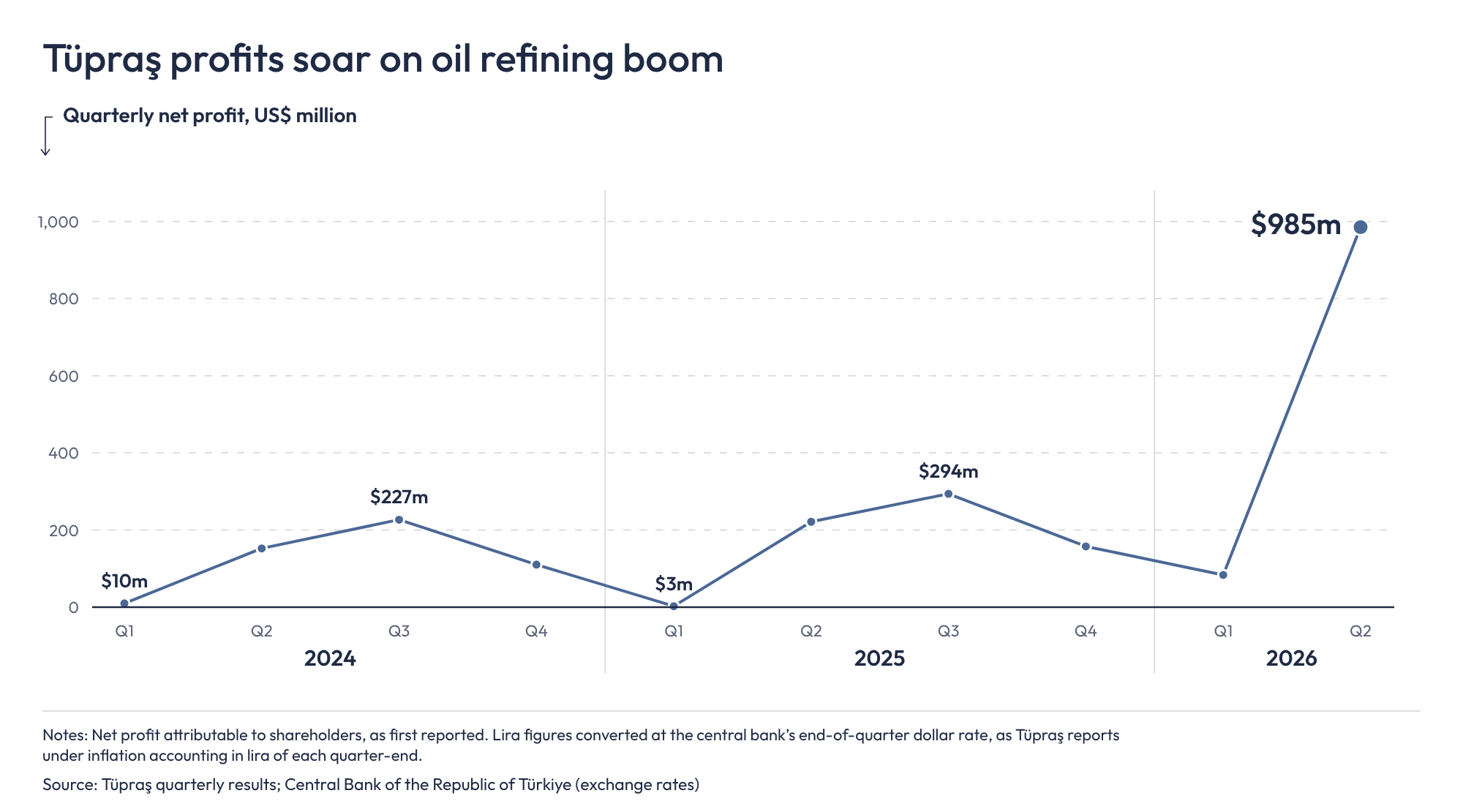
The oil business boom sits awkwardly with the climate and energy transition plans Koç and Tüpraş unveiled in 2021, when both pledged to become carbon neutral by 2050. Then, Tüpraş set out its aim to become “a leading carbon-neutral energy company”.
Despite these promises, in 2025, both companies lowered their targets for cutting emissions from their own operations by 2030, from 27% to 20% below 2017 levels. Tüpraş also cut its 2035 goal from 35% to 25%. The company still technically retains its long-term target of carbon neutrality by 2050, but the new plan will require much more drastic cuts after 2035.
Lowering the climate bar
Tüpraş blamed its weakening of climate ambition on “changing market dynamics, economic conditions and technological developments”. In a presentation announcing the revision to investors, the refiner said the energy outlook had changed since 2021.
The reasons it listed included elevated geopolitical tensions, increased investment in oil and gas extraction, which it said showed refined fuels remain vital for energy security – and even the depletion of the carbon budget to keep global warming to 1.5C.
Its parent company Koç pointed the finger at the slow pace of green hydrogen development, which the group said now had a “low feasibility” of transforming the energy sector after it had previously pinned much of its transition plan on the sustainable fuel.
The Turkish company’s new 2030 targets are certainly within reach. Tüpraş had already cut its operational emissions by 17% from 2017 levels by 2025, with nearly all of that progress achieved before the transition plan was unveiled, while Koç had reduced them by 16%.