

When it comes to the most important thing to curb climate change – moving away from planet-heating fossil fuels – governments have done enough negotiating, and their focus now should be on putting what they already agreed into practice, Brazil’s COP30 president told Climate Home.
That does not require repeating language in new UN texts or even consensus among countries about how to transition from coal, oil and gas, although they could choose to design a roadmap for that energy shift at this year’s climate summit in the Amazon, André Aranha Corrêa do Lago said in an exclusive interview.
“We’ve all already decided that we’re going to transition away from fossil fuels. What can be done in the negotiations is, for example, to decide that there will be a timeline or rules for how this transition will be made – whether it will be one type of country or another, which of the fossil fuels will come first etc,” he said, speaking in Spanish on a video call from Rio de Janeiro.
The comments from Brazil’s top climate diplomat, who is vice-minister for climate, energy and environment at the Ministry of Foreign Affairs, build on a proposal floated by the country’s environment minister last month in response to a question from Climate Home.
Brazil’s environment minister suggests roadmap to end fossil fuels at COP30
Speaking to journalists in London, Marina Silva said COP30 could result in a roadmap setting out what a “planned and just transition to end fossil fuels” – as agreed at the COP28 Dubai summit in 2023 – should look like.
“Perhaps we can come out of COP30 with a mandated group that can trace the roadmap for this transition,” she added.
Corrêa do Lago noted in the interview that Silva “left it open in her statement whether [a roadmap] will be something negotiated or something that will be built”, adding that “several countries” believe such a plan would first require a formal COP decision to produce one.

The COP30 president emphasised that while this is up to governments, “we can’t keep the world waiting for negotiations to move forward” before acting to transition away from fossil fuels in energy systems.
“It’s not true that it depends on that. There’s already enough approval from countries. Individual countries can do it because implementation isn’t by consensus. Implementation is that each country does what it thinks it can do,” he explained.
The UN Secretary-General and many researchers have argued that implementing the energy transition in a “just, orderly and equitable manner” requires industrialised countries which are historically the biggest carbon polluters to move first in cutting fossil fuels, with developing countries that need to tackle poverty and a lack of energy access following later.
Brazilian officials, for example, when asked about recent auctioning of oil exploration licences have said that global demand for oil is still increasing – and there is a need to debate how to move away from this and other polluting fuels in a fair and organised way.
COP to stay in Belém despite tricky logistics
Brazil has grabbed the spotlight, for both positive and negative reasons, for deciding to hold the annual UN climate summit in the Amazon region, whose forests store massive amounts of carbon but are constantly under threat of being cut down for timber, agriculture or mining.
Corrêa do Lago said President Lula’s “original idea, the symbolism of holding [COP30] in the Amazon, remains very strong” – and he rebutted the idea that part or all of the climate conference could be moved from the Amazon city of Belém due to growing concern about a lack of suitable and affordable accommodation for the more than 50,000 delegates expected there.
The climate negotiations veteran conceded that there had been “several requests and suggestions” about shifting the main talks to bigger and more accessible cities such as Rio de Janeiro – a hotly debated topic in the Brazilian press.
“But the decision is to do it in the best possible way – that is very well, in Belém,” he said.

He added that a long-awaited official online platform to help participants find reasonably priced accommodation in the city is due to be launched on July 15 and he expected more apartments would be made available for rent.
At June’s mid-year talks in Bonn, African nations, small island states and the least-developed countries said they had written to the COP30 presidency warning they might not be able to attend the negotiations due to the high cost of lodgings and travel.
“Regarding the management of hotels and rooms, there has been a positive reaction from the authorities and local population,” Corrêa do Lago said. “Soon, people will realise that the situation is much better than they imagined and that they will want to come.”
This week, the COP30 team announced that construction to expand and improve the Outeiro Port Terminal – where two cruise ships will house around 6,000 delegates – would be completed by mid-October.
Pessimistic outlook for public climate finance
Another pressing issue for negotiators once they reach Belém is where to find more money for climate action in developing countries, to meet the new 2035 goal agreed in Baku last year.
After tense talks, which almost collapsed over the amount rich countries were prepared to put on the table, two key targets were set: $1.3 trillion a year from all public and private sources, including $300 billion raised by donor governments.
Developing countries wanted far more of the headline $1.3 trillion to be public money provided as grants and cheap loans. But Corrêa do Lago said this was unlikely to happen.
“We need to explain the limits of the funds, of multilateral cooperation, and where this money can really come from,” he told Climate Home.
The COP30 and COP29 presidencies are currently working on a roadmap that will outline ways to deliver $1.3 trillion annually in climate finance by 2035, with input requested from finance ministers.
UN expects climate finance roadmap to offer “clear next steps”
The COP30 president said this report – due to be published before the Belém talks – would be “independent”, without “legal value”, and would serve as a basis for further discussions among governments. He emphasised that national needs for finance will vary – and some countries will require more public funding than others depending on how they are viewed by private investors.
Still, he warned against the “huge simplification” that even the core $300-billion climate finance goal could be met entirely from public funding, “especially in the context where a wealthy country has withdrawn and other rich countries are investing in defence”.
The United States under fossil fuel-enthusiast Donald Trump has given notice it will withdraw from the 2015 Paris Agreement to tackle climate change and has cut off most development aid and climate funding for poorer countries.
While the US technically remains part of the Paris pact until January 2026, and has not quit the underlying UN climate convention, Corrêa do Lago said his team had yet to receive any indication of whether the US government will attend COP30.
The post COP30 president: Transition from fossil fuels can start without climate talks appeared first on Climate Home News.
COP30 president: Transition from fossil fuels can start without climate talks

Three countries have been named by the Paris Agreement’s compliance committee for failing to submit a nationally determined contribution (NDC) and repeatedly snubbing offers of help with their climate plans.
After months of internal debate over whether to identify serial non-responders, the Paris Agreement’s Implementation and Compliance Committee (PAICC) named the three countries which have failed to engage with it over their NDCs on Friday.
It named Democratic Republic of Congo, Senegal and North Korea in a footnote of its annual report, adding that it decided to name them “with a view to facilitating engagement”, adding that representatives of the three nations had been invited to its meeting in early 2027 “with the purpose of identifying any challenges and constraints”.
“The Committee noted the importance of Parties engaging with the Committee in a timely manner, while noting that some delays may be due to the national capabilities and circumstances of the Parties”, the report said.
-
Under US pressure, World Bank says it will back gas “where appropriate”
The US wants the World Bank to expand its gas support while climate campaigners are pushing for it to end – its head spoke this week of limited backing for the fossil fuel -
IPCC scientists vow to press on with climate reports despite political deadlock
After governments again failed to agree a timeline, nearly 120 IPCC authors pledged to complete their assessment on time and with full scientific rigour -
Paris Agreement committee snubbed over missing NDC climate plans
Many governments have still not submitted a nationally determined contribution to the UN, breaching a key requirement of the Paris Agreement

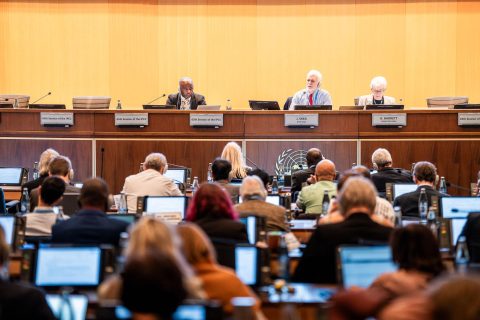

In July, PAICC said 12 countries had ignored its repeated attempts to discuss why they had not published an NDC as required every five years under the 2015 Paris accord.
Members of the committee had been divided over whether to name them, but at a September meeting decided to do so in their annual report to the annual climate COP summit.
By the time the report was published on Friday, only Congo, Senegal and North Korea “had not communicated an NDC or submitted a [Biennial Transparency Report] and had not yet responded to any of the Committee’s notifications, despite several reminders issued by the Committee in this regard”.
Rainforest and renewable energy ambitions
The silence from Congo and Senegal is notable because the former is home to much of the Congo Basin rainforest while the latter has sought billions of dollars in climate finance to support its renewable energy ambitions.
After Brazil, Congo has more rainforest than any country in the world. This forest, and the country’s peatlands, absorb huge amounts of greenhouse gas but are fast being lost to expanding farmland, charcoal production, logging and mining.
Senegal signed a Just Energy Transition Partnership with Canada and wealthy European nations in 2023, to help it meet its renewable energy targets under the-then government of Macky Sall. It was chair of the Least Developed Countries group between January 2022 and December 2023.

Tejas Rao, who is researching the PAICC as part of a doctoral thesis at Cambridge University, said the governments of the three countries should engage with the committee.
“Engagement costs these governments very little and the committee has shown it will listen,” he said.
“Silence leaves the committee with no basis to help, and it leaves the [governments] exposed to the narrative that they are simply disengaged,” he told Climate Home News.
Paris Agreement requirement
The 2015 Paris Agreement requires all parties to publish an NDC every five years outlining their emissions reduction targets, with each plan meant to be more ambitious than the country’s last NDC.
The latest set – the third round of plans, with new targets for 2035 – was due in February 2025. While most countries missed this deadline, all but around 30 – mostly small emitters but including Egypt, Vietnam and Argentina – have now submitted them.
Over the year, the PAICC – which is made up of government climate officials from developed and developing countries – has been communicating with governments that have not submitted NDCs and trying to overcome barriers to them doing so.
Some nations have cited exceptional circumstances as the reason for not submitting an NDC, a process that requires a significant amount of work in tracking emissions and consulting on how to curb them across the economy. For example, a letter from a Sudanese official to the PAICC, seen by Climate Home News, said that the country’s civil war had led to the suspension of its NDC preparation.
-
IPCC scientists vow to press on with climate reports despite political deadlock
After governments again failed to agree a timeline, nearly 120 IPCC authors pledged to complete their assessment on time and with full scientific rigour -
Under US pressure, World Bank says it will back gas “where appropriate”
The US wants the World Bank to expand its gas support while climate campaigners are pushing for it to end – its head spoke this week of limited backing for the fossil fuel -
Who shapes climate science? The equity question facing the IPCC
Early completion of the next global climate science assessment reports risks excluding research from the Global South, which is key to ensuring the findings are fair
The US and Iran are not signed up to the Paris Agreement and so do not have active NDCs, nor does Taiwan, which is not a UN member state.
Rao said that because the PAICC is “facilitative and non-punitive”, naming the countries “is meant to open a door, not close one – the invited consultation is the point”.
“In recent months, governments that explained their constraints, whether capacity, finance or domestic process, have been met with follow-up and support rather than sanction, and the number of silent governments has fallen sharply,” Rao said.
The post Paris Agreement committee names three countries snubbing it over NDCs appeared first on Climate Home News.
Paris Agreement committee names three countries snubbing it over NDCs