

Diplomats preparing for COP30 in the Brazilian city of Belém next month have been discussing an emerging issue that could feature for the first time at a UN climate summit: the global rush for energy transition minerals.
Metals such as copper, cobalt, lithium, nickel and graphite are vital for manufacturing clean energy transition technologies such as solar panels, wind turbines, batteries and electric vehicles – creating both new opportunities and risks for resource-rich countries.
Soaring demand for minerals – which are also used in the construction, digital and military sectors – provides an opportunity to spur economic development if mining is responsible and producing countries can turn their resources into high-value products.
But increased mining activity has fuelled environmental destruction, deforestation and conflict with communities, from Indonesia – which is opening new coal plants to power its nickel industry – to Zambia and Chile.
-
Ahead of COP30, Brazil grants Petrobras a licence to drill for oil in Amazon region
Brazil has authorised Petrobras to explore for oil off the Amazon coast, a move campaigners say undermines global climate goals -
COP30 needs an implementation forum, not another cover decision
The focus in Belém should be a plan to get results on climate action in the real world rather than haggling over a political statement


In preparatory talks over the past couple of months, developing countries with extensive mineral reserves, notably Latin American and African states, have warned that mining could become the Achilles heel of a just energy transition unless environmental and social safeguards are put in place to ensure the costs and benefits are shared fairly.
Diplomats have discussed the impacts of mining in negotiations on the social and economic implications of climate action, known as “response measures”.
They also raised the issue during talks to define the scope of a work stream to ensure that the transition from fossil fuels to clean energy is fair to workers, protects nature and support economic development, called the Just Transition Work Programme.
Civil society push for COP to tackle transition minerals
Brazil’s COP30 presidency has made an agreement with “concrete outcomes” on a just transition framework a key priority of the summit in Belém.
Separately, the government has spoken about the need for energy transition mineral production to respect human rights and promote sustainable development.
“In its interventions across international forums, Brazil has expressed support for the inclusion of principles that promote transparency, address illicit activities and corruption, encourage value addition in developing countries, and uphold environmental protection and human rights in the context of critical minerals production,” a COP30 spokesperson told Climate Home News.
The inclusion of energy transition minerals in COP30 decisions will require consensus among all countries but observers are cautiously optimistic.
Colombia proposes expert group to advance talks on minerals agreement
“The stars do seem to be aligning for COP30 to be the first to address the role of transition minerals governance in climate action but it’s still not a given,” said Antonio Hill, an advisor on the Natural Resource Governance Institute’s just transitions advocacy work.
“If achieved, it would address a glaring gap in the current global climate and energy transition agenda,” he added.
More than 200 civil society groups have signed an open letter urging countries to address energy transition minerals at COP30.
They called on them to welcome principles and recommendations of a UN panel on establishing transparent, sustainable and equitable mineral supply chains and to strengthen mineral governance.
A “timely and necessary” discussion
In a submission ahead of talks on the implications of climate measures last month, a coalition of 134 developing countries – known as the G77 and China – called for a “dedicated dialogue” on energy transition minerals.
It described it as “both timely and necessary” to enable countries to consider how growing mineral demand relates to their development priorities and climate plans.
The current dynamic “presents a serious risk of entrenching unsustainable development trajectories, undermining efforts toward industrial diversification, and jeopardising the prospects of a truly just transition for developing countries”, it said.
More than half of energy transition mineral reserves are estimated to be located on or near Indigenous land and a large majority of mines are located in biodiversity hotspots. Indigenous peoples are widely acknowledged to play a key role in preserving tropical forests that act as some of the world’s most important carbon sinks.

The issue was also raised during talks on defining a just energy transition framework.
The Independent Association of Latin America and the Caribbean (AILAC), which includes Colombia, Chile and Peru, warned that deforestation and land use changes caused by mineral extraction could undermine climate action and affect people’s rights to a healthy environment.
“A just transition approach could offer unique opportunities towards fairness and equity in the mining industry” and contribute to local development, the group said.
Colombia, which is proposing that countries discuss options for a binding agreement on minerals at the UN Environment Assembly in December, went further and called for the designation of “no-go areas” for mining.
No-go mining zones
Colombia’s demands are echoed by Indigenous groups.
Bryan Bixcul is from the Maya-Tz’utujil Indigenous group in Guatemala and serves as the global coordinator of the Securing Indigenous Peoples’ Rights in the Green Economy (SIRGE) coalition. He told Climate Home the Just Transition Work Programme will fail to be a tool for justice if it fails to directly address the harms caused by mining.
Efforts to green lithium extraction face scrutiny over water use
Key to SIRGE’s demand is for the text to make explicit references to the rights of Indigenous peoples, including those in voluntary isolation.
Bixcul said the text should include an obligation to establish “no-go” or exclusion zones on and around the land of the world’s remaining uncontacted Indigenous groups, which cannot give their consent to mining projects close to their lands. This, he said, violates the principle of no contact.
Protecting uncontacted Indigenous peoples
Videos have emerged showing members of an uncontacted Indigenous group warning outsiders away and begging for food on a site where forest was being cleared for nickel mining on Halmahera island in Indonesia.
NGO Survival International warned that the uncontacted Hongana Manyawa people, who live on the island, faced “a threat of genocide” because of nickel mining used to make batteries for electric vehicles.
In September, Norway’s government pension fund divested from French miner Eramet, which operates a large mine on the island, citing “unacceptable risk” of human rights violations, including forced contact. Eramet denied the presence of uncontacted groups in or near its concession.
“If countries don’t take a stance to protect the rights of Indigenous peoples in voluntary isolation, they will fail human rights, not just Indigenous people’s rights,” said Bixcul.
Brazil, which has promised the largest Indigenous participation in COP history in Belém, has called on countries to protect the demarcation of Indigenous lands as a key policy tool to address the climate crisis.
The post COP30 could confront “glaring gap” in clean energy agenda: mining appeared first on Climate Home News.
COP30 could confront “glaring gap” in clean energy agenda: mining

Three countries have been named by the Paris Agreement’s compliance committee for failing to submit a nationally determined contribution (NDC) and repeatedly snubbing offers of help with their climate plans.
After months of internal debate over whether to identify serial non-responders, the Paris Agreement’s Implementation and Compliance Committee (PAICC) named the three countries which have failed to engage with it over their NDCs on Friday.
It named Democratic Republic of Congo, Senegal and North Korea in a footnote of its annual report, adding that it decided to name them “with a view to facilitating engagement”, adding that representatives of the three nations had been invited to its meeting in early 2027 “with the purpose of identifying any challenges and constraints”.
“The Committee noted the importance of Parties engaging with the Committee in a timely manner, while noting that some delays may be due to the national capabilities and circumstances of the Parties”, the report said.
-
Under US pressure, World Bank says it will back gas “where appropriate”
The US wants the World Bank to expand its gas support while climate campaigners are pushing for it to end – its head spoke this week of limited backing for the fossil fuel -
IPCC scientists vow to press on with climate reports despite political deadlock
After governments again failed to agree a timeline, nearly 120 IPCC authors pledged to complete their assessment on time and with full scientific rigour -
Paris Agreement committee snubbed over missing NDC climate plans
Many governments have still not submitted a nationally determined contribution to the UN, breaching a key requirement of the Paris Agreement

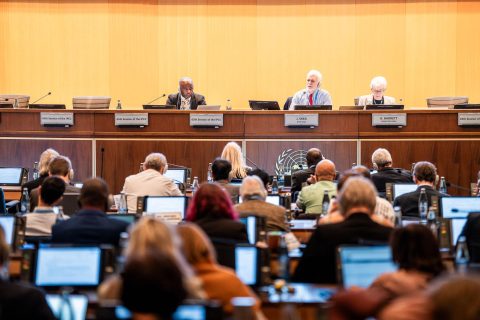

In July, PAICC said 12 countries had ignored its repeated attempts to discuss why they had not published an NDC as required every five years under the 2015 Paris accord.
Members of the committee had been divided over whether to name them, but at a September meeting decided to do so in their annual report to the annual climate COP summit.
By the time the report was published on Friday, only Congo, Senegal and North Korea “had not communicated an NDC or submitted a [Biennial Transparency Report] and had not yet responded to any of the Committee’s notifications, despite several reminders issued by the Committee in this regard”.
Rainforest and renewable energy ambitions
The silence from Congo and Senegal is notable because the former is home to much of the Congo Basin rainforest while the latter has sought billions of dollars in climate finance to support its renewable energy ambitions.
After Brazil, Congo has more rainforest than any country in the world. This forest, and the country’s peatlands, absorb huge amounts of greenhouse gas but are fast being lost to expanding farmland, charcoal production, logging and mining.
Senegal signed a Just Energy Transition Partnership with Canada and wealthy European nations in 2023, to help it meet its renewable energy targets under the-then government of Macky Sall. It was chair of the Least Developed Countries group between January 2022 and December 2023.

Tejas Rao, who is researching the PAICC as part of a doctoral thesis at Cambridge University, said the governments of the three countries should engage with the committee.
“Engagement costs these governments very little and the committee has shown it will listen,” he said.
“Silence leaves the committee with no basis to help, and it leaves the [governments] exposed to the narrative that they are simply disengaged,” he told Climate Home News.
Paris Agreement requirement
The 2015 Paris Agreement requires all parties to publish an NDC every five years outlining their emissions reduction targets, with each plan meant to be more ambitious than the country’s last NDC.
The latest set – the third round of plans, with new targets for 2035 – was due in February 2025. While most countries missed this deadline, all but around 30 – mostly small emitters but including Egypt, Vietnam and Argentina – have now submitted them.
Over the year, the PAICC – which is made up of government climate officials from developed and developing countries – has been communicating with governments that have not submitted NDCs and trying to overcome barriers to them doing so.
Some nations have cited exceptional circumstances as the reason for not submitting an NDC, a process that requires a significant amount of work in tracking emissions and consulting on how to curb them across the economy. For example, a letter from a Sudanese official to the PAICC, seen by Climate Home News, said that the country’s civil war had led to the suspension of its NDC preparation.
-
IPCC scientists vow to press on with climate reports despite political deadlock
After governments again failed to agree a timeline, nearly 120 IPCC authors pledged to complete their assessment on time and with full scientific rigour -
Under US pressure, World Bank says it will back gas “where appropriate”
The US wants the World Bank to expand its gas support while climate campaigners are pushing for it to end – its head spoke this week of limited backing for the fossil fuel -
Who shapes climate science? The equity question facing the IPCC
Early completion of the next global climate science assessment reports risks excluding research from the Global South, which is key to ensuring the findings are fair
The US and Iran are not signed up to the Paris Agreement and so do not have active NDCs, nor does Taiwan, which is not a UN member state.
Rao said that because the PAICC is “facilitative and non-punitive”, naming the countries “is meant to open a door, not close one – the invited consultation is the point”.
“In recent months, governments that explained their constraints, whether capacity, finance or domestic process, have been met with follow-up and support rather than sanction, and the number of silent governments has fallen sharply,” Rao said.
The post Paris Agreement committee names three countries snubbing it over NDCs appeared first on Climate Home News.
Paris Agreement committee names three countries snubbing it over NDCs