

Coffee is one of the most traded agricultural products in the world. Behind every cup lies a vast network of farms, many of which play a role in climate solutions. Shade-grown coffee farms, in particular, are gaining attention for their ability to store carbon and protect biodiversity.
Unlike conventional coffee grown under full sun, shade-grown coffee is cultivated beneath a canopy of trees. These trees capture carbon dioxide, cool the soil, and provide habitats for birds and insects.
Researchers estimate that shade-grown coffee farms store 70 to 80 metric tons of carbon per hectare. This is similar to what tropical forests can store. This makes them valuable natural carbon sinks. Yet in today’s carbon markets, their contributions are often undervalued or overlooked.
Why Shade-Grown Coffee Is Undervalued
Carbon credit markets reward activities that reduce or remove greenhouse gases, often through reforestation, renewable energy, or soil carbon projects. However, many coffee farms do not fit neatly into these categories.
Shade-grown coffee systems exist in a “gray zone.” They hold a lot of carbon, but current standards often miss their full impact.
Research in Phys.org, for example, shows that carbon captured in shade-grown coffee systems is seen as less valuable. This is compared to credits from large tree-planting projects. This undervaluation discourages farmers from maintaining or expanding these systems.
The challenge lies in verification. Measuring carbon in mixed-use farms is more complex than counting trees in a plantation.
Shade-grown farms mix crops with trees of various species and ages. This creates rich ecosystems, but it also complicates calculations. Without clear accounting frameworks, the market discounts their true value.
NZCBI ecologist Ruth Bennett, senior author of the study, remarked:
“There is a lot of money behind planting trees on degraded coffee farms, yet there are basically no financial incentives, outside of the Smithsonian Bird Friendly certification, to protect standing shade trees…To be clear, planting shade trees on monoculture coffee farms is a positive step, but our findings show tree planting alone can’t make up for what you lose when you remove mature shade trees.”
Global Evidence: What New Studies Reveal About Agroforestry
A recent meta-analysis published in Communications Earth & Environment offers fresh insights. The study looked at data from 67 research sites. It compared shaded monocultures, simple agroforestry, and complex agroforestry systems in various regions.
The findings show that complex agroforestry systems, which include mature native trees, store significantly more carbon than shaded monocultures. The study used statistical methods, such as Hedges’ g, to compare carbon stocks. It showed that farms with more tree species and higher tree density store more carbon.
Conceptual representation of carbon stock and biodiversity value across a gradient of coffee agroforestry complexity.
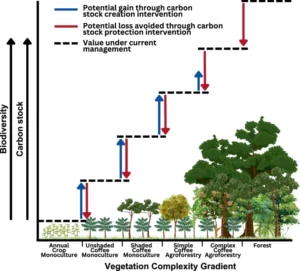
A study by the Smithsonian found that clearing shade-grown systems for plantations could release 174 to 221 million metric tons of carbon. That’s more than double what planting new trees on all plantation-style coffee farms could sequester.
The researchers found that coffee farms already hold about 482 million metric tons of carbon in their trees and plants. If all sun-grown farms added shade trees, they would only capture an extra 82 to 87 million metric tons of carbon.
These results show one key point: keeping existing shade trees gives more climate benefits than just planting new ones. It also highlights how current policies and market structures fail to account for these benefits.
Farmers at the Frontline: Unlocking Market Opportunities
If better recognition were given, millions of smallholder coffee farmers could benefit. Coffee is mostly grown in developing countries, where farmers often face unstable incomes. Linking shade-grown farms to carbon markets could provide an additional revenue stream.
For instance, carbon credit prices could go between $5 and $20 per ton in voluntary markets. Some credit types can cost less than five dollars, and others are above 20.

Coffee farmers could earn more by selling credits for the carbon stored in their trees and soils. A hectare of shade-grown coffee that stores 70 tons of carbon could be worth hundreds or even thousands of dollars in credits over time.
However, this potential remains mostly untapped. Certification costs, complex verification, and limited buyer awareness all stand in the way. Without reforms, farmers lose both income opportunities and incentives to keep their land forested.
Broader Climate and Biodiversity Benefits
Shade-grown coffee does more than store carbon. It also delivers ecosystem services that align with global sustainability goals. These include:
- Biodiversity protection: Forest-like farms support birds, pollinators, and other wildlife. Studies show that bird populations are much higher in shade-grown systems compared to sun-grown monocultures.
- Soil health: The canopy reduces erosion and maintains soil fertility.
- Water conservation: Tree cover shades streams and improves watershed health.
- Resilience: Farms with diverse crops and trees are less vulnerable to climate extremes, pests, and diseases.
These co-benefits strengthen the case for integrating coffee farms into carbon markets. Buyers want high-quality carbon credits that offer biodiversity and community benefits. They look for more than just raw carbon numbers. Shade-grown coffee projects could meet this demand with appropriate recognition.
Barriers to Fair Trade in Carbon Markets
Despite the promise, several challenges remain. Current carbon accounting tools are not designed for agroforestry systems like coffee. Without standardized methods, it is difficult to prove and sell credits. Certification processes can also be expensive, often beyond the reach of small farmers.
Another issue is market awareness. Many credit buyers are more familiar with large-scale reforestation or renewable energy credits. Educating investors and companies about the benefits of agroforestry-based credits is key to driving demand.
Policymakers also have a role. Coffee-producing countries could add shade-grown systems to their climate plans. This would help them qualify for international carbon finance. Partnerships among certification bodies, NGOs, and farmer cooperatives can cut costs. This makes participation easier for everyone.
From Niche to Mainstream: Brewing Climate Solutions
For shade-grown coffee to reach its potential in carbon markets, a shift is needed. Recognition of agroforestry as a legitimate and measurable form of carbon storage is the first step, as analysts suggest. Improved science, digital monitoring tools, and satellite imagery are making this easier. When measurement is more reliable, verification costs may drop. This can help millions of farmers.
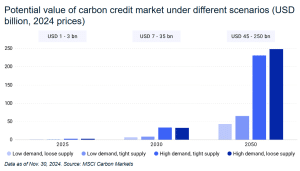
The global voluntary carbon market is projected to grow to $50 billion by 2030. Other estimates show it can reach up to $250 billion by 2050 in a high-demand scenario. If shade-grown coffee captures even a fraction of this, it could transform both farm incomes and climate outcomes.
Shade-grown coffee farms represent an overlooked climate asset. They store large amounts of carbon, protect biodiversity, and support rural livelihoods. Yet, carbon markets currently undervalue them, leaving both farmers and the environment at a disadvantage.
As carbon markets evolve, there is a growing opportunity to integrate coffee agroforestry systems. With better recognition, measurement tools, and supportive policies, shade-grown coffee could move from the margins to the mainstream of climate finance. For every cup of coffee, there could also be a story of carbon storage and environmental protection.
The post Coffee and Carbon Credits: Revealing the Real Value of Shade-Grown Coffee appeared first on Carbon Credits.

EU carbon credit claims changed on 27 September 2026, the day the Directive (EU) 2024/825 began to apply across the European Union. The change is narrow. It changes how a company can talk about the credits it buys. A product can no longer be called neutral on the strength of compensation alone; however, every specific, evidenced statement about what a company measured, reduced, and funded stays fully available.

The post Promoting Improved Cooking Practices in Nigeria appeared first on Terrapass.


-
Climate Change1 year ago
Guest post: Why China is still building new coal – and when it might stop
-

 Greenhouse Gases2 years ago
嘉宾来稿:满足中国增长的用电需求 光伏加储能“比新建煤电更实惠”
-
Greenhouse Gases1 year ago
Guest post: Why China is still building new coal – and when it might stop
-

 Climate Change2 years ago
嘉宾来稿:满足中国增长的用电需求 光伏加储能“比新建煤电更实惠”
-

 Renewable Energy12 months ago
Sending Progressive Philanthropist George Soros to Prison?
-
Climate Change2 years ago
Bill Discounting Climate Change in Florida’s Energy Policy Awaits DeSantis’ Approval
-
Greenhouse Gases1 year ago
嘉宾来稿:探究火山喷发如何影响气候预测
-

 Climate Change2 years ago
Analysis: China’s CO2 falls 1% in Q2 2024 in first quarterly drop since Covid-19