

Rising temperatures are redistributing the risk of childhood malaria in sub-Saharan Africa, resulting in areas of “new risk” in the east and south of the continent, but also “relief hotspots” in western Africa.
This is according to a new study, published in Nature, which provides the “most comprehensive look to date at the impact of climate change on any infectious disease”.
The research finds that since the year 1900, climate change has resulted in one extra case of malaria for every 1,000 children in sub-Saharan Africa on average.
Over the 21st century, climate change is expected to drive down malaria rates across the continent on average, as temperatures rise above the optimum range for mosquitoes.
However, the authors emphasise that continent-wide averages hide more detailed local trends.
They find that cooler parts of Africa face an increase in malaria risk, as rising temperatures have made the regions more suitable for malaria-carrying mosquitoes, while warmer regions see a suppression in malaria cases.
The lead author tells Carbon Brief that this is the first study to use “attribution” – a field of climate science which uses models to compare conditions in a world with global warming to one without – to assess the impact of climate change on malaria.
The study also reveals that climate change is not the main driver of shifting malaria risk in Africa, with public health measures and government policy making a more significant impact.
The “most important” message from the study, according to another expert, is that to eliminate malaria entirely, “effective surveillance, prevention and treatment remain substantially more influential – and more actionable – than climate change alone”.
Childhood malaria
Malaria kills hundreds of thousands of people every year. The World Health Organization (WHO) estimates that 610,000 people died due to the disease in 2024.
The disease is transmitted to humans by bites from mosquitoes infected with the malaria parasite. Malaria spreads most rapidly in warm, wet regions, where the parasite-carrying mosquitoes can live and breed.
However, malaria is preventable. A total of 42 countries – mainly in Europe and the Americas – have eliminated the disease entirely through a combination of measures including insecticide use, draining the swamplands that provide breeding habitats for mosquitoes and improving basic healthcare services .Global mortality from malaria declined by 90% over the 20th century.
Today, the vast majority of malaria cases are recorded in Africa, which was home to 95% of malaria cases and deaths in 2024. Children under the age of five make up three-quarters of all African malaria deaths.
The malaria-causing parasite can be detected using a blood test. Over the last century, scientists, government officials and healthcare professionals have collected thousands of blood samples from people across sub-Saharan Africa and tested for the presence of the malaria parasite.
In 2017, scientists brought together more than 50,000 samples collected from sub-Saharan Africa over 1900-2016. This data provides a “snapshot” of the amount of malaria in the population in any year in the last century the study explains.
Dr Colin Carlson is an assistant professor of epidemiology at the Yale school of public health and lead author of the study. He tells Carbon Brief that malaria in Africa is “extraordinarily well documented”, as a result of academic interest and colonial rule in the continent.
The size and quality of the malaria dataset are “exceptionally rare”, Carlson says. He explains that the dataset stretches back to before the impacts of human-caused climate change were strongly felt, making it “extraordinarily” valuable for this analysis.
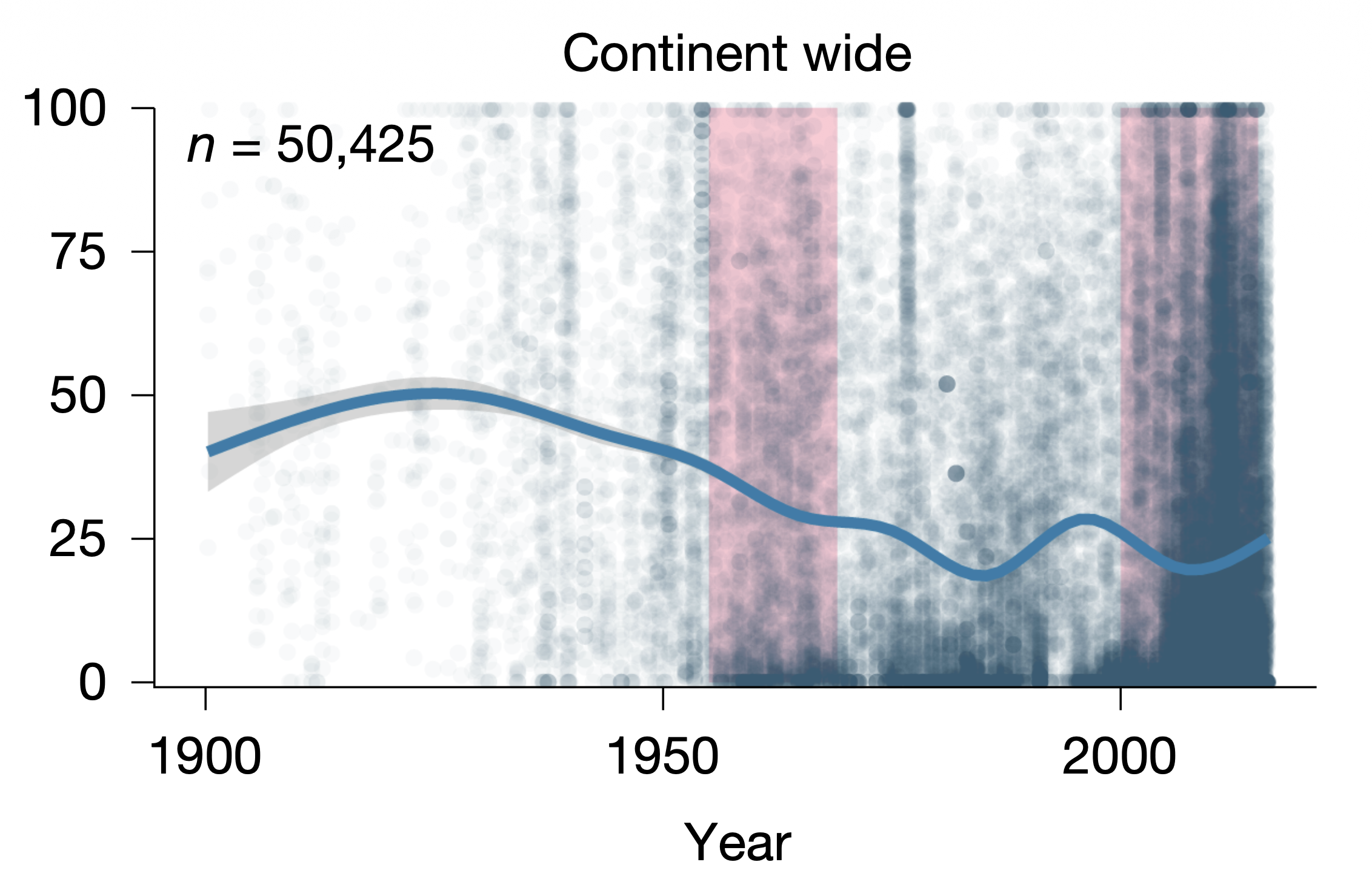
The chart below shows the percentage of children between two and 10 years old who tested positive for the malaria parasite over 1900-2016. Each dot indicates one blood test result and the pink vertical bars indicate periods of “successful malaria prevention intervention”, such as the 1955-69 global malaria eradication programme.
Attribution
The authors use the blood test survey data to develop a statistical model separating out the climatic, social and economic factors that affect malaria, such as temperature, rainfall, economic development, healthcare and population changes. This allows the authors to isolate the effects of the climate on malaria.
They find that malaria prevalence in children peaks when average monthly temperatures reach 24.9C, dropping off in warmer and cooler climates.
Mosquitoes also need stagnant or slow-moving water in which to lay their eggs. The authors find that periods of drought tend to decrease malaria prevalence one-to-two months later, whereas floods increase prevalence two-to-three months later. However, they conclude that rainfall is “less important than temperature” in predicting malaria rates.
They then combine the statistical models with climate models, to simulate childhood malaria rates in a range of past and future climates.
First, the authors simulate malaria rates in the present day, by running the models using the climate of 2000-14. They then carry out the same analysis, using the climate of a hypothetical world without human-caused climate change.
By comparing the two, the authors were able to attribute the impact of climate change on malaria rates across Africa.
The link between climate change and malaria in Africa is complex and “surprisingly contentious”, according to the authors. For example, they write that “malaria resurgence in the east African highlands became a particular point of contention, with over a dozen studies arguing for or against climate change as a substantial driver”.
It adds:
“Today, malaria experts generally agree that climate change has contributed to elevational shifts in malaria epidemics and the geographical ranges of mosquito vectors. However, the cumulative effect of climate change on the burden of malaria is still an open question.”
Lead author Carlson says this paper is “one of the first impact attributions on infectious disease” and the first attribution study on climate change and malaria. He adds:
“I think it’s the most clarity we’ve had on the malaria question.”
Dr Teresa Yamana, an associate research scientist at Columbia University, who was not involved in the study, praises its “rigorous” methodology. She tells Carbon Brief that the work “demonstrates the potential of climate attribution methods to quantify the impacts of climate change on infectious diseases”.
Warming world
The findings show that “climate change isn’t just making malaria worse or better – it’s moving it, says study author Prof Tamma Carleton, an assistant professor at UC Berkeley:
“Whether a place sees elevated malaria risks or reduced burdens under climate change depends on how hot it is today. We see relief in the hotspots and new risk nearly everywhere else.”
For example, in the Ethiopian highlands, low temperatures – which are unsuitable for mosquitoes to live and breed – have historically limited the spread of malaria. However, the region has seen childhood malaria rates increase by more than eight cases per 1,000 children since the year 1900 as rising temperatures have allowed the insects to expand their habitat.
The authors also found a similar increase in malaria prevalence in cooler southern African countries.
In contrast, global warming is pushing average temperatures above the ideal range for mosquitoes in many hotter parts of Africa, driving down malaria rates. The authors find that in western Africa, climate change has caused a reduction of four malaria cases per 1,000 children per year by 2014, reducing prevalence by 1-2%.
Overall, climate change has resulted in one extra case of malaria for every 1,000 children in sub-Saharan Africa since the year 1900, the study says.
The authors also run their models for three future climate scenarios: low (SSP1-2.6), intermediate (SSP2-4.5) and very-high (SSP5-8.5) emissions pathways. Comparing these to the present-day model results shows how climate change could affect malaria cases over the coming century.
They find that the trends observed so far will largely continue into the future – meaning climate change will lower the prevalence of malaria in warm regions and increase the prevalence in cool regions.
The study concludes that under the intermediate scenario, which is broadly in line with current climate policies, warming will drive down childhood malaria cases by about three cases per 1,000 children in central Africa and 16 cases per 1,000 children in west Africa by the end of the century.
By contrast, cases could increase by around 20% over the same period in regions such as the Rift Valley and coastal southern Africa – a rise of 30 cases per 1,000 children.
The maps below show changes in childhood malaria prevalence due to climate change in today’s climate (left) and the climate of 2096-2100 under the intermediate scenario (right).
Red indicates an increase in malaria prevalence and blue indicates a decrease. Greyer colours indicate greater uncertainty in the model results. White indicates regions where no data was collected.
Carlson tells Carbon Brief that this is “the first study to really confidently answer the highland East Africa debate”.
Eradicating malaria
Healthcare workers, governments and scientists have been working to eliminate malaria for decades.
On average, the authors find that climate change will reduce the prevalence of malaria in sub-Saharan Africa, as temperatures rise above the optimum range for mosquitoes. This effect is more pronounced at higher warming levels.
Under the low emissions scenario, about 1 case per 1,000 children will be averted by the end of the century. Meanwhile under the highest emissions scenario, average prevalence falls by 20 cases per 1,000 children, marking a 9% reduction.
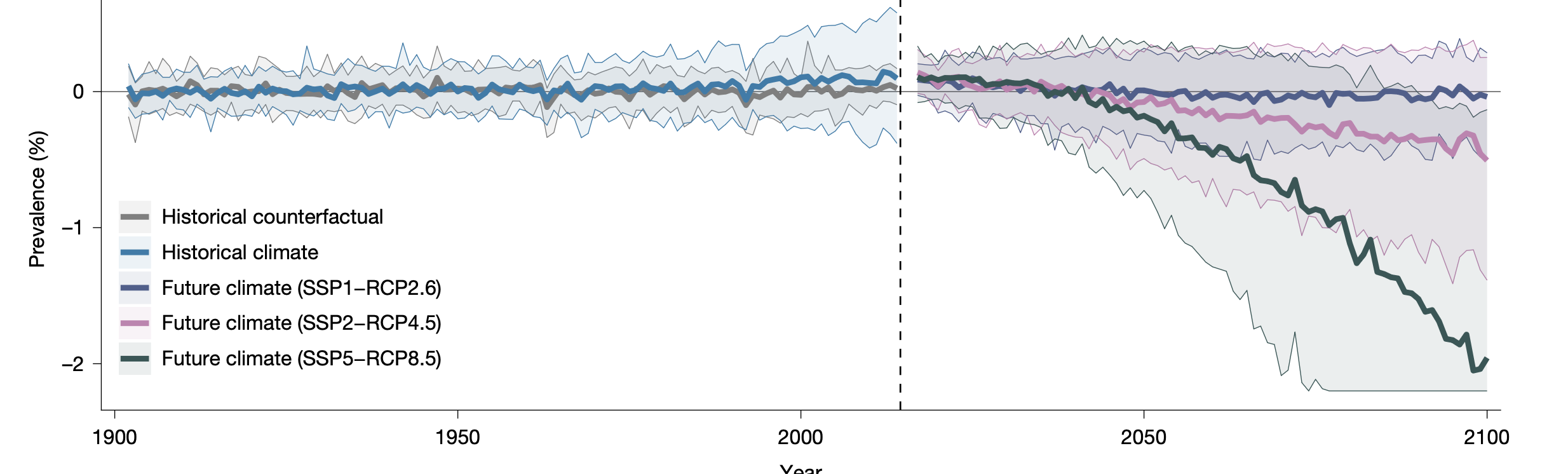
The graph below shows childhood malaria rates over 1990-2024 in the historical climate (blue) and in a world without climate change (grey). These estimates are shown relative to baseline prevalence across 1901-30.
After the year 2014, the plot shows projected future changes in malaria prevalence, relative to a 2015-20 baseline, in the low (purple), intermediate (pink) and high (green) scenarios.
Carlson emphasises that this does not mean that climate change is “good news” for healthcare in sub-Saharan Africa. He explains that climate change will bring a wide range of negative health impacts that will strain healthcare systems, adding:
“A world that is too hot for malaria is not a good world for the health of children.”
He also notes that climate change is “not the primary driving factor of malaria dynamics”. For example, he notes that malaria prevalence fell over 2000-15, by about 16 percentage points, after the disease was identified as a “critical global target of the Millennium Development Goals”.
This reduction is 200 times greater than the increase seen so far because of climate change, Carlson says. He adds:
“It would not be tremendously hard both to keep malaria out of new places and to eliminate it where it is maybe going to get a little bit of an assist from climate change.”
Dr Adugna Woyessa is a senior researcher at the Ethiopian Public Health Institute and was not involved in the study. He has previously carried out research on malaria in eastern Africa.
Woyessa praises the study, telling Carbon Brief that the research could bring about a “paradigm shift” in efforts to eliminate malaria. He argues that the study is a “tool for engaging giant development partners”, adding that “future work will be needed to situate these global trends in local contexts”.
Dr Janey Messina is an associate professor in the school of geography and the environment at the University of Oxford and was also not involved in the study. She praises the paper’s “strong” method.
However, she cautions that the findings “should not be interpreted as forecasts of total future malaria burden”, because they only model the impact of climate change on malaria, while excluding “social, demographic and public-health determinants”, such as inequality, migration, conflict and changing access to malaria interventions.
She adds:
“One of the paper’s most important messages is this: effective surveillance, prevention and treatment remain substantially more influential – and more actionable – than climate change alone.”
Carlson, C. et al. (2026) The past and future impact of climate change on childhood malaria in Africa, Nature, doi:10.1038/s41586-026-10840-w
Related

Q&A: Europe’s May and June heatwave deaths – and how they were counted
Guest post: France’s June heatwave caused more than 2,700 heat-related deaths

Revealed: Floods have forced at least 67 closures at NHS hospitals since 2021
Climate change could lead to 500,000 ‘additional’ malaria deaths in Africa by 2050
The post Climate change is driving a ‘shift’ in childhood malaria risk across Africa appeared first on Carbon Brief.
Climate change is driving a ‘shift’ in childhood malaria risk across Africa

Brazil’s environment minister says he is “very optimistic” that the Tropical Forest Forever Facility (TFFF) – a new rainforest fund to channel private and public finance to developing nations – can meet a key $10 billion funding target this year, and is not at risk from his country’s elections next month.
The TFFF, launched by Brazil at COP30 in the Amazon last November and co-led by Norway, is intended as an alternative to traditional grant-based forest finance. The fund aims to raise $125bn in public and private capital, invest it in bond markets, and then pay countries that keep their forests standing from the annual returns. Donor contributions needed to get it going have tailed off after an initial burst.
Speaking to Climate Home News on the sidelines of Climate Week in New York, Brazilian environment minister João Paulo Capobianco pointed out that in less than a year since its official launch, the TFFF has already secured $7.3bn from governments.
“How many other initiatives can say that?” he asked. “Of course, if you have $7 billion, it’s easier for more countries to consider their own contribution. And not just countries – non-governmental organisations also. We are expecting even more support.”
-
As El Niño intensifies, we should be investing more in the world’s farmers
Finance to help agriculture adapt to a hotter world and more extreme weather is vital for food security – but new data shows it’s on a downward trend -
COP31 attendees told not to interfere in Türkiye’s “internal affairs”
Amnesty International says the provision in the hosting agreement could have a “chilling effect” on free expression in Antalya -
Threatened by rising seas, small islands secure right to keep their statehood
Efforts to protect marine ecosystems and coastal communities have risen up the political agenda at the UN General Assembly in New York


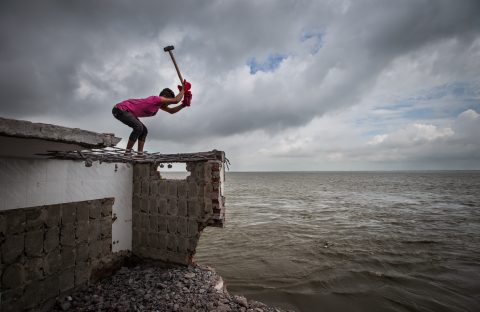
As its initial target, the TFFF aims to raise $10bn in seed capital from governments by the end of 2026, and still needs to fill a gap of $2.7bn. Its backers say that for each dollar in public funding, they can secure $4 from the private sector. Critics say the $10bn goal barely covers the fund’s expenses and would not allow it to make any significant payments to forest countries.
Because setting up its financial architecture, raising the starting capital and making the first investments will take time, experts say the TFFF is unlikely to generate any payments for developing countries before 2028.
Seeking new pledges
Capobianco told Climate Home News that Brazil is still in talks with potential new contributors to the fund, among them China, Korea and Japan, and said he hoped to see more pledges announced at the upcoming biodiversity and climate COPs in October and November. The Netherlands is expected to up its first small contribution and Canada may also come in, according to other sources close to the TFFF.
Because the fund was not created as part of the UN climate talks and is hosted by the World Bank, developing countries can contribute without taking on wider donor responsibilities for climate finance. Brazil and Indonesia – both large emerging rainforest nations – have each pledged $1bn to the TFFF.
Earlier in September, the UK became the latest country to pledge funding – promising a loan of £400 million (about $540 million). Capobianco welcomed the contribution and noted that Britain has also said it will keep “under review” the possibility of putting in more.
Currently the largest donor is Norway, which announced a $3bn pledge last year at COP30 in Belém. However, that pledge came with conditions, among them that the fund must reach $10bn in sponsor capital by 2026, and that Norway’s contribution can’t make up more than 20% of that total. Over the longer term, this means the fund must raise $15bn from governments to unlock Norway’s full investment.
Comment: UK’s budget juggling trick with rainforest loan for bus-fare cap needs transparency
Speaking at a forest finance event in New York, Norway’s environment minister Sigrun Aasland said the country’s pledge was made not “only out of solidarity but because of shared interests”, adding that protecting rainforests is critical for climate and biodiversity goals as well as for national security.
“Tropical deforestation matters to people in the Amazon and in the Congo. But let’s not forget that it also matters to global food production and to the cost of living in Oslo or in London,” she said.
At the event, Guyana’s minister of natural resources Vickram Bharrat said the TFFF is “one in a menu of options” to finance forest protection in developing countries. He added that to boost its capital “maybe we should put some amount of pressure on oil companies to contribute to the fund”.
Upcoming election “not a risk”
Brazil, which has been pivotal to getting the fund off the ground, is now heading into a national election that could see the country swing back to an anti-climate stance if right-wing candidate Flávio Bolsonaro beats current left-wing President Luiz Inacio Lula da Silva. Capobianco, however, said the election result does not pose a risk to the TFFF.
“It’s a global initiative, not a Brazilian initiative. We proposed the first idea, but nowadays it’s a global initiative,” he said. “We believe the investor countries and the tropical countries together have the possibility to continue this process.”
In Brazil, the first round of voting is scheduled for Sunday, October 4. If no candidate wins more than 50% of valid votes, a run-off ballot will take place on October 25.
COP30 roadmap to end deforestation will invite countries to draft domestic plans
In July, the TFFF board adopted a charter, which outlines the instrument’s objectives and values, including that 20% of the payments made to tropical countries will go directly to Indigenous people and local communities.
The charter also says the TFFF board may comprise up to 12 member countries during the initial phase. Currently, seven seats are filled by the Democratic Republic of Congo (DRC), Germany, Brazil, France, the Netherlands, Norway and Indonesia.
The board has also formally incorporated the Tropical Forest Investment Fund (TFIF) – the TFFF’s investment arm that will trade bonds in financial markets – hosted in Luxembourg.
The post Brazil confident new rainforest fund will reach $10bn donor milestone appeared first on Climate Home News.
Brazil confident new rainforest fund will reach $10bn donor milestone
Patrick Schröder is a senior research fellow at Chatham House’s Environment and Society Centre.
A climate summit serious about implementation cannot afford to leave major emissions reductions off the table. Yet, that is the risk COP31 faces unless it makes reducing raw material use central to the way countries decarbonise their economies.
On the sidelines of the UN General Assembly in New York last week, COP31 host Türkiye laid out proposals to accelerate emissions cuts in the next decade. Its plans include global goals to increase the share of recycled products in material use to at least 15% (up from 6.9% in 2025) and halve waste generation by 2035.
COP31 offers an opportunity to connect efforts to improve material circularity with stronger national climate commitments and mitigation pathways. But these targets could be a lot more ambitious.
The case for circularity
The Paris Agreement cannot be delivered through cleaner electricity alone. We must also reduce the emissions that are embedded in the way we extract resources, manufacture products, build infrastructure and dispose of waste.
Circularity principles are pivotal to credible mitigation pathways: designing technologies and products to last, repairing and reusing them, and reducing demand for virgin resources.
The scale of the opportunity is striking. A recent European Environment Agency review found that adopting such principles could deliver average global emissions reductions potential of 52% in the waste sector against a business-as-usual scenario, 48% in construction and buildings, 28% in transport and mobility, 26% in industry and 24% in agriculture.
-
Recycling could meet half of Europe’s critical mineral needs by 2050
A new report by an EU-funded research project says the bloc could harness its “urban mines” to reduce its dependence on China for energy transition minerals -
China maximises battery recycling to shore up critical mineral supplies
Beijing is bracing for a tsunami of spent EV batteries by taking steps to boost recycling – a strategy that could also cut its reliance on imports of clean energy minerals -
The Canadian city betting on recycling rare earths for the energy transition
As countries scramble to secure critical minerals, Kingston’s burgeoning clean tech ecosystem is attracting startups to create circular supply chains and reduce reliance on China


These figures make a compelling case for raising circularity ambitions across the economy, offering the promise of far more than better recycling bins.
In fact, recycling minerals used in cleantech equipment, for example, illustrate the extent of the emissions savings available. The carbon footprint of minerals and metals recovered from secondary sources is up to 80% lower than those produced from new mining and processing, according to the International Energy Agency.
A major EU-funded project estimates that recovered materials could substitute up to 56% of Europe’s primary critical raw material requirements by 2050, provided they achieve the necessary quality. The main takeaway goes beyond Europe: yesterday’s products can become tomorrow’s strategic resources while mitigating climate change.
In this light, a target to increase the share of recovered material use to 15% isn’t enough.
The evidence-based Circularity Gap Report found a 17% target by 2032 is possible and could unlock additional emissions reductions amounting to several gigatonnes of CO2.
Reducing material demand
A higher circularity metric is only part of the answer, however. An economy can increase its recycling rate at the same time as extracting more primary materials if total material demand keeps growing.
The tougher issue governments need to address is identifying what reductions in primary material use are needed.
The Circularity Gap Report uses an indicative benchmark of eight tonnes of virgin materials consumed per person annually. This is already being translated into policy: Germany’s 2024 circular economy strategy aims to reduce primary resource consumption, with the German Federal Environment Agency identifying six to eight tonnes per person as an ambitious target.

Reducing primary material demand will require a closer integration of energy and resource policies. Efficient EVs charged with solar power can complement better public transport and walkable cities, while batteries designed to be repaired and reused for stationary energy storage before being recycled will reduce the materials footprint of transport and clean energy services.
Coordinated infrastructure development and urban planning can prevent unnecessary overbuild, while renovating existing building stock reduces demand for new steel, cement and aluminium, which are emissions-intensive to produce. Connecting industrial waste heat to district heating networks can further reduce energy demand and emissions.
What governments should agree at COP31
COP31 can translate this approach into three concrete commitments.
First, governments should agree a stronger circularity ambition, supported by material-footprint indicators and milestones. The presidency should seek recognition of these priorities in negotiated outcomes, alongside concrete delivery partnerships under its COP31 Action Agenda.
Second, countries should include quantified circular economy measures in their updated nationally determined contributions (NDCs) and implementation plans. Such measures should include reuse, material efficiency and circularity targets, as well as transparent estimates of emissions savings that avoid double counting across sectors. By the end of 2025, countries had developed 101 national circular economy roadmaps and action plans, yet these often remained disconnected from their NDCs.
-
Self-taught mechanics give second life to Jordan’s glut of spent EV batteries
As EV sales boom in Jordan, a lack of formal infrastructure for dealing with end-of-life batteries is leading to some innovative solutions -
Indian start-ups mine e-waste for battery minerals but growing industry has a dark side
Recycling e-waste can unlock a vast and sustainable supply of transition minerals but in India the sector relies on a neglected informal economy


Third, climate finance should support the delivery of circular solutions such as material recovery at scale, investments into circular critical mineral value chains beyond mining, developing a circular plastics economy, and designing buildings and cities that support material reuse. Developing countries need technology, affordable finance and support to deliver these ambitions, including for the informal workers whose livelihoods depend on recovering and recycling materials.
The test for COP31 is to reach an agreement that can start the transformation of our production and consumption systems and how they are financed.
A headline circularity target will achieve little without policies that address absolute resource demand and deliver measurable emissions cuts. But COP31 offers an opportunity to make circularity a central element of climate policy, with targets strong enough to matter and institutions equipped to deliver them.
The post COP31 must aim higher to cut emissions from the use of materials appeared first on Climate Home News.
COP31 must aim higher to cut emissions from the use of materials
An exceptional El Niño is building. The World Meteorological Organization (WMO) says it has intensified to very strong levels and is likely to last at least through February 2027. If its current trajectory holds, it could become stronger than anything seen since WMO monitoring began four decades ago.
That is bad news for agriculture. El Niño – a naturally occurring weather phenomenon – can scramble rainfall patterns across the world, bringing drought to some regions and floods to others. And this time it is unfolding against the backdrop of a significantly hotter climate, with farmers already contending with unreliable growing seasons, extreme heat and less predictable rainfall because of global warming.
El Niño expected to bring next record-hot year as soon as 2027
We are seeing the consequences already. In Sri Lanka, drought linked to El Niño has dried wells and reservoirs and cut into crops and farmer incomes. Indonesia is experiencing its worst wildfire season in 11 years, with prolonged drought and extreme heat exacerbated by El Niño. And in Peru, authorities are preparing for the opposite extreme: intense rains, flooding and landslides which the national civil-defence agency says could affect around 1.2 million people.
These impacts will multiply as El Niño intensifies.
And yet, just as the risks to food production are rising, the money available to help farmers withstand them is shrinking.
10% funding decline in 2024
A forthcoming analysis from the Food and Agriculture Organization (FAO) shows that climate-related development finance for agrifood systems is moving in the wrong direction. In 2024, the latest year for which data is available, it fell by 10 percent compared with a 2 percent overall decline. The sectors that put food on our tables — crops, livestock, forestry and fisheries — received just 5 percent.
Yet this is precisely the moment when climate investment in agriculture needs to grow, not shrink. It can help communities adapt, build resilience and protect food security, while unlocking larger flows of public and private finance. Agriculture feeds us, supports the livelihoods of well over a billion people, and is often the first sector hit by drought, floods and extreme heat. Cutting that investment now is a false economy.
One failed harvest can plant the seed for the next crisis, forcing farmers to eat the seed they have saved for planting, sell livestock or tools, or take on debt. It can also deepen food insecurity, disrupt supply chains and drive up prices, showing up months later in supermarket aisles far away.
The Central American Dry Corridor, stretching through much of the region, shows both how exposed farmers are, and what investment can do. Based on an analysis of 41 years of satellite observations, FAO finds that some crop and pasture areas there face more than a 50 percent chance of agricultural drought over the coming months.
About half of Central America’s 1.9 million producers of maize, beans and other basic grains live in the Dry Corridor. Many grow food both for sale and for their own families. When a harvest fails, they lose both income and dinner.
El Salvador project conserves water and soil
In El Salvador, which lies within the Dry Corridor, more than 50,000 farmers have adopted practices to better withstand drought and increasingly unreliable rainfall through RECLIMA, a project financed by the Green Climate Fund and implemented by FAO in partnership with the government of El Salvador. It has substantial national co-financing, including from the country’s Environmental Investment Fund.
El Niño can intensify El Salvador’s annual mid-season dry spell, known as the canícula, turning it into a longer, harsher drought just as maize needs water most.
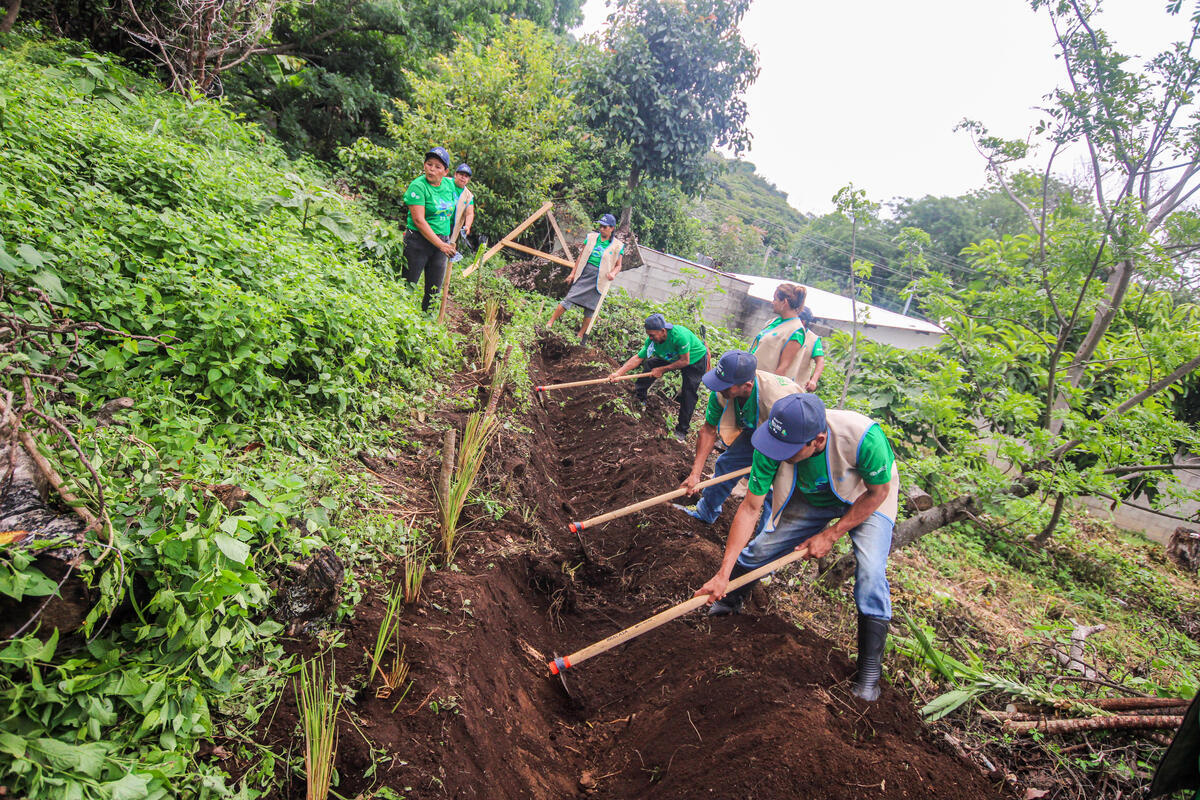
For María Cristina Corvera de López, a second-generation farmer in rural Nahualapa, adapting means changing how every drop of rain is captured and used. She plants trees alongside her crops to provide shade and minimise evaporation and uses simple irrigation channels and a homemade drip system to conserve water. Instead of burning stalks, leaves and husks after harvest, as generations before her did, she turns them into mulch to hold moisture in the soil.
“The effects of climate change are a constant challenge,” she says. But the new techniques have made her farm more resilient to El Niño as well. Where she once harvested about 50 bags of maize per acre, she now gets around 80, even during droughts. It’s enough to feed her family and sell the surplus.
Managing risk now cuts future costs
Together, these adaptations can mean the difference between losing a crop and getting through a dry season with enough food, seed and income to plant again. They are also the result of climate finance invested before disaster strikes.
RECLIMA shows what that kind of adaptation investment can buy. Adaptation accounted for 45 percent of climate-related development finance to agrifood systems in 2024, and multilateral development banks are directing more agricultural finance towards resilience. That shift reflects a growing recognition that adaptation is a form of risk management, not just a development cost.
We need much more of it. The same investments that help farmers withstand El Niño also enable them to adapt to a hotter, more unpredictable future. Cutting investment in the people who produce our food just as climate risks intensify does not save money. It simply pushes a much larger bill into the next harvest, the next food crisis, and the next El Niño.
The post As El Niño intensifies, we should be investing more in the world’s farmers appeared first on Climate Home News.
As El Niño intensifies, we should be investing more in the world’s farmers



-
Climate Change1 year ago
Guest post: Why China is still building new coal – and when it might stop
-

 Greenhouse Gases2 years ago
嘉宾来稿:满足中国增长的用电需求 光伏加储能“比新建煤电更实惠”
-
Greenhouse Gases1 year ago
Guest post: Why China is still building new coal – and when it might stop
-

 Climate Change2 years ago
嘉宾来稿:满足中国增长的用电需求 光伏加储能“比新建煤电更实惠”
-

 Renewable Energy11 months ago
Sending Progressive Philanthropist George Soros to Prison?
-
Climate Change2 years ago
Bill Discounting Climate Change in Florida’s Energy Policy Awaits DeSantis’ Approval
-
Greenhouse Gases1 year ago
嘉宾来稿:探究火山喷发如何影响气候预测
-

 Climate Change2 years ago
Analysis: China’s CO2 falls 1% in Q2 2024 in first quarterly drop since Covid-19